

Turning Pharmacology Anxiety into Confidence
Pharmacology is widely considered the most daunting hurdle in the nursing curriculum, acting as a gatekeeper for your clinical success. Integrating effective nursing student med cards early in your academic journey transforms complex chemical reactions into actionable clinical data. Many students struggle with the overwhelming volume of pharmacology knowledge, but consistent use of nursing student med cards provides the necessary framework to categorize drugs efficiently. By mastering nursing student med cards, you move from passive memorization to active clinical reasoning, ensuring you are prepared for the high-stakes rigor of the 2026 NCLEX standards. This guide will walk you through the essential systems required to build, manage, and utilize these tools to elevate your performance. We will explore how to transition from simply writing down drug facts to creating a powerful memory system that serves you throughout your entire career. Mastering these techniques now will pay dividends when you are in the middle of a high-pressure clinical shift.
Why Nursing Student Med Cards are the Gold Standard
The sheer volume of pharmacological information in a standard nursing program can leave even the most dedicated student feeling exhausted. Utilizing nursing student med cards is not merely a study preference; it is a proven pedagogical strategy for information retention and retrieval. These cards force you to condense vast textbook chapters into digestible, high-yield bits of data. When you prioritize nursing student med cards over traditional note-taking, you are actively participating in the “Stop-Look-Act” safety cycle crucial for patient care. If you find the sheer volume of writing assignments alongside clinical prep to be overwhelming, you can explore custom academic writing help to assist with your broader coursework load. This support ensures that when you enter clinical rotations, you are retrieving knowledge from a structured mental repository rather than trying to recall scattered notes.
Efficiency vs. Textbook Reading
- Targeted Information: Eliminates the fluff found in textbooks by focusing strictly on high-yield exam data.
- Time-Saving: Reduces review time significantly compared to rereading chapters before exams.
- Portability: Allows for quick study sessions during clinical downtime or transport.
- Active Synthesis: Forces the brain to synthesize information, which is far more effective than passive reading.
The “Stop-Look-Act” Benefit for Patient Safety
- Rapid Recall: Facilitates near-instant retrieval of critical drug dosages and contraindications.
- Safety Checks: Serves as a reliable double-check mechanism during medication administration rounds.
- Clinical Confidence: Reduces anxiety during patient assessments, leading to more professional interactions.
- Error Prevention: Minimizes medication administration errors by reinforcing black box warnings visually.
Buying vs. Building: Choosing the Right System
Deciding how to assemble your collection of study aids is a pivotal decision that impacts your daily workflow and long-term retention. While pre-made decks save time, creating your own nursing student med cards often leads to deeper cognitive engagement and better structural understanding. Recent student research highlights that the physical act of writing or typing out data points creates a stronger memory trace than passively reviewing pre-printed cards. You must weigh the convenience of a ready-to-go system against the educational value of building your personal study arsenal. For those seeking help with other complex assignments, research paper writing services offer a way to outsource drafting, freeing up time for you to focus on your pharmacology decks. Ultimately, your choice depends on your personal learning style and the time you have available during the semester.
Pros and Cons of Pre-made Decks
- Instant Access: Provides a comprehensive foundation without the labor of initial research.
- Uniformity: Offers a standardized approach that covers all common drug classes used in clinical settings.
- Limited Customization: Can be difficult to annotate with specific professor-led insights or clinical examples.
- Cost Implications: High-quality decks can be an investment, though often worth the saved time.
Pros and Cons of DIY (Deep Learning)
- Personalization: Allows you to include mnemonics and clinical stories that resonate personally.
- Structural Understanding: Teaches you how to organize pharmacological data logically by class.
- Time Intensive: Requires significant upfront hours to research and design each card.
- Content Accuracy: Relies on your ability to synthesize information from authoritative sources.
Anatomy of a High-Conversion Med Card
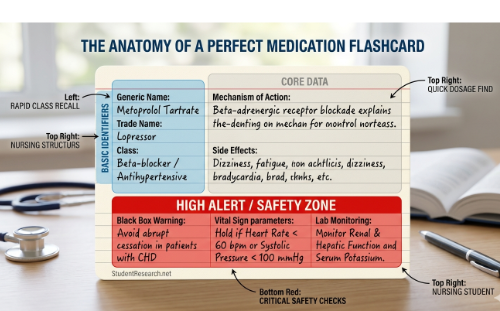
Creating a card that actually helps you pass exams requires more than just listing facts; it requires a strategic design that mirrors the NCLEX testing style. Based on student research, the most effective nursing student med cards follow a consistent layout that prioritizes safety and critical thinking. By compartmentalizing data, you avoid cognitive overload and ensure that every card provides a complete snapshot of a specific medication. Incorporating consistent categories across your entire set allows your brain to know exactly where to look for specific information, regardless of the drug being studied. This structure is essential for maintaining speed during your final exam review sessions.
The “Must-Know” Sections (Indications, Contraindications)
- Therapeutic Class: Always bold the class; it is the strongest clue for how a drug works.
- Mechanism of Action: Keep it to one simple sentence focusing on what the drug does in the body.
- Primary Indications: List the top 2-3 conditions the drug treats.
- Major Contraindications: Clearly flag patients who should absolutely not receive this medication.
The “Patient Safety” Section (Black Box Warnings, Labs)
- Black Box Warnings: Use a distinct color (like red) to highlight life-threatening alerts.
- Critical Labs: List the specific blood work to monitor (e.g., K+ levels for diuretics).
- Nursing Priorities: Include 1-2 essential assessments (e.g., orthostatic BP checks).
- Patient Education: Add a bullet point on what to tell the patient to watch for at home.
Choosing Your Tools: Digital vs. Physical
In 2026, the technology available for nursing education is vast, offering both digital and physical options for managing your study materials. The debate between digital apps and physical nursing student med cards often comes down to your personal workflow preferences and technological comfort level. Digital tools offer the advantage of synchronization and searchability, making them ideal for the fast-paced nature of modern clinical rotations. However, physical cards provide a tactile, distraction-free environment that some students find superior for long-term memory. Consider your environment, your device preferences, and your need for portability when making this decision.
Best Apps for Nursing Students in 2026
- Anki/Quizlet: The gold standard for spaced repetition algorithms.
- Notion: Excellent for building a searchable, customizable database of drugs.
- GoodNotes/Notability: Best for those who enjoy digital handwriting with a stylus.
- Cloud Syncing: Ensure your platform syncs across phone, tablet, and laptop.
Best Physical Card Templates/Supplies
- Index Card Systems: Using 4×6 cards provides enough space for comprehensive details.
- Color-Coded Pens: Essential for distinguishing classes (e.g., all anti-hypertensives in blue).
- Protective Sleeves: Keeps cards clean during messy clinical shifts.
- Ring Binders: Keeps your deck organized and portable for study on the go.
The #1-#6 Step-by-Step Creation Process
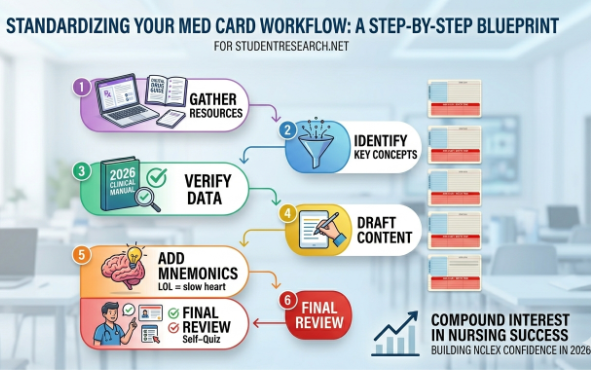
Developing a standardized workflow for creating your nursing student med cards is the secret to consistency and long-term success. Rather than reinventing the wheel for every drug, follow a defined process to keep your study time efficient. Student research confirms that applying a spaced repetition framework while drafting these cards maximizes retention. By following these numbered steps, you will spend less time formatting and more time absorbing the clinical data that matters most for your exams. Treat this creation process as a structured study habit that yields compound interest over the course of your degree.
Streamlining Your Workflow
- Step #1: Gather Resources: Collect your drug guide and professor’s lecture notes first.
- Step #2: Identify Key Concepts: Filter out the noise and find the 5 core facts for the drug.
- Step #3: Verify Data: Double-check against a reliable source like the 2026 clinical manual.
- Step #4: Drafting Content: Write the main drug data in a consistent order on the front.
- Step #5: Adding Mnemonics: Use memory tricks on the back to aid rapid recall.
- Step #6: Final Review: Conduct a quick self-quiz immediately after drafting the card.
Advanced Memory Techniques for Pharmacology
Once you have mastered the basics of creating nursing student med cards, the next step is applying advanced memory techniques to ensure recall under pressure. Pharmacology is notoriously difficult because of the sheer number of similar-sounding drugs. Using mnemonic devices and visual associations can help you distinguish between high-alert medications effectively. Developing your own personalized system of color-coding and shorthand ensures that your nursing student med cards remain a useful resource even during the final weeks of exam prep. These methods are designed to engage multiple areas of your brain, making the information stickier and easier to access during exams.
Incorporating Mnemonics for Drug Classes
- Suffix Associations: Link drug suffixes (e.g., “-lol”) to a specific action (e.g., “LOL, slow the heart”).
- Visual Storytelling: Create a short, funny story for a difficult drug class.
- Rhymes and Acronyms: Use simple rhymes for side effects or labs.
- Personalization: Mnemonics that feel “weird” to you are often the easiest to remember.
Color-Coding Systems for Rapid Recall
- Class Consistency: Use one color for all antibiotics, another for all cardiac drugs.
- Safety Indicators: Use bright colors for warning signs and side effects.
- Highlighting Logic: Only highlight the most critical data points to avoid visual clutter.
- Legend Creation: Keep a small reference card in your binder explaining your color key.
Maintaining Your Med Card Library
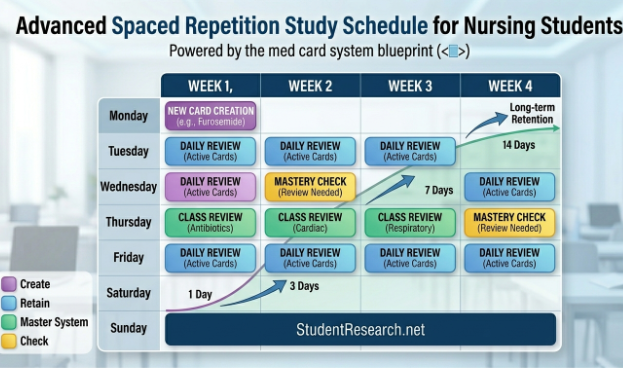
Building your nursing student med cards is only half the battle; maintaining them is where the real value lies over time. As pharmacology guidelines evolve, your cards must stay current to be safe and effective for your 2026 clinical requirements. An outdated card is not just useless—it can be dangerous if it contains incorrect dosages or outdated lab ranges. Establishing a routine for updating and organizing your library ensures that your study materials grow alongside your knowledge. Treat your collection as a living document that evolves with your nursing education and clinical experience.
Organization Tips for Clinical Rotations
- Categorization: Organize by system (e.g., Respiratory, Cardiac) rather than alphabetical order.
- Index Tabs: Use tabs to quickly jump to specific drug classes during clinical prep.
- Review Schedules: Audit your cards every few weeks to discard unneeded info.
- Digitization Backup: If using physical cards, consider scanning them as you build them.
Updating Cards Based on New 2026 Guidelines
- Annual Audit: Review your cards against the latest 2026 pharmacology textbook updates.
- Clinical Feedback: Update cards based on what you actually see used in clinical settings.
- Correction Journal: Keep a list of drugs that need updates and dedicate one hour a month to it.
- Cross-Reference: Always verify new info against clinical standard-of-care databases.
Conclusion: Your Path to Nursing Mastery
You now have a clear roadmap to revolutionize your study habits and conquer pharmacology. By leveraging high-quality nursing student med cards and maintaining a structured, clinical-focused approach, you are positioning yourself for academic and professional success in 2026. Whether you choose digital apps or physical index cards, the most important factor is consistent engagement with the material. Do not be discouraged by the volume of content; take it one card at a time and trust the system you have built.
Master your nursing student med cards with our #18 proven tips. Boost your pharmacology grades and exam confidence—The Ultimate Guide in 2026! Remember, the goal is not just to pass the next test, but to provide safe, competent care for your future patients. Start building your deck today and experience the difference that organized preparation makes in your nursing journey. Your future patients are counting on the clinical knowledge you are building right now. Keep pushing forward and utilize your nursing student med cards to stay ahead of the curve.

