

Clinical education is one of the most demanding yet rewarding aspects of nursing pedagogy, requiring a delicate balance of patient safety and educational mentorship. As a clinical instructor, finding the right nursing student evaluation comments examples is essential for providing feedback that is both constructive and legally sound. Whether you are working with a novice student learning their first IV insertion or an advanced student preparing for graduation, your written words fundamentally shape their professional identity and confidence. This comprehensive guide provides nursing student evaluation comments examples designed to save you precious administrative time while maximizing student growth and clinical outcomes.
Writing evaluations often feels like an impossible balancing act; you must address areas of concern without discouraging the learner or stifling their potential. Effective feedback requires a synthesis of student research and hands-on clinical observation. By utilizing standardized yet adaptable phrasing, you can ensure your comments are objective, actionable, and fully aligned with your program’s educational standards. In the following sections, we will explore specific phrases you can use in your daily rotations. These tools will help you foster a positive learning environment while maintaining the rigorous clinical safety standards required by your patients.
Your dedication to the evaluation process not only supports the individual student but also strengthens the entire nursing cohort. By carefully selecting your language, you demonstrate your professionalism and a deep, ongoing commitment to excellence in clinical teaching.
Why Quality Feedback Transforms Nursing Education
The role of a clinical instructor extends far beyond simple bedside supervision; it encompasses the active, daily molding of future healthcare leaders. Many instructors struggle with the immense time constraints that come with balancing patient loads and student grading simultaneously. Utilizing pre-drafted nursing student evaluation comments examples helps streamline your workflow significantly, allowing you to focus on the human side of teaching. By having a bank of high-quality phrases at your disposal, you can focus more on the teaching moments rather than the repetitive paperwork. This section aims to provide foundational strategies that simplify the assessment process while keeping your feedback meaningful, evidence-based, and highly impactful for the learner.
The Clinical Instructor’s Dilemma
- Balancing Act: Learning to manage time between direct patient care and student mentorship is a critical skill for all instructors.
- The Power of Words: Understanding how written feedback directly influences student self-efficacy and long-term professional development.
- Efficiency: Why having a “comment bank” allows for more intentional, face-to-face instruction rather than endless hours drafting documents.
How to Use This Guide
- Adaptability: Tips for modifying these examples to fit different clinical settings, such as the ICU, Med-Surg, or Pediatrics.
- Standardization: Using consistent evaluation metrics ensures fairness across the entire cohort, regardless of rotation site.
Mastering the Fundamentals: Evaluating Clinical Skills
Technical proficiency serves as the bedrock of nursing practice, and evaluating it requires extreme precision and care. Students often feel anxious during skills check-offs, making your feedback crucial for their confidence and clinical competence. By using specific nursing student evaluation comments examples, you can clearly articulate what was performed well and what needs refinement. This approach minimizes confusion and ensures that students understand the direct link between their actions and patient safety. Consistency in your language across all rotations helps establish a standard of excellence that every student must meet before they are cleared for independent practice.
The “How-To” of Skill Evaluation
- Identifying Mastery: Use these phrases to acknowledge when a student demonstrates safe, independent technique without prompting.
- Correcting Errors: Discover constructive ways to address minor technique flaws before they become dangerous habits.
- Documentation Improvement: Transition from vague praise to highly specific, observable outcomes that align with institutional requirements.
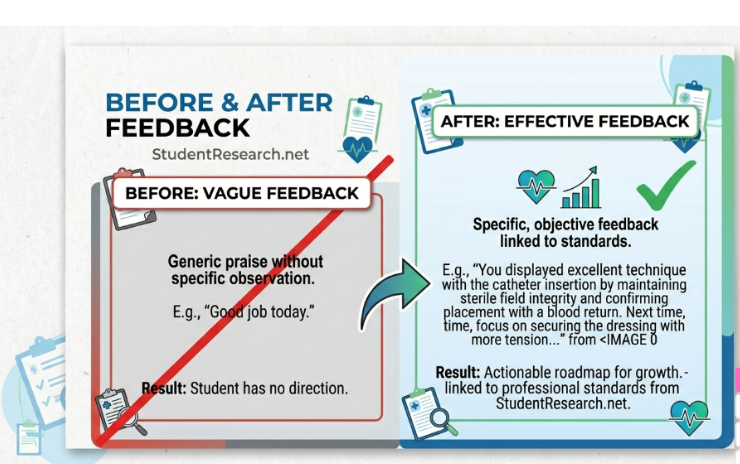
Vague vs. Objective Feedback Table
| Vague Feedback | Clinical Feedback (Improved) |
| “Good job on the IV start.” | “You displayed excellent technique with the catheter insertion by maintaining sterile field integrity and confirming placement with a blood return. Next time, focus on securing the dressing with more tension to ensure stability.” |
| “Medication pass was okay.” | “You accurately followed the seven rights of medication administration. Ensure that you verbally verify the patient identity using two methods before hanging the secondary bag.” |
| “Needs to be faster.” | “Your assessment speed is improving, but prioritize completing the head-to-toe assessment within the standard 15-minute window to allow for earlier intervention.” |
9 Examples for Technical Proficiency
- “Consistently adheres to sterile technique during wound dressing changes.”
- “Demonstrates accurate medication administration by following the seven rights every time.”
- “Shows great attention to detail when performing head-to-toe assessments.”
- “Maintains patient safety during all transfers and mobility assistance.”
- “Displays proficiency in IV site monitoring and fluid calculation.”
- “Correctly identifies all patient identifiers before initiating any procedure.”
- “Effectively utilizes personal protective equipment (PPE) in isolation scenarios.”
- “Shows improvement in physical assessment techniques after the initial demonstration.”
- “Maintains a clean and organized work environment during complex procedures.”
Assessing Clinical Judgment and Critical Thinking
Critical thinking is the hallmark of a skilled nurse, distinguishing them from a mere task-doer. When evaluating this competency, it is vital to capture the student’s reasoning behind their clinical decisions during the shift. Incorporating student research regarding evidence-based practice into your feedback loop can elevate the student’s understanding of complex disease processes. Using targeted nursing student evaluation comments examples allows you to highlight where the student successfully synthesized clinical data. To improve your critical thinking, you must be adept at using evidence-based tools. For help managing these resources, explore this guide on essential research apps for students to streamline your information gathering.
Connecting Pathophysiology to Care
- Assessment Skills: Look for students who connect lab values to the patient’s physical presentation.
- Prioritization: Observe how students handle changing schedules or urgent patient needs.
9 Examples for Decision-Making
- “Demonstrates strong ability to prioritize tasks based on patient acuity.”
- “Connects pathophysiology to the patient’s current symptoms accurately.”
- “Shows proactive thinking by anticipating physician orders based on lab values.”
- “Successfully identifies early signs of patient decline and notifies the team promptly.”
- “Uses evidence-based rationale when explaining care plans to patients.”
- “Analyzes diagnostic test results to determine the next steps in nursing care.”
- “Reflects on clinical decisions to identify areas for improved patient outcomes.”
- “Effectively manages care for multiple patients by grouping similar tasks.”
- “Asks insightful, higher-level questions regarding pharmacological interventions.”
Professionalism and Therapeutic Communication
Professionalism and therapeutic communication are non-negotiable standards in nursing practice. These soft skills are often the most challenging to document objectively because they are observed through interpersonal dynamics. However, using precise nursing student evaluation comments examples makes it easier to track progress in communication styles. By focusing on observable behaviors, such as tone, body language, and rapport-building, you provide clear pathways for improvement. This ensures that every student leaves your rotation with a better understanding of how to interact with diverse patient populations and interdisciplinary teams effectively.
Navigating Difficult Conversations
- Addressing Unprofessionalism: When a student is late or dismissive, document the behavior specifically. “Student arrived 15 minutes late to pre-conference, which impacted the team’s ability to transition care.”
- Red Flags: Immediate feedback is required if a student violates HIPAA or displays dismissive attitudes toward patients.
- Growth Opportunities: Frame feedback on bedside manner as a way to enhance patient satisfaction scores and safety.
9 Examples for Professional Behavior
- “Consistently demonstrates empathy and active listening with every patient interaction.”
- “Maintains a professional demeanor even when faced with challenging patient behaviors.”
- “Communicates effectively and respectfully with all members of the interdisciplinary team.”
- “Demonstrates excellent rapport-building skills with patients and their families.”
- “Is consistently punctual and prepared for pre-conference discussions.”
- “Uses appropriate non-verbal cues to build trust and therapeutic presence.”
- “Proactively seeks feedback and implements suggestions for improvement immediately.”
- “Maintains patient confidentiality and privacy during all clinical encounters.”
- “Collaborates well with peers to ensure high-quality patient care.”
Structuring Your Feedback for Maximum Impact
The way you structure your feedback can fundamentally change how a student receives it. A disorganized comment, no matter how well-intentioned, may be misinterpreted or ignored by the student. By applying a consistent framework, you ensure that your nursing student evaluation comments examples remain objective and focused on professional growth. This structural clarity is essential for creating a narrative of improvement throughout the clinical rotation. It empowers the student to take ownership of their development and act on your observations with confidence. When providing feedback to a student struggling to meet clinical standards, it is vital to keep the conversation forward-looking. Remind them that academic hurdles are not the end of their career by sharing resources like this complete guide for nursing students navigating academic setbacks.
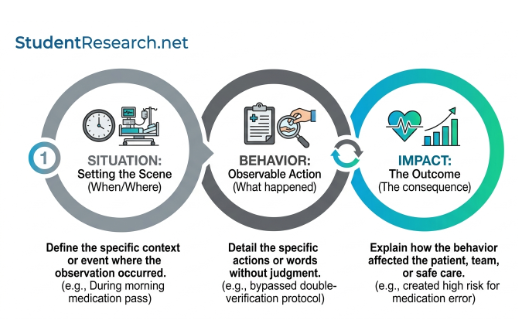
The S.B.I. Model (Situation-Behavior-Impact)
- Situation: Describe the specific event or clinical incident clearly (e.g., “During the 09:00 AM medication pass”).
- Behavior: Detail exactly what the student did or said without adding emotional judgment (e.g., “you omitted the second nurse verification step”).
- Impact: Explain the consequence of that behavior on the patient or team (e.g., “which creates a high risk for medication errors and puts patient safety at risk”).
Case Study: The S.B.I. in Action
- The Scenario: A student misses a crucial safety check during a busy morning shift.
- Ineffective Feedback: “You were careless with the medication check today.”
- Effective S.B.I. Feedback: “During the 09:00 AM medication pass, you bypassed the double-verification step for high-alert insulin. This behavior creates an unnecessary risk for a medication error. In the future, we must strictly adhere to the verification protocol regardless of time pressure to ensure we provide safe patient care.”
Documentation Tips for Legal and Academic Integrity
Documentation serves as a legal record of student progression, making accuracy and neutrality paramount. Instructors must ensure that every statement is backed by observable evidence to avoid bias or potential disputes during grade appeals. Utilizing standardized nursing student evaluation comments examples helps protect the integrity of the academic institution. Furthermore, relying on student research to justify your evaluations—such as referencing current clinical guidelines—adds a layer of pedagogical rigor to your assessments. This section will guide you through best practices for maintaining a clean, defensible, and constructive clinical record.
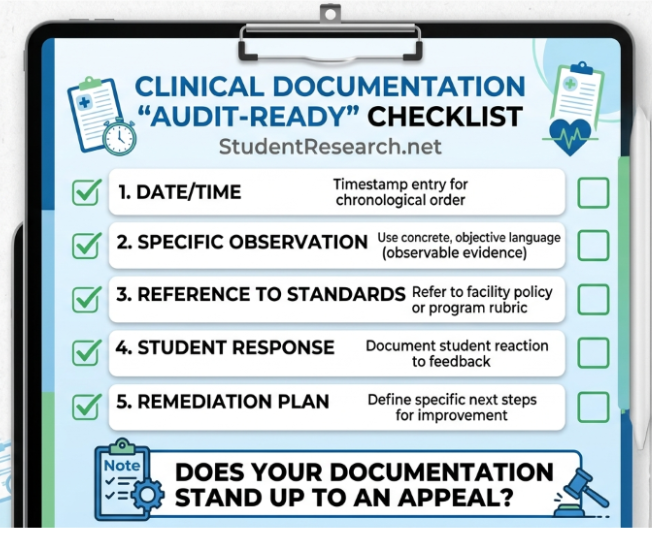
Clinical Documentation Checklist
- Date and Time: Always timestamp your entry to establish a chronological record of performance.
- Specific Observation: Use concrete, objective language (e.g., “Student performed dressing change independently after one demonstration”).
- Reference to Standards: Note when a behavior meets or deviates from the facility’s policy or the nursing program’s rubric.
- Student Response: Document the student’s reaction or acknowledgment of the feedback.
- Remediation Plan: Always include the next steps for improvement so there is no ambiguity about the expectations moving forward.
Objective vs. Subjective Writing
- Objective: “The student failed to verify the patient’s identity before medication administration.”
- Subjective (Avoid): “The student seemed forgetful or careless during the medication pass.”
Overcoming Evaluation Burnout
Clinical teaching burnout is a reality for many nurses juggling multiple responsibilities, including bedside care and teaching. Finding efficient ways to provide high-quality feedback is essential for maintaining your longevity in the instructor role. Integrating nursing student evaluation comments examples into your existing workflow reduces the time spent drafting repetitive entries. By creating a personal “comment bank,” you can spend more time mentoring students rather than typing notes. This approach not only saves time but also improves the consistency of the feedback you provide across different clinical shifts.
Time-Saving Hacks for Instructors
- Templates: Create a master document with common phrases categorized by skill level (Novice to Competent).
- Digital Tools: Use note-taking apps on mobile devices to log observations in real-time while the events are fresh.
- Reflective Journals: Require students to maintain a log where they evaluate themselves before you provide yours.
The Power of Self-Evaluation
- Student-Led Reflection: Require students to write their own evaluations first to promote critical self-reflection.
- Comparative Learning: Compare student self-assessment with your clinical observation for a more holistic review of their growth.
Conclusion: Your Role in Shaping Future Nurses
Your impact as a clinical educator resonates long after the semester concludes. By committing to providing thoughtful and consistent feedback, you help shape the future of the nursing profession. Using the nursing student evaluation comments examples provided in this guide ensures that every student receives the guidance they need to succeed. As you move forward, keep refining your approach to assessment based on the needs of your current cohort. Nursing student evaluation comments examples: Get 27 specific phrases to provide professional, actionable feedback for your nursing students today. You are not just grading clinical performance; you are mentoring the next generation of patient advocates.
Meta Description
Nursing student evaluation comments examples: Get 27 specific phrases to cite professional, actionable feedback for your nursing students today.

