

Why Your Career Starts Before Graduation
Navigating the path toward a successful healthcare career requires more than just classroom knowledge; it demands practical, real-world application. Mastering nursing student employment early in your academic journey is the definitive way to gain a competitive edge in an increasingly crowded job market. By securing a relevant role during your studies, you transition from a theoretical learner to a confident practitioner. This guide explores how nursing student employment can bridge the gap between your textbooks and the clinical floor. Whether you are aiming for hospital externships or local health clinic roles, your proactive approach today dictates your career trajectory tomorrow.
We have analyzed current industry trends to provide you with a comprehensive roadmap for balancing professional work with rigorous academic demands. Integrating nursing student employment into your schedule is not just about earning an income; it is about building the professional portfolio that recruiters crave in 2026. Through careful planning and strategic networking, you can transform your clinical experience into a gateway for high-paying opportunities post-graduation. This guide serves as your essential resource, reflecting rigorous student research and industry standards, to ensure you make the right choices for your unique professional development path and long-term success as a future healthcare leader. You are building the foundation of your future, and every step counts toward your long-term goals.
Understanding Your Market Value
Before applying for any position, it is vital to perform a personal assessment of what you bring to the table as a candidate. Many students underestimate the value of their clinical rotations and basic care skills, yet these are exactly what employers are seeking. Understanding your market value allows you to negotiate better terms and select roles that genuinely enhance your resume. In this section, we break down how to audit your current skills and capacity to ensure you are targeting the right opportunities for nursing student employment. This foundation is critical for any successful venture into the professional world while still studying.
Identifying Transferable Skills
- Clinical Proficiency: Highlighting your hands-on experience during hospital clinical rotations.
- Communication Skills: Leveraging your ability to convey critical information to diverse patient populations.
- Time Management: Emphasizing your ability to juggle academic deadlines with demanding shift schedules.
- Adaptability: Showcasing how you quickly adjust to fast-paced and high-pressure healthcare environments.
Assessing Your Capacity for Work
- The 3-Tier Capacity Check: Evaluating your academic load, personal commitments, and energy levels.
- Setting Realistic Hours: Determining a sustainable work schedule that avoids burnout and maintains high GPA standards.
- Role Alignment: Selecting jobs that provide high-value experience rather than just immediate income.
The 2026 Hierarchy of Nursing Student Roles
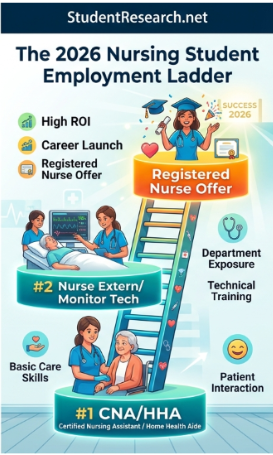
Choosing the right role is the most important decision in your strategy for effective nursing student employment. Not all jobs offer the same professional benefits, so prioritize positions that allow you to practice skills you will use as a registered nurse. This hierarchy helps you identify roles that provide the best ROI for your time investment. By focusing on high-impact positions, you ensure that your work experience is as valuable as your formal education. Consult student research platforms to see which roles correlate with the highest employment satisfaction rates.
Foundational Roles (#1-#4)
- #1 Certified Nursing Assistant (CNA): The classic entry-level role that builds deep clinical empathy and foundational patient care skills.
- #2 Student Nurse Extern: A prestigious position that offers deeper exposure to specific departments like ICU or ER.
- #3 Patient Sitter / Companion: Ideal for low-stress environments where you can observe nurse interactions and improve observation skills.
- #4 Home Health Aide: Provides unique insight into patient care outside of a hospital setting, perfect for learning independence.
Specialized/Administrative Roles (#5-#9)
- #5 Unit Secretary: Excellent for learning hospital workflow, charting systems, and interdisciplinary communication.
- #6 Phlebotomy Technician: Offers specialized technical training that makes you highly marketable in any clinical setting.
- #7 Research / Lab Assistant: Perfect for those interested in evidence-based practice and future student research contributions.
- #8 Telemetry Monitor Tech: Provides critical experience in cardiac monitoring and interpreting rhythm strips.
- #9 Pharmacy Tech Trainee: Helps you master pharmacology basics and medication administration safety protocols early.
Strategic Job Search Channels for 2026
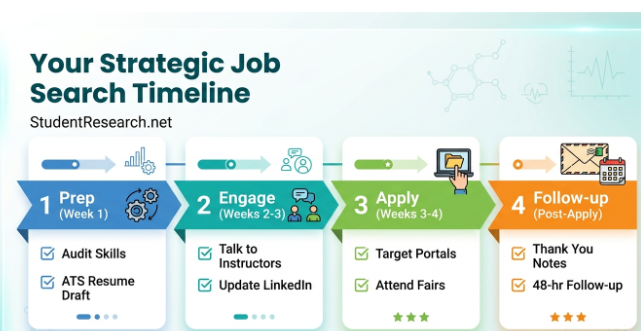
Finding the right vacancy requires a multi-channel approach that goes beyond standard internet job boards. Many of the best nursing student employment opportunities are never publicly advertised and are filled through internal referrals. You must learn to leverage digital platforms alongside institutional connections to uncover these hidden gems. By diversifying your search channels, you significantly increase your chances of finding roles that fit your school schedule perfectly. These proactive measures ensure you aren’t just finding a job, but finding a career stepping stone.
Digital Platforms (#10-#13)
- #10 Hospital Career Portals: Regularly monitoring the direct recruitment pages of your preferred local hospitals.
- #11 Handshake: Utilizing university-specific job boards designed for students and entry-level talent.
- #12 LinkedIn “Open to Work” Features: Optimizing your profile to signal your availability to healthcare recruiters.
- #13 Niche Nursing Job Boards: Exploring platforms specifically focused on nursing placements and internships.
Institutional Networking (#14-#18)
- #14 Faculty Mentorship Referrals: Asking professors for leads on local healthcare facilities that value students.
- #15 Clinical Rotation Site Managers: Building rapport with staff at your clinical site to inquire about open positions.
- #16 Alumni Networks: Connecting with graduates from your program who are now working in the area.
- #17 Professional Student Associations: Attending meetings to network with guest speakers and prospective employers.
- #18 University Career Fairs: Treating these events as serious interviews rather than casual exploration opportunities.
Crafting the “Nurse-Ready” Resume
Your resume acts as your professional introduction before you ever step foot in an interview room. For nursing student employment, recruiters want to see evidence of clinical competency, reliability, and academic success. You must highlight your limited experience in a way that maximizes your potential. A well-structured resume effectively communicates your readiness for responsibility and your commitment to the profession. Use this section to polish your documents until they shine with professional appeal.
Essential Resume Sections
- Clinical Rotations: Listing specific departments, patient populations, and equipment you have utilized.
- Certifications: Highlighting BLS, ACLS, or any other credentials that set you apart.
- Awards and Honors: Including scholarships or academic recognition that prove your dedication to excellence.
- Volunteering: Showcasing selfless service that proves your heart for healthcare, even if it is not clinical.
Mastering the Interview Process (#19-#23)
The interview is your opportunity to demonstrate that you are a reliable teammate who understands the gravity of the nursing profession. Nursing student employment interviews are often less about technical mastery and more about cultural fit and soft skills. You need to prepare thoughtful answers that highlight your problem-solving abilities and your dedication to patient safety. Success here depends on your ability to articulate your professional values clearly. Preparation turns anxiety into confidence during these high-stakes meetings.
Interview Success Tactics
- #19 Preparing for Behavioral Questions: Practicing stories that demonstrate your decision-making abilities in stressful situations.
- #20 Demonstrating Reliability: Communicating your track record of attendance and punctuality in both school and life.
- #21 Handling “Shift-Work” Questions: Proactively offering your availability to show you understand the realities of nursing schedules.
- #22 Understanding Scope of Practice Limits: Clearly stating what you can and cannot do, showing respect for licensure.
- #23 Interview Etiquette for Healthcare: Dressing professionally, maintaining eye contact, and showing genuine interest in the unit’s mission.
Balancing Act: Managing Work, Study, and Life
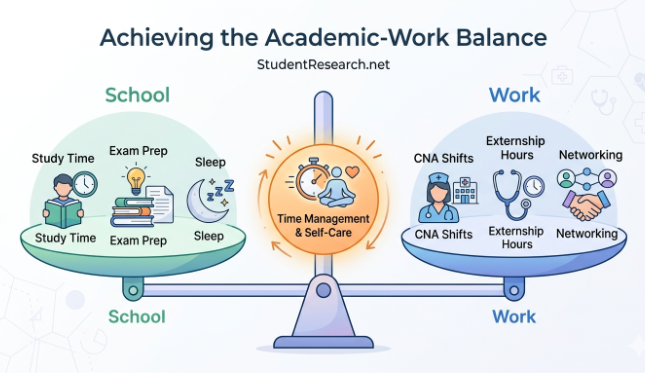
Maintaining academic performance while engaging in nursing student employment requires extreme discipline and foresight. If you are not careful, the stress of balancing these two demanding worlds can lead to burnout. Effective time management is not an option; it is a necessity for survival in nursing school. By implementing structural boundaries, you protect your grades while gaining valuable work experience. To protect your grades while working, streamline your assignment preparation by mastering foundational research skills; refer to this comprehensive guide on argumentative writing to speed up your academic workflow and reduce study time.
Time-Blocking Strategies (#24-#27+)
- #24 The “3-Day Study” Rule: Designating specific days exclusively for academic deep work to avoid falling behind.
- #25 Managing Clinical Fatigue: Planning recovery time after long shifts to ensure you are fresh for clinical rotations.
- #26 Communicating with Nurse Managers: Being transparent about your exam schedule so your manager knows your availability limits.
- #27+ Utilizing Academic Breaks for Extra Hours: Maximizing your work hours during holidays or summer breaks to minimize the load during the semester.
“Struggling to balance exhausting clinical rotations with endless essay deadlines? Don’t let stress compromise your nursing degree. StudentResearch.net provides expert, plagiarism-free academic writing support, giving you the peace of mind to focus on mastering your crucial hands-on patient skills.”
Legal and Ethical Best Practices
When engaging in nursing student employment, you must adhere strictly to the legal and ethical boundaries of your role. Understanding the scope of practice is not just a policy; it is a protection for both you and your patient. Even if a supervisor asks you to perform a task you have not been trained for, your primary responsibility is to the safety of the patient. These considerations form the ethical backbone of your early career. Always prioritize legal compliance to safeguard your future licensure.
Ethical Compliance Essentials
- Knowing Your Scope: Strictly operating within the duties approved for your specific job title.
- Documentation Integrity: Maintaining accurate and honest records of all patient interactions and care tasks.
- Confidentiality (HIPAA): Treating every patient interaction with the utmost respect for privacy and data security.
- Asking for Help: Recognizing when a situation exceeds your capability and immediately seeking a licensed professional.
9. Converting Student Experience into Graduation Offers
The ultimate goal of seeking nursing student employment is often to secure a post-graduation position. When you start working as a student, you are essentially auditioning for a permanent role at that facility. By consistently proving your worth and professionalism, you become the top choice when full-time positions open up. Do not treat your student job as a temporary gig, but as a long-term career strategy. Consistent effort here pays dividends when you finally transition to a registered nurse role, making your nursing student employment highly strategic.
Portfolio and Transition Tips
- Building a Professional Portfolio: Collecting positive feedback from patients and staff to showcase at your grad interview.
- Soliciting Mid-Job Performance Reviews: Asking your manager for feedback to ensure you are growing professionally.
- Seeking Mentorship: Identifying senior nurses who can guide your career path and vouch for your skills.
- Expressing Intent Early: Letting management know your goal is to stay with the facility after graduation.
Conclusion and Next Steps
Choosing to pursue nursing student employment is a bold, career-defining move that pays immense dividends for your future. We hope this guide has provided you with the necessary roadmap to navigate the complexities of working while studying. If you find yourself overwhelmed by the demands of clinical rotations and your job, remember that you don’t have to carry the burden alone—explore professional academic writing support services to ensure your assignments are handled with the care and expertise they require, helping you maintain your success in both your career and your studies. Nursing student employment: Explore our top 27+ expert tips and pathways to launch your career successfully in 2026.
Start your journey now by implementing the strategies above and securing a position that propels your professional growth. Remember, every shift you work as a student builds the muscles you will use as a nurse for decades to come. Stay focused, remain professional, and lean on the resources available to help you succeed. Your dedication to this dual path of learning and working will inevitably lead you to a rewarding and impactful healthcare career.
“Want to guarantee top-tier grades on every nursing paper? Elevate your academic performance with professional assistance from StudentResearch.net. Our experienced writers ensure excellence in every task. Visit our platform today and order your custom paper to secure your success.”

