

Many nursing students embark on their clinical journeys wondering: do student nurses get paid for their hard work? This burning question often stems from the financial pressure of balancing intensive clinical hours with the high cost of medical education. Understanding the realities of clinical compensation versus academic requirements is the first step toward financial stability. At student research, we recognize that navigating this balance requires more than just clinical skill; it demands strategic career planning. Whether you are searching for your first healthcare job or trying to manage expenses during your rotations, clarity on your earning potential is vital.
In this comprehensive guide, we will break down the financial landscape of nursing education and provide actionable paths to ensure you aren’t just surviving, but thriving. Relying on verified student research data, we aim to clear the confusion surrounding compensation so you can focus on what matters most: becoming an exceptional nurse.
The Reality of Clinical Rotations and Compensation: Navigating the Policy Landscape
Understanding the financial dynamics of your nursing education starts with a deep dive into the policies governing student status. It is a common misconception that clinical hours are simply “unpaid work.” In reality, there is a distinct legal and ethical boundary between a student learner and a paid employee, centered primarily on the concepts of liability and institutional responsibility.
Liability, Insurance, and the Student-Employee Divide
When you enter a healthcare facility as a student, you are there under an educational agreement between your nursing program and the hospital. Legally, the hospital is not your employer during these hours. This distinction exists to protect both parties: you, the student, are protected by the school’s malpractice insurance and are not held to the same standard of “independent practice” as a licensed nurse. Because you are not an employee, you are not on the facility’s payroll, and you cannot be held accountable for independent nursing decisions in the same legal capacity as a staff nurse.
If you were considered an employee while performing clinicals, the hospital would be liable for your actions under respondeat superior—a legal doctrine holding employers responsible for their employees’ conduct. By classifying you as a learner, the facility minimizes its direct liability, which is why clinical hours remain strictly educational and unpaid.
Clinical Rotations vs. Final Semester Preceptorships
It is vital to distinguish between standard clinical rotations and the final semester “preceptorship” or “capstone.” During your early years, rotations are often group-based with an instructor present. However, the final semester preceptorship mimics the actual workflow of a staff nurse, often involving one-on-one time with a preceptor.
While most programs still mandate that even these final hours remain unpaid for academic credit, some healthcare systems have begun to introduce “paid preceptorship” models or accelerated externship tracks. These are distinct from traditional clinicals because they often require a signed commitment to work for the facility after graduation. In these specific cases, the “preceptorship” is treated as an on-the-job training program rather than a purely academic credit-bearing requirement.
Uncovering the “Hidden Salary” of Your Clinicals
While you may not see a paycheck for your clinical hours, it is helpful to reframe these hours as an investment—a form of “hidden salary” that compounds over time. When you ask, do student nurses get paid, the answer in terms of immediate cash is usually no, but the long-term ROI is substantial.
- Networking Capital: Every clinical rotation is a de facto interview. You are working alongside the very nurses and managers who will determine whether you get hired for that dream residency program. This access is a tangible asset worth thousands of dollars in future career stability.
- Mentorship Value: The guidance you receive from experienced preceptors offers professional development that money simply cannot buy. Learning the “unwritten rules” of the unit and mastering complex clinical workflows provides you with a massive competitive edge over candidates who lack similar bedside exposure.
- The Currency of Licensure: You are essentially trading your time for the ability to sit for the NCLEX. Without these clinical hours, your degree holds no weight. Because you need these hours to achieve licensure, the “salary” you earn is your future ability to command a professional, high-earning salary as a Registered Nurse. By treating every clinical shift as a high-stakes networking opportunity, you are essentially “earning” your future salary, one shift at a time.
Top 13 Paths for Student Nurses to Generate Income: Your Roadmap to Financial Stability
Achieving financial independence during nursing school is a challenge that requires strategic foresight. While your primary focus is mastering clinical theory, the following 13 paths provide a framework for generating income while building the professional reputation necessary for your future career.
#1: Paid Summer Nurse Externships
- The Scenario: Sarah, a junior nursing student, identified her top-choice hospital’s externship program in January. She reached out to the recruitment office early, secured a recommendation from her clinical instructor, and was selected for an 8-week paid summer rotation in the ICU.
- How to Apply: Search hospital career portals using terms like “Student Nurse Externship” or “Summer Student Intern.”
- Strategic Advantage: These programs often lead to direct job offers upon graduation.
- Targeting Search: Filter for “New Grad” or “Student” programs to avoid being overwhelmed by staff nurse listings.
- Pro-Tip: Apply as soon as the portals open, as these highly coveted spots fill up within weeks.
#2: Certified Nursing Assistant (CNA) Roles
- The Scenario: Mark, a second-semester student, earned his CNA certification. He picked up weekend shifts at a local long-term care facility, which allowed him to practice foundational skills like patient transfers and hygiene while earning a steady hourly wage.
- How to Apply: Look on Indeed or LinkedIn for “CNA” or “Nursing Assistant” roles, specifically at facilities offering “PRN” or “Per Diem” status for flexibility.
- Skill Growth: This role provides early exposure to the rhythm of patient care.
- Resume Impact: Listing CNA experience shows potential employers you are already comfortable at the bedside.
- Financial Benefit: Steady hourly pay helps cover monthly textbook and supply costs.
#3: Patient Care Technician (PCT) Positions
- The Scenario: Elena found a PCT role at a busy medical-surgical unit. Because she had completed her first clinical semester, the hospital allowed her to perform blood draws and EKG monitoring, which sharpened her clinical confidence.
- How to Apply: Search for “Patient Care Tech” or “Clinical Tech” on hospital websites, filtering by your specific location.
- Competitive Edge: PCT roles often pay more than CNA roles due to the technical skills required.
- Workflow Integration: You learn the “unwritten” flow of a hospital unit, which makes future clinicals less intimidating.
- Negotiation: Highlighting your status as a nursing student can sometimes justify a higher pay bracket.
#4: Medical Scribe Opportunities
- The Scenario: David, who prefers administrative and analytical work, became a medical scribe. He followed physicians in the ED, documenting patient interactions, which allowed him to earn income while gaining unparalleled insight into clinical decision-making.
- How to Apply: Visit websites of large scribe companies like ScribeAmerica or check local hospital “Scribe” job postings.
- Educational Value: You see how doctors arrive at a diagnosis, which improves your own clinical reasoning.
- Flexibility: Many scribe shifts are overnight or weekends, making them ideal for a student schedule.
- Networking: Building rapport with ED physicians can lead to strong letters of recommendation.
#5: Phlebotomy Technician
- The Scenario: Jasmine obtained a phlebotomy certification over a winter break. By working as a mobile phlebotomist, she earned a higher hourly rate and gained thousands of hours of experience in the critical skill of venipuncture.
- How to Apply: Search for “Phlebotomist” or “Lab Tech Assistant” on job boards.
- Skill Dominance: By graduation, your ability to start IVs will be significantly advanced compared to peers.
- Schedule Control: Many labs operate outside of standard 9-5 hours, offering great night/weekend flexibility.
- Portfolio Building: This specific technical skill is a major resume highlight for future employers.
#6: Home Health Aide (HHA)
- The Scenario: Carlos chose home health to build deep patient relationships. Working one-on-one with elderly patients allowed him to study during “downtime” while receiving a consistent paycheck.
- How to Apply: Look for agencies like “Comfort Keepers” or “Visiting Angels” on Google Maps to find local branches.
- Autonomy: You learn to handle complex patient situations without a swarm of nurses nearby.
- Scheduling: Clients often need support at night or on weekends, which fits perfectly around clinicals.
- Patient Advocacy: You learn how to navigate insurance and family dynamics, essential soft skills for any nurse.
#7: University Clinical Lab Assistant
- The Scenario: Chloe worked within her own nursing school’s simulation lab. By setting up manikins and cleaning equipment for lower-level classes, she stayed immersed in the curriculum while getting paid by the department.
- How to Apply: Contact your nursing department’s office or financial aid office for “Student Worker” or “Lab Assistant” positions.
- Convenience: You don’t have to commute to a separate facility; you are already on campus.
- Academic Reinforcement: You are constantly reviewing the equipment and protocols taught in class.
- Institutional Ties: Building a relationship with faculty can open doors for research or teaching assistant roles.
#8: Unit Secretary / Health Unit Coordinator
- The Scenario: Sam took a weekend unit secretary role. He became an expert in hospital information systems (HIS) and physician order entry, which gave him a “big picture” understanding of how a unit functions.
- How to Apply: Look for “Unit Secretary” or “Ward Clerk” roles on hospital career sites.
- System Mastery: Understanding the computer systems (like Epic or Cerner) puts you ahead of other new grads.
- Communication Skills: You are the gatekeeper of the unit, learning how to manage high-pressure communication.
- Reduced Physical Strain: While not direct bedside care, it is a great way to earn money without the physical fatigue of a CNA.
#9: Private Tutoring for Pre-Nursing Students
- The Scenario: As a senior, Maria tutored students taking Anatomy & Physiology. Charging a premium rate, she refined her own foundational knowledge while earning more per hour than any clinical tech job.
- How to Apply: Advertise on “Wyzant,” your university’s student portal, or local social media groups.
- High ROI: The hourly pay for private tutoring often far exceeds entry-level healthcare jobs.
- Knowledge Retention: The best way to learn a subject is to teach it; this keeps your foundations rock solid.
- Professional Branding: Being an expert tutor builds your reputation as a leader within your program.
#10: Pharmacy Technician
- The Scenario: Ben worked as a pharmacy tech to master pharmacology. Understanding drug interactions, common dosages, and side effects gave him a massive leg up in his med-surg classes.
- How to Apply: Search for “Pharmacy Technician” at retail chains (CVS, Walgreens) or hospital pharmacies.
- Pharmacology Boost: Your drug card study time is effectively cut in half because you see these meds daily.
- Career Diversity: If you eventually want to specialize in oncology or critical care, you’ll already understand the pharmacy side.
- Consistency: Retail pharmacy hours are very predictable, aiding in planning your study sessions.
#11: Hospital Dietary Aide
- The Scenario: Lisa worked in the hospital dietary department, delivering specialized meals. This taught her the importance of nutrition in patient recovery, a topic often overlooked in traditional nursing studies.
- How to Apply: Search for “Dietary Aide” or “Food Service” on hospital career pages.
- Foot-in-the-Door: You are already inside the hospital’s HR system, making it easier to transfer to a clinical role later.
- Stress Management: It is a lower-stress environment that still allows you to observe unit culture.
- Flexibility: Shifts are usually set in stone, which helps if you struggle with time management.
#12: Telehealth/Customer Service Healthcare Role
- The Scenario: Jake worked for a medical call center, answering basic patient triage questions under strict protocols. He learned excellent phone etiquette and how to screen for emergency symptoms.
- How to Apply: Search for “Healthcare Customer Service” or “Triage Assistant” on Indeed.
- Remote Work Potential: Many of these roles are now remote, saving time on travel.
- Diagnostic Logic: You learn how to listen for specific keywords that indicate a life-threatening emergency.
- Patient Interaction: It helps develop your bedside manner, even if you aren’t physically at the bedside.
#13: Nursing School Research Assistant
- The Scenario: Noor applied to assist a professor conducting research on patient fall prevention. She was paid a stipend to collect data, which looked incredible on her residency application.
- How to Apply: Email your professors directly to ask if they are looking for research assistants for upcoming studies.
- Intellectual Value: You learn how evidence-based practice is actually created, rather than just reading about it.
- Prestige: Mentioning research experience in interviews makes you stand out as a top-tier candidate.
- Flexible Schedule: Often, data collection can be done on your own time, fitting perfectly into a busy clinical week.
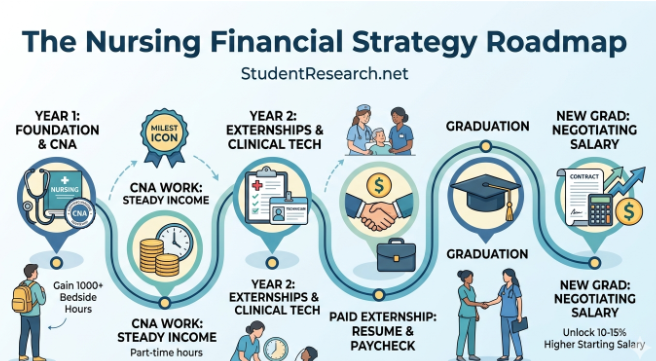
Leveraging Your Skills to Increase Earning Potential
As you position yourself as a capable professional, mastering how to structure your arguments is key—for more in-depth guidance on organizing complex ideas, check out our Argumentative Research Paper Topics: The Ultimate Guide. Your status as a nursing student is a powerful asset if you know how to market yourself correctly. Beyond simple hourly wages, you can increase your earning potential by acquiring “stackable” certifications and mastering hospital workflows before you ever sign your first full-time contract.
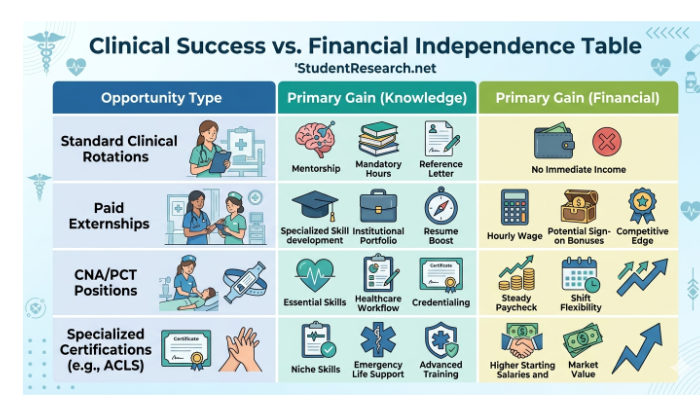
Why Clinical Rotations are Essential for Future Pay
- The “Experience Gap”: Most new graduates struggle to translate school theory into bedside practice. By maximizing your rotations, you close this gap early, making you a more efficient, safer nurse on Day 1.
- The ROI of Efficiency: Hospitals prioritize new hires who require less orientation time. If you can prove during interviews that your rotations gave you exposure to high-acuity units, you become a lower-risk hire who justifies a higher starting salary.
- The Networking Multiplier: Your clinical instructor and preceptors are your primary professional references. A glowing review from them in a specialized unit (like ICU or ER) acts as a signal to recruiters that you deserve a higher pay bracket.
- Data-Driven Success: Use your clinicals to document “wins”—such as the number of IVs started, EKG strips interpreted, or patient care plans developed. Keeping a digital log of these accomplishments turns an unpaid rotation into a verifiable work portfolio.
Negotiating Entry-Level Salaries After Graduation
- Know Your Market Value: Use tools like the Bureau of Labor Statistics or regional nursing forums to determine the fair market rate for your area. Never go into an interview without knowing the “floor” and “ceiling” for your specialty.
- Leveraging Prior Roles: When you negotiate, don’t just ask for more money. Explicitly link your past experience (e.g., CNA or externship work) to the hospital’s specific needs. “Because I already have 1,000 hours of experience in a telemetry unit, I will require significantly less onboarding time, which represents a cost-saving for the department.”
- The “Certification” Card: If you obtained certifications (like BLS, ACLS, or Phlebotomy) while a student, highlight these as ways you reduce the hospital’s training burden.
- Package Negotiations: If the base salary is non-negotiable, focus on shifting the needle on sign-on bonuses, relocation assistance, or tuition reimbursement for your future BSN/MSN advancement.
Financial Literacy Essentials for Nursing Students
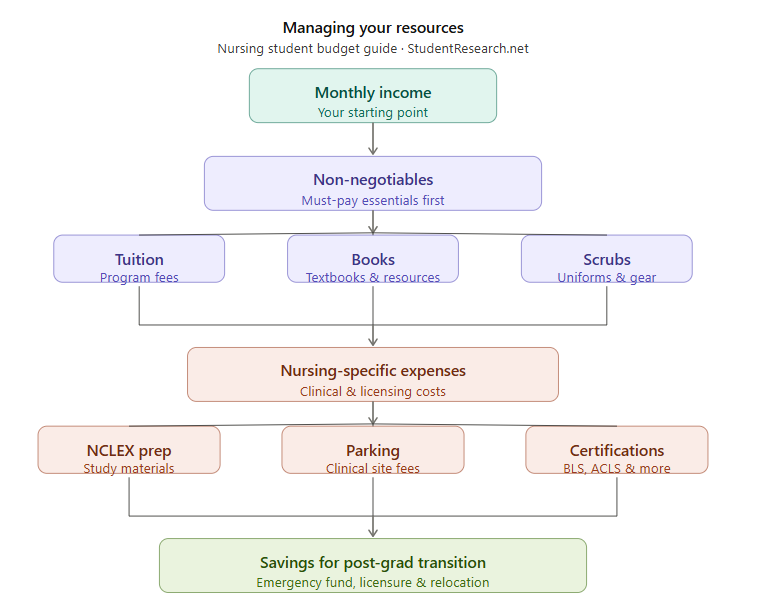
Nursing school is expensive, and balancing tuition, books, and living costs is a major stressor. Developing good financial habits is as essential as academic discipline, much like the foundation required for Research Paper Topics for High School Students, which helps students build the basic analytical skills needed to thrive in higher education.True financial literacy involves more than just working; it involves smart, proactive management of your existing resources.
Managing Expenses During Your Education
- The “Nursing Tax” Awareness: Account for hidden costs early—NCLEX review fees (often $300-$500), clinical gear, scrubs, and annual parking permits at hospitals. Build these into your monthly budget rather than paying them on credit.
- Utilizing Student Discounts: Leverage your
.eduemail address for everything from software subscriptions to health-focused apparel. This can save you hundreds of dollars annually that can be redirected toward your student loan principal. - Meal Prep and Sustainability: Relying on hospital cafeteria food is a budget-killer. Investing time in meal prepping ensures you eat better, which is crucial for your physical health during long clinical days, and saves thousands over a two-year program.
Understanding Future Salary Expectations
- Specialty Impact: Research the pay differences between Medical-Surgical, ICU, ER, and Public Health. Plan your electives to align with the higher-paying specialties early on.
- The “Overtime” Reality: Understand how overtime pay works in your region. Many nursing contracts offer 1.5x or even 2x for extra shifts, which can dramatically alter your lifestyle if managed correctly.
- Benefit Evaluation: A base salary is only one part of the picture. Factor in the value of 401(k) matching, health insurance premiums, and wellness stipends when comparing job offers.
Balancing Academic Rigor and Financial Stability
The greatest risk to your long-term income is failing a class or delaying graduation. Therefore, every financial decision must be filtered through the lens of your academic performance.
Strategic Time Management for Nursing Students
- The “Time-Blocking” Method: Use a color-coded calendar to block out study hours, clinical hours, and work shifts. If a work shift threatens your core study time, negotiate it away before it impacts your grades.
- Focusing on “High-Yield” Study: Since your time is limited by your work commitments, stop wasting time on passive reading. Use active recall and practice questions exclusively to maximize the information retained per hour studied.
- Protecting Sleep as an Asset: Your GPA is your primary currency. If you are working so much that you are sleep-deprived, you are actively devaluing your degree. Sleep is a non-negotiable requirement for cognitive performance.
Burnout Prevention and Mental Wellness
- Recognizing Early Indicators: Burnout manifests as irritability, apathy, or failing grades. If you feel these creeping in, have a pre-planned “financial reset” where you take a week off from non-essential work.
- Social Support Networks: Form study groups with peers who are also working. Sharing the burden of balancing work and school can provide essential emotional support.
- The “End-Goal” Perspective: Remind yourself during the hardest weeks that this is a temporary state. Your financial struggle as a student is an investment in a future of high-demand, high-wage career security.
Finding Paid Opportunities in Healthcare Settings
Do not limit your search to the most obvious roles. Many of the most lucrative or flexible opportunities exist in the “peripheral” healthcare sectors that are often ignored by traditional job boards.
Expanding Your Search Beyond the Unit
- Non-Clinical Administrative Roles: Look for work in hospital quality departments or clinical research offices. These roles are often more flexible and offer better networking opportunities with hospital leadership.
- Community-Based Healthcare: Don’t forget hospice agencies, public health clinics, or summer camps for children with medical needs. These often pay a flat daily rate and provide a less intense environment than a hospital.
- Niche Freelance Healthcare Work: If you have high competency, consider becoming a medical transcriptionist or a virtual health coach. These roles allow you to set your own hours entirely.
H3: Utilizing Digital Resources for Job Hunting
Social Media Groups: Join local “Nursing Students of [Your City]” groups on Facebook or LinkedIn. These private groups are often where managers post last-minute, flexible roles that they don’t want to list on public platforms.
Mastering Keywords: When searching on platforms like Indeed, rotate through specific terms like “Student Nurse Associate,” “Tech-1,” “Unit Clerk,” and “Patient Sitter.”
Direct Outreach: Often, the best jobs are never posted on Indeed. Use student research to identify the nurse managers of your target units and email them your resume directly with a polite inquiry about “Student Associate” roles.
Conclusion: Navigating Your Path to Financial Growth
While it is common to wonder, do student nurses get paid for clinical work, the real opportunity lies in the strategic roles available to you. By taking on externships and clinical support positions, you create your own financial success. For ongoing support throughout your nursing journey, remember that StudentResearch.net is your dedicated partner in academic and professional success. Remember, do student nurses get paid? They do when they prioritize roles that bridge the gap between their studies and the professional world. We hope this guide has answered your questions about whether do student nurses get paid and how to manage your finances.
Do student nurses get paid? Discover the reality of clinical rotations, externship opportunities, and how to maximize your financial potential. Use these 13 strategies to secure your future.

