

Entering the nursing profession is a rewarding journey, but many aspiring clinicians often find themselves asking, “Do nursing students get paid?” during their rigorous training years. This question is a common concern as you balance demanding clinical rotations with personal financial needs and academic commitments. At student research portals, we frequently analyze how nursing education shapes long-term career trajectories and immediate financial realities. Understanding the difference between unpaid clinical hours and compensated externships is vital for maintaining your focus on academic success.
This guide explores the diverse pathways available for nursing students to generate income while gaining the hands-on experience necessary for clinical excellence. By strategically planning your educational path, you can alleviate financial stress while building a robust resume that appeals to future employers in the competitive healthcare sector.
Do Nursing Students Get Paid During Standard Clinical Rotations?
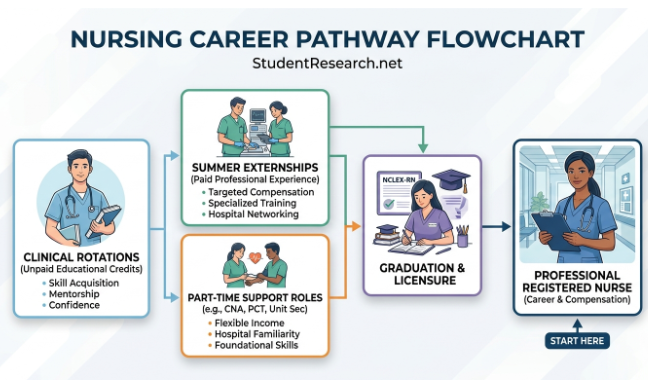
Standard clinical rotations serve as the backbone of your nursing education, providing the immersive experience required for licensure. While these hours are intensive, they are designed as credit-bearing components of your degree rather than employment.
Why Clinical Hours Are Typically Unpaid Educational Credits
- Learning Focus: These rotations prioritize student growth and clinical competency under the supervision of a preceptor.
- Accreditation: Regulatory bodies mandate these hours to ensure every graduate meets the required national standards for patient safety.
- Skill Integration: The primary goal is to apply theoretical knowledge to real-world patient care in a non-employment setting.
The Academic Value of Hands-On Nursing Experience
- Confidence Building: Exposure to diverse departments allows you to identify your preferred specialty early.
- Mentorship: You gain invaluable access to experienced nurses who provide guidance on professional nursing standards.
- Clinical Proficiency: Mastering technical skills like IV starts or patient assessments is best achieved in this supervised environment.
Are Nursing Students Get Paid Through Summer Externships?
If you are wondering do nursing students get paid in a professional capacity, summer externships are your best answer. These programs offer a bridge between the classroom and the bedside.
Leveraging Externship Programs for Competitive Pay
- #1: Targeted Compensation: Unlike clinicals, externships provide a salary or hourly wage for your time on the floor.
- Enhanced Autonomy: You perform more tasks under supervision, which helps you feel more like a paid member of the healthcare team.
- Institutional Recruitment: Hospitals use these programs to evaluate potential future hires, often offering permanent positions upon graduation.
Building Clinical Competence While Earning a Salary
- #2: Specialized Training: Externs often focus on high-acuity areas like ICU or ER, providing a competitive edge.
- Networking: Building connections with hiring managers during an externship is a critical component of successful student research for career advancement.
- Interview Preparation: Working as an extern allows you to practice the professional communication skills needed for your first job search.
Finding Opportunities Where Do Nursing Students Get Paid?
Finding the right balance between rigorous nursing studies and financial stability is a common hurdle. Fortunately, the healthcare industry provides several entry-level and clinical-support roles that allow you to earn income while reinforcing the lessons learned in your classroom and clinical rotations.As you begin your job search, utilize the tools outlined in our Research Apps for Students guide to streamline your search process and keep your application materials organized
Comparison Table: Entry-Level Healthcare Roles for Students
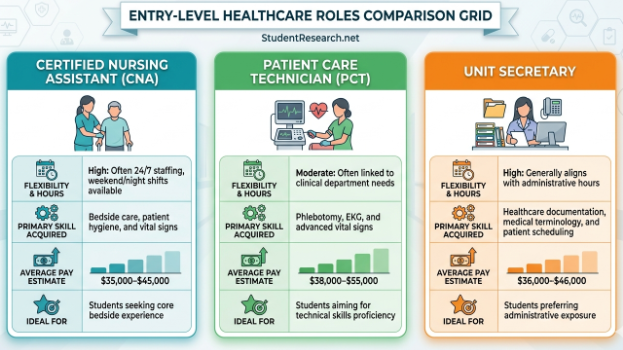
This table breaks down three common roles to help you decide which fits your current academic schedule and career goals.
| Role | Average Annual Salary | Flexibility | Primary Skill Acquisition |
| CNA | $35,000 – $45,000 | High (Shift Work) | Bedside care, patient hygiene, vitals |
| PCT | $38,000 – $55,000 | Moderate | Phlebotomy, EKG, advanced vitals |
| Unit Secretary | $36,000 – $46,000 | High (Often Clerical) | Healthcare documentation, medical terminology |
Note: Salary ranges are estimates based on 2026 data and vary significantly by geographic location, facility type, and experience.
Step-by-Step Guide: How to Find Your Ideal Student Role
To effectively search for these positions, leverage digital platforms to filter out irrelevant listings and target healthcare-specific opportunities.
- Use Strategic Keywords: On platforms like Indeed or LinkedIn, don’t just search for “job.” Use specific terms like “Student Nurse Tech,” “Nurse Extern,” “Clinical Assistant,” or “CNA – Student Nurse” to find roles that understand your academic constraints.
- Filter by “Entry Level” and “Part-Time”: Narrow your search to roles that explicitly state they are entry-level or student-friendly. Many hospital career portals (e.g., NYU Langone, HCA, or local health systems) have dedicated sections for “Student Careers” or “Externships.”
- Set Up Job Alerts: Create automated email alerts for your preferred keywords and location. This ensures you see newly posted student-nurse-specific positions immediately.
- Check Hospital Portals Directly: Larger hospital systems often host their own job boards that may not always sync perfectly with third-party aggregators. Bookmark the “Careers” pages of the top five hospitals in your area.
The “Secret” Advantage: Clinical-Adjacent Roles
Beyond traditional patient care, “clinical-adjacent” roles offer unique benefits that can make your future transition into a registered nurse position much smoother.
- Telemetry Monitoring: Working as a monitor technician allows you to spend your shift analyzing EKG strips. This role offers unmatched exposure to cardiac rhythms—a core competency in critical care nursing—and often pays a premium due to the technical nature of the work.
- Phlebotomy: By specializing in blood draws, you overcome the fear of performing invasive procedures. Future hiring managers often favor candidates who already possess high-level technical skills because it reduces the onboarding time required once you graduate.
- Resume Optics: These roles demonstrate to potential employers that you have invested extra time in the healthcare industry, possess a high degree of technical proficiency, and are comfortable in high-pressure clinical environments.
Do Nursing Students Get Paid Enough to Cover Expenses?
Managing the costs of nursing school requires a proactive approach to financial literacy and resource allocation. While you may not reach a full professional salary yet, strategic planning can help stabilize your budget.
Financial Planning and Budgeting for Nursing School
- Resource Tracking: Utilize tools from professional student research platforms to manage your monthly living expenses.
- Emergency Funds: Set aside a portion of your earnings from summer or part-time work to cover unexpected academic costs.
Exploring Scholarships and Tuition Reimbursement
- Institutional Aid: Check if your employer offers tuition assistance in exchange for a commitment to work post-graduation.
- External Scholarships: Numerous nursing-specific foundations offer grants that do not require repayment.
Strategies for Managing Finances During Your Program
Navigating nursing school requires more than just clinical excellence; it demands a robust financial plan to survive the high costs of tuition, textbooks, and clinical supplies. By implementing proactive budgeting strategies and tapping into student-exclusive resources, you can minimize financial strain and focus on your academic success.
Actionable Frameworks: The Student Nurse Budgeting Model
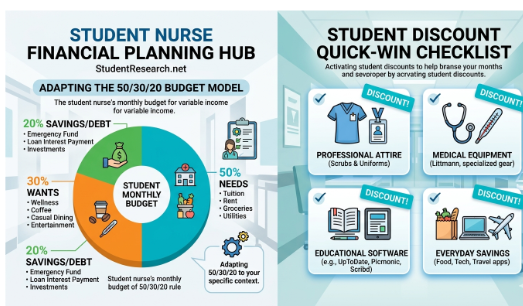
Managing variable income—such as erratic shift work or seasonal student loans—can be challenging. We recommend adapting the 50/30/20 rule to your specific nursing student context to maintain financial stability:
- 50% for Needs: This covers essential nursing school costs like tuition, clinical insurance, lab fees, and basic living expenses (rent, utilities, groceries).
- 30% for Wants: This bucket includes costs that support your well-being during stressful semesters, such as gym memberships, casual dining, or streaming subscriptions.
- 20% for Debt & Savings: Even as a student, prioritizing this ensures you stay ahead. Use this for loan interest payments or building an “emergency fund” for unexpected clinical needs like last-minute transport to a rotation site.
Sample Monthly Student Nurse Budget Template:
- Total Monthly Income: $1,500 (Part-time CNA shift work + small stipend)
- Fixed Expenses: $750 (50% – Rent, Utilities, Basic Food)
- Academic/Life Expenses: $450 (30% – Scrubs, Coffee, Transport)
- Debt Reduction/Savings: $300 (20% – Emergency fund or small loan payment)
Essential Student Discounts: Save Your Money
Leveraging your student status is one of the most underrated ways to keep your costs down throughout your program. Most vendors simply require a “.edu” email address or a valid student ID card to activate significant savings:
- Professional Attire: Brands like FIGS, Cherokee, and Uniform Advantage frequently offer 10–20% discounts for nursing students.
- Medical Equipment: Check sites like Littmann or specialized medical supply stores for “Student Bundles” on stethoscopes, blood pressure cuffs, and penlights.
- Educational Software: Platforms like UpToDate, Picmonic, or Scribd offer deep discounts for students, providing vital study aids for pharmacology and anatomy.
- Everyday Savings: Never underestimate the power of platforms like UNiDAYS or StudentBeans, which aggregate discounts for food delivery, tech gadgets (laptops/tablets), and even travel.
Debt Prevention: Federal vs. Private Loans
Understanding your financing options early is the best way to prevent overwhelming debt upon graduation. The type of loan you accept significantly dictates your post-graduation flexibility.
- Federal Student Loans: These should always be your first priority. They offer lower, fixed interest rates, income-driven repayment plans, and potential eligibility for Public Service Loan Forgiveness (PSLF) programs, which are highly relevant for nurses working in non-profit or public hospitals.
- Private Student Loans: These are often marketed aggressively to students with a “gap” in funding. Use these only as a last resort, as they typically carry variable interest rates that can escalate quickly. They rarely offer the same protections or forgiveness programs as federal options.
- The Long-Term Impact: Every dollar borrowed via private loans is a dollar that restricts your future career choices. By maxing out federal aid and exploring local scholarships first, you ensure that when you land your first role as a Registered Nurse, your paycheck goes toward your personal goals rather than servicing high-interest debt.
Turning Clinical Experience Into Long-Term Career Success
Every clinical rotation you attend is more than just a graduation requirement; it is a live-action test of your professional readiness. By strategically documenting your achievements, you can transform these unpaid hours into a high-value narrative that separates you from other entry-level applicants.Maintaining academic excellence is vital throughout your nursing program; for tips on managing your writing assignments, refer to our comprehensive guide on Argumentative Research Paper Topics to ensure your clinical reflection essays meet the highest scholarly standards.
Using the STAR Method for Clinical Documentation
The STAR method (Situation, Task, Action, Result) is the gold standard for describing your clinical experiences in resumes and cover letters. It forces you to focus on outcomes rather than just lists of duties.
- Situation: Briefly set the scene (e.g., “During my pediatrics rotation in a high-acuity unit…”).
- Task: Identify the specific challenge or goal (e.g., “I was responsible for managing the care of a patient with severe respiratory distress”).
- Action: Detail the specific steps you took (e.g., “I performed frequent suctioning, monitored vitals every 15 minutes, and collaborated with the respiratory therapist to adjust oxygen delivery”).
- Result: Quantify the outcome (e.g., “The patient showed marked improvement in oxygen saturation within two hours, and I received positive feedback from my preceptor for proactive intervention”).
Building a Digital “Clinical Portfolio”
A digital portfolio is a tangible asset that provides evidence of your clinical growth. Unlike a traditional CV, this portfolio offers recruiters a deeper look into your capabilities.
- Documenting Competencies: Create a logbook detailing the procedures you have mastered, such as IV insertions, wound care, or catheterizations. Keep a spreadsheet organized by specialty.
- Hours Log: Maintain an accurate record of clinical hours across different departments. This proves your adaptability and breadth of experience.
- Preceptor Feedback: Collect formal evaluations or letters of recommendation from your preceptors. These testimonials are invaluable during interviews, as they provide an expert third-party perspective on your work ethic and clinical acumen.
- Reflective Journals: Maintain brief notes on challenging patient scenarios. This demonstrates critical thinking and growth, which are highly attractive traits for new graduates.
Expert Interview Preparation: Selling Your Clinical Experience
When an interviewer asks, “What did you learn during your clinicals that makes you a strong candidate?” they are assessing your self-awareness and ability to apply theory to practice.
- Connect to the Facility’s Goals: Research the facility’s mission. If they prioritize “Patient-Centered Care,” answer by sharing a story where you advocated for a patient’s comfort or safety during a rotation.
- Highlight Adaptability: Describe a time when a clinical situation changed rapidly and you had to think on your feet. Emphasize your ability to remain calm and seek guidance from your preceptor.
- Show, Don’t Just Tell: Instead of saying, “I am a hard worker,” use a specific example from your student research portfolio. For instance: “During my rotation in the ICU, I learned how to prioritize care for multiple patients. By organizing my tasks based on clinical acuity, I ensured that every patient received timely medication and monitoring.”
- The “Continuous Learner” Persona: Frame your answer to show that clinicals taught you how to learn. Express that you understand nursing is an evolving field and that you possess the foundational skills to continue growing within their specific clinical environment.
Frequently Asked Questions About Nursing Student Income
Navigating the financial landscape of nursing school is complex. These final points clarify how students can balance work and school while ensuring they remain on the path to graduation.
Comparing Part-Time vs. Full-Time Work During Nursing School
- Prioritize Academics: Ensure your work hours never jeopardize your ability to pass core nursing exams.
- Institutional Benefits: Seek out roles within your clinical hospital to minimize commuting and maximize exposure.
Future Outlook on Paid Nursing Internships
- Industry Trends: More hospitals are adopting paid residency programs to address the growing demand for qualified nursing staff.
- Long-Term Impact: Investing in a role where you are paid to learn now will lead to higher initial starting salaries upon graduation.
Conclusion
In summary, the financial path for a student nurse is multifaceted. Whether you are seeking to answer the question, “Do nursing students get paid?” through externships or supplement your income as a CNA, there are numerous ways to balance your education with your bank account. Always look for roles that enhance your clinical practice rather than just providing a paycheck. Do nursing students get paid? Explore 5 proven ways to earn while studying, from externships to clinical roles, and boost your financial future. By utilizing these strategies, you can transition into your professional career with confidence, financial stability, and the experience needed to excel.

