

Landing your first job in the competitive healthcare sector often hinges on how well you showcase your student nurse clinical experience resume. As a nursing student, your clinical rotations are the most valuable assets you possess, providing a practical foundation that employers prioritize over textbook knowledge. At StudentResearch.net, we emphasize that your ability to articulate these hands-on moments can be the deciding factor in securing your dream position. By effectively documenting your time in the wards, you move beyond being just another applicant and start positioning yourself as a competent, entry-level professional ready to contribute to patient safety.
Mastering the art of writing a student nurse clinical experience resume requires both strategic keyword placement and a clear narrative of your clinical mastery, ensuring that your transition from academia to the bedside is as seamless and impactful as possible.
Understanding the Student Nurse Clinical Experience Resume
The clinical component of your education is where theory meets reality, and your resume must reflect this transition accurately. Understanding how to present your student nurse clinical experience resume correctly can differentiate you from hundreds of other candidates who only list their coursework.
Why Clinical Rotations Define Your Early Career
- Clinical rotations provide tangible evidence of your proficiency in fast-paced environments like the ICU or Med-Surg.
- They serve as the “work history” for new graduates who have not yet held a formal nursing position.
- Sharing these experiences highlights your familiarity with hospital workflows and patient care standards.
Aligning Your Experience with Hospital Expectations
- Hospitals look for candidates who understand their specific patient populations and care models.
- Tailoring your student nurse clinical experience to match a hospital’s mission statement increases your likelihood of being called for an interview.
- Alignment demonstrates that you are a proactive learner who understands organizational culture.
How to Showcase Your Student Nurse Clinical Experience
Your resume should act as a bridge between your academic life and the professional responsibilities you are about to assume. Using precise terminology to describe your student nurse clinical experience resume helps recruiters quickly grasp your level of preparedness.
Tailoring Experience for Specialized Units
- For Pediatric Rotations: Emphasize your ability to provide family-centered care, soothe distressed children, and perform age-specific assessments accurately. Use keywords like “developmental milestones,” “family education,” and “pediatric safety protocols.”
- For Emergency Room (ER) Rotations: Highlight your ability to prioritize care in a high-stress, rapidly changing environment. Focus on keywords like “triage,” “rapid assessment,” “multidisciplinary coordination,” and “crisis intervention.”
- For Geriatric or Long-Term Care: Focus on chronic disease management, fall prevention strategies, and dignity-centered care for elderly populations.
Transforming Generic Bullet Points into High-Impact Achievements
Many students list tasks passively, which hides their true potential. You must transition from writing what you did to what you achieved.
- Generic (Weak) Bullet Point: “Assisted nurses with patient care on the floor.”
- High-Impact (Results-Driven) Bullet Point: “Collaborated with primary nursing staff to manage a caseload of 4 patients in an acute Med-Surg unit, ensuring 100% compliance with safety protocols and medication administration timing.”
- Generic (Weak) Bullet Point: “Took vital signs for patients.”
- High-Impact (Results-Driven) Bullet Point: “Performed precise hourly vital sign assessments for high-acuity patients, proactively identifying early warning signs of hemodynamic instability and communicating findings to the charge nurse immediately.”
Why This Transformation Matters
- It proves you understand the “why” behind your actions, not just the “how.”
- It uses data to validate your student nurse clinical experience, which is the hallmark of professional nursing.
- It shows that you are ready to be an accountable member of the healthcare team from your first day on the job.
Building a High-Converting Nursing Resume Layout
A clean, professional layout is essential for ensuring your credentials are read by both human recruiters and automated systems. A well-organized student nurse clinical experience resume demonstrates a high level of attention to detail—a critical trait for any nurse.
Essential Sections for Entry-Level Nurses
Including Certifications and Licenses
- Clearly list your BLS, ACLS, or any other certifications earned during your studies.
- Mention your status regarding licensure exams, such as the NCLEX, to show you are on track for graduation.
Highlighting Volunteer and Academic Work
- Showcase your commitment to service through relevant volunteer experiences or roles in student research initiatives.
- Include academic projects that involved evidence-based practice, as these reflect clinical maturity.
Crafting Powerful Bullet Points for Clinical Achievements
The impact of your resume relies on the strength of your action verbs and the clarity of your results. When describing your student nurse clinical experience resume, focus on what you actually achieved during your rotations.
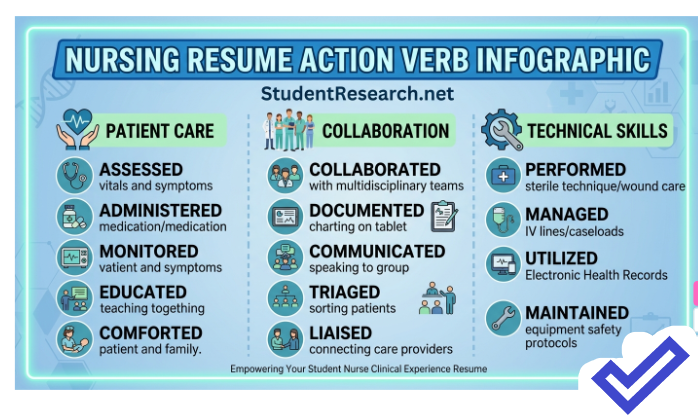
Using the STAR Method to Showcase Clinical Critical Thinking
To effectively highlight your growth, utilize the STAR method (Situation, Task, Action, Result). This framework ensures that every bullet point on your resume illustrates how you handle clinical responsibilities with intentionality.
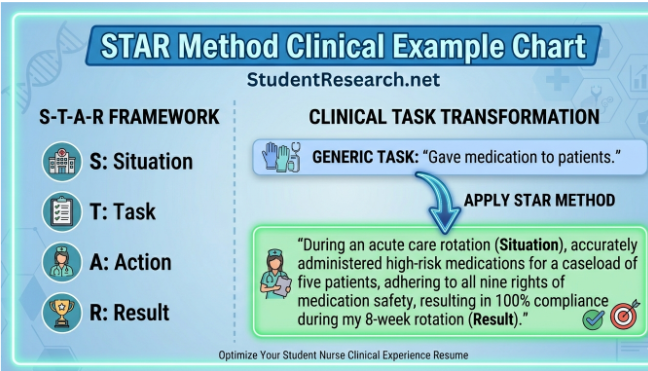
- Situation: Set the scene (e.g., a high-acuity patient in the ICU).
- Task: Define the challenge or objective you were responsible for.
- Action: Describe the specific steps you took using your clinical knowledge.
- Result: Quantify or qualify the positive outcome of your intervention.
Example: Converting a Routine Task
- Before (Routine): “Checked vital signs for patients during every shift.”
- After (STAR Method): “During an acute care rotation (Situation), I was tasked with monitoring hemodynamic stability (Task). I performed frequent, precise vital sign assessments and identified a downward trend in oxygen saturation (Action), which allowed the nursing team to intervene early and prevent a respiratory crisis (Result).”
Clinical Achievement Scenarios: Beyond the Bullet Point
Patient Education and Empowerment
“During my rotation in the cardiac unit, I encountered a patient struggling to understand their new medication regimen upon discharge. I recognized that the patient felt overwhelmed by the complex instructions, so I developed a simplified, visual-aid medication chart tailored to their daily routine. By taking the time to educate the patient and their family, I ensured they could confidently demonstrate how to take their medications safely, ultimately reducing the patient’s anxiety and increasing their readiness for discharge.”
Interdisciplinary Collaboration
“In my Med-Surg rotation, I identified a potential safety concern regarding a medication allergy that was not clearly marked on the patient’s bedside chart. I immediately engaged in a collaborative discussion with the primary nurse and the pharmacy team to verify the allergy and update the electronic health record accordingly. This proactive communication prevented a potential medication error, demonstrating my commitment to patient safety and my ability to effectively coordinate with a diverse interdisciplinary team.”
Safety Protocol Adherence and Advocacy
“While assisting with wound care for a long-term care resident, I noticed a break in sterile technique during a dressing change. I respectfully advocated for patient safety by pausing the procedure to reset the sterile field, explaining the importance of infection prevention to my clinical peer. This experience reinforced my dedication to maintaining stringent safety protocols and provided me with a valuable opportunity to demonstrate leadership and integrity in a high-stakes clinical environment, a key strength of my student nurse clinical experience.”
Optimizing for Nursing Applicant Tracking Systems (ATS)
Many hospitals utilize ATS software to screen resumes, making keyword optimization vital for your success. An ATS-friendly student nurse clinical experience resume ensures your application reaches a human manager’s desk.
Integrating Industry Keywords for Better Ranking
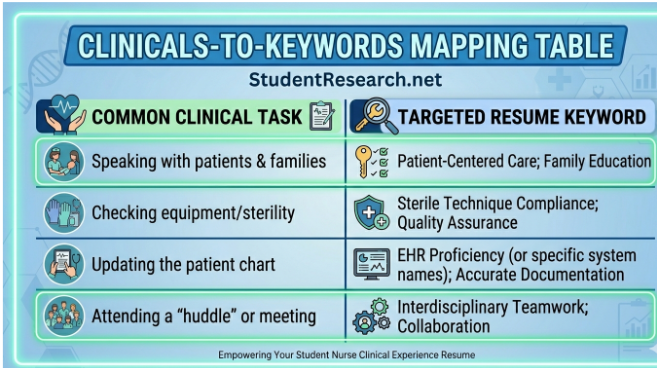
- Include standard nursing terminology like “patient advocacy,” “triage,” and “sterile technique.”
- Use the exact phrasing from job descriptions to show you have the specific student nurse clinical experience the hospital needs.
- To further refine your academic and professional documents, utilize the tools outlined in our ultimate guide to research apps for students to ensure your formatting and citation are flawless.
Common Formatting Pitfalls to Avoid
- Avoid complex graphics or tables that can confuse ATS scanners.
- Stick to standard fonts and simple layouts to maintain readability.
- Ensure that your student nurse clinical experience resume is saved as a searchable PDF or Word document.
The Power of Networking During Your Clinical Rotations
Your professional network is just as important as your technical skills when searching for a job. Networking during your clinicals can turn a rotation into a job offer, provided you have a polished student nurse clinical experience resume to hand out.
Building Professional Relationships with Preceptors
- Ask your preceptors for honest feedback to improve your clinical practice.
- Maintain a professional demeanor throughout every shift to build a reputation as a dependable student nurse.
Turning Clinical Mentors into Job References
- Identify preceptors who can speak specifically to your student nurse clinical experience.
- Ask for letters of recommendation early, and keep them on file for your future job search.
Final Review: Polishing Your Nursing Portfolio
Before submitting your application, conduct a thorough audit of your documents to ensure excellence. A high-quality student nurse clinical experience resume reflects your dedication to the nursing profession.
Proofreading for Clinical Terminology Accuracy
- Double-check the spelling of medical terms and clinical procedures to demonstrate your professionalism.
- Ensure your contact information and educational details are accurate and up-to-date.
Ensuring Consistent Professional Branding
- Use a consistent font and formatting style throughout your resume and cover letter.
- Leverage platforms like StudentResearch.net to find templates that align with industry standards for your student nurse clinical experience resume.
Launching Your Career After Graduation
Your final weeks as a student are the perfect time to finalize your job search strategy. With a strong student nurse clinical experience resume in hand, you are well-prepared to transition into a full-time role.
Next Steps for New Graduate Nurses
- Even if you faced setbacks earlier in your program, your clinical rotation history still demonstrates resilience, as detailed in our guide on rebounding from academic challenges.
- Keep track of application deadlines for new-graduate residency programs.
Preparing for Your First Nursing Interview
- Use your clinical experiences to answer “tell me about a time when” questions.
- Transform your student nurse clinical experience resume into a comprehensive narrative that highlights your unique value to the healthcare team. To summarize, you should master your student nurse clinical experience resume with 2 expert strategies. Learn how to highlight your rotations and land your dream job!

