

Securing a clinical externship is a milestone moment in any nursing student’s journey. It is the bridge between the theoretical knowledge gained in the classroom and the high-stakes reality of the hospital floor. Student nurse externship jobs provide an unparalleled opportunity to refine your clinical judgment and gain confidence before graduation.
In this guide, we explore 18 proven strategies to help you navigate this competitive landscape, secure your dream position, and hit the ground running.
The Ultimate Guide to Finding Student Nurse Externship Jobs
The search for the perfect externship begins long before you submit an application. This phase is about strategic planning and identifying hospital systems that value student growth.
Understanding Externship Models: Which is Right for You?
Externships generally fall into two categories: intensive summer programs and longitudinal year-round roles. Choosing the right one depends on your academic schedule and career goals.
| Feature | Summer Externship | Longitudinal/Year-Round |
| Duration | 8–12 weeks (Intensive) | Throughout the academic year |
| Focus | Rapid clinical immersion | Integrating work with coursework |
| Best For | Students wanting full-time experience | Students needing flexible part-time hours |
| Skill Gains | High-volume clinical skills | Long-term team integration |
Regional Differences in Application Strategy
The “where” matters as much as the “what.” Tailoring your approach based on your target hospital’s location and size can significantly improve your odds.
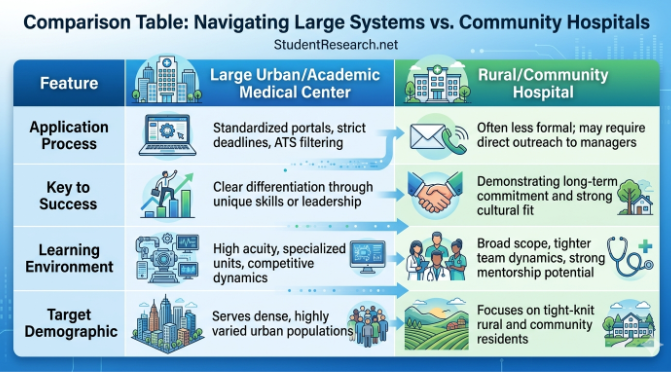
- Large Urban/Academic Medical Centers: These hubs often receive thousands of applications. The key here is differentiation. Use your cover letter to highlight unique volunteer experiences, research projects, or leadership roles. Follow their specific application portals strictly; they often use automated Applicant Tracking Systems (ATS) that filter for specific keywords.
- Rural/Community Hospitals: These facilities often prioritize longevity and culture fit. They may have less formal portals and rely more on personal connections. Consider calling the nurse manager or reaching out via LinkedIn to express sincere interest. Your willingness to work in underserved areas is a high-value asset here.
The “Must-Have” Document Checklist
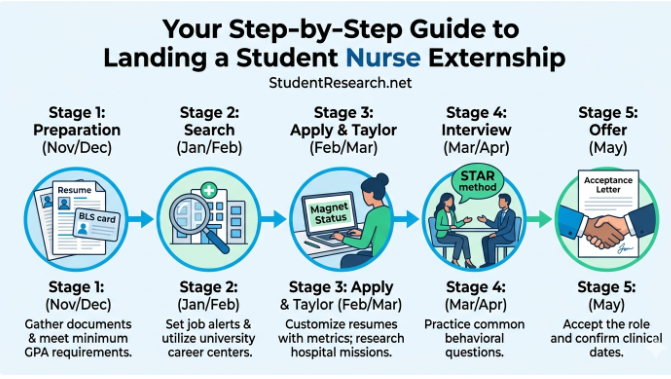
To ensure you aren’t scrambling when portals open (often in November/December), gather these documents into a digital folder today:
- Official Transcripts: Ensure your current GPA meets the minimum requirement.
- BLS/ACLS Certification: Verify your cards are valid through the end of the externship.
- Immunization Records: Hospitals require proof of titers for MMR, Varicella, and Hepatitis B, as well as current flu/COVID-19 vaccination records.
- Clinical Skill Logs: A summary of your current check-offs (e.g., Foley insertion, IV starts, sterile dressing changes).
- Letter of Recommendation (Academic): A pre-written request for a clinical instructor to vouch for your bedside performance.
- Updated Resume: Tailored to reflect your current clinical rotation experience.
Where to Search for Top-Tier Clinical Placements
Most top-tier externships are posted on hospital career portals, but do not overlook university job boards or professional nursing organizations like the NSNA. Set up automated job alerts using keywords like “student nurse extern” or “summer nurse intern” to stay ahead of application windows. Researching specific “Magnet” designated hospitals can also yield higher-quality educational programs, as these institutions have a mandate to support nursing research and professional development.
Crafting an Application That Stands Out
Your resume is your first professional impression. To compete for the best roles, you must treat your application as a professional marketing document that highlights your clinical competence and team-player mindset.
How to Build a Nursing Resume that Gets You Hired
Avoid generic, task-oriented descriptions. Hospitals want to see how your actions positively impacted patient outcomes and workflow efficiency. Use strong action verbs and metrics to provide concrete evidence of your skills.
Before vs. After: Elevating Your Resume Descriptions
- Before: Helped with patients.
- After: Collaborated with RNs to prioritize care for 4 patients in a fast-paced Med-Surg unit, ensuring timely administration of medications and accurate bedside documentation.
- Before: Took vitals.
- After: Monitored and analyzed vital signs for diverse patient populations, identifying and reporting early warning signs of clinical deterioration to the charge nurse.
- Before: Assisted with dressing changes.
- After: Performed sterile dressing changes using aseptic technique, maintaining a 100% compliance rate with hospital infection control protocols.
- Before: Attended clinical rotations.
- After: Completed over 300+ clinical hours across high-acuity departments, including ICU and ED, while mastering patient-centered care and electronic health record (EHR) documentation.
Writing a Winning Cover Letter for Nursing Students
A generic cover letter is an easy way to get your application moved to the bottom of the pile. To truly stand out, you must demonstrate that you have done your homework on the specific facility.
- Magnet Status Alignment: If the hospital is “Magnet” designated, emphasize your dedication to evidence-based practice, nurse autonomy, and professional development. Magnet hospitals look for students who show a commitment to lifelong learning and the pursuit of advanced nursing certifications.
- Mission Statement Integration: Research the hospital’s official mission, vision, and values. If their mission emphasizes “community-centric care,” weave that into your narrative. For example, explain how a previous volunteer experience aligns with their specific approach to community health.
- The “Why” Factor: Explicitly state why this hospital and this unit are your top choices. Connecting your personal career goals with the facility’s reputation for excellence demonstrates professionalism and sincere interest.
By linking your personal values to the institution’s organizational goals, you show the hiring manager that you are not just looking for “any job”—you are looking to contribute to their clinical team.
Mastering the Interview Process for Externships
The interview is your opportunity to move beyond the paper application and show hiring managers your clinical intuition, critical thinking, and professional maturity.
Top 10 Behavioral Interview Questions & The STAR Method
Behavioral questions focus on your past experiences to predict future performance. To excel, use the STAR method for every answer:
- S (Situation): Set the context.
- T (Task): Describe the challenge you faced.
- A (Action): Detail the specific steps you took.
- R (Result): Share the positive outcome or what you learned.
| Question | Focus Area | STAR Tip |
| 1. Tell me about a time you advocated for a patient. | Advocacy | Focus on patient safety and your communication with the RN. |
| 2. Describe a time you had a conflict with a peer. | Conflict | Emphasize listening and reaching a professional consensus. |
| 3. How do you handle high-pressure situations? | Prioritization | Describe a time you triaged tasks when multiple demands existed. |
| 4. Tell me about a time you made a mistake. | Accountability | Admit the mistake, take ownership, and explain your recovery. |
| 5. How do you manage a heavy workload? | Organization | Discuss your process for gathering supplies and “clustering” care. |
| 6. Describe a time you received constructive criticism. | Coachability | Show how you implemented the feedback to improve your practice. |
| 7. What would you do if a patient’s family was upset? | Empathy | Focus on active listening and maintaining professional boundaries. |
| 8. Tell me about a time you worked in a multidisciplinary team. | Collaboration | Highlight how you communicated with doctors, PT, or social work. |
| 9. Why are you interested in this specific hospital/unit? | Motivation | Link your clinical interests to their specialty outcomes. |
| 10. Where do you see yourself in 5 years? | Growth | Focus on professional certification and clinical mastery. |
Virtual Interview Etiquette: Setting the Stage
With many externship interviews now conducted via Zoom or Teams, your “virtual presence” is just as important as your clinical knowledge.
- Lighting & Environment: Avoid sitting with a window behind you, which casts you in shadow. Use a lamp in front of you to illuminate your face. Choose a clean, professional, and quiet background—a plain wall or a neat bookshelf is ideal.
- Camera Placement: Position your camera at eye level. If you are using a laptop, place it on a stack of books so you aren’t looking down at the interviewer, which can create a detached appearance.
- Eye Contact: It is tempting to look at the interviewer on the screen, but you should look directly into the camera lens to create the sensation of true eye contact.
- Body Language: Even though you are remote, sit upright. Keep your hands visible, and use intentional, calm hand gestures. Avoid fidgeting or looking away at other screens.
- Technical Rehearsal: Test your audio, microphone, and internet connection 15 minutes before the start time. Keep a physical copy of your resume, a notepad, and a pen within arm’s reach, just as you would for an in-person interview.
Essential Questions to Ask Potential Employers
At the end of the interview, the “Do you have any questions for us?” segment is mandatory. Asking thoughtful questions demonstrates that you are a serious professional.
- “What specific skills or qualities are you looking for in an extern for this unit?”
- “How do you support student nurses in balancing clinical tasks with their educational goals?”
- “Could you describe the typical onboarding process for a new extern?”
- “How does this unit measure success for a clinical student?”
By arriving prepared with both your STAR stories and your technical setup, you project confidence and readiness for the high-intensity nursing environment.
Transitioning into Student Nurse Externship Jobs Effectively
The first week is often a whirlwind of new information and routines.
Tips for Excelling on Your First Shift
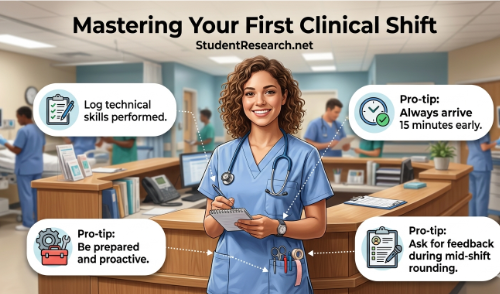
Arrive early, dress professionally, and always carry a pocket notebook. Being proactive—like offering to assist with vitals or restocking supplies—demonstrates that you are there to contribute, not just observe.
Managing Time Between School and Clinicals
Effective time management is essential. Create a master calendar that includes your academic deadlines and your clinical shifts. Communicate your availability clearly with your preceptor.
“Struggling to balance clinical rotations with demanding research papers? Elevate your academic performance today with professional guidance from StudentResearch.net. We specialize in turning complex nursing concepts into clear, high-quality papers that secure your academic success effortlessly.”
Leveraging Your Externship for Career Growth
Think of your 10-week externship not just as a clinical rotation, but as a long-form interview. Your objective is to shift from being a “student observer” to a “proven team member” who can provide safe, efficient care upon graduation.
The Power of Clinical Journaling: Tracking Your Growth
Many students lose track of the specific procedures and high-acuity interventions they perform. By the time you reach new-grad interviews, these memories often blur. Start a professional “Clinical Journal” to document your hands-on experience; this becomes a powerful tool when answering behavioral interview questions later.
How to Structure Your Clinical Log:
- Date & Department: Record where you were (e.g., ICU, Med-Surg).
- Technical Procedures: List skills such as central line dressing changes, NG tube insertions, phlebotomy, or wound vac management.
- Patient Complexity: Note the acuity level. Instead of just “cared for patient,” write “managed 4-patient assignment with complex titration of cardiac drips.”
- Clinical Reasoning: Record why a specific intervention was chosen. This demonstrates that you were not just performing tasks, but thinking critically.
Protocol for Requesting Letters of Recommendation
A strong letter of recommendation (LOR) from a preceptor or nurse manager is the “gold standard” for new-grad hiring. However, obtaining one requires professional tact and careful timing.
Professional Etiquette Guidelines:
- Timing is Critical: Do not ask on your first day. Wait until your mid-point evaluation when you have established a rapport and demonstrated competence. Request the letter at least 4–6 weeks before you actually need it.
- Provide the “Prep Package”: Make it easy for your preceptor to say yes. Provide them with:
- Your updated resume.
- A list of your clinical achievements (pulled from your Clinical Journal).
- A brief summary of your career goals.
- The deadline and submission instructions (e.g., a link to a portal or a specific email address).
- The “Out” Clause: Frame the request to allow them to decline comfortably. Say: “I have truly valued your mentorship and learned so much from your approach to patient care. Would you feel comfortable writing a strong letter of recommendation for my future career applications?” 4. Follow-Up and Gratitude: Always send a thank-you note—handwritten is best—after they agree. Once the job search is over, circle back to update them on where you landed. It builds a permanent bridge in your professional network.
Turning Your Externship Into a Full-Time Offer
Your preceptor is your biggest internal advocate. If you desire a position on that unit, express this intent clearly during your final weeks. Ask, “What is the formal process for transitioning from an extern to a new graduate nurse on this unit?” When you voice your desire to stay, you signal loyalty, which is a highly valued trait in clinical management.
By proactively documenting your skills and managing your professional relationships, you are doing more than just completing a clinical rotation—you are actively constructing the foundation of your nursing career.
Common Challenges During Clinical Externships
You will face obstacles, but how you handle them defines your growth.
Overcoming Imposter Syndrome as a Student
It is normal to feel like you don’t know enough. Acknowledge that you are there to learn. If you don’t know an answer, say, “I am not sure, but I will find out,” and follow through.
Balancing Scope of Practice and Learning Goals
Always operate within your student scope of practice. When in doubt, ask. Your primary goal is to learn how to safely and effectively provide patient care under supervision.
Advanced Clinical Skills to Showcase
Go beyond the basics to set yourself apart as a top candidate.
Developing Professionalism at the Bedside
Professionalism is shown through punctuality, how you communicate with multidisciplinary teams, and how you maintain patient confidentiality.
Improving Patient Care Efficiency
Watch your preceptor’s workflow. Learn how to cluster tasks effectively, which will make you faster and more efficient as you transition into a licensed role.
Long-Term Career Benefits of Early Experience
The investment you make in your externship pays dividends long after the rotation ends.
Why Early Clinical Exposure Boosts Your Resume
Having “Externship” on your resume signals to future employers that you have already proven you can handle a high-acuity environment. It differentiates you from candidates who have only experienced clinicals in a group setting.
Building Your Professional Reputation Early
Nursing is a small world. The connections you build today are your professional network for the next 20 to 30 years. Always lead with kindness, reliability, and an eagerness to learn.
“Is your nursing capstone project feeling overwhelming? Simplify your journey with StudentResearch.net. Our expert team provides tailored support to ensure your writing meets the highest standards. Don’t wait until the deadline—visit our website and order your research help today!”

