

The path to becoming a registered nurse is as demanding as it is rewarding, requiring students to juggle complex clinical rotations, rigorous pharmacology studies, and the high-pressure environment of patient care. Mastering the art of setting smart goals examples for nursing students is the most effective way to transform overwhelming academic requirements into actionable, bite-sized achievements that foster professional growth. By implementing a structured framework, you move beyond simple task lists and begin developing the critical thinking skills necessary for high-stakes decision-making. Whether you are navigating your first clinical placement or preparing for final certification exams, intentional goal setting provides a compass to guide your progress and maintain your mental well-being. This proactive approach to student research and clinical application ensures that you do not just survive nursing school, but truly excel. By focusing on measurable milestones, you create a sustainable rhythm for your education, effectively bridging the gap between theoretical classroom knowledge and the practical realities of the bedside.
Why Smart Goals Examples for Nursing Students are Essential for Success
The transition from the safety of the classroom to the dynamic, high-stakes environment of a clinical ward can be daunting for any nursing student. By utilizing a structured goal-setting framework, you can significantly reduce test anxiety, avoid the common pitfalls of burnout, and systematically build the clinical confidence required for a long-term career.
- Standardized Growth: Goal setting allows you to measure progress against professional nursing standards rather than subjective feelings of overwhelm.
- Preventing Burnout: By breaking down massive semester objectives into manageable, weekly steps, you maintain high motivation throughout the term.
- Professional Longevity: Establishing these habits early on creates a foundation for lifelong learning and professional advancement in the healthcare sector.
Understanding the Framework: SMART Criteria Explained
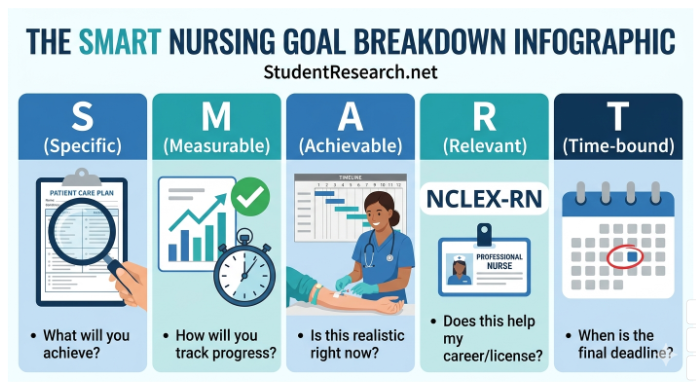
Understanding the SMART acronym is the foundational step in turning abstract desires for “doing better” into concrete, actionable plans for improvement. Each pillar—Specific, Measurable, Achievable, Relevant, and Time-bound—serves as a critical filter that forces you to articulate exactly what success looks like in your daily practice. Beyond mere definitions, adopting this framework leverages Goal-Setting Theory, which posits that clear, challenging goals lead to higher performance and greater task focus. When you take the time to write these objectives down, you engage in a process of externalizing your intentions, which significantly increases your neural commitment to following through, even during the most demanding clinical shifts. Using digital resources, such as the templates available on various student research portals, allows you to digitize this process, turning a mental exercise into a tracked, professional development portfolio.
Defining Each Pillar for Nursing Applications
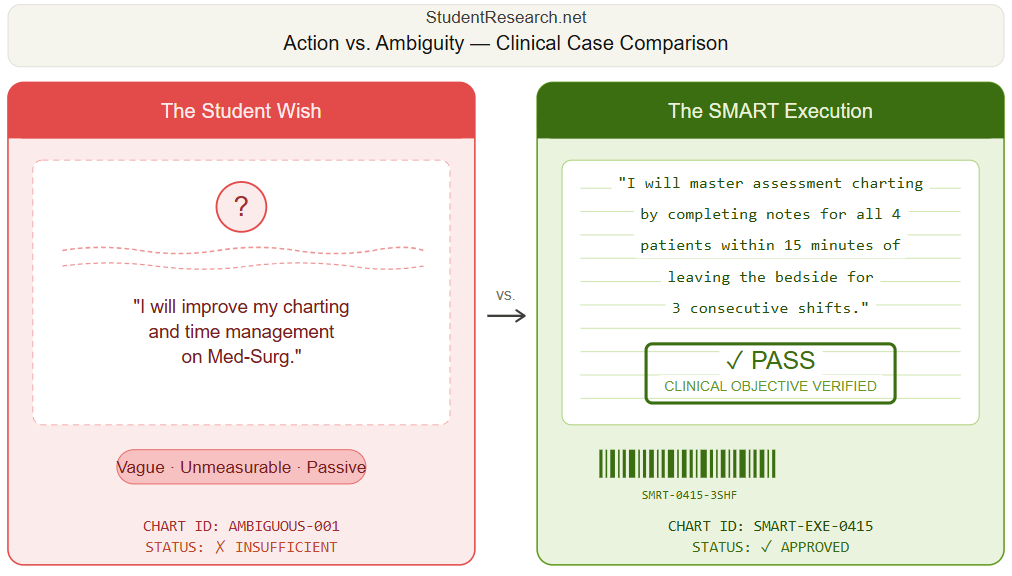
- Specific: You must define exactly what you want to accomplish in clear, unambiguous language.
- Common Pitfall: Using vague verbs like “learn,” “improve,” or “get better at.” These are hard to track and leave you feeling unaccomplished.
- Pro-Tip: Ask yourself the “Five Ws”: Who is involved? What do I want to accomplish? Where will this happen? Which requirements or constraints are present? Why do I want to do this?
- Measurable: Every goal needs a concrete indicator of progress. If you cannot measure it, you cannot manage it.
- Common Pitfall: Setting goals that rely on subjective feelings, such as “I want to feel more confident in medication passes.”
- Pro-Tip: Attach a numerical value or a binary outcome (pass/fail) to the goal. Instead of “feeling confident,” aim to “perform five consecutive error-free medication administrations without preceptor intervention.”
- Achievable: While goals should challenge you, they must also be realistic given your current level of experience and the constraints of your clinical site.
- Common Pitfall: Setting “heroic” goals that ignore the reality of a busy hospital unit or your current skill level as a student.
- Pro-Tip: If a goal feels impossible, break it down further. Success breeds success; hitting smaller, achievable milestones builds the momentum needed for larger competencies.
- Relevant: Your objectives must directly contribute to your growth as a competent, safe nurse.
- Common Pitfall: Focusing on tasks that are low-priority or irrelevant to the core competencies required for your current rotation or degree requirements.
- Pro-Tip: Align your goals with your clinical course objectives. If your course focuses on cardiac care, ensure your SMART goals are centered on ECG interpretation or hemodynamic monitoring rather than administrative tasks.
- Time-bound: A goal without a deadline is merely a wish. Time constraints create the necessary urgency to prioritize your learning.
- Common Pitfall: Keeping goals open-ended, which often leads to procrastination.
- Pro-Tip: Assign a specific date or a milestone (e.g., “by the end of week four”) for completion. This creates a psychological trigger that keeps you accountable throughout your student research and practice.
Incorporating Time-Bound Deadlines into Your Study Routine
- Block Scheduling: Dedicate specific, non-negotiable hours each day to high-intensity tasks like pharmacology review, care plan writing, or NCLEX practice questions.
- Milestone Tracking: Utilize digital tools or a student research database to log your progress, celebrate small wins, and hold yourself accountable for meeting weekly deadlines.
- Review Cycles: Set aside time at the end of every clinical week to evaluate if you met your time-bound objectives or if you need to adjust your approach based on the feedback received from your clinical instructors.
Top 12 Smart Goals Examples for Nursing Students (Clinical Focus)
Applying the SMART framework to your clinical practice transforms vague intentions into a clear roadmap for success. Below, we have converted common student aspirations into 12 concrete mini-case studies that bridge the gap between classroom theory and the fast-paced reality of the hospital floor.
Mastering Technical Skills and Procedures
- IV Insertion
- Before: “I want to get better at inserting IVs.”
- After: “I will successfully perform three unassisted, correct IV insertions on different patient types within the next two clinical shifts.”
- Clinical Context: Crucial for success in Emergency Departments and Med-Surg units where rapid venous access is a priority.
- Wound Care Management
- Before: “I want to learn how to do dressing changes.”
- After: “I will complete five full sterile dressing changes according to hospital policy, ensuring zero contamination, by the end of my current rotation.”
- Clinical Context: Essential for wound care clinics and geriatric nursing, where infection control is paramount.
- Medication Administration
- Before: “I want to be more accurate with my meds.”
- After: “I will achieve 100% accuracy on three consecutive patient medication passes by strictly verifying the ‘six rights’ of administration without prompts from my preceptor.”
- Clinical Context: A foundational requirement for all nursing students, especially in high-acuity cardiac or renal wards.
- Blood Glucose Monitoring
- Before: “I need to get better at checking blood sugars.”
- After: “I will accurately obtain and document blood glucose levels for all four of my assigned patients within 15 minutes of the scheduled time for the duration of this week.”
- Clinical Context: Highly relevant for Endocrinology and Med-Surg nursing.
- Catheterization (Foley)
- Before: “I want to practice inserting catheters.”
- After: “I will perform two successful, sterile Foley catheter insertions under instructor supervision, maintaining complete aseptic technique, before the end of this month.”
- Clinical Context: Critical for Perioperative and Urology care.
- Vital Signs Collection
- Before: “I want to be faster at taking vitals.”
- After: “I will obtain and document full vitals for four patients in less than 20 minutes, including identifying one abnormal reading and reporting it, for the next three shifts.”
- Clinical Context: A core skill for all nursing environments, particularly in triage.
Improving Interpersonal Communication and Patient Advocacy
- Patient Education
- Before: “I want to communicate better with patients.”
- After: “I will explain discharge instructions to three patients using the teach-back method, ensuring they can summarize at least two medication side effects, by Friday.”
- Clinical Context: Vital for Post-Op and primary care settings.
- Shift Handovers (SBAR)
- Before: “I want to do better at giving report.”
- After: “I will deliver a comprehensive, concise SBAR report to the oncoming nurse for all assigned patients during every shift this month, with no more than two clarifications required.”
- Clinical Context: Essential in ICU and Step-down units where concise communication saves lives.
- Conflict Resolution
- Before: “I want to handle difficult families better.”
- After: “I will utilize active listening and empathy statements during two interactions with frustrated family members, aiming to de-escalate concerns without involving the charge nurse.”
- Clinical Context: Highly useful in Pediatrics and fast-paced Emergency Departments.
- Interdisciplinary Collaboration
- Before: “I want to work better with the care team.”
- After: “I will proactively speak up and offer one clinical observation or suggestion during the interdisciplinary rounds for my patients, twice a week for this rotation.”
- Clinical Context: Important in Rehabilitation and Long-term care settings.
- Patient Advocacy
- Before: “I want to advocate for my patients.”
- After: “I will identify one specific patient need not yet met by the current care plan and present a formal suggestion to my preceptor by the start of each morning shift.”
- Clinical Context: Critical in Oncology and Hospice nursing.
- Cultural Competence
- Before: “I want to be more culturally aware.”
- After: “I will research and incorporate one specific cultural preference or practice into the care plan of an assigned patient, documented by the end of my next clinical week.”
- Clinical Context: Increasingly essential in diverse urban hospital centers and public health nursing.
Setting Academic Milestones for Nursing Programs
Academic success is just as vital as clinical performance, yet it requires a different set of strategic planning skills. Integrating your student research with your coursework will help you master dense subjects like pharmacology and anatomy, ensuring you retain the information needed for real-world patient care. To further accelerate your learning, you can utilize structured drug card templates and strategies to transform overwhelming lists of medications into actionable, bite-sized knowledge.
- Pharmacology Mastery: Allocate two hours of deep-work study time every Tuesday and Thursday to map drug classes and their associated nursing interventions.
- Anatomy Recall: Create flashcard sets for each organ system, aiming to memorize the primary pathologies and common nursing diagnoses by mid-semester.
- Prioritization: Practice NCLEX-style priority questions for 30 minutes daily to sharpen your ability to identify the most critical patient needs.
Overcoming Common Hurdles in Achieving Your Goals
Even the most dedicated students encounter roadblocks that threaten to derail their progress. Remember, setbacks are a natural part of any academic journey; if you face unexpected academic challenges, you can explore resources like this guide to navigating nursing school setbacks to help you stay resilient and focused on your long-term success.
- Dealing with Burnout: Practice mindfulness and prioritize rest to maintain mental clarity throughout high-stress clinical semesters.
- Seeking Mentorship: Connect with peers and seniors who have navigated the same clinical challenges to gain fresh perspectives on your goal-setting strategy.
Tracking Your Growth and Adapting Goals
Goal setting is an iterative, dynamic process; as your clinical knowledge expands, your goals must evolve to challenge your growing skill set. Simply setting a goal is only half the battle; the true mastery lies in the consistent evaluation of your progress and the willingness to pivot when the clinical environment demands it. By treating your nursing education as a continuous feedback loop, you ensure that every shift is an opportunity for professional advancement rather than just a series of tasks to be checked off. Regularly seeking objective feedback from your clinical preceptor is essential to ensure that your self-assessment aligns with the professional reality of your performance.
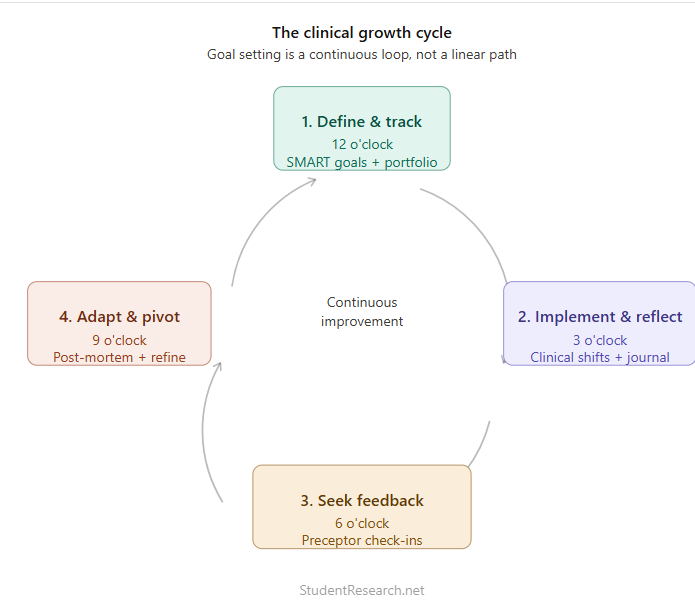
The “Post-Mortem” Analysis
At the conclusion of every clinical rotation, perform a “post-mortem” analysis of your goals. This structured reflection allows you to identify patterns in your behavior and learning style that can be optimized for future placements. Ask yourself these five critical questions:
- What was the biggest barrier to my goal this week?
- How did my preceptor’s specific feedback change my approach?
- Which clinical task felt the most “natural” this week?
- What is one skill I avoided because of fear or uncertainty?
- If I could redo this rotation, what single change would yield the highest return on my learning?
Visualizing Progress
We recommend creating a “Goal Progress Tracker” using a simple spreadsheet or a physical whiteboard system. Design it for success with columns for “Goal,” “Due Date,” “Status,” and “Notes.” The act of visualizing your growth keeps your long-term vision at the forefront of your daily student research and clinical practice.
Conclusion: Elevating Your Nursing Career from Day One
Consistent goal setting is the most powerful tool a nursing student can possess to build professional confidence and competence. By mastering the ability to set specific, measurable objectives, you ensure that every clinical hour contributes to your future success as a capable, compassionate nurse. Remember, the journey to becoming a healthcare leader starts with the small, intentional steps you take today. Master your clinical rotations using 12 smart goals examples for nursing students and learn how to set achievable objectives for academic success. Start drafting your plan now, and take ownership of your professional development.

