

Stepping into the world of healthcare is an exhilarating transition from theory to practice, but the most common question on every aspiring nurse’s lips is: when do nursing students start clinicals? This pivotal moment represents the bridge between classroom lectures and real-world patient care, where “book smarts” transform into life-saving skills. Whether you are eyeing an ADN or a BSN, understanding the timeline of your clinical rotation is the first step toward mastering your nursing education and clinical confidence.
The Roadmap to Practice: When Do Nursing Students Start Clinicals?
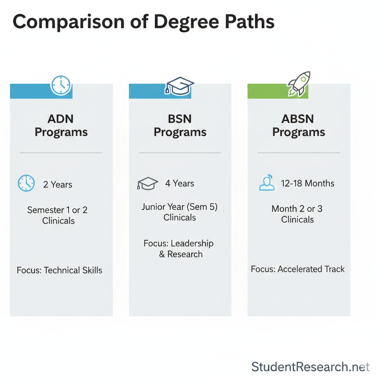
The timeline for entering a hospital setting varies significantly depending on the specific nursing program and degree path you choose. Generally, most students find that when nursing students start clinicals, it occurs after they have demonstrated a foundational understanding of anatomy and basic patient safety. This ensures that you are prepared for the high-stakes environment of a modern medical facility.
Standard Timelines by Program Type
- Associate Degree in Nursing (ADN): Often starts as early as the first semester or the beginning of the second.
- Bachelor of Science in Nursing (BSN): Typically begins in the junior year (fifth semester).
- Accelerated Programs: May see students entering clinical sites within the first 2–4 months.
Comparison of Degree Paths
| Program Type | Total Duration | Clinical Start Window | Focus Area |
| ADN | 2 Years | Semester 1 or 2 | Technical Skills |
| BSN | 4 Years | Semester 5 (Junior Year) | Leadership & Research |
| ABSN | 12-18 Months | Month 2 or 3 | Fast-track Clinicals |
Prerequisites and the “Gatekeeper” Courses
Before you can set foot on a hospital floor, you must prove your competency through a series of rigorous “gatekeeper” courses. Academic institutions use these prerequisites to filter for students who possess the scientific literacy required for patient safety. Knowing when do nursing students start clinicals often depends on how quickly you clear these academic hurdles.
The Core Sciences
- Anatomy and Physiology: Understanding the human body’s structure and function.
- Microbiology: Learning about pathogens and infection control.
- Pharmacology: Calculating dosages and understanding drug interactions.
Mastering Pharmacology Calculations
- Dimensional Analysis: The standard method for ensuring medication safety.
- Metric Conversions: Essential for converting grams to milligrams instantly.
- IV Drip Rates: Calculating how many drops per minute a patient requires.
Is your grade too important to risk? Our multi-level editing at StudentResearch.net guarantees excellence. Every paper undergoes rigorous grammar checks, fact verification, and strict quality control, ensuring your nursing assignments are clinically accurate and perfectly polished before delivery.
Milestone 1: The Role of the Simulation Lab
Before the real-world experience begins, students must spend significant time in the “Sim Lab.” This controlled environment allows you to make mistakes on high-fidelity mannequins rather than human patients. It is during this phase that you begin to understand the rhythm of a shift and the technicalities of when nursing students begin hands-on rotations.
What Happens in the Sim Lab?
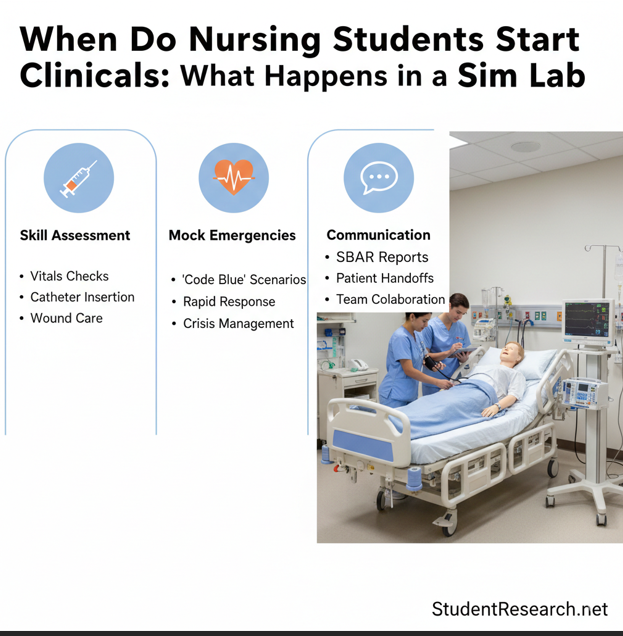
- Skill Assessment: Checking vitals, inserting catheters, and wound care.
- Mock Emergencies: Practicing “Code Blue” scenarios in a safe space.
- Communication Training: Learning how to hand off reports using the SBAR method.
Milestone 2: Health Clearances and Legal Requirements
A major factor in when do nursing students start clinicals is the completion of administrative and health-related paperwork. Hospitals have strict “onboarding” processes similar to new employees to protect their patient population. If your paperwork is delayed, your clinical start date will likely be pushed back as well.
Necessary Documentation
- Immunization Records: Proof of MMR, Varicella, Hep B, and Flu shots.
- Background Checks: Fingerprinting and criminal record screenings.
- Drug Screening: Maintaining a drug-free status is mandatory for hospital access.
Milestone 3: The Fundamentals Rotation
The first actual clinical experience is usually referred to as “Fundamentals.” This is when nursing students start clinicals by focusing on basic patient hygiene, mobility, and comfort. While it might seem basic, this rotation builds the rapport-building skills that define excellent nursing care.
Skills Practiced in Fundamentals
- ADLs (Activities of Daily Living): Helping patients bathe, dress, and eat.
- Vitals Signs: Mastering the manual blood pressure cuff and oxygen saturation.
- Patient Positioning: Learning how to turn patients to prevent pressure ulcers.
Want to stay in total control? At StudentResearch.net, you can chat directly with your assigned writer. Collaborate on outlines, provide instant updates, and ensure your clinical reports reflect your unique voice through real-time, transparent communication today!
Milestone 4: Mastering Specialized Rotations
As you progress, the question shifts from “when” to “where.” Advanced semesters introduce you to specialized units like Pediatrics, Labor and Delivery, or ICU. Each of these rotations requires a different set of clinical priorities and emotional intelligence.
The Diversity of Specialized Units
- Medical-Surgical: The “bread and butter” of nursing, focusing on adult chronic illness.
- Psychiatric Nursing: Focusing on mental health assessments and de-escalation.
- Community Health: Working in clinics or schools rather than traditional hospitals.
Milestone 5: The Preceptorship and Beyond
The final stage of when nursing students start clinicals is the “capstone” or preceptorship. In this phase, you are paired one-on-one with a working nurse and follow their exact schedule, including nights and weekends. This is the ultimate test of your readiness to enter the workforce as a licensed professional.
Preparing for Graduation
- NCLEX Prep: Integrating clinical knowledge with board exam questions.
- Resume Building: Documenting the hours spent in various hospital units.
- Job Networking: Making impressions on unit managers for future employment.
Conclusion
Navigating the timeline of a nursing program requires patience, dedication, and a clear understanding of your school’s curriculum. To summarize your journey, here are the 8 key stages of clinical progression:
- Completion of Prerequisites: Clearing the academic path.
- Lab Competency Exams: Proving you can handle the equipment.
- Background and Health Clearance: Securing your legal right to practice.
- Fundamentals Rotation: Learning the basics of patient dignity.
- Intermediate Med-Surg: Managing multiple patients at once.
- Specialty Rotations: Exploring OB, Peds, and Psych units.
- Advanced Skills: Mastering IV starts and complex wound care.
- Final Preceptorship: Transitioning from student to colleague.
Knowing when do nursing students start clinicals is essential for planning your life and career. This guide explores the 8 vital milestones for mastering your nursing rotation timeline and hospital requirements.

