

Stepping onto a hospital floor for the first time as a student feels less like a school day and more like a high-stakes leap into the heart of healthcare. You might be wondering, what do nursing students do in clinicals that differentiates a classroom lecture from the fast-paced reality of a cardiac ward? This guide serves as your roadmap, transforming that initial anxiety into the professional confidence required to save lives.
The Transition from Theory to Practice
The shift from a simulated lab to a bustling hospital wing is the most pivotal moment in a nurse’s education. This phase allows students to apply complex physiological concepts to breathing, feeling human beings. It is here that the abstract becomes tangible and the responsibility of care truly begins.
Bridging the Knowledge Gap
- Application of Pathophysiology: Observing how chronic conditions manifest in real-time patients.
- Pharmacology in Action: Understanding the timing and delivery of medications beyond the textbook.
- Critical Thinking Development: Moving from “following a list” to “anticipating a need.”
The Role of the Clinical Instructor
- Supervision: Ensuring every procedure is performed according to safety standards.
- Debriefing: Facilitating post-shift discussions to analyze what went well and what didn’t.
- Evaluation: Providing feedback on your evolving technical and soft skills.
Core Responsibilities and Daily Tasks
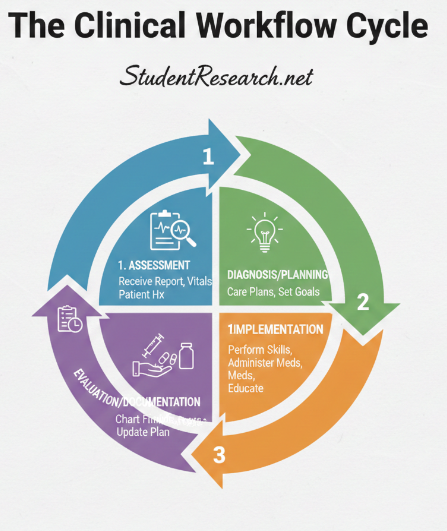
When asking what do nursing students do in clinicals (#1), the answer often starts with the fundamental “Activities of Daily Living” (ADLs). These tasks are the building blocks of patient rapport and physical assessment. While they may seem basic, they provide the essential data needed for more complex medical decisions.
Direct Patient Care Activities
- Hygiene Assistance: Helping patients with bathing, oral care, and grooming to prevent infection.
- Mobility Support: Assisting with “ambulation” (walking) or repositioning bedbound patients to avoid pressure ulcers.
- Nutrition Monitoring: Recording intake and output (I&Os) to ensure proper hydration and caloric levels.
Vital Signs and Data Collection
- Manual Blood Pressure: Mastering the art of hearing Korotkoff sounds in a noisy environment.
- Pulse Oximetry: Monitoring oxygen saturation levels during activity and rest.
- Blood Glucose Monitoring: Performing “finger sticks” for diabetic patients and reporting results.
- H4: Frequency of Checks
- Standard “Q4” (every four hours) checks for stable patients.
- More frequent monitoring for post-operative or unstable patients.
- H4: Frequency of Checks
Mastering Clinical Skills and Procedures
As students progress, they move from basic care to technical interventions. This is where you get to use the professional tools you’ve only seen in simulation labs. These skills are practiced under the watchful eye of a preceptor to ensure patient safety and comfort.
Medication Administration
- The Six Rights: Verifying Right Patient, Drug, Dose, Route, Time, and Documentation.
- Injections: Administering subcutaneous or intramuscular shots with precision.
- IV Therapy: Monitoring fluid rates and checking for signs of infiltration or phlebitis.
Wound Care and Sterile Technique
- Dressing Changes: Removing old bandages and applying new, sterile coverings to surgical sites.
- Suture Assessment: Checking for signs of redness, edema, or discharge (REEDA scale).
- Catheterization: Learning the strict sterile protocols for inserting or maintaining urinary catheters.
Communication and Interdisciplinary Collaboration
Nursing is a team sport, and clinicals are your first real practice in professional communication. You aren’t just talking to patients; you are translating medical jargon for families and reporting data to doctors. Understanding what do nursing students do in clinicals (#2) must include the “SBAR” communication tool.
Patient and Family Education
- Discharge Instructions: Explaining how to take meds at home.
- Disease Management: Teaching a newly diagnosed patient how to manage their condition.
- Emotional Support: Providing a listening ear to stressed family members.
The Healthcare Team Dynamic
- Rounding with Doctors: Following the medical team to understand the broader treatment plan.
- Consulting Specialists: Coordinating with physical therapists or dietitians.
- Shift Hand-off: Learning how to give a concise, accurate report to the next nurse.
Comparison of Clinical Settings
Not all clinical rotations are created equal; the environment dictates the pace of your learning. Depending on your current semester, you might find yourself in the quiet halls of a nursing home or the chaotic environment of an Emergency Room. The skills you prioritize will shift significantly based on the patient population you serve.
Comparing Specialties
The following table outlines the different focuses you will encounter throughout your rotations:
| Rotation Type | Primary Focus | Typical Duration | Student Intensity |
| Med-Surg | General Recovery | 6–10 Weeks | High |
| Pediatrics | Development/Family | 4–6 Weeks | Moderate |
| OB/Maternal | Labor & Delivery | 4–6 Weeks | Fast-Paced |
| Psychiatric | Mental Health | 4–6 Weeks | Moderate |
| Critical Care | Hemodynamics | 4–6 Weeks | Very High |
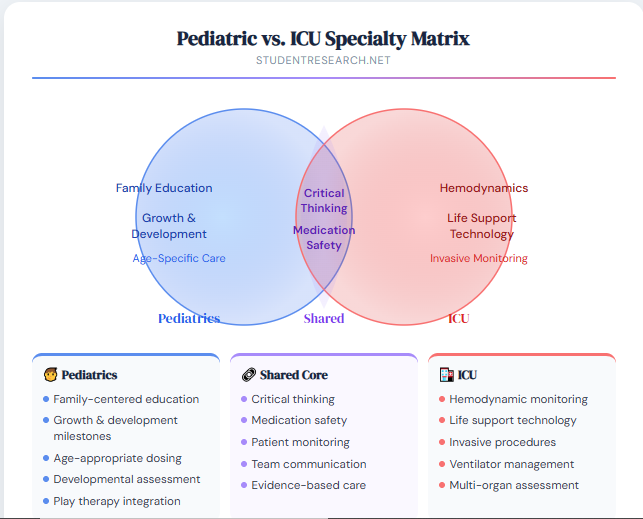
Pediatrics: Family-Centered Care and Developmental Milestones
- Developmental Assessments: Evaluating if a child is meeting age-appropriate milestones.
- Weight-Based Calculations: Double-checking every medication dose based on weight in kilograms.
- Distraction Techniques: Utilizing bubbles or toys to keep a child calm during procedures.
- Family Coaching: Teaching parents how to manage chronic pediatric conditions at home.
The ICU: High-Acuity Monitoring and Critical Interventions
- Ventilator Management: Observing how nurses manage airway pressures and oxygen titration.
- Titrating Vasopressors: Learning how potent medications are adjusted to maintain stable vitals.
- Neurological Checks: Performing frequent GCS scale assessments on critically ill patients.
- H4: ICU Technical Skills
- Assisting with the setup of invasive monitoring lines.
- Interpreting basic EKG rhythms like sinus bradycardia.
- Monitoring chest tube output for post-surgical patients.
- H4: ICU Technical Skills
Documentation and the Electronic Health Record (EHR)
If you didn’t chart it, you didn’t do it—this is the golden rule of modern nursing. Students spend a significant portion of their day at a computer terminal, learning how to document their findings accurately. This is a critical part of what do nursing students do in clinicals (#3) because it becomes a legal record of care.
The Art of Charting
- Assessment Flows: Checking off body systems and noting abnormalities.
- Narrative Notes: Writing clear, objective descriptions of unusual events.
- Flowsheets: Tracking vitals and I&Os over a 12-hour period.
Integrating Student Research
- Evidence-Based Practice: Using student research to justify specific nursing interventions in your notes.
- Policy Review: Looking up hospital protocols to ensure documentation meets legal standards.
- Case Studies: Utilizing your patient’s chart to complete academic assignments.
Struggling to balance clinical hours and heavy paperwork? Let StudentResearch.net handle the heavy lifting. Our expert writers deliver top-tier nursing papers that guarantee the grades you deserve while you focus on saving lives at the bedside.
Essential Clinical Gear Checklist
Being prepared means having the right tools in your bag before the shift begins. Your clinical bag is your mobile headquarters, containing everything from diagnostic tools to personal sustenance. Organizing your gear efficiently is part of what do nursing students do in clinicals (#4) to stay ahead of the curve.
Must-Have Diagnostic and Medical Tools
- Stethoscope: A high-quality acoustic model is essential for pediatric and ICU assessments.
- Penlight & Scissors: For pupil checks and cutting through dressings or medical tape.
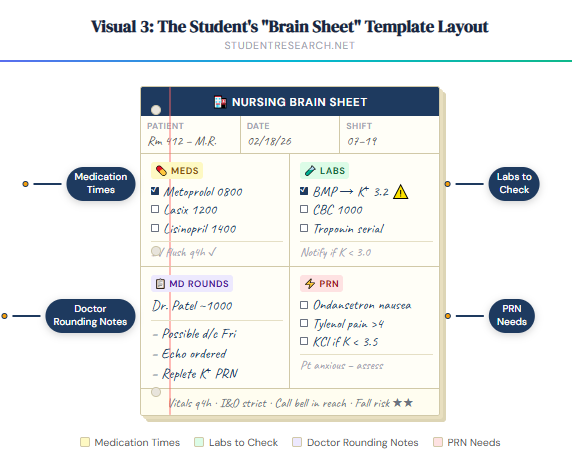
- Multi-Color Pen: Used for color-coding different parts of your patient “brain sheet.”
- Folding Clipboard: Provides a surface for charting that fits easily into a scrub pocket.
Personal Care and Survival Items
- Compression Socks: Essential for preventing leg fatigue during 12-hour shifts.
- High-Protein Snacks: Quick fuel like nuts or protein bars for short breaks.
- Hydration: A leak-proof water bottle to stay alert throughout the day.
- Hand Cream: To soothe dry skin caused by frequent hospital-grade sanitizers.
The Impact of Student Research on Clinical Care
Modern nursing is rooted in science, not just tradition, requiring constant academic engagement. During your rotations, you will often find that your academic assignments require you to bridge the gap between recent studies and bedside care. This ensures that the care you provide is up-to-date and effective.
Applying Evidence at the Bedside
- Infection Control: Utilizing latest student research on hand hygiene and PPE to reduce hospital-acquired infections.
- Patient Safety: Implementing fall prevention protocols based on national statistics.
- Pain Management: Exploring non-pharmacological methods like guided imagery.
Contributing to the Profession
- Data Collection: Sometimes assisting in hospital-wide quality improvement projects.
- Peer Education: Sharing new findings from your student research with classmates during post-conference.
- Innovation: Thinking of better ways to organize supplies or improve patient flow.
Challenges and Survival Tips
Clinicals are exhausting—physically, mentally, and emotionally—requiring a plan for resilience. You will be on your feet for 12 hours, sometimes witnessing difficult situations that test your resolve. Understanding what do nursing students do in clinicals (#8) also means preparing for the “hidden” work of staying healthy.
Managing the Physical Demand
- Supportive Footwear: Investing in quality shoes is a long-term health investment.
- Hydration Habits: Drinking water every time you pass a designated “safe zone” for fluids.
- Body Mechanics: Learning how to lift and move patients without injuring your back.
Emotional Resilience
- Coping with Loss: Processing the reality of patient decline with your instructor.
- Stress Management: Utilizing deep breathing during a hectic or high-pressure shift.
- Self-Care: Prioritizing sleep and mental “unplugging” after a long clinical day.
- H4: Helpful Resources
- School-provided counseling services.
- Peer support groups within your nursing cohort.
- H4: Helpful Resources
Is your clinical schedule leaving you zero time for sleep? Reclaim your weekends with professional help from StudentResearch.net. We provide custom, high-quality nursing assignments so you can master your rotations without the stress of looming deadlines.
Conclusion and Final Reflections
As you finish your final rotation, you will realize that your time on the floor has shaped you into a clinician. You have moved from a nervous observer to an active participant in the healing process. Every vital sign taken and every hand held has prepared you for the moment you finally wear the “RN” badge.
Looking Forward to Graduation
- NCLEX Preparation: Using clinical experiences to answer critical-thinking questions.
- Networking: Building relationships with managers on units you enjoyed most.
- Lifelong Learning: Recognizing that clinicals are just the beginning of your education.
Discover what do nursing students do in clinicals with this ultimate guide. Learn about patient care, skills, and rotations to excel in your career. This foundational experience is the bridge to your future.
Student vs. Registered Nurse Comparison
| Nursing Student Role | Registered Nurse (RN) Role |
| Supervision: Operates under an instructor’s license | Autonomy: Operates under their own professional license |
| Patient Load: Typically manages 1–2 patients | Patient Load: Manages 4–6 patients on average |
| Documentation: Notes are co-signed by an instructor | Documentation: Legally responsible for all entries |
| Focus: Learning specific skills and applications | Focus: Patient outcomes and total unit flow |
Meta Description: Discover what do nursing students do in clinicals with this ultimate guide. Learn about patient care, skills, and rotations to excel in your career.

