

Transitioning from a textbook-heavy classroom to a fast-paced hospital ward is the most exhilarating—and nerve-wracking—part of medical education. You’ve spent months memorizing anatomy and pharmacology, but now it’s time to apply that knowledge to a living, breathing person. What are clinicals for nursing students? Simply put, they are the bridge between theory and practice, the “on-the-job” training where your identity shifts from a student to a healthcare professional. In this guide, we explore the intricate layers of clinical rotations and provide 15 essential insights to help you master this transformative experience.
Defining the Clinical Experience
The core of any nursing program is the clinical rotation, a mandatory component where students practice skills under the supervision of licensed professionals. Many beginners ask, “what are clinicals for nursing students” in terms of daily structure and expectations. This phase allows you to move beyond plastic mannequins and engage in real-time patient care in diverse healthcare environments.
The Core Objectives of Clinical Rotations
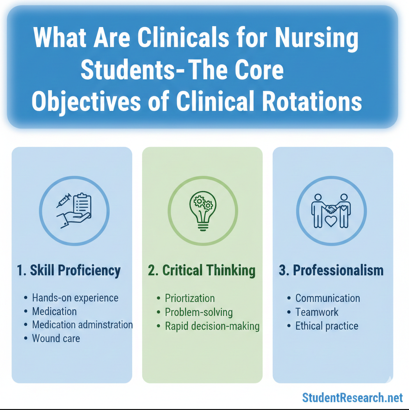
Clinicals are designed to ensure that you can safely and competently handle the responsibilities of a Registered Nurse (RN). Educators focus on three primary pillars of development during these hours.
- Skill Proficiency: Gaining hands-on experience with catheters, IVs, and wound care.
- Critical Thinking: Learning to prioritize patient needs based on changing vitals.
- Professionalism: Developing a “bedside manner” and communicating with a multidisciplinary team.
1. Skill Mastery
- Perfecting the “Five Rights” of medication administration.
- Learning to document patient history accurately in Electronic Health Records (EHR).
2. Clinical Judgment
- Recognizing the early signs of patient deterioration before a code occurs.
- Applying the nursing process (ADPIE) in a fast-paced environment.
Navigating the Clinical Environment
The landscape of a hospital can be a maze of different departments, each with its own culture and pace. When considering what clinicals for nursing students involve, one must look at the variety of settings, from the high-stakes Intensive Care Unit (ICU) to the community-focused local clinic. You will rotate through several specialties to find where your passion truly lies.
Common Clinical Settings and Specialties
Nursing education is comprehensive, meaning you won’t just stay on one floor for your entire degree. Each rotation offers a unique set of challenges and patient demographics.
| Specialty | Primary Focus | Typical Patient Population |
| Medical-Surgical | Acute illness and post-op care | Adults with diverse pathologies |
| Pediatrics | Growth, development, and childhood illness | Neonates to adolescents |
| OB/GYN | Labor, delivery, and postpartum care | Expectant mothers and newborns |
| Psychiatric | Mental health and behavioral therapy | Patients with psychological disorders |
| ICU/ER | Critical, life-threatening conditions | High-acuity trauma or organ failure |
3. The Med-Surg Foundation
- Managing a heavy patient load (typically 2-4 patients for students).
- Understanding the flow of a standard hospital shift.
4. Specialized Care Units
- The Operating Room (OR): You will observe the strict protocols of the “sterile field.” Your role involves understanding the circulating nurse’s duties and the importance of surgical counts.
- The Neonatal Intensive Care Unit (NICU): In this setting, you learn “cluster care.” You focus on minute dosage calculations and maintaining the fragile homeostasis of premature infants.
- The Emergency Department (ED): This rotation builds your “triage mindset.” You will learn to assess and stabilize patients in seconds during high-trauma scenarios.
The Role of the Clinical Instructor and Preceptor
A major part of understanding what clinicals are for nursing students is knowing who will guide you. You aren’t thrown into the deep end alone; you are supported by instructors and staff nurses. These mentors evaluate your performance and ensure that patient safety remains the top priority.
Collaborative Learning and Supervision
Your instructor is your advocate and your evaluator, while the floor nurse (preceptor) is your real-world guide. Navigating these relationships is key to a successful rotation.
- Pre-Conference: A meeting before the shift to discuss patient assignments and goals.
- Post-Conference: A debriefing session to discuss what was learned and what could be improved.
- Hands-on Supervision: The instructor watches you perform new tasks to ensure compliance with hospital policy.
5. Constructive Feedback
- Accepting critiques on your technique without taking it personally.
- Asking “why” behind every intervention to deepen your understanding.
6. Team Collaboration
- Working with Nursing Assistants (CNAs) to ensure patient hygiene.
- Reporting significant findings to the primary RN immediately.
Are you ready to see your GPA soar? Don’t let a single paper hold you back. At StudentResearch.net, our expert writers craft high-caliber assignments designed to earn the top marks you deserve. Secure your academic future with us today!
Expectations and Daily Responsibilities
To truly answer what are clinicals for nursing students, one must look at the clock. A typical clinical day often starts at 6:30 AM and can last 8 to 12 hours. It is physically demanding, mentally exhausting, but incredibly rewarding as you see the direct impact of your care.
The Ultimate Student Nurse “Brain Sheet” Template
Organization is the secret to surviving your first shift. A “brain sheet” is a personalized shorthand document that tracks everything from medication times to vital signs, ensuring you never miss a beat when your instructor asks for an update.
| Patient Info | Vitals & Labs | Assessment/Notes |
| Room: ________ | BP: ________ | Neuro: Alert / Orient x ___ |
| Name/Initials: ________ | HR: ________ | Resp: Clear / Crackles / O2 |
| Age/Sex: ________ | Temp: ________ | Cardiac: Regular / Murmur |
| Admitting Dx: | SpO2: ________ | GI/GU: LBM / Voiding |
| ____________________ | Blood Sugar: ____ | Skin: Intact / Stage: ___ |
| Allergies: ________ | Pain (1-10): ____ | IV Site/Fluids: ________ |
7. Rigorous Documentation
- Charting Accuracy: Ensuring all vitals and “I&Os” (Intake and Output) are recorded in the EHR immediately.
- Objective Language: Avoiding biased terms and sticking to observable patient data.
8. Patient Advocacy
- The Safety Stop: Speaking up if you notice a potential medication error or a break in sterile technique.
- Education: Ensuring the patient understands their rights and their care plan before discharge.
Overcoming Challenges and Succeeding
Many students feel overwhelmed when first discovering what nursing clinicals are. The “imposter syndrome” is real, and the fear of making a mistake can be paralyzing. However, the goal of these rotations is learning, not perfection, and there are proven strategies to help you excel.
Tired of surface-level sources failing your bibliography? Our specialists at StudentResearch.net bypass basic search engines to access proprietary databases and peer-reviewed journals. Get the evidence-based, deep-dive research required for high-level nursing excellence and scholarly clinical papers
Professional Communication and the SBAR Method
Mastering communication is a core part of what clinicals for nursing students aim to teach. The SBAR (Situation, Background, Assessment, Recommendation) tool is your best friend when calling a physician or handing off a patient.
- S (Situation): “I am calling about Patient X who is experiencing sudden shortness of breath.”
- B (Background): “Patient X was admitted for a hip replacement and has a history of asthma.”
- A (Assessment): “Lung sounds have wheezing in the upper lobes; SpO2 has dropped to 88%.”
- R (Recommendation): “I recommend an immediate respiratory therapy consult and a stat chest X-ray.”
9. Interdisciplinary Communication
- Practicing the SBAR script with your instructor before calling a provider.
- Learning to take verbal orders (if permitted by your program’s scope).
10. Managing Stress and Anxiety
- Using “box breathing” techniques during high-pressure moments.
- Setting realistic expectations: you are there to learn, not to be an expert yet.
H4: 11. Physical Readiness
- Investing in high-compression socks to prevent leg fatigue during 12-hour shifts.
- Packing a clinical bag with 15 essentials: stethoscope, shears, penlight, and nutrient-dense snacks.
12. Ethico-Legal Awareness
- HIPAA Compliance: Never taking photos in the hospital or sharing patient details on social media.
- Informed Consent: Understanding your role in witnessing (but not obtaining) surgical consent.
13. Professional Appearance
- Following the school’s uniform policy strictly to project competence.
- Keeping hair tied back and jewelry minimal for hygiene and safety.
14. Cultural Competence
- Adapting care plans to respect religious dietary restrictions or modesty requirements.
- Using hospital-approved interpreters rather than family members for medical translation.
15. Lifelong Learning: The Reflection Journal
To truly understand what are clinicals for nursing students, you must reflect. Use these prompts in your post-clinical journal:
- What was the most challenging interaction today?
- How did I apply a theory from my textbook to a real patient?
- What is one goal I have for my next shift?
Conclusion
In summary, what are clinicals for nursing students? They are the crucible where your classroom education is forged into clinical competence. By embracing these 15 points—from mastering the “Brain Sheet” and SBAR communication to specialized OR rotations and deep reflection—you are not just passing a class; you are becoming a nurse. Mastering these clinical rotations is the final step toward earning your license and making a real difference in the lives of your future patients.
Meta Description: What are clinicals for nursing students? Learn about hands-on training, 15 vital tips for success, and how to master rotations.

