

The journey through nursing school is demanding, but the moment you start applying for clinical placements, externships, or that first job, the competition becomes fierce. You’re no longer just competing for a spot in a classroom; you’re vying for a position that shapes your entire career. Recruiters and hiring managers often receive dozens, even hundreds, of applications for student nurse roles. So, how do you stand out when you lack the formal RN experience that full-fledged nurses possess?
The answer lies in your student nurse resume objective.
This objective is not merely a formality; it’s your personal 30-second elevator pitch—a concentrated summary designed to capture attention and immediately confirm your relevance. This guide will break down a powerful, proven formula for crafting an objective that cuts through the clutter, bypasses automated screening software, and moves your application straight into the “interview” pile. The objective is a strategic marketing tool that sets the tone for your entire resume.
Why is Your Student Nurse Resume Objective Important? A Guide to the First Cut
The resume objective isn’t just filler; it’s the critical first checkpoint your application must pass. Before human eyes ever scan your clinical rotations or GPA, your objective faces two crucial gatekeepers: the machine and the overwhelmed recruiter. Fail this test, and the rest of your meticulously crafted resume may never be seen.
What is ATS and How Do Robots Read Your Resume?
Most large healthcare systems rely on sophisticated software to manage the immense volume of applications they receive. Understanding this digital gatekeeper, the Applicant Tracking System (ATS), is step one in ensuring your objective makes the cut.
- Keyword Matching: ATS software scans your resume for essential keywords (e.g., “patient safety,” “EMR documentation,” “pediatric care”) that match the job description.
- Immediate Relevance: A well-crafted objective immediately confirms to the ATS that your document is relevant to the specific role and specialty, increasing your application’s score.
- Formatting Check: Simple, clear language in the objective avoids confusing the ATS parser, guaranteeing your core information is correctly extracted and categorized.
Understanding The 6-Second Recruiter Rule
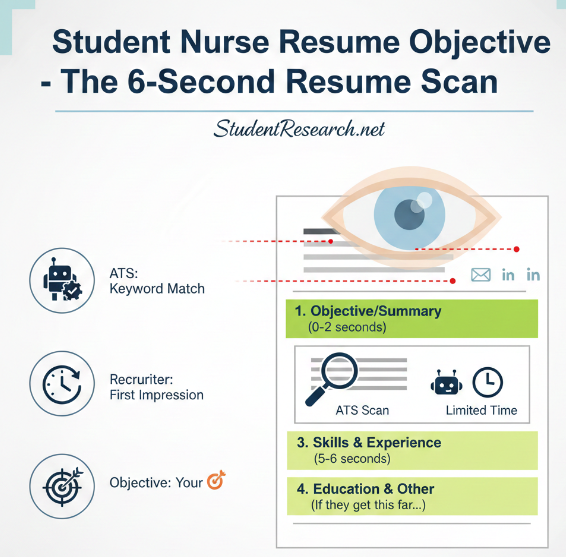
If your resume successfully passes the robotic screen, it lands on the desk (or screen) of a human recruiter who is often dealing with an immense workload. Their attention span is extremely limited, making your objective your only chance to make a decisive, positive impression.
- The First Impression: Studies show recruiters spend an average of six to eight seconds reviewing a resume before deciding to keep or discard it.
- Instant Confirmation: The objective must instantly validate that the applicant’s goals align with the job’s needs (e.g., explicitly stating you seek the specific unit or externship).
- Direction Setting: A strong objective directs the recruiter’s attention to the most relevant parts of your experience below (e.g., highlighting that you have completed a relevant ICU rotation).
Worried about investing in essential academic writing help? StudentResearch.net guarantees your satisfaction with a straightforward money-back policy. If our work doesn’t meet your rigorous standards, you get a full refund. Protect your career investment and write with confidence at StudentResearch.net
How To Write an Irresistible Objective: The 3-Part Formula
Now that you know why the objective matters, let’s look at the how. The most effective student nurse objectives aren’t vague or generic; they are surgical and specific. They follow a simple, three-part formula that ensures you hit all the necessary points for both the ATS and the recruiter in less than three lines of text. Master these three components, and you’ll create an irresistible objective every time.
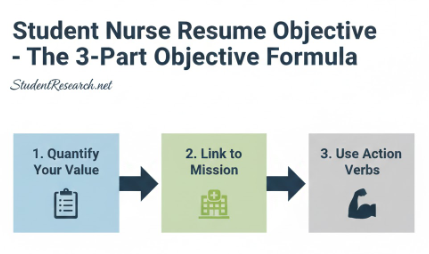
Part 1: Benefits of Quantifying Your Clinical Value (The ‘What’)
Recruiters want to know what value you bring, even as a student. Use the first part of your objective to briefly quantify and specify the clinical skills and knowledge you currently possess.
- Specific Skills: Mention relevant, measurable skills developed in simulation or clinical settings (e.g., IV starts, EMR documentation, basic wound care, therapeutic communication).
- Patient Population: Reference the specific patient population or specialty you’ve focused on (e.g., Geriatrics, Women’s Health, Acute Care) to show early focus.
- Quantify Experience: Briefly quantify your educational experience (e.g., “leveraging 300+ clinical hours” or “final semester student”).
Part 2: Steps To Linking to the Facility’s Mission (The ‘Why Them?’)
The biggest mistake applicants make is focusing only on themselves. Use the second part of the formula to strategically link your ambitions to the mission and core values of the specific hiring facility.
- Research Key Values: Identify the facility’s stated priorities (e.g., innovation, community health equity, or patient-centered care).
- Integration: Use those exact keywords in your objective to demonstrate alignment (e.g., “to support $$Hospital Name$$’s commitment to health equity and collaborative care”).
- Proof of Interest: This crucial step proves you did your homework and are genuinely interested in their institution, not just any job.
Part 3: Selecting High-Impact Action Verbs (The ‘How’)
The verbs you choose define the intensity and professionalism of your objective. Always lead with strong, active verbs that convey competence, responsibility, and action.
- Weak Verbs to Avoid: Seeking, wanting, hoping, wishing (these make you sound passive).
- Strong Verbs to Use: Integrate, utilize, collaborate, assess, apply, support, prioritize (these make you sound active and ready).
- Purpose: An active verb establishes you as an active participant and contributor, not just a passive observer waiting to be taught.
Examples of Student Nurse Objectives for Specialty Placements
The type of objective you write must change based on where you are applying. You need to transition from a generalist objective to one that is highly specific when targeting specialized units like the ER, OR, or community health roles. Here are powerful examples tailored for different environments.
Types of High-Acuity Objectives (Critical Care, ER, OR)
When applying for placements in high-acuity areas, the focus must shift toward critical thinking, rapid assessment, and resilience under pressure.
How to Write an Objective for Emergency Department Placement
- Objective: Highly resilient final-semester student nurse utilizing advanced rapid assessment skills and triage understanding, seeking an ED Externship at $$Hospital Name$$ to collaboratively prioritize patient flow and deliver focused care in high-stress, unpredictable environments.
How to Write an Objective for Operating Room Internship
- Objective: Detail-oriented student nurse seeking a Perioperative Internship, prepared to integrate knowledge of surgical safety protocols and sterile technique to effectively support the surgical team and ensure optimal patient outcomes.
Examples of Community and Public Health Objectives
These placements require a different skill set—focusing less on hospital machinery and more on patient education, preventative care, and understanding social determinants of health.
How to Write an Objective for School Nurse Externship
- Objective: Passionate student nurse seeking a Public Health placement within the $$District Name$$ school system, utilizing strong patient education and primary care assessment skills to promote preventative health and wellness among the student population.
How to Write an Objective for Home Health Placement
- Objective: Compassionate student nurse looking for a Home Health placement, prepared to apply holistic assessment techniques and autonomous critical thinking to support continuity of care for patients within their community settings.
Fixing Your Resume: 5 Ways To Avoid Objective Mistakes
Even if you follow the three-part formula, small errors can sabotage your entire application. Recruiters often look for these common mistakes, not because they are overly critical, but because they hint at a lack of attention to detail—a critical flaw in nursing. Here are the most common pitfalls and how to fix them.
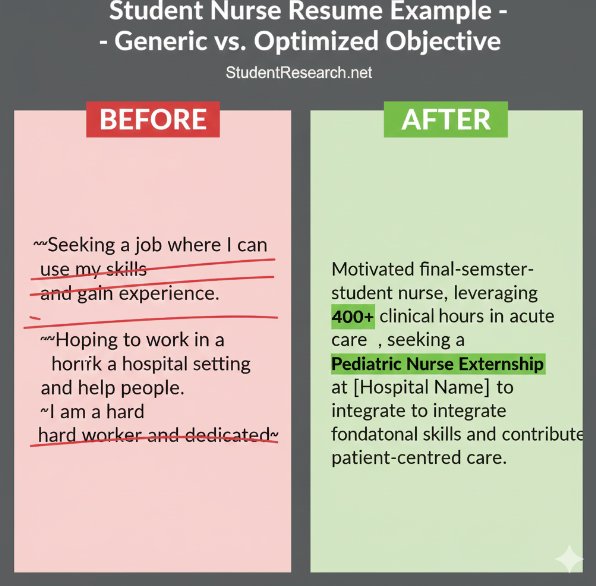
H3: Mistake 1: The “Me, Me, Me” Focus (Reasons for Failure)
This is the most frequent error: writing an objective solely focused on the applicant’s needs. If your objective heavily uses phrases like “to gain experience” or “to meet clinical hours,” you are failing to market your value.
- The Fix: Shift the focus from gaining to contributing. Instead of “To gain experience in the NICU,” write, “To apply current knowledge of infant care and family support to contribute to positive outcomes in the NICU.”
Mistake 2: The Generic Copy-Paste Problem
Using the same objective for every single application is a guaranteed way to fail the ATS check and show a lack of effort to the human reviewer. Generic objectives are immediately recognized as low-effort.
- The Fix: Always tailor the objective by explicitly naming the specific unit, the facility, or the patient population mentioned in the job post. Customization is the fastest way to signal genuine interest.
Mistake 3: What Does Overuse of Abstract Nouns Mean?
Recruiters are tired of seeing words like “dedicated,” “professionalism,” and “excellence.” While these qualities are important, they are subjective and do not explain what you can actually do.
- The Fix: Replace abstract nouns with measurable skills. Instead of saying you have “great professionalism,” state that you utilize “adherence to ethical standards and strict HIPAA protocols.”
Need absolute proof that your paper will be perfect? Check out the free sample work portfolio at StudentResearch.net! Our portfolio showcases the exceptional quality of our academic essays and reports, allowing you to make a confident, informed decision before you ever pay a dime.
H3: Mistake 4: Punctuation and Grammar Errors: Why Is This Critical?
Errors in your objective—the first paragraph a recruiter reads—signal a critical lack of detail that is unacceptable in a patient-care environment. If you can’t proofread three lines of text, how can you be trusted with medication calculations?
- The Fix: Proofread your objective three times. Read it backward to catch spelling errors, and ask a peer to review it for flow and punctuation.
Guide to Resume Architecture: Placing the Objective in Context
The objective is just one piece of the puzzle; its true power comes from its location and its synergy with the rest of your document. Strategic placement ensures the recruiter sees your strongest content first and immediately understands how the rest of your resume supports your claims.
Where Does the Objective Go? The Above-the-Fold Rule
In resume design, “above the fold” refers to the content visible without scrolling. The objective must be immediately prominent to maximize its impact.
- Placement: The objective should be the very first section of content on your resume, placed directly underneath your contact information (Name, phone, email, LinkedIn).
- Visual Weight: Ensure it is brief (two to three lines) and separated by clean white space to make it easily digestible for the hurried recruiter.
H3: Understanding Seamless Integration with Clinical Experience
Your objective sets up an expectation; the rest of your resume must deliver on that promise. A strong objective promises value and your clinical experience section proves competence.
- The Follow-Through: If your objective mentions “utilizing advanced assessment skills in an acute care setting,” your Clinical Experience section must immediately detail those specific rotations and the assessment tasks performed.
- Consistency: Use similar, reinforcing keywords in both the objective and the clinical descriptions to ensure the ATS scores the document highly for consistency.
How Do I Leverage Other Sections to Support the Objective?
Don’t overlook non-clinical sections—they can provide crucial proof points that strengthen the claims made in your objective.
- Certifications: Always list required certifications (BLS, ACLS, PALS) immediately. If your objective mentions patient safety, these certifications provide immediate proof.
- Volunteer Work: Use non-clinical volunteer roles to demonstrate soft skills cited in the objective, such as therapeutic communication, teamwork, or leadership.
- Academic Honors: Mention a high GPA or academic awards to reinforce a claim of being “highly analytical” or “detail-oriented” in the objective.
Need quick help with APA or MLA formatting and citation? Access our free Educational Resources and Guides! StudentResearch.net offers valuable writing tips, citation help, and academic support to instantly boost your own skills—no purchase required. Start improving your grades today
The Copy-Paste Vault: Examples of 10 Objectives to Deploy
To help you get started immediately, here is a vault of specialized student nurse resume objectives. Remember to always replace bracketed information ([Unit Name], [Hospital Name]) with your tailored details.
Examples of General Acute Care Objectives (2 Options)
- Option 1: Dedicated student nurse leveraging 400+ hours of Medical-Surgical experience, seeking a Clinical Residency at $$Hospital Name$$ to apply knowledge of pharmacology and EMR documentation while prioritizing patient safety and interdisciplinary collaboration.
- Option 2: Motivated final-semester student utilizing foundational critical thinking and therapeutic communication skills to support the Med-Surg team, contributing to efficient patient flow and quality outcomes.
Examples of Specializing in Women’s/Maternal Health (2 Options)
- Option 1: Compassionate student nurse seeking a Labor & Delivery Externship, prepared to apply specialized knowledge of fetal monitoring and family-centered care to support positive outcomes for mothers and infants at $$Facility Name$$.
- Option 2: To join the Women’s Health team at $$Clinic Name$$, utilizing strong health education and advocacy skills to facilitate preventative care and empower diverse patient populations toward better reproductive health.
Examples of Behavioral Health/Psychiatric Nursing (1 Option)
- Objective: Highly perceptive student nurse seeking a placement in Behavioral Health, prepared to utilize crisis intervention strategies and advanced therapeutic communication techniques to foster a safe, healing environment for patients struggling with acute mental illness.
Conclusion
Your student nurse resume objective is the difference between an interview invitation and the discard pile. It is your single most important tool for marketing your potential when you lack licensure. Do not treat it as a trivial opening line; treat it as your application’s mission statement. Master the 3-part formula to write a high-impact student nurse resume objective. By implementing this strategic approach—quantifying value, linking to the mission, and using active verbs—you will Pass the ATS and land your clinical placement with these examples! Take the time to tailor and perfect this critical section, and you will dramatically increase your chances of securing that vital clinical role. Now go update your resume and apply with confidence!

