

The journey from student to registered nurse is defined by continuous learning, and mastering the art of clinical reflection is the single most powerful tool in your arsenal. While technical skills are essential, the ability to analyze and learn from every clinical experience is what truly separates a novice from a highly professional nurse. This essential guide is focused on providing practical student nurse reflection examples and troubleshooting tips to break down the complex reflective process and ensure you not only meet academic requirements but excel in your practice.
Why is Reflection Important for Nursing Students?
While clinical reflection might seem like just another required academic assignment, it is truly the bedrock of lifelong professional development and critical thinking in healthcare. This section lays the groundwork by exploring the essential role reflection plays, setting the stage for the practical student nurse reflection examples we will explore later in the guide.
What is Clinical Reflection? Definition and Role
Before diving into effective examples, it is crucial to establish a common, analytical understanding of what true clinical reflection entails—it is far more than simply journaling about your shift.
- Steps to Move Beyond the Diary Entry
- Reflection is a structured, analytical process of reviewing a clinical event to understand the underlying causes and long-term implications.
- It requires honest self-assessment, critical analysis of one’s actions, and linking practice to established theory or evidence-based guidelines.
- The ultimate goal is professional transformation: turning a simple experience into actionable, codified professional knowledge.
- Reasons for The High-Stakes Mandate
- Academic Grading: University and college programs heavily weight reflective essays as the primary proof of your critical thinking and ability to synthesize knowledge.
- Competency Sign-offs: Demonstrating the ability to reflect on, assess, and improve performance is often required by clinical mentors to sign off on specific skills or overall placement competencies.
- Professional Registration: Regulatory bodies (such as the NMC, or local nursing boards) require ongoing, recorded reflective practice as a core standard for maintaining fitness to practice throughout your career.
- Continuous Improvement: Reflection builds emotional and clinical resilience and ensures you learn definitively from both mistakes and successes, making you a safer and more effective nurse.
Troubleshooting: Why Isn’t Meaningful Reflection Working?
Many students find themselves hitting the same wall: their reflections sound generic, lack depth, or simply don’t earn the highest marks. The reason is often rooted in three common, yet solvable, psychological and analytical barriers that prevent true critical engagement. By addressing these foundational issues, you can unlock the power of genuine self-assessment and turn mediocre reflections into powerful learning documents.
Fixing The Fear of Admitting Mistakes
It’s a natural human response to shy away from documenting errors, especially when a grade is on the line, but reflection must embrace failure as the most fertile ground for learning.
- Understanding The “Blame” vs. “Learning” Mindset (H4)
- The Blame Trap: Focusing on who was responsible, or external factors like “the environment was too busy” or “the shift was understaffed.”
- The Learning Focus: Redirecting the narrative to what you could have controlled and how your reaction influenced the outcome.
- Phrase Shift: Instead of saying “I forgot,” say “My organization of the trolley did not support timely task completion, indicating a need for better pre-shift planning.”
- Reflection is a safe, confidential academic space to document vulnerability and growth, not a performance review for termination.
Worried about essay privacy? Never compromise your academic journey. At StudentResearch.net, your personal information and order details are shielded by secure payment systems and top-tier data encryption. Get expert help with complete confidence and privacy protection
Fixing Getting Stuck in Description
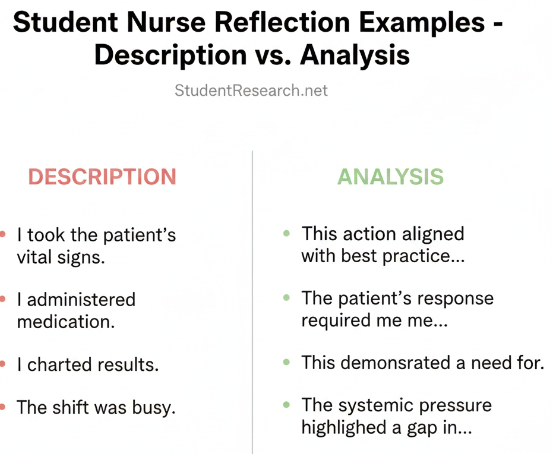
The most frequent mistake students make is writing an essay that reads like a simple handover or a diary entry detailing what they saw rather than what they thought.
- Difference Between Description and Analysis
- Description (Low Mark): “I took the patient’s vital signs, administered medication, and charted the results.” (A simple sequence of events.)
- Analysis (High Mark): “The patient’s BP spiked after the medication administration. This required an immediate assessment of potential side effects, linking the clinical presentation to pharmacological theory (Drug X’s mechanism of action).” (Linking action to knowledge.)
- Critical Inquiry: Ask why you chose a specific action, why the outcome occurred, and what evidence supports or refutes your intervention.
How to Develop Emotional Literacy in Reflections
Clinical events are inherently emotional, but your feelings must be processed professionally and connected back to your professional role and ethical responsibility.
- Ways to Name and Process Feelings Professionally (H4)
- Move beyond vague terms like ‘stressed’ or ‘sad,’ and use professional terminology.
- Employ terms such as moral distress, ethical anguish, compassion fatigue, or overwhelming responsibility.
- Analyze the emotion’s source: “My feeling of moral distress stemmed from witnessing a breakdown in patient autonomy, which conflicts directly with the NMC Code of Conduct (2018).”
- Use the feeling as a starting point for the Analysis section, not the end point of the Feelings section.
4 Examples of Student Nurse Reflection Prompts
Knowing what happened is one thing; knowing what to reflect on is another. These four essential prompts cover the most valuable learning experiences in a clinical setting, providing a powerful structure you can adapt for your own assignments.
How to Reflect on Unexpected Patient Interactions
Dealing with a patient or family member who questions your knowledge can be intimidating, but it offers rich material for reflection on communication, confidence, and delegation.
- Scenario: A patient or family member challenges your knowledge or care.
- Focus Example
- Description: An experienced family member questioned the timing and route of a pain medication you were preparing.
- Analysis: Why did I feel defensive? Was my knowledge base on this specific drug administration protocol sufficiently robust?
- Learning Outcome: Identifying knowledge gaps in pharmacology and recognizing the importance of therapeutic communication when dealing with anxious relatives.
Need more than just an essay? StudentResearch.net offers comprehensive academic support for every stage of your nursing program. From research papers and critical case studies to editing your final dissertation, we cover it all. Get the specialized writing assistance you need today!
Guide to Reflecting on Inter-Professional Conflict
Healthcare is teamwork, and breakdowns in communication between different professions are unfortunately common. Reflecting on these moments is crucial for developing advocacy and collaborative skills.
- Scenario: Witnessing or participating in a breakdown of communication within the Multi-Disciplinary Team (MDT).
- Focus Example
- Evaluation: What communication tool (e.g., SBAR, closed-loop) could have prevented the ambiguity? What role did professional hierarchy play in the reluctance to question the instruction?
- Learning Outcome: Analyzing communication styles and learning to respectfully escalate conflicts or seek clarification while maintaining professional conduct.
How to Reflect on Traumatic/Emotional Moments
Nursing inevitably involves exposure to high-stress, traumatic, or highly emotional situations. Reflecting on these is essential for building long-term emotional resilience and preventing burnout.
- Scenario: A particularly traumatic or emotionally draining clinical moment (e.g., end-of-life care, unexpected code blue).
- Focus Example (H4)
- Feelings/Analysis: Connecting your feelings (e.g., moral anguish, inadequacy) to the importance of psychological safety and debriefing.
- Learning Outcome: Developing resilience and implementing self-care strategies, such as post-shift debriefing with a mentor or utilizing hospital support services.
Reflecting on Successful Skill Acquisition
Reflection is not just for mistakes; successful moments offer valuable insights into why something worked, allowing you to replicate competency and confidence.
- Scenario: A moment where you competently delivered a new or complex skill (e.g., IV insertion, complex wound dressing).
- Focus Example (H4)
- Evaluation: Which preparatory steps, mental rehearsal techniques, or environmental factors (e.g., patient positioning, mentor support) led to the successful outcome?
- Conclusion: Defining competency not just as task completion, but as the integration of knowledge, skill, and appropriate patient interaction.
- Learning Outcome: Identifying transferable skills (e.g., effective patient teaching, excellent pain management) that contributed to the procedural success.
How to Elevate Your Grade: Linking Practice to Evidence
The difference between a passing reflection and one that earns top marks is the critical link between your personal experience and external, authoritative sources. This is where you prove you are thinking like a professional, using literature, policy, and ethical frameworks to analyze your actions.
Ways to Use Professional Language (Criticality Vocabulary)
Your choice of words should signal to the reader that you have moved past the descriptive stage and are now engaging in high-level critical analysis.
- Vocabulary for Criticality (H4)
- Connectors: Use phrases like “Consequently,” “In contrast to,” “Furthermore,” and “This highlights the necessity of…”
- Analytical Verbs: Employ terms such as “demonstrates,” “validates,” “mitigates,” “conforms,” “deviates,” or “substantiates.”
- Avoid: Phrases like “I think,” “I guess,” or “maybe.” Use assertive, evidence-based language.
Why Integrate Literature and Policy (The “Why” Behind the “What”)
Every action in healthcare is governed by a standard, a policy, or a theory, and your reflection must prove you recognize and adhere to these professional frameworks.
- The “Why” Behind the “What”
- Supporting Analysis: If you discuss a communication failure, cite a study on communication breakdowns or reference the SBAR framework.
- Ethical Frameworks: If you faced a dilemma, reference the four main ethical principles (Autonomy, Beneficence, Non-Maleficence, Justice) or your regulatory body’s Code of Conduct.
- The Professional Imperative: Citing policy or literature transforms your personal learning into a professionally validated conclusion, which is the hallmark of advanced reflection.
Steps to Document Professional Growth: The Action Plan
A reflection is incomplete—and ultimately useless—without a clear, measurable plan for future practice. The Action Plan is your commitment to ensuring the lesson you learned today is successfully applied tomorrow.
Guide to The Action Plan Checklist (Making it Measurable)
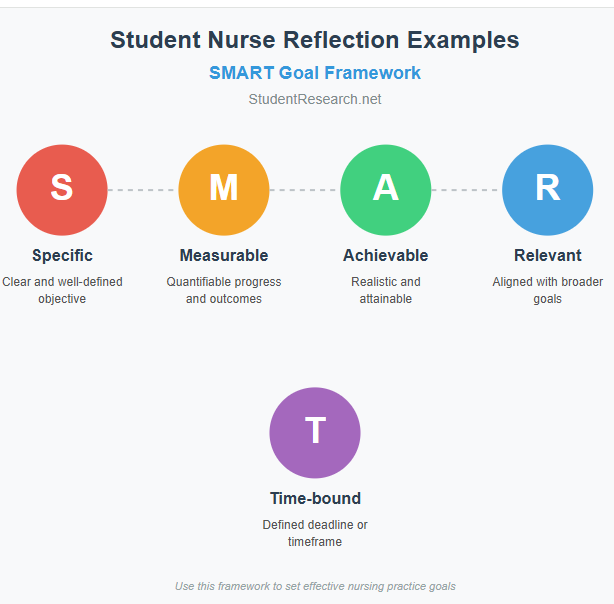
Ensure your goals are not vague hopes, but SMART commitments that you can track and evaluate in your next clinical placement.
- Defining Success
- Weak Goal: “I will be more confident when talking to doctors.”
- SMART Goal: “I will utilize the SBAR communication framework during three handover reports this week, recording verbal feedback from the nurse receiving the report to assess clarity.”
- Measurable Results: Your goal must define what evidence you will gather (e.g., feedback score, successful completion rate, documented research notes) to prove improvement.
The Feedback Loop: Using the next placement/shift to implement and review the goal
- The reflection process is cyclical: the Action Plan from one reflective piece becomes the “Description” or “Success/Failure” of your next.
- Always begin a new reflection by reviewing whether your previous Action Plans were successfully implemented and how they impacted the new experience.
Conclusion: The Continuous Cycle of Nursing Growth
Reflection is the defining activity of a professional nurse, ensuring continuous mastery of the profession. You now have the tools needed to master clinical reflection! This guide has provided expert student nurse reflection examples, troubleshooting tips, and 4 essential prompts to help you effectively link clinical practice to theory, transforming every shift into professional growth.
Final Takeaways for the Student Nurse
- Reiterate that structured reflection is the currency of professional practice, allowing you to continually assess and elevate your standards of care.
- Encourage honesty and vulnerability in the writing process; the most critical reflections lead to the most valuable learning.
- The Action Plan is the most important part—it proves that your reflection isn’t a dead-end assignment but the starting point for growth.
- Call to action: Share your biggest reflection challenge or the framework you prefer in the comments below!

