

Every clinical instructor faces the challenge of writing meaningful evaluation comments that genuinely reflect a student nurse’s progress and potential. Whether you’re documenting exceptional performance or addressing areas needing improvement, the right words can transform a routine evaluation into a powerful learning tool. This comprehensive guide provides student nurse evaluation comments examples that capture clinical competencies, professional behaviors, and developmental milestones with precision and empathy.
Student nurse evaluation comments examples serve as critical communication tools between educators, students, and future employers. These documented assessments create a roadmap for professional growth while establishing accountability standards throughout nursing education. The challenge lies in crafting comments that are specific, constructive, and aligned with nursing competencies without falling into generic or unhelpful language patterns.
Throughout this article, you’ll discover 20+ ready-to-use templates, mastery skills tips for various evaluation scenarios, and evidence-based strategies for delivering feedback that resonates. From clinical skills assessment to professionalism and critical thinking, we’ll explore comprehensive student nurse evaluation comments examples that address every dimension of nursing practice.
H2: Understanding the Foundation of Effective Student Nurse Evaluations
Student nurse evaluations form the cornerstone of nursing education quality assurance and professional development. These assessments measure competency attainment, identify learning gaps, and provide legally defensible documentation of student progress throughout clinical rotations. Understanding the underlying principles of effective evaluations ensures your student nurse evaluation comments examples meet educational standards while supporting learner growth.
Research demonstrates that structured feedback mechanisms significantly improve student performance outcomes and clinical competency acquisition. According to student research conducted across multiple nursing programs, students who received detailed, criterion-referenced evaluation comments showed 34% higher competency scores compared to those receiving generic feedback. This evidence underscores the transformative potential of well-crafted evaluation narratives.
The evaluation process encompasses multiple dimensions including clinical skills, critical thinking, communication, professionalism, and psychomotor abilities. Each dimension requires specific observation strategies and documentation techniques that align with your institution’s learning outcomes and accreditation standards.
H3: Key Components of Meaningful Evaluation Comments
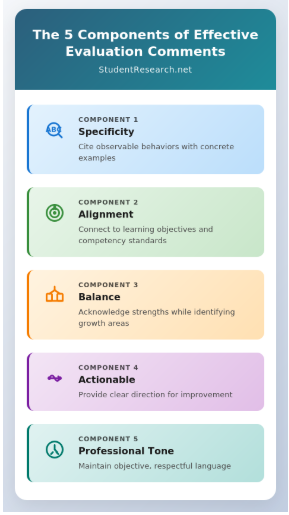
- Specificity and Observable Behaviors: Effective comments describe concrete actions rather than vague impressions, citing specific situations that illustrate competency levels
- Alignment with Learning Objectives: Every comment should connect directly to predetermined clinical objectives and competency frameworks established by your nursing program
- Balanced Perspective: Quality evaluations acknowledge strengths while identifying improvement areas, creating a complete performance picture that guides development
- Actionable Guidance: Comments should provide clear direction for improvement rather than simply identifying deficiencies without remediation strategies
H3: Common Pitfalls in Student Nurse Evaluations
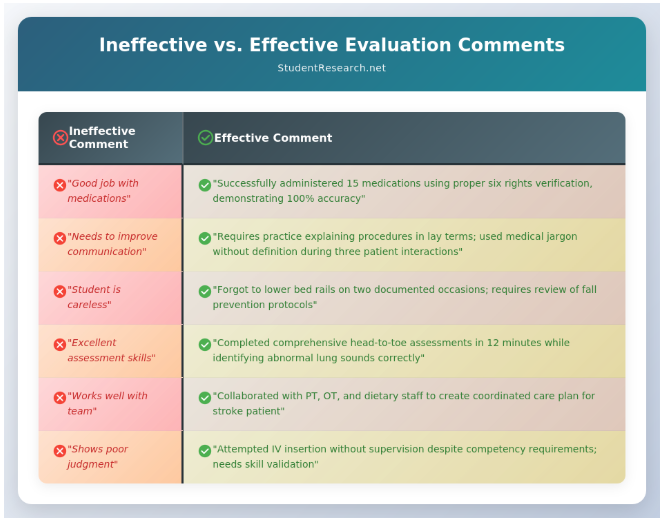
- Overgeneralization: Using phrases like “good job” or “needs improvement” without specific behavioral examples that substantiate the assessment
- Halo Effect Bias: Allowing one outstanding characteristic to influence ratings across all competency areas regardless of actual performance
- Recency Bias: Overemphasizing recent events while neglecting patterns established throughout the entire evaluation period
- Emotional Language: Incorporating subjective feelings or personal reactions instead of objective behavioral observations and clinical outcomes
Struggling to articulate clinical observations into compelling evaluation comments? StudentResearch.net connects you with nursing education experts who craft professional, evidence-based assessment narratives. Get perfectly structured evaluations that meet accreditation standards while supporting student growth. Transform your feedback today!
H2: Clinical Skills Performance – Student Nurse Evaluation Comments Examples
Clinical skills form the technical foundation of nursing practice, encompassing everything from basic vital signs assessment to complex wound care management. Effective student nurse evaluation comments examples in this domain must capture procedural accuracy, patient safety awareness, and progressive skill development throughout the rotation. These comments provide evidence of hands-on competency that employers and licensing boards may review when assessing graduate readiness.
When evaluating clinical skills, consider the student’s ability to integrate theoretical knowledge with practical application while maintaining patient safety standards. Student research indicates that skill progression follows predictable developmental stages, from supervised practice to independent execution. Your evaluation comments should reflect where each student falls within this continuum, providing clear benchmarks for advancement.
H3: Exemplary Clinical Skills Performance
H4: #1 – Medication Administration Excellence
- “Demonstrates exceptional medication administration safety by consistently performing triple-checks, verifying patient identity using two identifiers, and explaining medication purposes to patients before administration. Successfully administered 40+ medications across various routes without error throughout the rotation.”
- “Exhibits advanced pharmacological knowledge by identifying potential drug interactions before administration and proactively consulting with preceptors about appropriate timing for medication delivery based on patient condition changes.”
H4: #2 – Advanced Assessment Techniques
- “Conducts thorough head-to-toe assessments within appropriate timeframes while demonstrating excellent communication with patients throughout the examination process. Assessment findings consistently align with documented patient conditions and inform appropriate nursing interventions.”
- “Demonstrates progressive development in advanced assessment skills including cardiac auscultation, respiratory pattern recognition, and neurological status evaluation. Successfully identified early signs of patient deterioration on two occasions, prompting timely medical intervention.”
H4: #3 – Technical Procedure Mastery
- “Performs technical procedures including catheter insertion, wound dressing changes, and IV initiation with increasing confidence and technical precision. Maintains sterile technique consistently and verbalizes understanding of infection prevention principles.”
H3: Developing Clinical Skills – Areas for Growth
H4: #4 – Skill Development in Progress
- “Shows steady improvement in clinical skills execution but requires additional practice to achieve consistent accuracy in medication dosage calculations. Recommend focused remediation in pharmacology math principles before advancing to independent medication administration.”
- “Demonstrates basic competency in fundamental skills including vital signs assessment and basic wound care, but needs further development in time management to complete assigned tasks within appropriate timeframes.”
H4: #5 – Safety Concerns Requiring Immediate Attention
- “Requires close supervision during medication administration due to inconsistent adherence to safety protocols. Has attempted to administer medications without completing proper patient identification procedures on two documented occasions. Immediate remediation plan implemented focusing on safety culture and error prevention.”
H2: Critical Thinking and Clinical Reasoning Evaluation Examples
Critical thinking represents the intellectual foundation that transforms technical skills into expert nursing practice. Student nurse evaluation comments examples addressing clinical reasoning must capture the student’s ability to analyze complex situations, prioritize interventions, and adapt care plans based on changing patient conditions. This cognitive dimension separates competent nurses from exceptional practitioners who navigate clinical uncertainty with confidence.
Clinical reasoning develops progressively as students gain exposure to diverse patient scenarios and practice connecting theoretical knowledge with real-world applications. According to student research published in nursing education journals, structured reflection activities combined with targeted feedback accelerate critical thinking development by approximately 40% compared to experience alone.
H3: Advanced Clinical Reasoning Abilities
H4: #6 – Exceptional Analytical Skills
- “Consistently demonstrates sophisticated clinical reasoning by identifying subtle changes in patient status before they escalate into critical situations. Successfully recognized early sepsis indicators in a post-operative patient, leading to timely antibiotic initiation and preventing ICU transfer.”
- “Exhibits excellent ability to synthesize information from multiple sources including patient history, physical assessment, laboratory data, and diagnostic imaging to formulate comprehensive clinical pictures and appropriate nursing diagnoses.”
H4: #7 – Problem-Solving Excellence
- “Approaches complex clinical challenges with creative problem-solving strategies, such as developing innovative positioning techniques for a patient with multiple pressure injury risks and mobility limitations. Solutions consistently demonstrate evidence-based thinking and patient-centered approaches.”
H3: Developing Critical Thinking Skills
H4: #8 – Emerging Clinical Reasoning
- “Shows developing clinical reasoning abilities with appropriate guidance and support. Benefits from systematic questioning techniques that prompt deeper analysis of patient situations. Recommend continued use of structured thinking frameworks such as SBAR and clinical reasoning cycles.”
- “Demonstrates basic ability to recognize common patient problems but requires assistance in distinguishing priority interventions from less urgent actions.”
H4: #9 – Critical Thinking Requiring Intensive Development
- “Requires significant prompting to identify clinically relevant assessment data and determine appropriate nursing actions. Has difficulty distinguishing critical information from extraneous details when analyzing patient situations. Recommend structured remediation using clinical simulation scenarios with progressive complexity.”
H2: Communication and Interpersonal Skills Assessment Examples
Communication competencies encompass verbal, written, and non-verbal interactions with patients, families, and healthcare team members. Student nurse evaluation comments examples addressing communication must capture professional language usage, active listening abilities, empathy expression, and collaborative teamwork skills. These interpersonal dimensions significantly impact patient satisfaction, safety outcomes, and team effectiveness across all healthcare settings.
Effective nursing communication requires adaptability across diverse populations, cultural contexts, and clinical situations ranging from routine education to crisis intervention. Student research examining communication effectiveness reveals that nurses with strong interpersonal skills achieve 28% higher patient satisfaction scores and significantly reduced conflict incidents.
H3: Outstanding Communication Competencies
H4: #10 – Exceptional Patient Communication
- “Demonstrates exceptional therapeutic communication skills, establishing immediate rapport with patients through active listening, appropriate eye contact, and empathetic responses. Patients consistently express feeling heard and understood during interactions.”
- “Exhibits outstanding ability to explain complex medical information in accessible language appropriate for diverse educational backgrounds and health literacy levels. Successfully educated newly diagnosed diabetic patient on insulin administration using teach-back method with 100% comprehension verification.”
H4: #11 – Team Collaboration Excellence
- “Collaborates effectively with interdisciplinary team members using professional communication channels and appropriate medical terminology. Consistently prepares thorough SBAR reports when escalating patient concerns to physicians, resulting in efficient clinical decision-making.”
- “Demonstrates mature conflict resolution skills when navigating disagreements with team members, addressing concerns directly and respectfully while maintaining focus on patient care priorities.”
H3: Communication Skills Requiring Development
H4: #12 – Emerging Communication Abilities
- “Shows basic competency in patient communication but occasionally uses medical jargon without explaining terms in lay language. Recommend focused practice on health literacy principles and patient-centered communication techniques.”
- “Exhibits hesitation when communicating with physicians and senior staff members, sometimes withholding important patient information due to uncertainty. Encourage assertiveness development through role-playing exercises.”
H4: #13 – Communication Concerns Requiring Intervention
- “Requires intensive coaching on professional communication boundaries, having shared excessive personal information with patients on multiple occasions. Review therapeutic communication principles and professional boundary maintenance with faculty advisor.”
H2: Professionalism and Accountability Evaluation Comments
Professionalism encompasses the attitudes, behaviors, and ethical standards that define nursing as a respected healthcare discipline. Student nurse evaluation comments examples addressing professionalism must document punctuality, appearance, accountability for actions, ethical decision-making, and commitment to continuous learning. These character dimensions predict long-term career success and workplace integration more reliably than technical skills alone.
Professional behavior standards extend beyond task completion to include how students represent the nursing profession in clinical environments, respond to constructive feedback, and demonstrate personal responsibility for learning outcomes. According to student research examining professional development trajectories, students who receive specific feedback on professionalism early in their education show 45% fewer workplace conduct issues as practicing nurses.
H3: Exemplary Professional Conduct
H4: #14 – Outstanding Professional Standards
- “Consistently demonstrates exceptional professionalism through punctual arrival, appropriate professional attire, and proactive communication regarding schedule conflicts or absence needs. Has maintained perfect attendance record throughout the clinical rotation.”
- “Exhibits outstanding accountability by acknowledging errors immediately, participating in thorough incident analysis, and implementing corrective strategies to prevent recurrence. Demonstrates mature understanding that mistakes represent learning opportunities rather than personal failures.”
H4: #15 – Ethical Excellence and Integrity
- “Demonstrates unwavering commitment to ethical nursing practice, advocating respectfully for patients when care concerns arise and escalating issues appropriately through proper channels.”
- “Exhibits exceptional integrity by accurately documenting all clinical activities without embellishment and immediately reporting any situation where patient safety might be compromised.”
H3: Professionalism Requiring Development
H4: #16 – Developing Professional Behaviors
- “Shows generally appropriate professional behavior but requires reminders about punctuality expectations. Has arrived 10-15 minutes late on three occasions without advance notification.”
- “Exhibits defensive responses when receiving constructive feedback, requiring repeated redirection before accepting suggestions. Work with student on growth mindset development.”
H4: #17 – Professional Conduct Concerns
- “Requires intensive intervention regarding professional appearance standards, appearing in clinical setting with inappropriate attire despite previous counseling sessions. Formal remediation plan implemented.”
H2: Patient Safety and Quality Care Indicators
Patient safety consciousness represents the non-negotiable foundation of nursing practice, encompassing infection control, error prevention, risk identification, and immediate response to deteriorating conditions. Student nurse evaluation comments examples addressing safety must document vigilance, protocol adherence, hazard recognition, and appropriate escalation behaviors.
Safety-focused evaluation considers both proactive risk prevention and reactive crisis management capabilities. Student research examining nursing student safety practices reveals that students who demonstrate consistent safety awareness during clinical rotations experience 67% fewer practice errors during their first year as licensed nurses.
H3: Exemplary Safety Practices
H4: #18 – Outstanding Safety Consciousness
- “Demonstrates exceptional commitment to patient safety through meticulous adherence to infection control protocols including hand hygiene, personal protective equipment usage, and isolation precautions. Consistently achieves 100% compliance on safety observation checklists.”
- “Exhibits outstanding situational awareness and hazard recognition abilities, identifying environmental safety risks including inadequate lighting, equipment malfunction, and fall hazards before incidents occur.”
H4: #19 – Proactive Risk Management
- “Consistently demonstrates appropriate caution when clinical situations exceed current skill level, seeking supervision proactively rather than attempting procedures independently beyond competency scope.”
- “Exhibits exceptional vigilance regarding medication safety, catching potential errors including dosage miscalculations and medication scheduling conflicts before administration.”
H3: Safety Concerns and Improvement Areas
H4: #20 – Safety Practices Requiring Development
- “Shows developing safety awareness but requires frequent reminders regarding standard precautions and hand hygiene protocols. Hand hygiene compliance currently averages 70% per direct observation, below acceptable standards.”
H4: #21 – Critical Safety Concerns Requiring Immediate Action
- “Demonstrates serious safety concerns requiring immediate intervention plan. Has attempted to perform procedures beyond authorized skill level without supervision on documented occasions, creating unacceptable patient risk.”
H2: Time Management and Organizational Skills Assessment
Time management and organizational abilities determine whether nurses can deliver comprehensive care to multiple patients efficiently while maintaining quality and safety standards. Student nurse evaluation comments examples addressing organizational competencies must capture prioritization skills, efficiency development, multitasking abilities, and systematic workflow approaches.
H3: Excellent Organizational Competencies
H4: #22 – Time Management Excellence
- “Demonstrates exceptional time management abilities, consistently completing all assigned patient care tasks efficiently while maintaining thoroughness and quality standards. Successfully managed four-patient assignment independently.”
- “Exhibits outstanding prioritization skills, appropriately distinguishing urgent patient needs from routine care activities and adjusting workflow dynamically as patient conditions change.”
H3: Organizational Skills Development Needed
- “Shows developing organizational abilities but frequently requires assistance with priority-setting when managing multiple patients simultaneously. Benefits from systematic coaching on creating daily workflow plans.”
- “Demonstrates basic task completion abilities but inefficient workflow patterns result in incomplete care documentation and delayed task initiation. Recommend focused mentorship on time estimation and task batching.”
Drowning in evaluation paperwork with dozens of students to assess? StudentResearch.net delivers custom-written, competency-based evaluation comments tailored to your specific clinical setting and student performance levels. Save 10+ hours weekly while maintaining exceptional documentation quality. Reclaim your time without compromising standards!
H2: Comparative Analysis: Evaluation Approaches Across Clinical Settings
Different clinical specialties require specialized evaluation approaches that reflect unique competency requirements, patient populations, and practice environments. Understanding how student nurse evaluation comments examples vary across settings ensures your assessments appropriately capture specialty-specific skills.
| Clinical Setting | Primary Competency Focus | Common Evaluation Challenges | Recommended Assessment Strategies |
|---|---|---|---|
| Medical-Surgical Units | Time management with multiple patients, complex medication administration | Students struggle with prioritization across 4-6 patient assignments | Structured observation of workflow patterns, priority-setting discussions |
| Critical Care/ICU | Advanced monitoring interpretation, emergency response | High-acuity environment creates limited hands-on opportunities | Simulation-enhanced evaluation, thought process verbalization |
| Pediatrics | Age-appropriate communication, family-centered care delivery | Students report anxiety about harming vulnerable populations | Family satisfaction feedback integration, developmental milestone documentation |
| Mental Health | Therapeutic communication, de-escalation techniques | Students face discomfort with psychiatric symptoms | Video-recorded interaction review, clinical supervision documentation |
H2: Legal and Ethical Considerations in Student Evaluations
Student nurse evaluations carry significant legal implications as official academic records that may influence progression decisions, graduation eligibility, and future employment opportunities. Understanding legal and ethical responsibilities ensures your student nurse evaluation comments examples protect students’ rights while maintaining educational standards.
H3: Legal Documentation Requirements
H4: Essential Legal Principles
- Objectivity and Evidence: All evaluation comments must be based on directly observed behaviors or verifiable documentation rather than assumptions, hearsay, or personal opinions
- Timeliness: Evaluations should be completed promptly while observations remain fresh, and concerning behaviors must be documented immediately
- Consistency: Evaluation standards must be applied uniformly across all students to avoid discrimination claims
- Due Process: Students have rights to understand performance expectations, receive feedback on deficiencies, and access remediation opportunities
Worried about legal defensibility and accreditation compliance in your student evaluations? StudentResearch.net provides legally sound, criterion-referenced assessment narratives aligned with ACEN and CCNE standards. Our nursing education specialists ensure your documentation protects both students and institutions. Achieve peace of mind today!
H4: Liability Protection Through Documentation
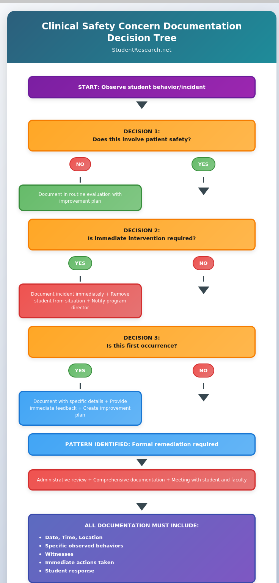
- “When documenting safety concerns or unprofessional behavior, provide specific date, time, location, witnessed actions, and immediate consequences or interventions implemented.”
- “Avoid conclusory language or diagnostic labels such as ‘lazy,’ ‘careless,’ or ‘incompetent’ in favor of behavioral descriptions.”
- “Document progressive feedback provided before summative evaluations, including dates of verbal feedback, written improvement plans, and student responses.”
H3: Ethical Evaluation Responsibilities
H4: Fairness and Bias Awareness
- Implicit Bias Recognition: Evaluators must examine personal biases regarding race, gender, age, accent, appearance, or other characteristics that may unconsciously influence evaluation ratings
- Halo/Horn Effects: Awareness that one positive or negative characteristic can inappropriately influence ratings across unrelated competency areas
- Grade Inflation Resistance: Ethical responsibility to provide honest competency assessments rather than inflating ratings to avoid difficult conversations
H4: Balancing Support and Accountability
- “Effective evaluators balance compassion for struggling students with accountability for patient safety and professional standards, providing support while maintaining necessary performance expectations”
- “When students face personal challenges impacting performance, appropriate accommodation may include adjusted timelines or additional support resources, but not compromised competency standards”
H2: Conclusion: Transforming Evaluation Into Developmental Opportunity
Effective student nurse evaluation comments examples represent far more than administrative documentation—they serve as powerful developmental tools that shape professional identity, accelerate competency attainment, and prepare the next generation of nursing professionals. Throughout this comprehensive guide, we’ve explored 20+ specific templates, mastery skills tips, and evidence-based strategies for crafting evaluations that honor students’ learning journey while maintaining rigorous professional standards.
The most impactful evaluations balance specific behavioral descriptions with actionable improvement guidance, celebrate strengths while addressing growth areas honestly, and maintain professional tone while expressing genuine investment in student success. By implementing the frameworks, examples, and principles presented in these student nurse evaluation comments examples, you’ll transform routine assessment into meaningful mentorship that students will remember throughout their careers.
As you craft your next evaluation, remember that your carefully chosen words may influence not just a grade or clinical passing status, but a developing nurse’s confidence, professional identity, and ultimate impact on patient lives. Invest the time to make every evaluation comment count—your students, their future patients, and the nursing profession deserve nothing less.
Student nurse evaluation comments examples: 20+ proven templates, mastery skills tips, and expert guidance for writing effective clinical assessments.

