

Entering the world of nursing education is as exhilarating as it is demanding, often leaving students feeling overwhelmed by the sheer volume of clinical and academic requirements. To navigate this journey successfully, mastering smart goals for nursing students is the most effective way to transform a daunting syllabus into a series of manageable victories. A SMART goal is a structured framework that ensures your objectives are clear, reachable, and trackable, rather than vague aspirations.
By implementing this system, you provide yourself with a roadmap that reduces stress and enhances your focus on what truly matters: becoming a competent, compassionate healthcare professional. Establishing these goals early on is not just about passing exams; it is about building the discipline and professional habits required for a lifelong career in nursing.
1. What is a SMART Goal? Definition and Importance in Nursing
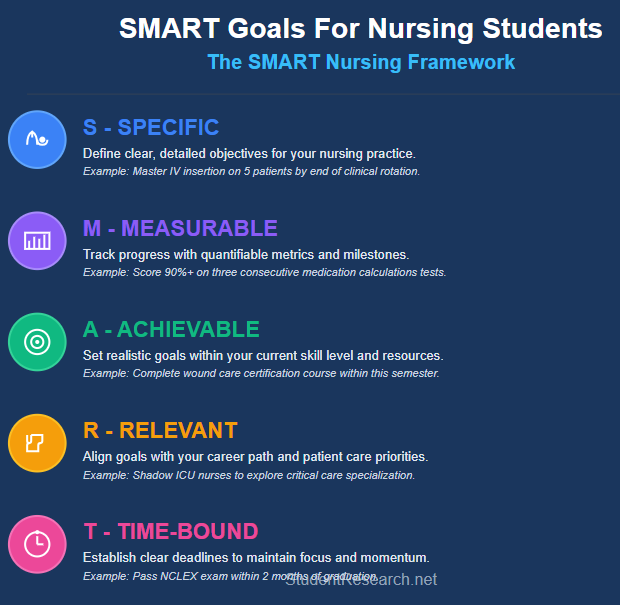
Understanding the SMART Framework for Students
- Specific: You must define exactly what you want to accomplish to avoid ambiguity in your busy schedule.
- Measurable: Every goal needs criteria to track progress and stay motivated throughout the semester.
- Achievable: Ensure your goals are realistic based on your current resources and time constraints.
- Relevant: Your objectives should align with your ultimate desire to provide excellent patient care and pass the NCLEX.
- Time-bound: Every goal requires a deadline to create a sense of urgency and prevent procrastination.
Brilliant Way #1: Use Specificity to narrow your clinical focus
- Identify a specific clinical skill, such as “performing a sterile dressing change,” rather than a vague goal like “getting better at clinicals”.
- Specify the exact patient population or department you want to master during your current rotation.
- Draft a written statement that outlines who is involved and what you specifically want to achieve by the end of the week.
Why is Goal Setting Important for Future Nurses?
- Prioritization: It helps you distinguish between urgent tasks and those that can wait, which is a vital skill in a hospital setting.
- Confidence Building: Meeting small, incremental goals builds the self-efficacy needed for high-stakes clinical environments.
- Professional Accountability: Learning to set and meet goals now prepares you for the rigorous standards of nursing practice.
Brilliant Way #2: Create Measurable benchmarks to track academic progress
- Quantify your study goals by aiming for a specific percentage on practice quizzes, such as scoring 85% or higher.
- Track the number of hours spent on focused, undistracted study sessions each week.
- Use a digital tracker or journal to log your progress toward completing comprehensive care plans.
Brilliant Way #3: Steps to set Achievable and realistic expectations
- Break down large projects, like a capstone or research paper, into smaller, bite-sized tasks.
- Evaluate your weekly calendar to ensure your study goals do not conflict with necessary rest or clinical shifts.
- Consult with faculty or peers to confirm if your timeline for mastering a new skill is realistic.
Brilliant Way #4: Aligning Relevant goals with healthcare values
- Ensure your personal learning goals reflect core nursing values of patient safety and evidence-based practice.
- Connect your academic milestones to your long-term career vision, such as becoming a specialized NP or ICU nurse.
- Focus on goals that improve your ability to communicate effectively with a diverse patient demographic.
Brilliant Way #5: How do I set effective Time-bound deadlines?
- Assign a hard deadline for every task, even those that do not have a formal due date from your instructor.
- Use the “backward planning” method by starting with your exam date and working backward to schedule study milestones.
- Set a timer for study intervals, like the Pomodoro technique, to ensure you remain productive within your time limits.
2. Ways to Achieve Academic Excellence: Mastering Theory and Exams
Success in nursing school requires more than just hard work; it demands a strategic approach to absorbing massive amounts of complex information. To truly excel, students must move beyond rote memorization and embrace active learning techniques that foster long-term retention. By applying smart goals for nursing students to your study habits, you can transform your academic performance and approach every exam with a sense of calm authority.
Guide to Preparing for the NCLEX from Day One
- Start by familiarizing yourself with the NCLEX-RN test plan to understand the categories of client needs.
- Dedicate a specific portion of your weekly study time to answering practice questions that mimic the exam’s format.
- Review the rationales for both correct and incorrect answers to strengthen your clinical reasoning.
- Focus on mastering safety and infection control principles, as these are heavily weighted on the licensure exam.
Brilliant Way #6: Integrating NCLEX-style questions into daily study
- Commit to completing a set number of practice questions, such as 15 to 20, every single day.
- Use mobile apps to answer questions during short breaks or commute times to maximize efficiency.
- Categorize your practice sessions by subject area to identify and improve your weakest knowledge points.
Best Ways to Improve Your Nursing Grade Point Average (GPA)
- Create a consistent study schedule that prioritizes your most difficult subjects when your energy levels are highest.
- Form or join a focused study group to gain different perspectives on challenging clinical concepts.
- Attend all professor office hours to clarify misunderstandings before they impact your exam scores.
- Utilize active note-taking methods, such as the Cornell system, to better organize lecture material.
Tired of surface-level citations? At StudentResearch.net, we don’t use basic sources. Our professional writers access proprietary databases and peer-reviewed academic journals to ensure your nursing papers are backed by the most rigorous, high-level evidence-based research available.
Benefits of active recall and spaced repetition for exams
- Active Recall: Force your brain to retrieve information from memory rather than just re-reading your textbook.
- Spaced Repetition: Review material at increasing intervals to move information from short-term to long-term memory.
- Self-Testing: Use flashcards or blank-sheet brain dumps to verify what you actually know versus what you recognize.
Elevate Your Grade Profile
Is your GPA stuck in neutral? Let StudentResearch.net help you reach the finish line. Our goal is to craft bespoke academic work that earns you the top marks you need to stay competitive in your nursing career.
Understanding Complex Pathophysiology Concepts Explained
- Break down diseases into their cellular origins to understand how they affect the body as a whole.
- Use visual aids like flowcharts and diagrams to map out the progression of specific conditions.
- Relate pathophysiological changes to the clinical manifestations you observe in your patients.
- Focus on the “why” behind every symptom to ensure you can explain the disease process to others.
3. How to Develop Clinical Competence and Practical Skills
Transitioning from the classroom to the hospital floor is often the most intimidating part of the nursing journey. However, by setting clear objectives for your rotations, you can bridge the gap between theory and practice while ensuring patient safety remains your top priority.
Steps to Building Confidence in Patient Assessment
- Practice your assessment techniques on peers or family members to get comfortable with the physical movements.
- Develop a systematic “head-to-toe” routine so you never miss a vital observation during a shift.
- Learn to trust your intuition by comparing your findings with the patient’s baseline data.
- Ask for immediate feedback from your clinical instructor after performing an assessment to refine your skills.
Brilliant Way #7: Mastering the head-to-toe assessment flow
- Memorize a standard sequence, starting with the neurological status and ending with the skin integrity of the lower extremities.
- Keep a small “cheat sheet” in your pocket to remind you of specific system checks during high-stress moments.
- Narrate your actions to the patient to build rapport and ensure you are being thorough.
Importance of Accuracy in Medication Administration
- Always adhere to the “Rights” of medication administration: right patient, drug, dose, route, time, and documentation.
- Minimize distractions in the medication room to prevent potentially fatal errors.
- Educate yourself on the mechanism of action and side effects of every drug before you administer it.
- Verify high-alert medications with a second licensed nurse to ensure maximum safety.
Brilliant Way #8: Troubleshooting and reducing dosage calculation errors
- Double-check every math calculation using a consistent formula, such as dimensional analysis.
- Use a calculator for every step, even for simple addition, to avoid mistakes caused by fatigue.
- Practice “back-of-the-envelope” estimations to ensure your calculated dose looks correct before proceeding.
Tips to Learn Technical Skills Like IV Starts and Wound Care
- Watch expert nurses perform the skill several times before attempting it under supervision.
- Volunteer for every opportunity to perform a technical skill, even if it makes you nervous.
- Review the hospital’s policy and procedure manual for specific equipment guidelines before use.
- Focus on maintaining a sterile field as your primary goal during invasive procedures.
4. Guide to Time Management: Balancing Life and Clinicals
Managing a nursing schedule requires the precision of a triage nurse, as you must juggle intense academic requirements alongside physically demanding shifts. By applying smart goals for nursing students, you can move from a state of constant “firefighting” to a structured routine that respects both your professional ambitions and your personal life.
Difference Between Clinical Rotations and Lecture Schedules
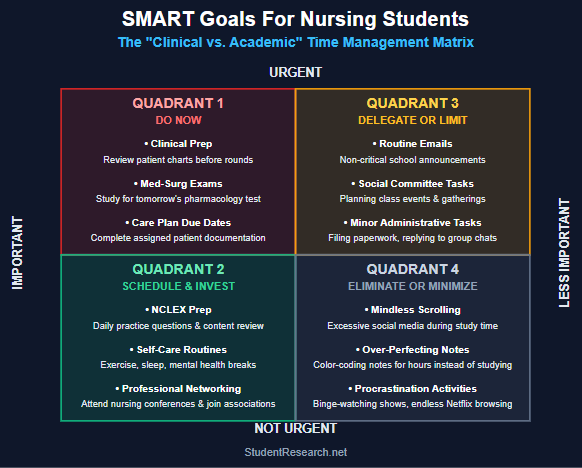
- Clinical Rotations: These involve hands-on patient care in hospital settings, often requiring 8 to 12 hours of standing, documentation, and real-time critical thinking.
- Lecture Schedules: These are structured classroom sessions focused on theory, pharmacology, and pathophysiology, requiring high levels of seated concentration.
- The Balancing Act: Successful students treat clinical days as professional work shifts and lecture days as academic deep-dives.
Brilliant Way #9: Utilizing a “Master Calendar” for clinical rotations
- Map out every clinical site, department, and start time at the beginning of the semester to visualize your “on-duty” days.
- Include travel time and post-shift recovery periods to ensure you are not over-scheduling yourself after long rotations.
- Use color-coding to distinguish between hospital hours, lecture times, and mandatory lab simulations.
Ways to Successfully Complete Nursing Care Plans
- Start your research while still at the clinical site by gathering as much relevant patient data as possible from the chart.
- Use standardized nursing taxonomies (NANDA-I, NIC, NOC) to ensure your language is professional and accurate.
- Schedule specific blocks of time, ideally 48 hours before the due date, to synthesize your data into a cohesive plan.
Brilliant Way #10: Steps to breaking down complex documentation tasks
- Divide the care plan into sections: Assessment, Diagnosis, Planning, Implementation, and Evaluation.
- Focus on completing one section at a time to prevent the feeling of being overwhelmed by the total document length.
- Review your pathophysiology links first, as they often form the foundation for the rest of your nursing interventions.
Which Productivity Tools are Better for Nursing Students?
- Digital Planners: Apps like Google Calendar or Notion are excellent for real-time updates to shifting clinical schedules.
- Task Managers: Tools like Todoist or Trello help track the status of multiple assignments simultaneously.
- Focus Apps: Use Forest or specialized Pomodoro timers to stay off social media during heavy study sessions.
5. Benefits of Prioritizing Self-Care and Mental Resilience
Nursing school is a marathon of emotional and physical endurance, making self-preservation a non-negotiable part of your strategy. Integrating smart goals for nursing students into your wellness routine ensures that you do not reach graduation day feeling completely depleted. A positive mindset isn’t just a preference; it is a clinical necessity for providing high-quality care to others.
Reasons for Nursing School Burnout and How to Fix It
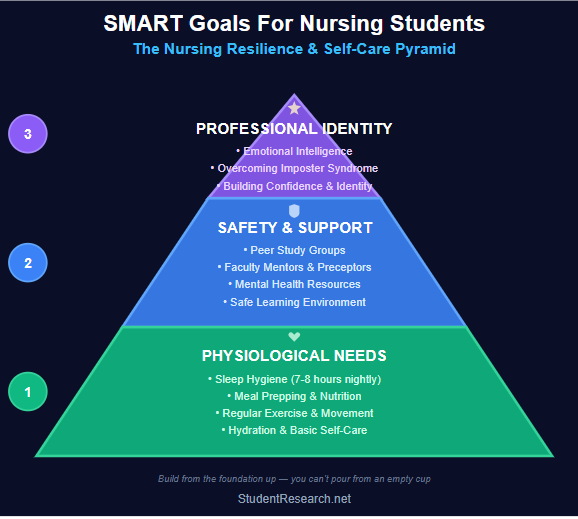
- High Cognitive Load: The constant pressure to absorb life-saving information can lead to mental exhaustion.
- Compassion Fatigue: Exposure to patient suffering during clinicals can take an emotional toll if not processed correctly.
- The Fix: Implement regular “mental health check-ins” and seek peer support groups where you can safely decompress.
Brilliant Way #11: Establishing a “Zero-Study” zone for mental rest
- Designate specific times or physical spaces, like your bedroom or a favorite park, where nursing textbooks are strictly forbidden.
- Use this time to engage in hobbies or social activities that have nothing to do with healthcare.
- Protecting these boundaries prevents your identity from being entirely consumed by your role as a student.
Understanding Physical Health Needs for Longevity
- Recognize that your body is your most important tool; it requires proper fuel and rest to function in a high-stress environment.
- Set specific goals for hydration, especially during long clinical shifts where you might forget to drink water.
- Prioritize consistent movement or stretching to combat the physical strain of hospital work.
Brilliant Way #12: Benefits of meal prepping for 12-hour hospital shifts
- Prepare nutrient-dense meals on your off-days to avoid relying on cafeteria junk food or vending machines during shifts.
- Focus on high-protein snacks that provide sustained energy rather than quick sugar spikes.
- Pre-packing your meals saves time and mental energy on early clinical mornings when every minute counts.
Why is Emotional Intelligence Important in Nursing?
- Patient Rapport: High EQ allows you to connect with patients and their families during their most vulnerable moments.
- Conflict Resolution: It helps you navigate complex social dynamics of a healthcare team and resolve disagreements professionally.
- Stress Management: Recognizing your own emotional triggers allows you to stay calm and focused during clinical emergencies.
6. Professional Development: Steps to Launching Your Career
Building a successful career in healthcare begins long before you receive your diploma. By applying smart goals for nursing students to your professional networking and job preparation, you can ensure a smooth transition from the classroom to a clinical environment.
Types of Nursing Organizations to Join (NSA/SNA)
- National Student Nurses’ Association (NSNA): This organization provides a gateway to professional advocacy and large-scale networking events.
- Specialty-Specific Groups: Joining associations like the American Association of Critical-Care Nurses (AACN) allows you to focus on your area of interest early on.
- Local State Chapters: These groups are vital for understanding regional legislative issues that will affect your future practice.
Brilliant Way #13: Building a professional network through student associations
- Set a goal to attend at least one professional conference or local meeting per semester.
- Use these platforms to meet recruiters and nurse managers who often scout talent at student events.
- Volunteer for leadership roles within the organization to demonstrate your initiative and teamwork skills.
Guide to Securing a Nursing Externship or Residency
- Research local hospitals that offer specialized “New Grad” residency programs with structured mentorship.
- Start preparing your application materials at least six months before the program’s start date.
- Tailor your clinical experience descriptions to match the core values of the specific healthcare system.
Brilliant Way #14: How do I prepare for a high-stakes nursing interview?
- Practice answering behavioral-based questions using the STAR method (Situation, Task, Action, Result).
- Conduct mock interviews with faculty or peers to refine your communication and body language.
- Prepare specific examples of clinical situations where you demonstrated critical thinking or advocacy for a patient.
How to Find a Mentor in the Healthcare Field
- Look for experienced staff nurses during your clinical rotations who demonstrate the professional traits you admire.
- Be explicit about your desire for mentorship, asking for specific feedback on your clinical performance.
- Maintain these professional relationships through regular check-ins even after your rotation ends.
7. Troubleshooting Common Obstacles to Your Success
Even with the best planning, nursing school will present unexpected challenges. Learning how to troubleshoot these issues and pivot your strategy is essential for maintaining your momentum and mental well-being.
Why do I feel like a fraud? Imposter Syndrome Explained
- Understanding the Feeling: Many high-achieving nursing students feel like they do not belong or are just “getting lucky”.
- The Reality: This feeling usually stems from the high stakes of healthcare and the vast amount of knowledge yet to be mastered.
- Counteracting the Syndrome: Keep a “success journal” where you record positive feedback from patients and successful clinical outcomes.
Steps to Adjusting Goals When Life Happens
- Assess the Situation: Honestly evaluate how personal emergencies or academic setbacks impact your current timeline.
- Prioritize Non-Negotiables: Identify which goals must be kept and which can be delayed without derailing your graduation.
- Seek Assistance: Do not wait until you are drowning to reach out to academic advisors or counseling services.
Brilliant Way #15: The “Pivot” strategy for failing an exam or skill check
- Analyze the failure objectively to identify exactly where the knowledge or performance gap occurred.
- Create a new, specific SMART goal centered on remedial study or extra practice in the lab.
- Treat the setback as a learning opportunity rather than a reflection of your worth as a future nurse.
Ways to Maintain Motivation Throughout Nursing School
- Revisit your original “Why”—the reason you chose to become a nurse—on a weekly basis.
- Celebrate small victories, like mastering a difficult pharmacology concept or finishing a long clinical week.
- Stay connected with peers who share your drive and positive mindset to foster a supportive environment.
8. Conclusion: Summary of SMART Goals for Nursing Students
Master SMART goals for nursing students with 15 brilliant ways to succeed. Learn how to pass exams, master clinicals, and stay positive. Reading this guide is the first step toward transforming your educational journey into a series of reachable milestones.
15 Facts About Successful Nursing Student Habits
- They prioritize sleep to ensure cognitive function during clinical shifts.
- They use practice questions as a primary study tool rather than passive reading.
- They are not afraid to ask for help when a concept remains unclear.
- They treat clinical rotations like a semester-long job interview.
- They engage in meal prepping to maintain energy through 12-hour shifts.
- They utilize a master calendar to manage clinical and lecture schedules.
- They establish “zero-study” zones to prevent academic burnout.
- They actively seek out mentorship from experienced healthcare professionals.
- They apply the STAR method to prepare for professional job interviews.
- They use the Pomodoro technique to maintain focus during study blocks.
- They join professional organizations like the NSNA early in their education.
- They practice active recall to ensure long-term retention of theory.
- They break down large documentation tasks into manageable steps.
- They maintain a positive mindset by celebrating small incremental wins.
- They pivot their study strategies immediately after an academic setback.
Final Encouragement for Your Journey
- Remember that every expert nurse was once a student facing the same anxieties you feel today.
- Your persistence and dedication are the foundation of the safe, compassionate care you will provide to your future patients.
- Trust the process and stay committed to the incremental growth that SMART goals provide.
How to Start Writing Your First SMART Goal Today
- Pick one academic or clinical challenge you are currently facing.
- Apply the SMART criteria to create a written plan with a clear deadline.
- Share your goal with a peer or mentor for added accountability

