

Stepping into the healthcare world as a student can feel like diving into the deep end of a very large pool without a life vest. However, securing professional student nurse jobs is the ultimate way to build a bridge between theoretical textbook knowledge and real-world clinical excellence. This guide is designed to help you navigate the diverse landscape of employment opportunities available to you before you even sit for your NCLEX, ensuring you are mastering the environment you will one day lead.
Understanding the Landscape of Professional Student Nurse Jobs
The healthcare industry is currently facing a significant staffing shortage, which has opened unprecedented doors for nursing students to enter the workforce early. These roles are specifically structured to respect your academic schedule while providing a paycheck and invaluable bedside manner practice. By choosing the right path now, you are effectively mastering the foundational skills required for a seamless transition into a Registered Nurse (RN) role.
Benefits of Early Clinical Employment
- Enhanced Clinical Competency: Gain hands-on experience with patient vitals, hygiene, and mobility.
- Networking Opportunities: Build relationships with Nurse Managers and recruiters at top-tier hospitals.
- Financial Independence: Offset the high costs of nursing tuition with competitive hourly wages.
Networking for Future Residency
- Internal Hiring Preference: Many hospitals prioritize hiring their own student workers for New Grad Residencies.
- Reference Building: Secure strong letters of recommendation from seasoned RNs who have seen your work ethic.
- Cultural Fit: Determine if a specific hospital’s culture aligns with your personal values before committing long-term.
Criteria and Qualifications for Student Nursing Roles
Before applying for professional student nurse jobs, it is essential to understand the legal and institutional requirements that vary by state. Most roles require you to be actively enrolled in an accredited ADN or BSN program and to have completed at least one clinical rotation. Meeting these benchmarks ensures that you have the basic safety knowledge required to assist licensed staff effectively.
Essential Documentation and Certifications
- BLS Certification: A current Basic Life Support for Healthcare Providers card is non-negotiable.
- Enrollment Verification: A formal letter from your registrar or a current transcript.
- State Registry: Some states require you to be listed on the Nursing Assistant Registry even if you are a student.
| Feature | Student Nurse Tech | Certified Nursing Assistant (CNA) |
| Education Req. | 1-2 Semesters of Nursing School | 75-150 Hour Certificate Program |
| Scope of Practice | May include advanced skills (IV starts) | Limited to basic ADLs |
| Supervision | Direct RN Supervision | RN or LPN Supervision |
Why settle for average grades? At StudentResearch.net, we guarantee excellence through a rigorous multi-stage review process. Every paper is scrutinized by our internal editorial team for accuracy and original thought. Secure your academic success with our ironclad quality standards.
Mastering Your Career: 20+ Professional Student Nurse Jobs
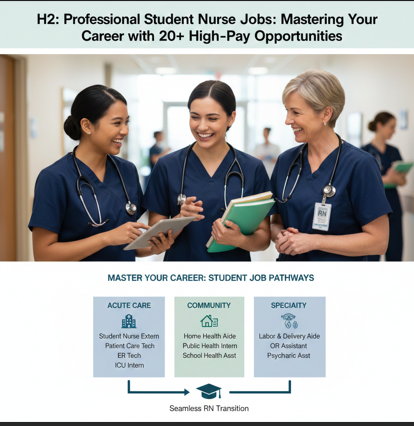
This section highlights the diverse range of opportunities available to nursing students looking to expand their horizons. Each of these professional student nurse jobs offers a unique perspective on patient care, from high-octane emergency rooms to the steady pace of community health. Selecting a role that aligns with your future specialty can give you a significant head start in your nursing journey.
Acute Care and Hospital-Based Roles
- Student Nurse Extern: A formal summer or year-round program focusing on RN-level shadowing.
- Patient Care Technician (PCT): Working in hospitals to perform phlebotomy, EKGs, and basic care.
- Emergency Room Technician: Assisting in high-pressure environments with wound care and splinting.
- Critical Care Student Intern: Shadowing in ICU environments to understand complex hemodynamics.
- Telemetry Technician: Monitoring heart rhythms and alerting the RN to significant changes.
The Value of Externships
- Skill Expansion: Often allows students to practice skills like catheter insertion or dressing changes under supervision.
- Dedicated Mentorship: Pairs you with a specific preceptor for the duration of the program.
- Bridge to Hire: High conversion rates from extern to permanent RN staff.
Specialized Clinical Support Roles
- Operating Room Assistant: Helping with room turnover and sterile field preparation.
- Labor and Delivery Aide: Assisting postpartum moms and helping with newborn vitals.
- Psychiatric Nursing Assistant: Focusing on therapeutic communication and patient safety in mental health.
- Pediatric Care Aide: Providing age-appropriate care for children in a clinical setting.
- Hospice Student Aide: Learning the delicate art of end-of-life care and family support.
Community and Outpatient Opportunities
- Home Health Aide: Providing one-on-one care in a patient’s private residence.
- Public Health Intern: Assisting in vaccination clinics and community health screenings.
- School Health Assistant: Supporting school nurses with screenings and minor injuries.
- Phlebotomist: Focusing exclusively on blood draws and specimen processing.
- Medical Assistant (Student): Working in outpatient clinics to room patients and take histories.
Administrative and Non-Bedside Roles
- Unit Secretary: Managing the flow of a nursing unit and coordinating physician orders.
- Health Screener: Conducting temperature and symptom checks in corporate settings.
- Triage Support: Assisting in urgent care clinics with initial patient flow.
- Medical Scribe: Documenting physician-patient encounters in real-time.
- Campus Peer Tutor: Helping junior nursing students master anatomy or pharmacology.
- Research Assistant: Helping nursing faculty gather data for clinical studies.
Balancing Work and Nursing School
While pursuing professional student nurse jobs, your primary responsibility remains your academic success and passing the NCLEX. Finding a balance requires strict time management and a workplace that understands the rigors of a nursing curriculum. Many students find that working one or two shifts a week actually improves their study habits by providing real-world context to their lectures.
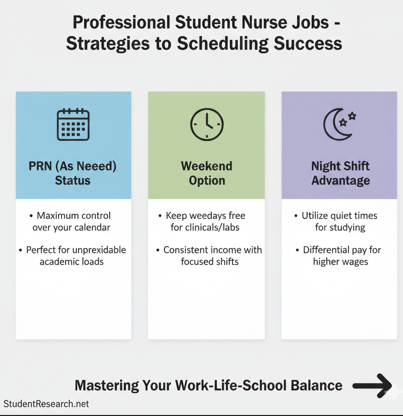
Strategies for Scheduling Success
- PRN (As Needed) Status: Offer to work “per diem” to have maximum control over your calendar.
- Weekend Option: Dedicate your weekends to work to keep your weekdays free for clinicals and labs.
- Night Shift Advantage: Use the “downtime” on quiet nights for reviewing flashcards or textbooks.
| Work Schedule | Pros | Cons |
| Full-Time | Maximum income and benefits | High risk of academic burnout |
| Part-Time | Steady income and routine | Less flexibility during finals week |
| PRN/Per Diem | Total flexibility | No guaranteed hours or benefits |
Struggling with complex nursing theories? Trust StudentResearch.net for academic excellence. Our writers hold advanced MA and PhD degrees in nursing and healthcare, ensuring your assignments reflect deep clinical expertise and scholarly rigor. Let our experts handle the research today!
How to Apply for Professional Student Nurse Jobs
The application process for these roles is your first taste of professional healthcare recruitment. You must present yourself as a reliable, eager learner who is committed to the facility’s mission and patient safety. Tailoring your resume to highlight your clinical rotations is the key to standing out in a sea of applicants seeking professional student nurse jobs.
Crafting a Student-Focused Resume
- Clinical Rotation Section: List the units you have visited, hours completed, and skills performed.
- Soft Skills: Emphasize communication, empathy, and your ability to work under pressure.
- GPA and Honors: Include your academic achievements to demonstrate your dedication to the field.
Sample Resume Template for Students
- Header: Full Name, Contact Info, LinkedIn.
- Summary: Highlight BSN candidate status and total clinical hours.
- Clinical Experience: Detail specific skills like Foley insertion or EKG placement.
Tired of losing points on citations? Mastering APA, MLA, or Chicago style is effortless with StudentResearch.net. We provide flawless formatting across all major citation styles, ensuring your nursing papers are professional and perfectly polished. Get the grade you deserve now!
Interview Tips for Aspiring Student Nurses
Healthcare interviews often involve behavioral questions that assess how you handle stress and interpersonal conflict. When interviewing for professional student nurse jobs, focus on your “why”—the reason you chose nursing in the first place. Showing enthusiasm and a willingness to perform “lowly” tasks like bed changes with a smile goes a long way with hiring managers.
Common Interview Questions to Prepare For
- Conflict Resolution: “Tell us about a time you handled a difficult patient.” Focus on de-escalation.
- Prioritization: “How do you handle multiple tasks?” Use the ABCs (Airway, Breathing, Circulation).
- Self-Awareness: “What is a mistake you made in clinical?” Show honesty and a learning mindset.
Transitioning from Student Worker to Registered Nurse
The ultimate goal of taking on professional student nurse jobs is to make your future transition to an RN role as smooth as possible. By the time you graduate, you will already be familiar with the Electronic Health Record (EHR) system, the hospital layout, and the staff. This familiarity reduces the “reality shock” that many new nurses experience during their first year of practice.
Leveraging Your Experience for a Higher Starting Salary
- Internal Years of Service: Some hospitals count your time as a tech toward your total “years of service” for benefits.
- Negotiation Power: Use your specific unit knowledge as leverage for a better starting position.
- Proven Track Record: You are a “low-risk” hire because management already knows your performance.
Tools for Success: Resume, Cover Letter, and Interview Prep
Resume
To help you secure one of those professional student nurse jobs, your resume needs to highlight your clinical hours just as much as your work history. Because you haven’t graduated yet, recruiters look for your “clinical footprint”—the actual time you’ve spent on hospital floors during school.
Here is a professional, ATS-friendly resume template designed specifically for a student nurse.
[Full Name]
City, State, Zip | Phone Number | Professional Email | LinkedIn Profile
Professional Summary
Dedicated and highly motivated Nursing Student (BSN/ADN candidate) with [Number] clinical hours completed in diverse healthcare settings. Seeking to leverage strong foundational knowledge and hands-on patient care skills in professional student nurse jobs. Proven ability to remain calm in high-pressure environments, deliver compassionate care, and assist registered nursing staff in achieving optimal patient outcomes.
Education
Bachelor of Science in Nursing (Candidate) | [University Name] | [City, State] Expected Graduation: [Month, Year]
- GPA: [3.X]/4.0 (Optional if 3.5+)
- Honors: Dean’s List, [Scholarship Name], Student Nursing Association Member.
Clinical Rotations
This section is vital for professional student nurse jobs as it proves your hands-on experience.
Medical-Surgical Rotation | [Hospital Name] | [Total Hours]
- Assisted in the care of 4-5 adult patients with chronic conditions (COPD, Diabetes, Hypertension).
- Performed wound care, Foley catheter insertion, and medication administration under RN supervision.
Critical Care / ICU Rotation | [Hospital Name] | [Total Hours]
- Monitored hemodynamic status and interpreted cardiac rhythms for critically ill patients.
- Observed and assisted in emergency response and ventilator management protocols.
Maternity & Pediatrics Rotation | [Hospital Name] | [Total Hours]
- Provided postpartum care and assisted with newborn screenings and breastfeeding support.
Relevant Healthcare Experience
Patient Care Assistant / Nursing Assistant | [Facility Name] | [Dates of Employment]
- Provided high-quality activities of daily living (ADLs) to a 15-bed unit.
- Accurately documented vital signs, intake/output, and blood glucose levels in [EHR Software Name, e.g., Epic].
- Collaborated with the multidisciplinary team to ensure patient safety and fall prevention.
Certifications & Skills
Certifications
- BLS for Healthcare Providers | American Heart Association | Exp: [Date]
- CNA License | [State] Registry #123456 (If applicable)
- HIPAA Privacy & Security Training | [Year]
Technical & Soft Skills
- Clinical Skills: Phlebotomy, EKG Lead Placement, Sterile Technique, Tracheostomy Care.
- Technology: Epic/Cerner/Meditech EHR, Microsoft Office Suite, Telemetry Monitoring.
- Soft Skills: Therapeutic Communication, Critical Thinking, Multitasking, Patient Advocacy.
Professional Affiliations
- Member, National Student Nurses’ Association (NSNA)
- Volunteer, [Red Cross / Local Community Clinic]
Tips for Customization:
- Keywords: Ensure you use the phrase professional student nurse jobs or “Nurse Extern” in your summary if that is the specific role you are targeting.
- The 1-Page Rule: Keep your resume to one page. As a student, recruiters want to see a concise snapshot of your clinical readiness.
- Quantify: Instead of saying “helped patients,” say “Assisted 10+ patients daily with mobility and hygiene care.”
Cover Letter
To secure professional student nurse jobs, your cover letter must balance your status as a learner with your reliability as a staff member. This draft is designed to show a hiring manager that you are ready to contribute to the team immediately while you finish your degree.
Cover Letter Template
[Full Name] [Phone Number] | [Professional Email] [LinkedIn Profile URL]
[Date]
[Hiring Manager Name] (Use “Nurse Recruitment Team” if name is unknown) [Hospital or Facility Name] [Department, e.g., Medical-Surgical Unit] [Address]
RE: Application for [Specific Job Title, e.g., Student Nurse Extern]
Dear [Hiring Manager Name],
As a current [Junior/Senior] Nursing student at [University Name] with over [Number] clinical hours already completed, I am writing to express my strong interest in the professional student nurse jobs currently available at [Hospital Name]. Having followed [Hospital Name]’s reputation for excellence in patient-centered care and clinical innovation, I am eager to contribute my skills to your [Specific Unit, e.g., Oncology] team.
During my recent clinical rotations at [Hospital Name where you did rotations], I developed a deep appreciation for the fast-paced nature of acute care. I have successfully managed a patient load of [Number] under the guidance of my preceptor, where I honed my skills in physical assessments, electronic health record documentation, and therapeutic communication. My background as a [mention any previous role like CNA or Volunteer] has provided me with a solid foundation in patient safety and comfort, which allows me to integrate seamlessly into a busy nursing unit.
I am particularly drawn to this role because I am committed to mastering the clinical competencies required for a successful transition into a Registered Nurse role upon my graduation in [Month/Year]. I understand the importance of reliability and teamwork in healthcare; I am a proactive worker who takes initiative in assisting the nursing staff with everything from basic ADLs to complex clinical procedures.
Thank you for your time and for considering my application. I am eager to discuss how my clinical training and dedication to the nursing profession make me an ideal fit for your team. I look forward to the possibility of an interview.
Sincerely,
[Your Signature]
[Your Printed Name]
Strategic Advice for Your Cover Letter
- The “Mastering” Angle: By using the phrase “mastering the clinical competencies,” you signal to the recruiter that you are not just looking for a paycheck, but are dedicated to professional growth.
- Address the Pain Point: Hospitals are often short-staffed. Using phrases like “proactive worker” and “integrate seamlessly” tells them you will be a help, not a burden.
- Align with Values: Look up the hospital’s “Mission and Values” page. If they value “Integrity,” work that word into your second paragraph.
High-Impact Cover Letter Strategy
- Personalization: Address the specific Nurse Manager or Unit.
- Value Proposition: Mention your specific clinical hours and certifications like BLS.
- The “Mastering” Phrase: Explicitly state your goal of mastering clinical competencies.
Interview Prep
To ensure you are fully equipped for professional student nurse jobs, we have compiled the essential documents you need to apply today. These tools are designed to help you bypass the automated filters and get your profile in front of a hiring manager. Success in nursing requires preparation, and these templates provide the framework for mastering your professional presentation.
First Day Success Checklist
- Arrive Early: 15 minutes before the shift starts.
- Tools of the Trade: Carry a pocket notebook and a reliable black pen.
- Social Integration: Introduce yourself to the Charge Nurse and Unit Secretary immediately.
Conclusion: Start Your Journey Today
Mastering the art of nursing starts long before you receive your license. By engaging in professional student nurse jobs, you are investing in your future self and ensuring that you have the confidence needed to save lives. Whether you choose to work in a fast-paced ICU or a community clinic, the experience you gain today will be the foundation of your successful career tomorrow.
Meta Description: Explore professional student nurse jobs to gain experience.Explore 20+ roles for mastering your clinical skills and career growth.

