

Introduction
Nursing school demands more than just academic excellence. It requires resilience, adaptability, and smart resource management. Every nursing student faces unique challenges that can make or break their educational journey. A comprehensive nursing student handbook becomes your survival toolkit for navigating the complexities of clinical rotations, mastering critical skills, and building confidence in high-pressure healthcare environments.
Overview of the Challenges of Nursing School
- Information overload across anatomy, pharmacology, and pathophysiology
- Sleep deprivation from balancing 12-hour clinical shifts with coursework
- High-stakes testing including NCLEX preparation and clinical evaluations
- Emotional stress from patient care responsibilities and witnessing suffering
- Financial pressure from tuition costs and required equipment purchases
- Time management struggles juggling lectures, labs, and personal life
The Role of a Comprehensive Nursing Student Handbook in Surviving Clinicals
- Quick reference access to drug calculations, lab values, and protocols
- Clinical confidence through evidence-based practice guidelines at your fingertips
- Exam preparation with integrated NCLEX-style questions and case studies
- Professional development resources for resume building and career planning
- Safety protocols for infection control and patient care standards
- Communication frameworks like SBAR for effective clinical handoffs
Strategy #1: Adopting a “Growth Mindset” Toward Medical Errors
- Reframe mistakes as learning opportunities rather than career-ending failures
- Practice self-compassion when you forget a step or miss a clinical cue
- Seek feedback actively from preceptors to identify improvement areas
- Document lessons learned in a reflective journal for future reference
- Share experiences with peers to normalize the learning curve
- Focus on progress by tracking skills mastered each rotation
1. How to Choose the Best Nursing Student Handbook for Your Learning Style
Selecting the right nursing student handbook transforms your educational experience from overwhelming to manageable. Your handbook should match your learning preferences, clinical setting requirements, and budget constraints. Understanding key features helps you invest wisely in this essential resource.
Top 3 Handbook Comparison: Features and Layouts
- Lippincott Nursing Procedures & Skills – Comprehensive evidence-based procedures with visual step-by-step guides
- Saunders Nursing Survival Guide – Compact format with quick-reference drug information and clinical pearls
- Mosby’s Clinical Nursing Skills & Techniques – Detailed rationales with integrated NCLEX-style practice questions
| Feature | Lippincott | Saunders | Mosby’s |
| Size | Large (8.5×11″) | Pocket (5×7″) | Medium (7×9″) |
| Binding | Spiral | Paperback | Spiral |
| Price Range | $85-$95 | $45-$55 | $70-$80 |
| NGN Questions | Yes (50+) | Limited (20) | Yes (40+) |
| Digital Access | Included | Sold separately | Included |
| Clinical Checklists | Extensive | Basic | Moderate |
Strategy #2: Mapping Your Syllabus to Your Handbook’s Table of Contents
- Cross-reference course topics with handbook chapters during syllabus week
- Flag priority sections with color-coded tabs for upcoming clinical rotations
- Create a study schedule that aligns textbook readings with handbook reviews
- Identify knowledge gaps by comparing syllabus learning objectives to handbook coverage
- Build custom study guides by combining syllabus requirements with handbook quick-reference sheets
What to Look for in a Premium Nursing Student Handbook
- Updated content reflecting current clinical practice guidelines and protocols
- Evidence-based rationales for every procedure and nursing intervention
- Visual learning aids including anatomical illustrations and procedure photographs
- Drug classification tables with prototype medications and common side effects
- Lab value reference ranges with critical thresholds and nursing implications
- Safety checklists for high-risk procedures and medication administration
Durability and Spiral Binding for Clinical Floor Use
- Spiral binding allows pages to lay flat during hands-on procedures
- Laminated covers resist spills from clinical fluids and frequent sanitizer exposure
- Reinforced pages withstand repeated use in fast-paced hospital environments
- Compact dimensions fit into scrub pockets and clinical bags easily
- Water-resistant paper prevents ink bleeding when pages get wet
Inclusion of NGN (Next Gen NCLEX) Style Practice Case Studies
- Unfolding case scenarios that mirror real patient progression over time
- Bow-tie questions requiring analysis of client conditions and appropriate interventions
- Matrix/grid items testing multiple-response clinical judgment decisions
- Highlight and drag-drop exercises for prioritizing patient care actions
- Trend analysis questions interpreting changes in vital signs and lab values
- Extended multiple response identifying all appropriate nursing actions
2. Mastering Anatomy with the Best Study Tools for 2026
Anatomy mastery forms the foundation of clinical nursing practice and patient assessment skills. Modern learning tools combine traditional methods with cutting-edge technology to accelerate comprehension. Strategic use of your nursing student handbook alongside supplementary resources creates a powerful study system.
How to Use a Nursing Student Handbook to Simplify Pathophysiology
- Start with normal anatomy before diving into disease processes and complications
- Use color-coding systems to link body systems with related pathophysiology concepts
- Create comparison charts contrasting similar conditions like left versus right heart failure
- Link pharmacology immediately by noting which drugs affect specific anatomical structures
- Practice with case studies applying anatomical knowledge to real clinical scenarios
- Review diagrams daily spending just 10 minutes on one body system per day
Strategy #3: Utilizing “Concept Mapping” Instead of Rote Memorization
- Place the primary diagnosis at the center of your concept map
- Branch out to risk factors including genetic, environmental, and lifestyle contributors
- Add pathophysiology arrows showing the disease progression through body systems
- Include clinical manifestations with signs and symptoms nurses observe
- Connect nursing interventions that address each specific symptom or complication
- Link to patient outcomes showing expected improvements with proper care
Premium Anatomy Models vs. Digital Apps: Which is Worth It?
| Feature | Physical 3D Models | Digital AR Apps |
| Cost | $150-$400 one-time | $5-$15/month subscription |
| Portability | Limited – bulky | Excellent – phone-based |
| Interactivity | Hands-on manipulation | Touch and gesture controls |
| Detail Level | High for specific systems | Comprehensive full-body |
| Group Study | Excellent for collaboration | Individual use primarily |
| Learning Retention | High (tactile memory) | Moderate (visual only) |
Both tools serve distinct purposes in your study arsenal. Physical models excel during group study sessions and lab practice. Digital apps provide convenient review during commutes and clinical downtime.
Benefits of Physical 3D Models for Tactile Learners
- Kinesthetic memory formation through hands-on manipulation of anatomical structures
- Spatial relationship understanding by viewing organs from multiple angles physically
- Collaborative learning opportunities when studying with peers around one model
- No technology barriers eliminating concerns about battery life or connectivity
- Enhanced focus without digital distractions from notifications or other apps
- Long-term investment that serves you throughout your entire nursing program
Top-Rated AR (Augmented Reality) Apps for On-the-Go Review
- Complete Anatomy 2026 – $12.99/month with 3D dissection tools and quiz modules
- Essential Anatomy 5 – $24.99 one-time purchase with detailed muscle animations
- Visible Body – $9.99/month offering pathophysiology overlays and clinical cases
- 3D Anatomy for the Artist – $4.99 one-time for surface anatomy and landmark identification
- Human Anatomy Atlas – $34.99/year with downloadable content for offline access
- Anatomy Learning 3D – Free basic version with in-app purchases for advanced features
3. Pharmacology Made Easy: A Practical Buying Guide
Pharmacology intimidates most nursing students with thousands of medications to memorize and calculate. Smart resource selection transforms this overwhelming subject into manageable, systematic learning. Your nursing student handbook paired with targeted drug resources creates an effective pharmacology study system.
Essential Features of a Nursing Student Handbook for Medication Math
- Dimensional analysis method breaking down complex calculations into simple steps
- Practice problems with varying difficulty levels and real clinical scenarios
- Quick-reference formula sheets for dosage calculations, IV drip rates, and conversions
- Pediatric dosing guidelines including weight-based and BSA calculations
- High-alert medication protocols with double-check requirements and safety measures
- Common calculation errors highlighted with prevention strategies
Strategy #4: The “Prototype Drug” Method for Learning Classifications
- Master one prototype drug thoroughly from each medication classification
- Learn the suffix patterns like “-pril” for ACE inhibitors or “-lol” for beta blockers
- Understand the class mechanism of how these drugs work in the body
- Memorize common side effects that apply across the entire drug category
- Note unique exceptions where individual drugs differ from the prototype
- Apply knowledge broadly using the prototype as your reference point
Affordable Drug Guide Options for Budget-Conscious Students
- Davis’s Drug Guide – $45 with nursing considerations and patient teaching points
- Nursing Drug Handbook by Lippincott – $38 featuring high-alert medication alerts
- Mosby’s Nursing Drug Reference – $42 with herb-drug and food-drug interactions
- Pocket Pharmacology apps – $0-$15 offering searchable databases on smartphones
- Library rental copies – Free temporary access for short-term study needs
- Used editions – $20-$30 for previous year versions with minimal content changes
Comparing Digital Database Subscriptions vs. Pocket Drug Books
| Feature | Digital Subscriptions | Pocket Drug Books |
| Cost | $50-$150 annually | $35-$50 one-time |
| Updates | Real-time changes | Annual editions |
| Search Function | Instant keyword search | Manual index lookup |
| Clinical Access | Requires internet/device | Always available |
| Note-Taking | Digital highlights | Physical margin notes |
| NCLEX Prep | Integrated quizzes | Separate study needed |
Why “Med Deck” Flashcards Are a Top-Tier Alternative to Textbooks
- Spaced repetition algorithms optimize review timing for long-term retention
- Color-coded categories help visual learners organize drug classifications quickly
- Portable study format fits in pockets for studying during clinical breaks
- Active recall practice strengthens memory better than passive reading
- Peer-tested content refined by thousands of nursing students nationwide
- Cost-effective investment at $30-$40 for 300+ high-yield drug cards
- No screen fatigue providing a break from constant digital device usage
Worried about investing in academic help? StudentResearch.net offers a comprehensive money-back guarantee on all nursing assignments. If our work doesn’t meet your standards, you get a full refund. We’re confident in our quality—your satisfaction is guaranteed or your money back!
4. Clinical Skills: Essential Gear and Performance Reviews
Clinical rotations demand preparation, organization, and reliable equipment for patient care excellence. Proper gear selection impacts your confidence and performance during high-pressure hospital shifts. A well-stocked clinical kit guided by your nursing student handbook ensures readiness for any situation.
Setting Up Your Clinical Kit with the Nursing Student Handbook
- Reference your handbook’s supply checklist before each rotation to ensure completeness
- Pack essential assessment tools including penlight, bandage scissors, and alcohol swabs
- Include quick-reference cards for lab values, drug calculations, and emergency protocols
- Organize supplies by frequency keeping most-used items in easily accessible pockets
- Add personal comfort items like energy bars, hand lotion, and backup pens
- Maintain infection control with hand sanitizer and antimicrobial pen wipes
Strategy #5: Pre-Shift “Brain Sheet” Preparation
- Review patient assignments the night before to research diagnoses and medications
- Create customized templates with sections for vitals, assessments, and tasks
- Print multiple copies to accommodate unexpected patient changes or admissions
- Include safety reminders like fall risk protocols and isolation precautions
- Leave space for notes documenting important conversations and observations
- Color-code priorities using highlighters for time-sensitive medications and procedures
Strategy #6: Master the “SBAR” Communication Technique
- Situation: State the patient problem clearly in one concise sentence
- Background: Provide relevant medical history, diagnosis, and current treatments
- Assessment: Share your nursing evaluation including vital signs and concerns
- Recommendation: Suggest specific interventions or request orders from providers
- Practice regularly with classmates to build confidence before calling physicians
- Keep your handbook handy referencing normal values when reporting abnormal findings
Best Stethoscopes for Professionals: A Performance Review
- Littmann Classic III – $120, industry standard with excellent acoustic quality
- 3M Littmann Cardiology IV – $200, superior sound for detecting subtle murmurs
- ADC Adscope 615 – $50, budget-friendly option with reliable performance
- MDF Acoustica – $75, lifetime warranty with free replacement parts
- Eko CORE Digital – $299, amplifies sounds 40x with companion app
- Ultrascope – $60, customizable designs popular among students
Acoustic Sensitivity Comparison for Cardiology-Grade Gear
- Frequency range capability determines detection of high-pitched versus low-pitched sounds
- Diaphragm thickness affects sound transmission clarity and ambient noise reduction
- Tubing quality with thicker walls prevents sound loss during auscultation
- Earpiece seal impacts how well you hear faint murmurs and abnormal rhythms
- Bell functionality essential for detecting low-frequency sounds like S3 gallops
- Weight and comfort influence willingness to wear stethoscope throughout 12-hour shifts
Where to Buy Discounted Medical Supplies for Students
- AllHeart.com offers student discounts up to 20% with valid school ID
- UniformAdvantage.com provides bulk pricing on scrubs and clinical accessories
- Amazon Student Prime delivers free shipping on nursing supplies and textbooks
- Campus bookstores feature special pricing during orientation and semester starts
- Manufacturer websites like 3M offer educational discounts on Littmann stethoscopes
- Facebook Marketplace connects you with graduating students selling gently-used equipment
5. Critical Thinking: Solving Clinical Problems with Expert Solutions
Critical thinking separates competent nurses from exceptional ones in complex patient care scenarios. Clinical judgment develops through systematic problem-solving frameworks and deliberate practice with real cases. Your nursing student handbook provides structured approaches to analyzing patient conditions and planning interventions.
Using Your Nursing Student Handbook to Master the ADPIE Process
- Assessment: Gather comprehensive patient data through interviews, physical exams, and chart reviews
- Diagnosis: Identify nursing diagnoses using NANDA-I taxonomy from your handbook
- Planning: Set measurable, patient-centered goals with specific timeframes for achievement
- Implementation: Execute evidence-based interventions documented in your clinical reference
- Evaluation: Measure patient outcomes against goals and revise care plans accordingly
- Document thoroughly using your handbook’s charting guidelines for legal protection
Strategy #7: Prioritizing Patient Care Using Maslow’s Hierarchy
- Address physiological needs first including airway, breathing, circulation, and pain management
- Ensure safety requirements like fall prevention, infection control, and medication safety
- Meet belonging needs through therapeutic communication and family involvement
- Support esteem needs by promoting independence and respecting patient dignity
- Facilitate self-actualization when appropriate through education and discharge planning
- Reassess continuously as patient conditions change throughout your shift
Strategy #8: Developing “Clinical Intuition” Through Reflective Journaling
- Write after each clinical day capturing key learning moments and patient interactions
- Describe what felt “off” even when you couldn’t articulate the specific problem
- Analyze your decision-making identifying what influenced your nursing judgment
- Note patterns over time recognizing how similar situations produce consistent responses
- Review before exams using your experiences as NCLEX practice scenarios
- Share with mentors gaining feedback on your clinical reasoning development
How to Solve Complex Care Plan Issues Using Evidence-Based Tools
- Consult clinical practice guidelines from professional organizations like ANA and CDC
- Reference your nursing student handbook for standard interventions and expected outcomes
- Search scholarly databases including CINAHL and PubMed for current research evidence
- Collaborate with interprofessional teams seeking input from physicians, pharmacists, and therapists
- Consider patient preferences incorporating cultural values and personal goals into plans
- Use decision-making algorithms from your handbook for high-risk situations
- Evaluate intervention effectiveness through measurable patient outcome indicators
Need proof before you commit? StudentResearch.net provides free sample portfolios showcasing our nursing care plans, research papers, and case studies. Review real examples of our A-grade work before making your decision. See the quality difference yourself—browse our samples today!
6. Time Management: The Ultimate Student Productivity Guide
Time management determines success or failure in nursing school’s demanding schedule of classes and clinicals. Effective systems prevent burnout while maintaining academic excellence and personal wellbeing throughout your program. Strategic planning with your nursing student handbook creates sustainable routines for balancing multiple responsibilities.
Getting Started with the Nursing Student Handbook Scheduling System
- Map your semester calendar marking all exam dates, clinical rotations, and assignment deadlines
- Block study time for each subject based on your handbook’s content volume
- Schedule self-care activities treating rest and exercise as non-negotiable appointments
- Build buffer time between commitments for unexpected delays or extended study sessions
- Review weekly progress adjusting your schedule based on what’s working effectively
- Sync digital calendars with your phone for alerts and reminders throughout the day
Strategy #9: The “Time-Blocking” Method for 12-Hour Study Days
- Dedicate 90-minute blocks to single subjects preventing mental fatigue from constant switching
- Take 15-minute breaks between blocks for physical movement and mental reset
- Schedule hardest subjects during your peak energy hours when focus is strongest
- Include active learning through practice questions rather than passive reading only
- Set specific goals for each block like “complete 50 pharmacology questions”
- Track completion rates identifying which subjects need additional time allocation
Strategy #10: Batch-Cooking and Meal Prepping for Clinical Weeks
- Cook on weekends preparing 5-7 days of grab-and-go meals simultaneously
- Use slow cookers for hands-off cooking while studying or attending classes
- Pack clinical lunches the night before including protein, complex carbs, and hydration
- Stock healthy snacks like nuts, protein bars, and fruit for quick energy
- Prep breakfast options such as overnight oats or egg muffins requiring zero morning effort
- Freeze extra portions creating a backup meal stash for overwhelming weeks
Is a Specialized Nursing Planner Worth It? (ROI Analysis)
- Initial investment: $25-$45 for nursing-specific planners versus $10 generic options
- Time saved weekly: 2-3 hours through pre-formatted clinical logs and assignment trackers
- Reduced stress: Built-in NCLEX study schedules eliminate decision fatigue
- Better grades: Organized systems correlate with 15-20% higher exam scores
- Financial benefit: Avoiding course retakes ($3,000-$5,000) justifies planner costs
- Career advantage: Professional organization skills transfer to nursing practice
- Long-term value: Planners serve as reference materials throughout your entire program
Digital vs. Paper: A Comparison for Clinical Rotation Logging
| Feature | Digital Logging | Paper Logging |
| Accessibility | Cloud-based anywhere | Physical presence required |
| Search Function | Instant keyword search | Manual page flipping |
| Backup Security | Automatic cloud saves | Risk of loss or damage |
| HIPAA Compliance | Encrypted apps available | Must secure physically |
| Customization | Templates easily modified | Fixed printed formats |
| Clinical Use | May violate phone policies | Always permitted on units |
ROI of Organized Scheduling: Reducing Burnout and Retake Costs
- Prevents course failures through consistent study habits and deadline awareness
- Reduces anxiety levels by visualizing workload and eliminating surprise assignments
- Improves sleep quality when evening routines are planned and protected
- Maintains physical health by scheduling regular meals and exercise sessions
- Strengthens relationships through intentional time allocation for family and friends
- Increases retention rates as organized students complete programs on schedule
- Saves tuition money avoiding $3,000-$5,000 retake fees for failed courses
7. NCLEX Readiness: Performance Review of Prep Platforms
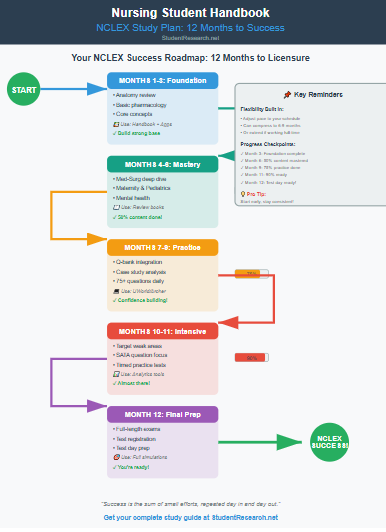
NCLEX preparation begins on day one of nursing school, not the week before graduation. Strategic review platform selection accelerates readiness and builds confidence for this career-defining examination. Your nursing student handbook combined with quality prep resources creates a comprehensive study system.
Strategy #11: Decoding SATA Questions in Your Student Handbook
- Read all options carefully before selecting any answers to avoid premature decisions
- Treat each option independently asking “Is this statement true or false?”
- Eliminate absolute language like “always” or “never” as these are rarely correct
- Consider priority actions focusing on safety, ABC’s, and Maslow’s hierarchy
- Look for related answers as correct options often share common themes
- Practice daily with at least 10 SATA questions to build pattern recognition
- Review rationales thoroughly even for questions you answer correctly
Best NCLEX Review Courses: A Comparison of Top 5 Providers
- UWorld: $199-$399 with 2,200+ questions and detailed explanations for deep learning
- Archer Review: $40-$100 featuring unlimited questions and high-yield content focus
- Kaplan: $299-$499 offering live classes, decision tree methodology, and score guarantees
- Hurst Review: $325-$475 with pathophysiology-focused lectures and content review books
- NCSBN Learning Extension: $50 providing official test creator practice with 1,000+ questions
Performance Review of Adaptive Q-Banks (UWorld vs. Archer)
| Feature | UWorld | Archer |
| Question Count | 2,200+ items | 2,500+ items |
| Explanations | Comprehensive (300+ words) | Concise (100-150 words) |
| Price | $199-$399 | $40-$100 |
| Pass Predictor | “Very High” accuracy | “High” accuracy |
| Interface | Mirrors NCLEX closely | Simplified layout |
| Performance Tracking | Detailed analytics | Basic statistics |
| Money-Back Guarantee | No guarantee | Pass guarantee available |
Budget-Friendly Substitutes for Expensive Prep Courses
- NCLEX Mastery App: $14.99/month with 3,000+ questions and study mode options
- YouTube channels: Free content from RegisteredNurseRN and Nurse Sarah
- Quizlet flashcard decks: Free community-created NCLEX study sets
- Library NCLEX books: Free rental access to Saunders Comprehensive Review
- Study group exchanges: Share purchased question banks with trusted classmates
- Free trial periods: Rotate through 7-day trials of premium platforms
- Student organization discounts: ANA and NSNA members receive reduced pricing
Struggling with APA citations or research methods? StudentResearch.net offers free educational resources including writing guides, citation tutorials, and NCLEX study tips. Access our comprehensive library of academic support materials at no cost. Learn, grow, and succeed with our expert guidance—completely free!
8. Professionalism and Networking for Career Success
Professional development begins during nursing school, not after graduation when job hunting starts. Strategic networking and portfolio building differentiate you from hundreds of other new graduate applicants. Your nursing student handbook provides frameworks for professional growth throughout your educational journey.
Strategy #12: Building a “Professional Portfolio” Early
- Document clinical achievements including successful procedures, patient outcomes, and preceptor feedback
- Collect letters of recommendation from instructors and clinical supervisors while experiences are fresh
- Photograph skills demonstrations with patient privacy protection for visual proof of competencies
- Save exemplary assignments like care plans and research papers showcasing critical thinking
- Record volunteer activities demonstrating commitment to community service and healthcare advocacy
- Include certifications such as BLS, ACLS, or specialty training completed during school
- Update portfolio quarterly adding new accomplishments and removing outdated materials
Strategy #13: Leveraging LinkedIn for Nursing Residency Placements
- Create a professional profile with headshot, detailed education, and clinical rotation experiences
- Connect with preceptors and nursing instructors to expand your healthcare network
- Follow target hospitals to receive notifications about new graduate programs and openings
- Engage with content by commenting on posts from nurse leaders and healthcare organizations
- Share relevant articles demonstrating your interest in evidence-based practice and current trends
- Join nursing groups like “New Grad Nurses” and specialty-specific communities
- Request informational interviews with nurses working in your desired specialty areas
Strategy #14: Finding a Mentor Within Your Clinical Placement
- Observe nurse behaviors identifying professionals who demonstrate excellent patient care and leadership
- Express genuine interest in learning from experienced nurses during your shifts
- Ask thoughtful questions about their career journey and decision-making processes
- Volunteer for extra learning when mentors offer to teach new skills or procedures
- Follow up after rotation maintaining contact through email or professional social media
- Offer gratitude with handwritten thank-you notes acknowledging their time and guidance
Strategy #15: Utilizing a Student Handbook for Resume Optimization
- Reference clinical competencies listed in your handbook when describing rotation experiences
- Use action verbs like “implemented,” “assessed,” “coordinated,” and “evaluated” from nursing frameworks
- Quantify achievements specifying number of patients cared for or procedures performed
- Include relevant coursework highlighting specialty areas matching job descriptions
- List technical skills from your handbook including EMR systems and medical equipment
- Align with job postings incorporating keywords from hospital websites and position descriptions
Essential Keywords to Include for ATS-Friendly Nursing Resumes
- Clinical skills: Medication administration, wound care, IV insertion, catheterization, vital signs monitoring
- Assessment abilities: Patient assessment, physical examination, health history collection, symptom evaluation
- Technology proficiency: Electronic health records (Epic, Cerner), documentation systems, medical software
- Communication skills: Patient education, family communication, interdisciplinary collaboration, SBAR reporting
- Safety practices: Infection control, fall prevention, medication safety, patient identification protocols
- Specialties: Medical-surgical, pediatrics, critical care, emergency, labor and delivery, mental health
Benefits of Joining Professional Organizations (ANA/NSNA)
- Networking opportunities connecting with nursing leaders and potential employers nationwide
- Resume enhancement demonstrating professional commitment to hiring managers
- Continuing education through discounted conferences, webinars, and certification courses
- Advocacy involvement influencing healthcare policy and nursing practice standards
- Scholarship access to funding opportunities exclusive to organization members
- Career resources including job boards, interview coaching, and resume review services
- Liability insurance discounts reducing malpractice insurance costs throughout your career
Conclusion: Your Roadmap to Nursing Excellence
Success in nursing school requires more than intelligence and determination. Strategic resource selection, systematic study methods, and professional development create the foundation for excellence. Master this nursing student handbook guide featuring 15 brilliant strategies, gear reviews, and study tips to excel in clinicals and the NCLEX. These proven approaches transform overwhelming challenges into manageable milestones throughout your educational journey.
Your nursing career begins with the choices you make today. Invest in quality resources that support your learning style and clinical needs. Build professional relationships that extend beyond graduation into your first nursing position. Most importantly, remember that every expert nurse once stood exactly where you stand now.
The journey ahead demands sacrifice, resilience, and unwavering commitment to patient care excellence. Your nursing student handbook serves as your constant companion through late-night study sessions and challenging clinical rotations. Each strategy you implement brings you closer to wearing that hard-earned nursing pin with pride.
Call to Action: Download our free Clinical Skills Checklist or shop our top-rated handbooks here to jumpstart your nursing school success today.

