

Failing out of nursing school can feel devastating, but it doesn’t have to end your healthcare career dreams. Many nursing schools that accept failed students exist across the country, offering pathways for dedicated individuals to return and succeed. Whether you struggled with clinical rotations, academic rigor, or personal circumstances, understanding your options is the first step toward a successful comeback.
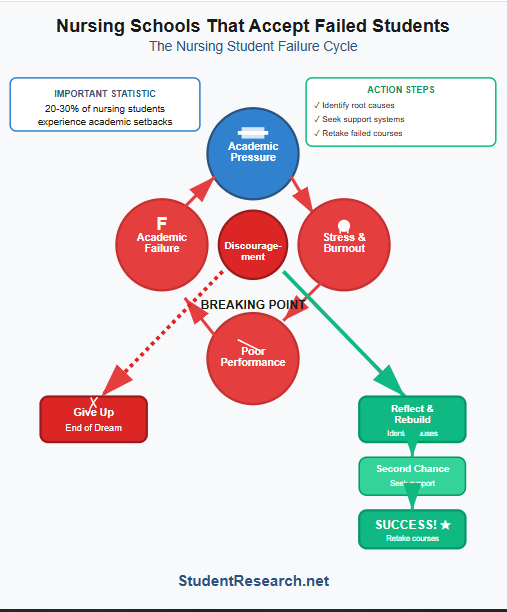
What Does It Mean When Nursing Students Fail
Academic failure in nursing programs includes:
- Not meeting the 2.5-3.0 GPA requirement
- Failed critical exams or clinical competencies
- Incomplete clinical hours
Student research shows 20-30% of nursing students fail or withdraw before completion. Academic dismissal (required to leave) differs from voluntary withdrawal (personal choice)—a distinction that matters when reapplying.
Why Failure Doesn’t End Your Nursing Career Dream
Many successful nurses failed their first attempt. Student research indicates returning students often perform better because they’ve developed:
- Enhanced self-awareness and study strategies
- Stronger time management skills
- Increased maturity and determination
What This Guide Will Cover
This guide provides everything you need to restart your nursing journey:
- Common failure reasons and solutions
- Schools welcoming students with setbacks
- Steps to strengthen your reapplication
- Building a compelling case for readmission
Understanding Why Students Fail Nursing Programs: Common Causes and Factors
Understanding the root causes of nursing school failure is essential for preventing history from repeating itself. Most failures stem from a combination of academic challenges and personal circumstances that overwhelm students. By identifying these factors early, you can develop targeted strategies to overcome them in your next attempt.
What Are the Most Common Academic Challenges in Nursing School
Academic struggles represent the majority of nursing school failures. These challenges often compound over time, making it difficult to recover once a student falls behind:
NCLEX Preparation Difficulties Lead to Failure
- Complex question formats: NCLEX-style questions require critical thinking beyond simple memorization
- Test anxiety: High-stakes assessments create pressure that affects performance
- Inadequate preparation resources: Not utilizing practice exams and study guides effectively
Science Courses Cause Students to Struggle
- Rigorous prerequisites: Anatomy, physiology, and pharmacology require extensive memorization
- Fast-paced curriculum: Limited time to master complex biological concepts
- Application challenges: Difficulty connecting theoretical knowledge to clinical practice
Struggling With Complex Nursing Assignments?
StudentResearch.net has you covered—from a 5-paragraph essay to a full-scale dissertation. We support 50+ subjects and every academic format (APA, MLA, Chicago, etc.). Whether it’s pathophysiology papers or clinical reflection essays, our expert writers deliver quality work tailored to your needs.
Clinical Performance Issues Result in Dismissal
- Skill competency: Inability to perform procedures safely and accurately
- Professional behavior: Communication issues or unprofessional conduct during rotations
- Critical thinking deficits: Struggling to make appropriate patient care decisions under pressure
Reasons for Non-Academic Failure in Nursing Programs
Life circumstances frequently derail even the most dedicated nursing students. Non-academic factors are often more challenging to address than academic struggles because they’re less predictable and harder to control:
Personal and Family Emergencies
- Caregiving responsibilities: Caring for ill family members or children
- Health crises: Personal illness or injuries requiring extended recovery
- Loss and grief: Death of loved ones affecting focus and attendance
Financial Constraints Force Students to Withdraw
- Tuition increases: Rising costs exceeding initial financial planning
- Work-study conflicts: Needing to increase work hours to cover expenses
- Loss of financial aid: Academic probation affecting scholarship eligibility
Mental Health and Burnout in Nursing School
- Depression and anxiety: Overwhelming stress leading to clinical symptoms
- Imposter syndrome: Feeling inadequate despite meeting program requirements
- Physical exhaustion: Sleep deprivation from balancing coursework, clinicals, and work
Difference Between Academic Dismissal and Voluntary Withdrawal
Understanding this distinction is crucial for your reapplication strategy:
- Academic dismissal: Forced exit due to GPA, failed courses, or clinical incompetence—requires explanation and remediation evidence
- Voluntary withdrawal: Personal choice to leave—offers more flexibility in explaining circumstances and demonstrates agency
Types of Nursing Schools That Accept Failed Students: Your Options Explained
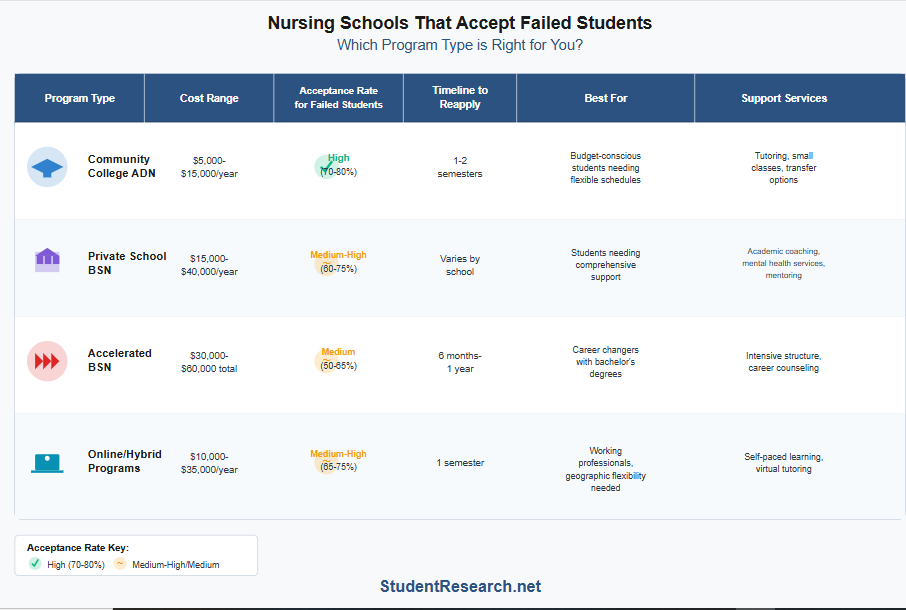
Community Colleges with Flexible Admission Policies
Community colleges often provide the most accessible pathway back into nursing education. They typically have more forgiving admission standards and offer robust support services for returning students:
Benefits of Community College Nursing Programs for Returning Students
- Lower cost: Significantly reduced tuition compared to private institutions
- Open enrollment policies: Many have less stringent GPA requirements for readmission
- Smaller class sizes: More individualized attention from instructors
- Local accessibility: Convenient locations reducing commute stress
- Transfer options: ADN programs that allow bridge to BSN completion
What Are the Typical Requirements for Readmission
- Minimum waiting period: Usually 1-2 semesters before reapplication
- Remediation courses: Retaking failed classes with passing grades (typically C+ or higher)
- Letters of recommendation: From healthcare professionals or previous instructors
- Personal statement: Explaining circumstances and growth since failure
When to Reapply: Timeline Considerations
- Immediate reapplication: If dismissal was due to fixable non-academic issues
- One semester wait: When you need time to retake 1-2 prerequisite courses
- One year wait: If significant academic remediation or personal circumstances require resolution
Private Nursing Schools with Second-Chance Programs
Private institutions often have more resources and flexibility in their admission processes. While more expensive, they may offer advantages that justify the investment:
Why Private Schools Have Higher Acceptance Rates for Previously Failed Students
- Enrollment goals: Financial incentives to maintain full cohorts
- Holistic admissions: Greater emphasis on potential and growth rather than past performance alone
- Specialized programs: Some schools specifically market to non-traditional and returning students
Examples of Additional Support Services Offered
- Academic coaching: One-on-one tutoring and study skills development
- Mental health resources: Counseling services and stress management programs
- Peer mentoring: Pairing with successful students for guidance
- Extended testing time: Accommodations for students with documented learning differences
Understanding the Cost Considerations
- Higher tuition: Expect $15,000-$40,000 annually for private programs
- Financial aid options: Scholarships specifically for returning students
- Return on investment: Faster completion may offset higher costs
No Surprise Fees. Ever.
Get an instant, all-inclusive quote at StudentResearch.net. Our price includes formatting, bibliography, and title pages for free—no hidden charges. Budget-friendly options for students rebuilding their academic journey. Invest in quality work without breaking the bank or facing unexpected costs at checkout.
Accelerated BSN Programs for Career Changers
Accelerated programs can be surprisingly receptive to students with previous nursing school attempts. These intensive programs value life experience and maturity:
Why Accelerated Programs May Be More Forgiving of Past Failures
- Non-traditional students: Programs designed for career changers with diverse backgrounds
- Life experience valued: Maturity and prior degree completion demonstrate capability
- Fresh start perspective: Previous nursing attempt shows genuine commitment to the profession
What Are the Prerequisites and Requirements
- Bachelor’s degree: Must hold degree in any field
- Prerequisite GPA: Usually 3.0+ in required science courses
- Recent coursework: Science prerequisites typically must be within 5-7 years
- Full-time commitment: Programs require 12-18 months of intensive, full-time study
Online and Hybrid Nursing Programs
Distance learning options have expanded dramatically, offering flexibility for students who need accommodation. These programs can be ideal for those whose previous failure involved scheduling or location challenges:
Benefits of Flexible Learning for Students with Past Failures
- Self-paced components: Better control over learning speed for difficult concepts
- Work-life balance: Ability to maintain employment while studying
- Reduced commute stress: Eliminating travel time for theory coursework
- Geographic flexibility: Access to programs outside your immediate area
What Does Accreditation Mean for Online Programs
- CCNE or ACEN accreditation: Essential for NCLEX eligibility and employment
- Clinical placement support: Reputable programs assist with finding local clinical sites
- Technology requirements: Reliable internet and appropriate devices necessary for success.
How to Strengthen Your Application After Failing Nursing School: Steps to Success
Your reapplication must tell a compelling story of growth and preparedness. Simply reapplying without addressing your previous failure will likely result in another rejection. This section provides actionable strategies to transform your setback into your strongest qualification.
Ways to Address Your Previous Failure Honestly
Transparency and accountability are critical when reapplying to nursing programs. Admissions committees appreciate honesty and want to see that you’ve deeply reflected on what went wrong:
Write a Compelling Personal Statement About Failure
- Lead with accountability: Take responsibility without making excuses or blaming others
- Identify specific causes: Explain exactly what led to your failure (poor study habits, unrealistic workload, personal crisis)
- Demonstrate insight: Show you understand the deeper issues, not just surface problems
- Connect to solutions: Explain how you’ve addressed each factor that contributed to failure
Steps to Taking Responsibility and Showing Growth
- Acknowledge mistakes honestly: Avoid minimizing or deflecting responsibility
- Provide concrete evidence: Reference specific courses taken, therapy attended, or skills developed
- Show changed circumstances: Explain how your situation differs now (resolved family issues, financial stability)
- Express mature commitment: Demonstrate realistic understanding of nursing school demands
Your Secret is Safe With Us!
Complete anonymity guaranteed at StudentResearch.net. Your personal details and order information are 100% confidential and protected with secure encryption. Focus on your nursing career goals while we handle your academic needs—discreetly and professionally. No judgment, just results.
Guide to Building a Stronger Academic Foundation
Academic preparation is the most tangible way to prove you’re ready for a second attempt. Strengthening your credentials removes doubt about your capability:
When to Retake Failed Courses
- Before reapplying: Retake all failed nursing courses with grades of B or higher
- Recent completion: Complete retakes within one year of reapplication
- Same institution when possible: Shows commitment and familiarity with curriculum
How to Complete Prerequisite Courses with High Grades
- Target courses: Focus on sciences where you previously earned C’s or below
- Demonstrate excellence: Aim for A’s to prove academic capability
- Build incrementally: Take one challenging course per semester to ensure success
Examples of Additional Certifications That Strengthen Applications
- CNA certification: Shows hands-on patient care competency
- BLS/CPR certification: Demonstrates preparedness for clinical requirements
- Medical terminology courses: Proves commitment to healthcare vocabulary mastery
- Phlebotomy or EKG certification: Additional clinical skills that show initiative
Ways to Gain Relevant Healthcare Experience
Nothing demonstrates commitment to nursing like working in healthcare settings. Practical experience also helps you determine if nursing is truly your calling:
CNA or Medical Assistant Positions Help Your Application
- Patient care skills: Hands-on experience with activities of daily living
- Clinical environment exposure: Comfort in hospital or clinical settings
- Professional references: Supervisors who can attest to your work ethic and aptitude
- Reality check: Confirmation that patient care aligns with your career goals
Volunteer Work in Healthcare Settings
- Demonstrates passion: Shows commitment even without compensation
- Networking opportunities: Connections with nurses who can mentor and recommend you
- Diverse experiences: Exposure to different specialties and patient populations
- Application enhancement: Volunteer hours strengthen your candidacy
How to Secure Strong Letters of Recommendation
Quality recommendations can make or break your reapplication. Choose recommenders strategically and prepare them thoroughly:
Ask for References After Academic Failure
- Healthcare supervisors: Current employers who can speak to your clinical capabilities
- Instructors from retaken courses: Professors who witnessed your academic improvement
- Clinical preceptors: Nurses who supervised you during successful clinical rotations
- Academic advisors: Staff who helped you develop your remediation plan
What Your Recommenders Should Address in Their Letters
- Specific improvements: Concrete examples of growth since your previous attempt
- Work ethic and resilience: Ability to overcome challenges and persist
- Clinical aptitude: Hands-on skills and patient interaction capabilities
- Maturity and professionalism: Readiness for the demands of nursing school
Steps to Meeting with Admissions Counselors Effectively
Personal contact with admissions staff can significantly impact your application outcome. These meetings demonstrate initiative and allow you to address concerns directly:
- Schedule early: Meet before application deadlines to understand specific requirements
- Prepare questions: Ask about readmission policies, support services, and success rates for returning students
- Bring documentation: Show evidence of remediation, improved grades, and certifications
- Follow up professionally: Send thank-you emails and maintain contact throughout the application process
Conclusion
Your journey doesn’t end with one setback—it’s simply taking a different path than you originally planned. Thousands of nurses working today experienced academic failures, withdrew from programs, or needed multiple attempts before earning their licenses. What separates those who eventually succeed from those who give up is persistence, strategic planning, and the willingness to learn from mistakes.
Why Your Failure Is Not Final
The nursing profession needs diverse individuals who bring resilience, empathy, and real-world experience to patient care. Your struggle has given you insights that straight-A students may never develop—understanding what it means to face adversity, rebuild after disappointment, and advocate for yourself when systems feel overwhelming. These are precisely the qualities that make exceptional nurses.
What Are the Key Takeaways for Success
Looking for nursing schools that accept failed students? Get our complete guide to reapplication options, requirements, and success strategies that can transform your second attempt into a successful outcome:
- Research multiple pathways: Community colleges, private schools, and online programs all offer opportunities
- Address root causes: Identify and resolve the specific academic or personal issues that caused your initial failure
- Build undeniable credentials: Strong grades in retaken courses, healthcare certifications, and relevant work experience remove doubt
- Craft honest narratives: Your personal statement should demonstrate accountability, growth, and realistic self-awareness
- Seek support systems: Utilize tutoring, counseling, mentorship, and study groups from day one
Steps to Take Today to Restart Your Nursing Journey
Begin your comeback by taking concrete action immediately. Contact admissions offices at three different types of programs to understand their specific readmission requirements. Enroll in at least one prerequisite course for the upcoming semester to demonstrate academic commitment. If you’re not currently working in healthcare, apply for CNA certification courses or volunteer positions to gain clinical exposure. Most importantly, reflect deeply on what derailed you previously and develop a written plan addressing each factor. Your second chance at nursing school starts with the decision to move forward today—make that decision count.

