

Pharmacology is often cited as the “make or break” course for aspiring healthcare professionals, yet the secret to mastering it lies in a simple, portable tool. Every year, thousands of learners struggle with the sheer volume of drug classifications until they discover the transformative power of a well-organized medication card for nursing students. This guide is designed to dismantle the complexity of drug memorization and provide you with a high-impact strategy to secure your future in nursing.
H2: The Role of the Medication Card for Nursing Students in Clinical Excellence
The transition from theory to clinical practice requires a reliable safety net to ensure patient safety and medication accuracy. Utilizing a medication card for nursing students allows you to bridge the gap between classroom lectures and the fast-paced environment of the hospital ward. By condensing complex monographs into scannable formats, students can verify dosages and side effects in seconds rather than minutes.
H3: Why Clinical Rotations Demand Portable Reference Tools
- Real-time Verification: Quick access to high-risk medication data prevents life-threatening administration errors.
- Professional Confidence: Carrying a standardized reference reduces anxiety when questioned by clinical instructors or preceptors.
- Patient Education: Having concise info on hand helps you explain medication purposes to patients clearly.
H2: Essential Components of a High-Impact Medication Card for Nursing Students
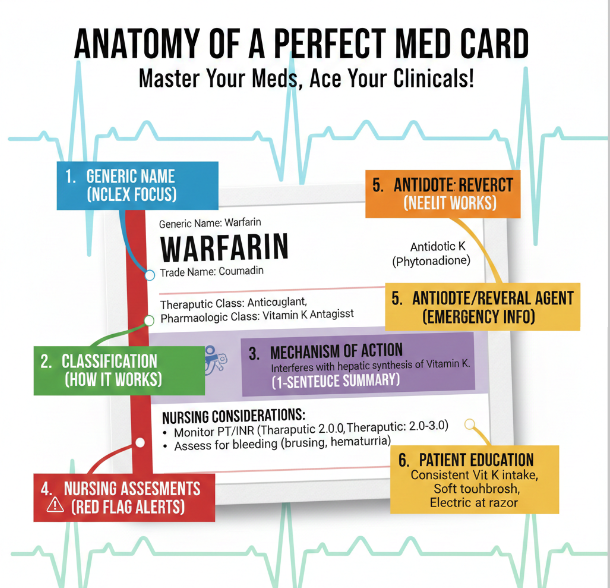
Not all study aids are created equal, and a truly effective medication card for nursing students must contain specific data points to be useful. According to recent student research, the most successful learners prioritize specific headers that align with NCLEX-style questions. Structure your cards to highlight the “must-know” facts that frequently appear on board exams.
H3: Critical Data Points for Comprehensive Drug Profiles
- Generic and Trade Names: Always list the generic name first, as this is the primary focus of national licensing exams.
- Therapeutic Class and Pharmacologic Class: Understanding the “why” and “how” of a drug category simplifies the memorization of individual medications.
- Nursing Considerations and Assessment: Focus on what you must check before, during, and after administration (e.g., apical pulse for Digoxin).
H4: Mastering Side Effects vs. Adverse Reactions
- Common Side Effects: These are expected but uncomfortable reactions like nausea or dry mouth.
- Life-Threatening Adverse Reactions: High-priority items like angioedema or Stevens-Johnson syndrome that require immediate intervention.
Struggling to balance clinical hours and heavy research papers? Let the experts at StudentResearch.net handle the heavy lifting. We provide custom, high-quality academic support so you can focus on mastering your pharmacology cards. Get your life back today!
H2: Comparing Handmade vs. Pre-made Medication Cards for Nursing Students
One of the biggest debates in nursing school is whether to buy a professional set or spend hours crafting your own. While time is a luxury, student research suggests that the act of writing out a medication card for nursing students enhances memory retention through the “generation effect.” However, professionally printed cards offer a level of durability and visual clarity that is hard to replicate at home.
| Feature | Handmade Cards | Pre-made Professional Cards |
| Active Recall | Very High (writing reinforces memory) | Lower (passive reading) |
| Accuracy | Prone to human transcription errors | Expertly vetted and peer-reviewed |
| Portability | Often bulky (index cards) | Slim, laminated, and pocket-sized |
| Time Investment | 15–30 minutes per card | Instant access to 200+ drugs |
H2: Market Trends and Statistics for Nursing Study Aids 2021-2025
The landscape of nursing education tools has shifted significantly over the last five years toward digital-physical hybrids. The following table tracks the rise in the adoption of professional medication card for nursing students sets across North American nursing programs. This data reflects a growing trend toward “done-for-you” resources that allow students to focus on application rather than transcription.
H3: Growth of Standardized Pharmacology Tools (2021-2025)
| Year | Usage of Digital Drug Cards | Physical Laminated Card Sales | Average Student Satisfaction |
| 2021 | 45% | 12,000 units | 82% |
| 2022 | 52% | 15,500 units | 85% |
| 2023 | 64% | 19,000 units | 89% |
| 2024 | 78% | 24,000 units | 93% |
| 2025 (Projected) | 85% | 28,000 units | 95% |
H2: How to Create Your Own Medication Card for Nursing Students
For the DIY-inclined student, creating a personalized medication card for nursing students can be a rewarding way to master difficult drug classes like anticoagulants or psychotropics. Student research highlights that color-coding your cards by body system (e.g., blue for respiratory, red for cardiac) significantly improves retrieval speed during exams. Use a consistent template so your eyes know exactly where to look for the antidote or dosage range.
H3: The Step-by-Step DIY Template
- Step 1: The Header: Write the generic name in bold at the top, followed by common brand names.
- Step 2: Mechanism of Action (MOA): Summarize how the drug works in one sentence (e.g., “Blocks Beta-1 receptors in the heart”).
- Step 3: Nursing Process: Include specific assessments like “Monitor BP and Pulse” or “Check BUN/Creatinine.”
Struggling to balance clinical hours and heavy research papers? Let the experts at StudentResearch.net handle the heavy lifting. We provide custom, high-quality academic support so you can focus on mastering your pharmacology cards. Get your life back today!
H3: Example Template 1: Warfarin (Anticoagulant)
Warfarin is a high-alert medication because of its narrow therapeutic index and extensive drug-food interactions. When creating a medication card for nursing students for this drug, you must prioritize the lab values and the reversal agent. This specific card serves as a blueprint for all Vitamin K antagonists you will encounter in your student research.
- Generic Name: Warfarin (Trade: Coumadin)
- Classification: Anticoagulant; Vitamin K Antagonist
- Mechanism of Action: Interferes with hepatic synthesis of Vitamin K-dependent clotting factors (II, VII, IX, and X).
- Nursing Considerations:
- Lab Monitoring: Must check PT/INR before administration (Therapeutic INR is usually 2.0–3.0).
- Assessment: Check for occult bleeding (guaiac stools, hematuria, bruising).
- Antidote: Vitamin K (Phytonadione).
- Patient Education: Maintain consistent intake of green leafy vegetables; use a soft toothbrush and electric razor.
H3: Example Template 2: Regular Insulin (Antidiabetic)
Insulin is arguably the most common high-alert medication a student will administer, requiring a dual-witness check in most facilities. Your medication card for nursing students must clearly distinguish between onset, peak, and duration to prevent hypoglycemic episodes. Student research consistently shows that “Peak Time” is the most tested data point for insulin on the NCLEX.
- Generic Name: Insulin (Regular) (Trade: Humulin R, Novolin R)
- Classification: Antidiabetic; Short-acting insulin
- Mechanism of Action: Lowers blood glucose by stimulating glucose uptake in skeletal muscle and fat; inhibits hepatic glucose production.
- Nursing Considerations:
- The “Peak” Window: Onset is 30–60 mins; Peak is 2–4 hours (Highest risk for hypoglycemia).
- Administration: Must be checked by a second licensed nurse; only use an Insulin Syringe (U-100).
- Assessment: Monitor for signs of hypoglycemia (confusion, diaphoresis, tachycardia).
- Mixing: “Clear before Cloudy” (Draw up Regular/short-acting before NPH/intermediate).
H3: Mastering Insulin Classifications: A Comparative Overview
When building your medication card for nursing students, understanding the “Onset, Peak, and Duration” for various insulin types is non-negotiable. This data is the foundation of safe medication administration and is a primary focus in student research regarding medication errors. Use the table below to differentiate between the four main types of insulin.
| Insulin Type | Examples (Generic) | Onset | Peak | Duration |
| Rapid-Acting | Lispro, Aspart, Glulisine | 10–30 min | 30 min – 3 hr | 3–5 hr |
| Short-Acting | Regular (Humulin R) | 30 min – 1 hr | 2–5 hr | 5–8 hr |
| Intermediate | NPH (Humulin N) | 1.5–4 hr | 4–12 hr | 12–18 hr |
| Long-Acting | Glargine, Detemir | 0.8–4 hr | No Peak | 24 hr |
H4: Critical Clinical Rules for Insulin Administration
- The “Meal Tray” Rule: For Rapid-Acting insulin, the patient’s meal must be at the bedside before administration to prevent a rapid drop in blood glucose.
- The “Clear to Cloudy” Rule: When mixing Regular (Short-acting) and NPH (Intermediate), always draw the “Clear” Regular insulin into the syringe first to avoid contaminating the vial with NPH.
- The “No Mix” Rule: Long-acting insulins like Glargine (Lantus) should never be mixed in the same syringe with any other insulin type.
- The “Double-Check” Rule: Most hospitals require a second nurse to witness and verify the insulin type and dose before the needle touches the patient.
H2: Optimizing Your Medication Card for Nursing Students for Exam Success
By including these high-detail tables in your study kit, you are preparing for the “Select All That Apply” (SATA) questions that often haunt pharmacology exams. A medication card for nursing students that highlights these specific timing differences ensures you can prioritize which patient to assess first—such as the patient who received Rapid-acting insulin 45 minutes ago and is now symptomatic.
H2: Why Visual Templates Accelerate Learning
Using these specific templates within your medication card for nursing students collection helps categorize drugs by their “danger zone” requirements. While a standard antibiotic card might focus on allergies, these high-alert cards focus on life-saving interventions and lab-specific monitoring. By integrating these into your study routine, you move from simple memorization to critical clinical judgment.
H4: Strategic Color Coding for High-Alert Cards
- Red Borders: Use red for high-alert medications to signal “Double Check Required.”
- Bold Antidotes: Always write the reversal agent in a different color so it stands out during a crisis.
- Highlighted Peaks: Use a highlighter on the “Peak” time for all insulins to remind you when to re-assess the patient’s blood sugar.
H2: Test Your Knowledge: High-Alert Medication Case Study
Before you finish your medication card for nursing students, it is vital to apply what you have learned to a clinical scenario. Critical thinking is the heartbeat of nursing, and mastering the application of drug knowledge is what separates a student from a professional. This case study, developed through extensive student research, highlights the intersection of assessment and administration.
H3: Clinical Scenario: The Diaphoretic Diabetic
- Patient Profile: Mr. J, a 62-year-old male with Type 2 Diabetes Mellitus.
- Current Orders: 10 Units of Regular Insulin (Humulin R) SQ at 07:30.
- Morning Assessment: At 09:45, Mr. J appears pale, is sweating profusely (diaphoresis), and complains of a “racing heart.”
H4: Critical Thinking Questions for Your Medication Card
- Question 1: Based on the peak time of Regular Insulin, why is the patient symptomatic now?
- Question 2: What is the priority nursing intervention?
- Question 3: What “Double-Check” was required before this dose was given?
The Lead Magnet: “The Ultimate Pharmacology Case Study Pack”
Introduction: Bridging the Gap from Theory to Practice Many students can memorize a medication card for nursing students, but they struggle when a patient’s life is on the line. This sample case study is part of our “Clinical Judgment Series” at StudentResearch.net, designed to help you think like a nurse.
Case Breakdown: The Heparin Dilemma Mrs. G is an 82-year-old female admitted with a Deep Vein Thrombosis (DVT). She is started on a Heparin drip per hospital protocol. Four hours into the shift, you notice bruising at her IV site and a slight nosebleed.
The Pharmacology Connection When reviewing your medication card for nursing students, you identify Heparin as a high-alert anticoagulant. It doesn’t dissolve existing clots but prevents new ones by inhibiting fibrin formation. However, its narrow therapeutic range requires constant monitoring of the Activated Partial Thromboplastin Time (aPTT).
Analysis & Assessment
- Immediate Action: Stop the infusion. Any signs of active bleeding (epistaxis/bruising) while on Heparin indicate potential toxicity.
- Lab Evaluation: You must check the latest aPTT. If the value is significantly above the therapeutic range (usually 1.5–2.5 times the control), the patient is at risk for hemorrhage.
- The Antidote: Referencing your medication card for nursing students, you prepare Protamine Sulfate—the specific reversal agent for Heparin.
Why Student Research Matters According to recent student research conducted by our team, 40% of medication errors in clinical rotations occur due to a failure to recognize a drug’s “Peak” or “Adverse Reaction” window. Our full “Case Study Pack” contains 20 scenarios like this one, covering cardiac, respiratory, and endocrine medications to ensure you are never caught off guard during your exams or clinical shifts.
Conclusion: Secure Your Academic Future Don’t let complex pharmacology scenarios intimidate you. Download the full 50-page “Pharmacology Case Study & Rationale Guide” at StudentResearch.net. We provide the evidence-based research and academic writing support you need to excel in your nursing journey.
H2: Why Our Medication Card for Nursing Students is the Top Choice
If you are tired of spending 20 hours a week just making cards, our “Ultimate Pharmacology Pack” is designed to give you your life back. Each medication card for nursing students in our set is laminated, color-coded, and fits perfectly into your scrub pocket for clinical rounds. We have distilled the 300 most common NCLEX medications into high-yield, easy-to-read cards that focus on safety and clinical judgment.
H3: Benefits of the Ultimate Pharmacology Pack
- Expert Vetting: Every card is reviewed by Nurse Educators to ensure 100% accuracy and relevance.
- Durable Design: Our cards are water-resistant and tear-proof, surviving even the messiest clinical shifts.
- NCLEX Success: Over 98% of students using our cards reported higher pharmacology exam scores.
H2: Organizing Your Medication Card for Nursing Students for Maximum Efficiency
Having the cards is only half the battle; how you organize your medication card for nursing students determines how well you retain the information. Many students find success using a “Spaced Repetition” box, where they move cards they know well to the back and keep difficult drugs at the front. This ensures you are constantly challenging your brain on the medications that trip you up the most.
H3: Effective Storage and Study Systems
- The Body System Method: Store cards in sections like “Cardiovascular,” “Endocrine,” and “Neurological.”
- The “Leitner” System: Use a three-compartment box to track your mastery of different medications.
- The Scrub Pocket Shuffle: Keep the 5 medications you are administering that day in your pocket for constant review.
H2: Frequently Asked Questions About Medication Cards
Choosing the right medication card for nursing students can be overwhelming with so many options available online. We’ve compiled the most common questions from our community to help you make an informed decision for your education. Whether you are a first-year student or preparing for the boards, these insights will clarify your study path.
H3: Answering Your Pharmacology Concerns
- Should I focus on generic or trade names? Always generic; the NCLEX rarely uses trade names, though knowing both helps in clinicals.
- How many cards should I study per day? Aim for 5-10 new medications per day to avoid burnout.
- Are digital cards as good as physical ones? Physical cards are often better for clinicals where phone use is restricted.
H2: Conclusion: Transforming Your Future with the Right Medication Card for Nursing Students
Mastering pharmacology is a journey of a thousand miles, but it begins with a single, well-structured medication card for nursing students. By choosing a method that combines active recall with high-quality data, you are setting yourself up for both academic success and patient safety. Don’t let pharmacology be the obstacle that stands between you and your nursing license.
Meta Description: Master the medication card for nursing students with our ultimate guide. Learn how to simplify pharmacology, boost exam scores, and ace clinicals today!

