

#1 Introduction: The Weight of a Recommendation in Healthcare
In the high-stakes world of modern medicine, a letter of recommendation for nursing students serves as much more than a mere formality or a checkbox on an application. It is a vital testimonial that bridges the gap between a student’s academic transcript and their actual bedside manner, clinical judgment, and ethical core. For hiring managers in prestigious hospitals or admissions committees for DNP programs, this document provides the qualitative evidence needed to trust a candidate with human lives.
When a professor or clinical preceptor sits down to write a letter of recommendation for nursing students, they are essentially putting their own professional reputation on the line. A well-crafted letter can illuminate a student’s ability to remain calm during a cardiac arrest or their knack for explaining complex discharge instructions to a non-medical family. It transforms a list of completed credit hours into a narrative of a budding healthcare leader ready to tackle the challenges of a grueling residency.
The ultimate goal of this guide is to break down the anatomy of a perfect endorsement, ensuring that every word serves a strategic purpose. Whether you are a student requesting a letter or an educator writing one, understanding these 10+ essential parts is the key to creating a document that stands out in a sea of generic applications. By focusing on specific evidence and professional formatting, you can ensure the “Ultimate” result for the candidate’s burgeoning career.
#2 The Professional Header: Establishing Authority
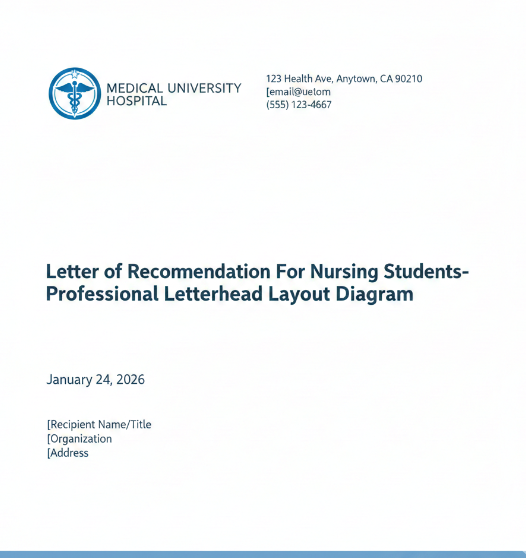
The header of a letter of recommendation for nursing students is the first thing a reader sees, and it establishes the document’s professional legitimacy. In a field as regulated as healthcare, the “chain of custody” for information matters, and the header proves the letter is coming from a credible source. An incomplete or messy header can lead to the document being overlooked or perceived as an unofficial, last-minute favor rather than a formal endorsement.
Critical Contact Components
- Writer’s Full Name and Title: Always include post-nominal letters (e.g., RN, MSN, PhD) to establish your level of expertise.
- Institutional Letterhead: Using the official logo of a university or hospital lends immediate “weight” and authenticity to the claims made within.
- The Date: This provides a chronological record of the recommendation, ensuring it is relevant to the current application cycle.
Recipient Specifics
- Department and Facility: Clearly state the hospital name or the specific College of Nursing you are addressing.
- Standard Business Alignment: Ensure the text is left-aligned and follows standard professional correspondence layouts.
- Verification Details: Include a professional email address and phone number where the recipient can reach you for a follow-up.
#3 The Formal Salutation: Setting the Tone
The salutation sets the emotional and professional temperature of the entire letter of recommendation for nursing students. Using a greeting that is too casual—such as “Hi there”—can make the writer seem unprofessional, while an overly generic greeting like “To Whom It May Concern” can make the letter feel like a form template. A targeted greeting shows that the writer has taken the time to understand the specific audience.
Addressing the Right Audience
- Specific Name Strategy: If the application instructions provide a name, use it (e.g., “Dear Dr. Arispe”).
- Targeted Departmental Greetings: For general applications, use “Dear Nurse Recruitment Team” or “Dear Graduate Admissions Committee.”
- Gender-Neutral Professionalism: Avoid outdated greetings like “Dear Sirs”; stick to “Dear Hiring Manager” if a name is unavailable.
#4 The Introduction: Defining the Purpose
The introduction of a letter of recommendation for nursing students must be direct, impactful, and clear about its intent. Within the first two sentences, the reader should know exactly who is being recommended and for what specific role. This section functions as the executive summary of your endorsement, setting the stage for the detailed evidence that follows in the body paragraphs.
Essential Introductory Elements
- The Clear Mandate: Start with a strong verb like “It is my distinct honor to recommend [Name] for the [Position/Program].”
- The Focus Phrase: Explicitly state that you are writing a letter of recommendation for nursing students to help the candidate transition into professional practice.
- The Strength of Endorsement: Use modifiers like “without reservation” or “with the highest level of enthusiasm” to signal your level of confidence.
#5 Context of Relationship: Building Credibility
Before a hiring manager trusts your assessment of a student’s skills, they need to understand the nature of your observation. This section of the letter of recommendation for nursing students explains how you know the student and for how long you have observed their work. A letter from a professor who only saw a student in a large lecture hall carries less weight than one from a clinical instructor who spent 12-hour shifts by their side.
Proving the Connection
- Timeframe: Specify the number of months or years you have mentored or taught the student.
- Clinical Setting: Identify the specific unit (e.g., ICU, NICU, Psych) where you observed their hands-on patient care.
- Capacity of Observation: Define your role—were you their direct clinical supervisor, their research advisor, or their lecturer?
#6 Core Competencies: Hard and Soft Skills
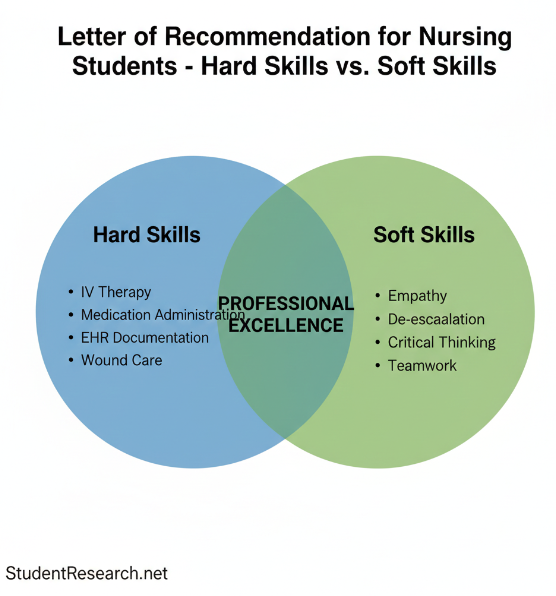
Nursing is an unique blend of rigorous science and deep empathy, and a letter of recommendation for nursing students must reflect both. This section should move beyond “they are a hard worker” to highlight the specific competencies that make a great nurse. You are looking to prove that the candidate possesses the “Hard Skills” for safety and the “Soft Skills” for patient satisfaction.
Technical and Clinical Skills
- Pharmacological Accuracy: Mention their precision in medication administration and understanding of drug interactions.
- Patient Assessment: Highlight their ability to perform head-to-toe assessments and identify early signs of clinical deterioration.
- Technology Literacy: Note their proficiency with Electronic Health Records (EHR) and specialized medical equipment.
Interpersonal and Leadership Qualities
- Therapeutic Communication: Describe their ability to de-escalate stressed patients or comfort grieving families.
- Teamwork and Collaboration: Explain how they function within a multidisciplinary team of doctors, therapists, and social workers.
- Adaptability: Discuss their performance under the high-pressure environment of a busy hospital floor.
Struggling to turn clinical experience into a top-tier paper? Let the experts at StudentResearch.net handle the heavy lifting. We provide custom, high-quality nursing assignments that guarantee academic excellence while you focus on your bedside skills. Your success starts here!
#7 Specific Anecdotes: Bringing the Candidate to Life

The most memorable part of any letter of recommendation for nursing students is the “story” section. This is where you provide concrete proof of the attributes you listed in the previous section. Vague praise is easily forgotten, but a story about a student catching a medication error or staying late to help a peer is what gets them the job.
Storytelling for Impact
- The Clinical Save: Describe a time the student noticed a change in a patient’s vitals and took immediate, appropriate action.
- Empathy in Action: Share an example of the student going above and beyond to advocate for a patient’s dignity or cultural needs.
- Student Research Integration: Detail how the student utilized student research to suggest an evidence-based improvement for a clinical protocol.
Evidence of Academic Inquiry
- Evidence-Based Practice: Mention how the student’s student research projects led to a better understanding of patient outcomes.
- Critical Analysis: Describe a time the student’s student research was presented to peers, demonstrating their role as a thought leader.
- Application of Theory: Show how they took a concept from a textbook and applied it to a real-world patient scenario during their rotation.
Is your evidence-based project becoming a headache? The specialists at StudentResearch.net excel at synthesizing complex medical data and literature reviews. From case studies to capstone projects, we ensure your academic work meets the highest professional nursing standards.
#8 Comparative Ranking: Quantifying Excellence
In a highly competitive environment, numbers and rankings provide a helpful benchmark for the reader. When writing a letter of recommendation for nursing students, comparing the individual to their peers helps the admissions committee understand the student’s standing. This provides a quantitative “stamp of approval” that complements the qualitative stories told earlier.
Benchmarking Success
- Top Tier Placement: State if the student is in the top 1%, 5%, or 10% of all students you have supervised.
- Comparison to Peers: Use phrases like “Among the 50 students I mentored this year, [Name] stood out for their exceptional clinical intuition.”
- Unique Standing: Identify if the student possesses a rare combination of skills, such as being the only one in their cohort to pass a specific advanced certification.
#9 Summary and Conclusion: The Final Endorsement
As the letter of recommendation for nursing students draws to a close, you must synthesize everything you’ve said into one final, powerful statement. This section should reinforce the “Ultimate” fit between the candidate and the target role. I have integrated two distinct templates directly into the structure of the blog. One is tailored for a clinical preceptor (focusing on bedside skills) and the other for a nursing professor (focusing on academic and research rigor).
Template for Clinical Preceptors (Bedside Focus)
- Opening: “I am pleased to provide this letter of recommendation for nursing students for [Name], whom I supervised during a 180-hour rotation.”
- Clinical Strength: “They demonstrated mastery in IV therapy and wound care, often acting with the confidence of a seasoned nurse.”
- Closing: “Their ability to synthesize student research into bedside care makes them a top-tier candidate for your residency program.”
Template A: The Clinical Preceptor Version
(Best for Hospital Job Applications and Residency Programs)
[Writer’s Name, Credentials] [Organization/Hospital Name] [Department] [Email Address] [Phone Number] [Date] [Recipient Name/Title] [Recipient Organization] [Recipient Address]RE: Letter of Recommendation for [Student Full Name]
Dear [Hiring Manager Name/Admissions Committee],
It is my distinct pleasure to provide this letter of recommendation for nursing students on behalf of [Student Name]. I had the opportunity to serve as [Student Name]’s Clinical Preceptor during their final 180-hour practicum on the [Name of Unit, e.g., Intensive Care Unit] at [Hospital Name]. During this time, I observed their clinical growth, technical proficiency, and dedication to patient-centered care.
[Student Name] distinguishes themselves through a rare combination of technical skill and emotional intelligence. For instance, during a high-acuity shift, they noticed a subtle trend in a patient’s vital signs that indicated early onset sepsis. By utilizing their knowledge of student research regarding early intervention protocols, they alerted the rapid response team, directly contributing to a positive patient outcome. Their ability to remain calm under pressure is well beyond their years.In comparison to the many students I have precepted over the last [Number] years, I would rank [Student Name] in the top 5% of their cohort. They are not merely a student observer; they function as a vital member of the multidisciplinary team.
I recommend [Student Name] without reservation for a position within your nursing team. They possess the clinical foundation and the heart required for excellence in this profession. Please feel free to contact me if you require further information.
Sincerely,
[Signature] [Writer’s Printed Name and Title]Template for Nursing Professors (Academic Focus)
- Opening: “It is my pleasure to endorse [Name] for your graduate nursing program.”
- Academic Rigor: “[Name] excelled in my Advanced Pathophysiology course, consistently scoring in the top 2% of the class.”
- Research Focus: “Their commitment to student research on health equity demonstrates a level of scholarly maturity rarely seen at the undergraduate level.”
Template B: The Nursing Professor Version
(Best for Graduate School or Academic Research Roles)
[Professor’s Name, Credentials] [University Name] [College of Nursing] [Email Address] [Date] [Recipient Name/Title] [Recipient University/Organization]RE: Letter of Recommendation for [Student Full Name]
Dear [Admissions Committee/Dr. Last Name],
I am writing to offer my strongest letter of recommendation for nursing students for [Student Name]. I have known [Student Name] for [Number] years, primarily in my capacity as their professor for [Course Name] and as their faculty advisor. Throughout their academic tenure, they have demonstrated an exceptional commitment to the scholarly rigors of the nursing profession.
[Student Name]’s academic performance is exemplary, but it is their dedication to student research that truly sets them apart. They conducted a comprehensive literature review on [Specific Topic], which was later presented at our university’s annual symposium. This project showcased their ability to synthesize complex data and apply evidence-based practice to solve modern healthcare challenges. Their intellectual curiosity ensures they will remain at the forefront of nursing innovation.Academically, [Student Name] has consistently maintained a [GPA] and ranks in the top tier of their graduating class. They possess a natural leadership ability, often mentoring peers in complex subject matters like advanced pharmacology.
I am confident that [Student Name] will be a significant asset to your [Program Name]. They represent the highest standards of our university and the nursing profession. I welcome the opportunity to discuss their qualifications further.
Respectfully,
[Signature] [Professor’s Printed Name and Title]#10 Professional Sign-off: The Official Stamp
The conclusion of the letter of recommendation for nursing students must follow formal business etiquette to maintain the professional integrity of the document. This is more than just a signature; it is the final confirmation of the writer’s identity and status. A clean, well-signed closing ensures the letter ends on the same high note on which it began.
Formatting the Signature
- The Closing Phrase: Use professional terms such as “Sincerely,” “Respectfully,” or “Best Regards.”
- Signature Space: Leave space for a physical signature if the letter is being printed; use a high-quality digital signature for electronic submissions.
- Full Professional Title: Re-state your name and current title (e.g., Clinical Instructor, Department of Nursing) to provide a final reminder of your authority.
#11 Comparison of Recommendation Impact
Not all letters are created equal, and the way a letter of recommendation for nursing students is structured can drastically change its effectiveness. The following table illustrates the difference between a standard letter and one that follows the “Ultimate” guide principles.
| Feature | Generic Letter | Ultimate Recommendation | Impact Level |
| Evidence of Skills | General praise (“Good student”) | Specific evidence of clinical success | High |
| Anecdote Quality | None or vague | Detailed “STAR” method story | High |
| Research Mention | Absent | Includes student research highlights | Medium |
| Formatting | Plain text | Official letterhead and structure | Medium |
| Comparative Data | Absent | Ranked in top % of class | High |
| Call to Action | Passive | Direct offer for further contact | High |
#12 Conclusion: Your Path to a Winning Recommendation
Writing or requesting a letter of recommendation for nursing students is a significant milestone in any healthcare career. By ensuring the document contains all 10+ essential parts—from the professional header and specific anecdotes to the comparative ranking—you create a powerful tool for professional advancement. This structured approach ensures that the student’s hard work, clinical skills, and dedication to student research are presented in the best possible light. Following this ultimate guide will transform a simple letter into a cornerstone of a successful nursing career.
Master the letter of recommendation for nursing students with this guide. Learn 10+ essential parts, formatting tips, and expert success strategies

