

The transition from the classroom knowledge to the complexity of real-world patient care can be one of the most challenging hurdles for any aspiring nurse. Textbooks provide the foundation, but true competence is built through application, critical thinking, and clinical decision-making. This is where case studies become an indispensable educational tool. They offer safe, simulated environments where you can apply theoretical concepts, interpret patient data, and develop effective care plans—essential skills for both the NCLEX and a successful career.
This resource is designed to highlight the immense value of accessing free case studies for nursing students with answers. Utilizing these materials effectively significantly enhances student research and clinical reasoning capabilities. By engaging in rigorous student research based on clinical scenarios, you move beyond memorization and truly understand the why behind nursing interventions. This guide will outline the five most effective ways to use these free resources to transform your learning and achieve clinical excellence.
#1:Why is Using Case Studies Important?
The primary benefit of integrating case studies into your study regimen is the development of robust clinical judgment. This section explores the fundamental reasons why is using case studies important for preparing you for real-world practice and the rigorous NCLEX exam. Mastering this application of knowledge is the crucial #1 way to master clinical skills outside of the hospital setting.
Benefits of Case Studies for Critical Thinking Skills
Case studies are the ultimate tool for pushing students beyond simple recall. By presenting complex, evolving patient narratives, they force you to think like a practicing nurse.
How to Analyze Complex Scenarios
- They require synthesis of knowledge across multiple domains (e.g., pharmacology, anatomy, and pathology).
- Students must identify the pertinent information while filtering out irrelevant details—a key skill in a fast-paced environment.
Steps to Prioritizing Care Interventions
- You must immediately evaluate which patient issues pose the greatest threat to life.
- Practice applying prioritization frameworks like ABC (Airway, Breathing, Circulation) and Maslow’s Hierarchy of Needs to scenarios.
Understanding Clinical Decision-Making
Learning how to make sound clinical decisions is the core purpose of nursing school. Case studies provide the necessary practice for this complex process.
Simulating Real-World Nursing Practice
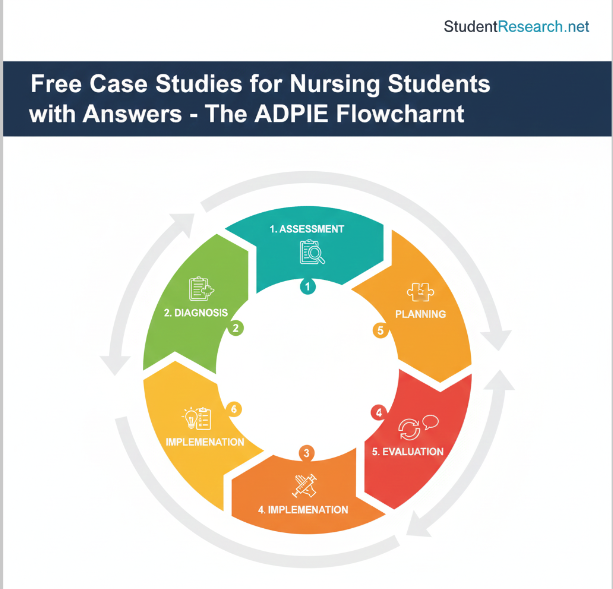
- Case studies walk you through the entire nursing process—from initial patient Assessment to final Evaluation.
- This continuous cycle allows you to practice evidence-based planning and adaptive implementation.
What is Pathophysiology in Context?
- Instead of memorizing disease facts, you see how diseases manifest in a unique patient.
- This contextual learning helps solidify the link between the underlying pathology and the clinical signs/symptoms.
Guide to NCLEX Examination Preparation
The NCLEX-RN is structured to test your clinical judgment, not just your memory. Case studies are the most effective method for preparing for the application-based questions on the exam.
Tired of generic papers? StudentResearch.net guarantees academic rigor! Your complex assignments are handled exclusively by degree-holding experts with Master’s/Ph.D. qualifications in your field. Get the subject matter authority you deserve.
#2:Where to Find Free Case Studies for Nursing Students?
Finding high-quality, reliable learning materials can often feel like a challenge in itself, but there are many excellent free resources available. This section details where to find free case studies for nursing students that come complete with answers and rationales. Knowing how to locate these resources is the essential #2 way to master clinical skills without spending a fortune.
Types of Academic and Institutional Resources
Your own school or local academic institutions are often the best starting point for credible, vetted learning tools. These resources usually require some exploration but yield high-quality content.
University and College Libraries
- Check for access to clinical databases (e.g., CINAHL, UpToDate) which often contain clinical vignettes or teaching scenarios.
- Many university nursing departments publish public educational materials specifically designed for student practice.
Open-Access Nursing Journals
- Look for sections labeled “Teaching Case Reports” or “Clinical Education” in peer-reviewed, open-access journals.
- These sources offer real-world complexity, although they may require more adaptation for self-study.
Professional Nursing Organizations and Health Agencies
Major health organizations frequently provide free, evidence-based examples tailored to specific medical specialties or public health concerns. This is a valuable source for specialized knowledge.
What Does Government Health Agency Websites Offer?
- Sites like the CDC or WHO often feature comprehensive clinical training modules on infectious diseases, disaster preparedness, or public health nursing.
- These resources emphasize protocols, prevention, and population-level care planning.
Ways to Use Educational Technology Platforms
Various non-profit and educational websites are dedicated entirely to providing free clinical scenarios for self-directed student learning.
#3:How to Maximize Learning with Case Studies and Answers
Accessing the case studies is only the first step; the key to true mastery lies in your structured approach to solving them. This section details the steps and strategies for how to maximize learning with case studies and answers, ensuring you gain the maximum benefit from every scenario you tackle. Adopting this rigorous, methodical approach is the #3 way to master clinical skills.
The Steps to Solving a Nursing Case Study
To emulate real clinical practice, you should follow a systematic, step-by-step process before checking the answers. This discipline strengthens your independent judgment.
- Step 1: Initial Assessment and Data Collection: Systematically read and highlight all pertinent information (vitals, history, current complaints, medications).
- Step 2: Identifying Key Problems and Nursing Diagnoses: Formulate relevant NANDA-I diagnoses, ensuring they are based on the assessed patient data.
- Step 3: Planning and Interventions: Determine appropriate nursing goals, expected outcomes, and specific, prioritized actions with rationales.
- Step 4: Evaluation and Comparison: Use the provided answer key to compare your reasoning and identify specific knowledge gaps.
Why is the Answer Key Important?
The answer key should be used as a learning guide and a feedback mechanism, not as a shortcut. Its primary value is in revealing flaws in your reasoning.
Self-Correction and Immediate Feedback
- Instead of simply checking if your answer is correct, focus on why the provided answer is the optimal choice.
- Use the feedback to immediately correct your knowledge or process before moving to a high-stakes clinical setting.
What is the Difference Between an Answer and a Rationale?
- A good resource provides not just the correct answer but a detailed rationale (the why).
- Always seek scenarios that provide in-depth explanations, as these are critical for understanding the evidence-based reasoning.
Worried about originality? StudentResearch.net guarantees 100% unique content, crafted from scratch and delivered with a free plagiarism report. We prioritize your academic integrity and peace of mind. Submit confidently every time!
#4: 5 Examples of Case Studies for Nursing Students
Exposure to a variety of clinical scenarios is critical for developing a comprehensive understanding of patient care across different populations and disease processes. This section provides five essential examples of case studies for nursing students that you should seek out for practice. Practicing these diverse scenarios is the #4 way to master clinical skills.
Example 1: What is Acute Myocardial Infarction (AMI)?
- Focus: Cardiac assessment, EKG interpretation, immediate pharmacological (e.g., nitroglycerin, aspirin) and non-pharmacological interventions.
Example 2: Troubleshooting Type 2 Diabetes Mellitus Exacerbation
- Focus: Patient education on diet and lifestyle, medication management (insulin administration and titration), monitoring for complications like DKA or HHS.
Example 3: Fixing Post-Operative Respiratory Distress
- Focus: Prioritization using the ABC framework, effective pain management strategies, recognizing and rapidly responding to opioid-induced respiratory depression (a common post-surgical complication).
Example 4: When to Intervene in a Pediatric Asthma Flare-up
- Focus: Age-appropriate assessment of respiratory effort, correct use of rescue inhalers and nebulizers, parent/guardian education regarding triggers and prevention.
Example 5: Mental Health Crisis Protocol Explained
- Focus: Therapeutic communication techniques, applying safety protocols for self-harm or aggression, understanding legal/ethical considerations (e.g., involuntary commitment procedures).
#5: Ways to Integrate Case Studies into Your Study Routine
Making case studies a regular, interactive part of your routine enhances retention and deepens critical thinking skills beyond solitary study. This section focuses on ways to integrate case studies into your study routine for maximum long-term impact. Collaboration and practicing documentation are the two most powerful elements of the #5 way to master clinical skills.
Collaborative Learning and Group Discussions
Working through cases with your peers exposes you to different ways of thinking and helps you refine your own clinical reasoning under gentle pressure.
How Do I Use Case Studies in Group Study?
- Assign each group member a different role (e.g., Primary Nurse, Pharmacist, Physician) to argue for specific interventions.
- Use consensus-building to arrive at the optimal care plan, mimicking interprofessional teamwork.
Learn by Teaching the Concepts
- The act of explaining your care plan and rationales to a study partner forces you to articulate your reasoning clearly and logically, which solidifies your understanding.
How to Document and Communicate Patient Status
Clinical competence requires not just excellent care but also clear, professional communication about that care. Use case studies to practice essential documentation skills.
What is a Comprehensive SOAP Note?
- Practice documenting your findings, interventions, and evaluation using the structured Subjective, Objective, Assessment, Plan format based on the case.
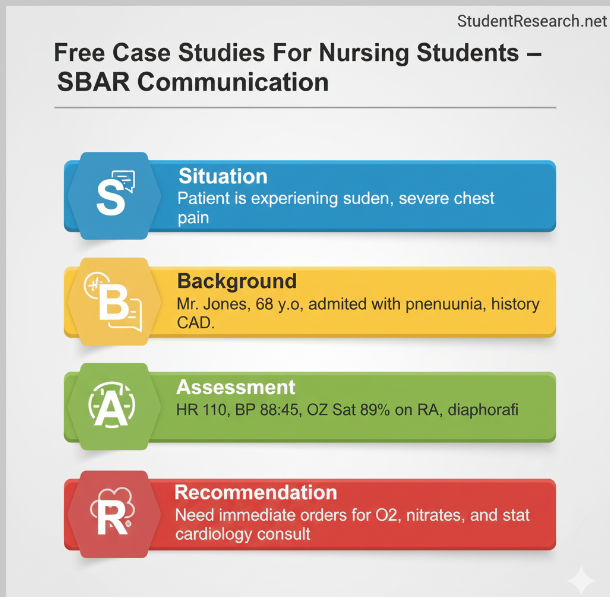
Guide to the SBAR Framework
- Practice verbally communicating the patient’s critical needs and status using the concise Situation, Background, Assessment, Recommendation framework for smooth handoffs.
Conclusion
Case studies are undeniably the single most effective tool for developing clinical judgment—the bedrock of nursing competence. By embracing the five systematic ways discussed—understanding why they matter, knowing where to find them, adopting a structured approach, studying diverse examples, and integrating them into your routine—you equip yourself for success. The wealth of free case studies for nursing students with answers available online is a powerful, accessible resource waiting to be leveraged. Start incorporating a case study into your weekly study plan today to build confidence and truly excel in your clinical rotations and the NCLEX. This way you unlock clinical success with free case studies for nursing students with answers. Learn where to find them, how to maximize your study, and see 5 examples.
Need urgent help at 3 AM? StudentResearch.net offers 24/7 customer support for consultations, revisions, and urgent assistance. We cover every time zone, ensuring international students always have round-the-clock academic backing.

