

Why You Need a Top-Rated Manual BP Cuff Now
The path to becoming a registered nurse is rigorous, and nothing feels more crucial than mastering the core assessment skills. That’s why securing a top-rated manual BP cuff isn’t just a basic requirement; it’s the foundation of clinical competence. A high-quality, calibrated device ensures you get accurate readings in the skills lab and on the hospital floor, building the confidence necessary for safe patient care. For every dedicated blood pressure cuff for nursing students, this initial investment is critical to developing the precise auscultation technique required by instructors.
Where to Buy Your First Reliable Clinical Tool
Your purchasing strategy should prioritize accuracy and reliability over price. Here are the most trustworthy sources for your first clinical tool:
- Medical Supply Stores (Online/Local): These specialized stores carry calibrated, clinical-grade equipment, reducing the risk of purchasing low-quality or inaccurate consumer models that could undermine your training.
- University Bookstores/Program Bundles: Some nursing programs offer pre-selected kits that include a verified, approved cuff and stethoscope, ensuring compliance with strict curriculum standards and guaranteeing quality.
- Trusted Online Retailers: Look for established medical equipment brands on major e-commerce sites, always prioritizing products with high ratings specifically from other healthcare students or practicing professionals.
- Manufacturer Websites: Purchasing directly can sometimes guarantee access to the newest models and direct warranty and calibration support, giving you peace of mind throughout your program.
Manual vs. Digital: Which BP Cuff Type Should You Buy?
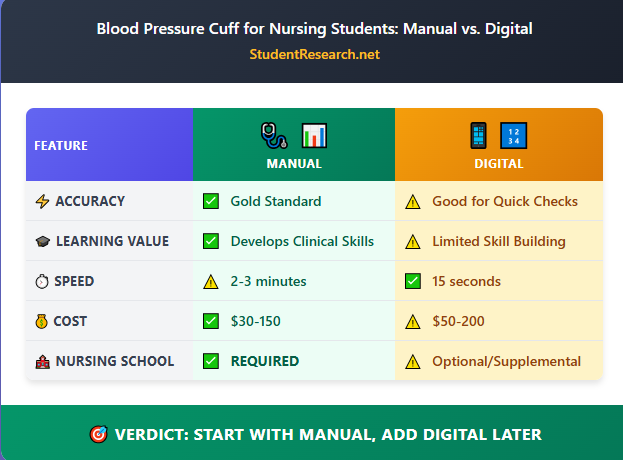
When purchasing a new clinical tool, nursing students must choose between a manual or a digital BP cuff. Your primary tool must be a manual aneroid sphygmomanometer, as nearly all nursing programs require you to master the manual technique of auscultation. This foundational skill is non-negotiable for accurate patient assessment and critical thinking.
The Pros and Cons of Each Type for Nursing Practice
- Nursing programs require manual auscultation to teach the non-negotiable skill of listening for precise Korotkoff sounds, which are the definitive signposts for systolic and diastolic pressure.
- Mastering the manual technique, which is part of effective student research into patient status, cannot be outsourced to a machine.
- Relying solely on a digital device early on will leave you unprepared for critical assessments required by your instructors.
Manual (Auscultatory) Sphygmomanometers: The Gold Standard for Practice
- Benefits: Teaches the fundamental skill of auscultation, relies purely on observation, and is generally considered the most accurate method when performed correctly. It forces you to rely on your senses, a crucial professional skill.
- Components: Requires coordinating an Aneroid gauge (the dial), the cuff and bladder, and a good stethoscope.
- Cons: Requires extensive practice; highly dependent on the operator’s technique and hearing; it is slower than digital.
Digital (Automatic) Cuffs: When to Use Them
- Benefits: Speed, ease of use (one-button operation), and clear digital results, making them ideal for quick self-checks or for helping patients understand their own readings.
- Drawbacks for Students: They rely on oscillometric principles, which can be easily skewed by movement, irregular heart rhythms, or low battery. This can delay the crucial development of manual auscultation skills.
Need help with your next paper? From a five-paragraph essay to a full-scale doctoral dissertation, we cover over 50+ subjects and every academic format (APA, MLA, Chicago, etc.). Let us be your one-stop academic solution! Visit StudentResearch.net today
How to Choose the Right Cuff: Critical Features for Accuracy
Once you commit to a manual sphygmomanometer, you must evaluate its technical features to ensure clinical accuracy. Choosing the right blood pressure cuff involves scrutinizing its components, calibration, and fit, as these factors directly impact patient safety and the reliability of your data. Failing to consider these critical features is a common oversight that can lead to frustratingly inaccurate readings in the clinical setting.
Best Cuff for Specific Arm Sizes and Accurate Readings
- Accuracy in BP measurement is completely dependent on using the correct cuff size for the patient’s arm circumference.
- Using a cuff that is too small leads to falsely high readings, while one that is too large results in falsely low readings, both of which are critical safety risks.
- Ignoring these technical details is a common mistake in initial student research purchases.
The Importance of a Calibrated Gauge.
- Always look for aneroid gauges that display the AAMI (Association for the Advancement of Medical Instrumentation) logo or other regulatory certification.
- Before every single use, physically check that the gauge’s needle rests precisely on the zero mark.
- A gauge that fails to zero is out of calibration and is unreliable, requiring immediate repair or replacement.
Multi-Size Cuffs and Index Marks.
- Ideally, your kit should contain cuffs in two common sizes (Adult and Large Adult), to cover diverse patient populations during practice.
- Ensure the cuff material features clear index and arterial marks.
- These visual guides confirm the cuff is the right fit for the patient’s arm circumference, guaranteeing valid measurement mechanics.
Is It Worth It? Assessing Durability and Materials
Your blood pressure cuff for nursing students will face constant stress—repeated inflation, folding, stuffing into pockets, and frequent cleaning with alcohol or bleach wipes. Durability is a key factor in making your investment worthwhile.
Recommended Bladder Materials (e.g., latex-free, TPU/PVC).
- Choose latex-free materials to avoid triggering patient allergies.
- Bladders made of thick TPU (thermoplastic polyurethane) or PVC are more resistant to punctures and leaks, providing longevity in a fast-paced environment.
Sturdy Valve and Tubing.
- The air release valve (thumb screw) should feel solid and allow for slow, smooth, controlled deflation (the standard 2–3 mmHg per second).
- Flimsy valves often cause the pressure to drop too quickly, leading to inaccurate readings.
- Look for thick-walled, non-kinking tubing for durability.
The Top-Rated Cuff Kits (Stethoscope Combos)
- While the primary focus is the cuff, remember the stethoscope is the complementary tool.
- A high-quality sphygmomanometer paired with a cheap stethoscope will still yield poor results.
- Many top manufacturers offer diagnostic kits where both tools are bundled, often providing superior acoustic quality and reliability for both lung sounds and BP measurement.
Worried about budget creep? Get an instant, all-inclusive quote! Our price guarantees include formatting, bibliography, and title pages for free—with absolutely no hidden charges. Invest in your success with transparent pricing at StudentResearch.net.
The Top 3 Best Blood Pressure Cuffs for Nursing Students (Reviews)
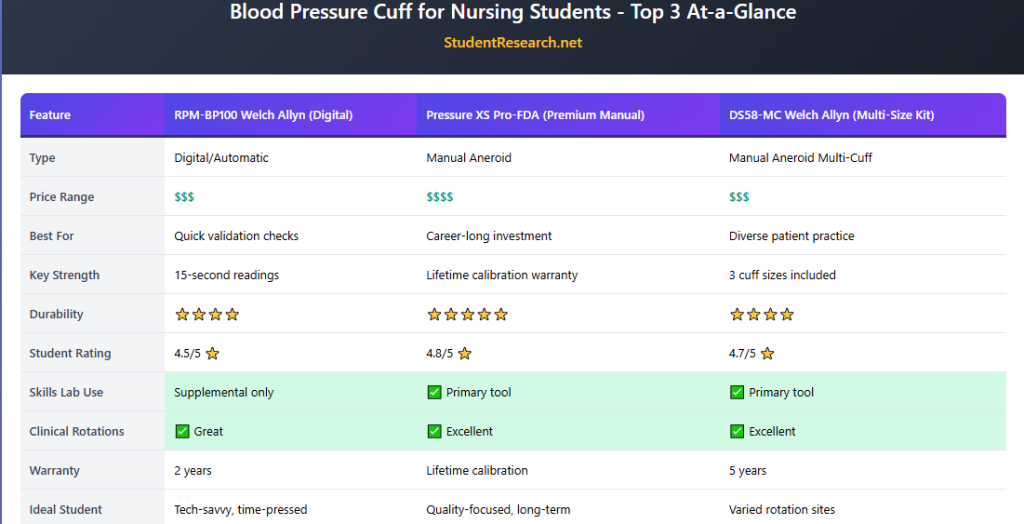
The search for the right tool often comes down to specific needs and budget. This section reviews our top three categories of the best blood pressure cuff for nursing students, balancing affordability, clinical quality, and versatility. These recommendations are categorized to help you quickly find the perfect match for your stage of training.
Recommendation 1: RPM-BP100 Welch Allyn Home Blood Pressure Monitor
- The RPM-BP100 by Welch Allyn (now a part of Hillrom) is often cited for its precision and is an ideal, supplementary digital device.
- While the core focus remains manual, this model offers hospital-grade technology for quick, reliable checks, saving time during non-critical assessments.
- It’s known for reducing measurement variance, making it excellent for clinical use outside of manual skills practice.
- This model represents a blend of ease-of-use and clinical-level assurance, making it a powerful tool for time-sensitive readings.
Key Selling Points:
- Digital Accuracy: Features the same oscillometric technology used in many hospital settings for reliable readings, particularly useful for double-checking manual measurements.
- SureBP Technology: Provides accurate readings in just 15 seconds, significantly faster than traditional manual checks, ideal for busy clinical rotations.
- Connectivity (Optional): Some versions offer Bluetooth connectivity for seamless tracking of readings, aiding in data management for assignments or chronic patient monitoring.
- Durable Design: Constructed to withstand the rigorous demands of frequent use and professional cleaning, unlike many consumer-grade digital cuffs.
Best For:
- Students seeking a highly accurate digital cuff to validate manual measurements or use for quick checks in appropriate settings.
- Clinical rotations where speed and immediate documentation of non-critical vitals are prioritized.
- Programs that integrate digital charting and require advanced data tracking capabilities.
Recommendation 2: Pressure XS Pro-FDA Smart Blood Pressure with VIBRA technology: The Clinical-Grade Investment (Worth the Price)
- FDA-cleared device known for its clinical-grade accuracy, often used as a benchmark for comparison.
- Features “VIBRA Technology” to stabilize readings, minimizing errors caused by movement or subtle technique flaws common among students.
- Constructed with robust, durable materials (metal manometer, heavy-duty valve) designed to withstand rigorous hospital environments and frequent cleaning.
- Backed by a substantial calibration warranty (often lifetime), confirming its commitment to long-term reliability and precision.
- Represents a professional-level investment that saves money over time by eliminating the need for cheaper, inaccurate replacements.
Key Selling Points:
- Lifetime calibration warranty (if applicable), metal manometer housing, precision valve.
Best For:
- Students who plan to use this cuff throughout their career and require top-tier reliability.
Recommendation 3: DS58-MC Welch Allyn DS58 Family Practice Kit-Best Cuff for Diverse Practice (Multi-Size)
- Multi-Size Advantage: This kit is designed for comprehensive practice, including multiple cuff sizes (e.g., child, adult, large adult), which is crucial since cuff size affects reading accuracy dramatically.
- Welch Allyn Durability: Features a robust, shock-resistant aneroid gauge from a trusted clinical brand, ensuring long-term reliability against accidental drops common in busy hospital environments.
- Interchangeable Cuffs: All cuffs are easily and quickly interchangeable on the same gauge, allowing seamless adaptation to a wide variety of patient arm circumferences without carrying multiple sphygmomanometers.
- Ensures Accuracy: Purchasing a multi-size set prevents false high or false low readings that occur when the cuff is incorrectly sized, supporting accurate data collection essential for safe patient care.
- Ideal for Diverse Rotations: Having pediatric, adult, and large adult cuffs prepares students for rotations in family medicine, emergency, or long-term care, where patient demographics are highly varied.
Key Selling Points:
- This versatile option typically includes three separate cuffs (Adult, Large Adult, and often a Small Adult/Pediatric cuff) that all connect easily to a single, high-quality gauge.
- This wide range is vital for accurate reading across different patient demographics and provides a huge advantage during competency check-offs involving varied scenarios.
Best For:
- Advanced students or those wanting maximum preparation for diverse patient populations.
- Practicing on various cuff sizes during training solidifies your understanding of measurement principles, making you a safer, more adaptable clinician immediately upon graduation. This ensures your final selection for a blood pressure cuff for nursing students is fit for any patient arm.
Getting the Best Results: Tips to Maximize Cuff Accuracy
Owning the best blood pressure cuff for nursing students is only half the battle; the other half is flawless technique. Accurate readings depend on strict adherence to protocol, which is why your instructors emphasize practice, practice, practice. Use these actionable tips to maximize the accuracy of your device.
Actionable Tips to Perfect Your Technique
- Brief, actionable advice for new students.
Common Mistakes to Avoid:
- Ensure the patient is seated, feet flat on the floor, and the arm is supported at heart level.
- Pumping too slowly or deflating too quickly (faster than 2–3 mmHg per second) are common errors that cause inaccurate readings.
- Also, be aware of the “auscultatory gap,” a silent interval between the systolic and diastolic pressures that can lead to underestimating systolic pressure.
Environmental Factors:
- Never take a reading over clothing.
- Ensure the patient has rested for at least five minutes prior.
- Caffeine, tobacco, and pain can all temporarily affect BP, so document the context of your reading.
Beyond the Purchase: The Importance of Consistent Practice
- The only way to develop the muscle memory and auditory acuity needed for manual BP is through consistent, real-world application.
- Practice on multiple peers with varying arm sizes to adapt technique to different sound clarity levels.
- The more often you use your blood pressure cuff for nursing students, the faster you will master this vital skill.
Final Verdict: Ready to Order Your Blood Pressure Cuff Online?
Get the Right Cuff and Start Your Clinical Journey
The journey to becoming a competent nurse starts with mastering core clinical skills, and the manual blood pressure measurement technique is paramount. While digital devices offer speed and convenience, your professional development hinges on the accuracy and reliability of an aneroid sphygmomanometer. Prioritize calibration, the correct cuff size, and durable materials, treating this purchase as the first major investment in your clinical career, not just another school supply. Equip yourself! This complete 2025 blood pressure cuff for nursing students buying guide reviews the best manual options, durability, and top kits. Choose wisely, practice diligently, and take confident steps onto the hospital floor.
Facing a crushing deadline? Missed deadlines are simply not an option. We guarantee on-time delivery or your money back, even on the tightest three-hour assignments. Eliminate your pressure instantly with StudentResearch.net.

