
The journey from nursing school student to licensed professional is one of the most exciting, yet challenging, career transitions. While completing rigorous clinical rotations and mastering complex concepts are monumental achievements, the clinical experience alone often doesn’t translate effectively onto a professional document. Hiring managers at top hospitals and healthcare facilities are looking beyond grades and hours logged; they seek demonstrated competence, quantifiable accomplishments, and proof of mastery in critical areas. This is where strategic resume optimization becomes essential. Our goal is to detail the specific nursing student skills for resume use, moving them from vague attributes to measurable achievements. To help you structure your accomplishments, we’ll dive deep into five critical categories—Clinical Proficiency, Communication, Critical Thinking, Leadership, and Technology—all supported by relevant student research and clinical application. By reframing your experiences through this lens, you can ensure your application stands out. Every element, from accurate dosage calculation to the conclusions drawn from thorough student research, must be presented as a valuable professional asset.
Is your research paper lacking authority? Our writers use proprietary databases and premium academic journals for deep-dive research. StudentResearch.net guarantees scholarly, authoritative sources for your most critical assignments.
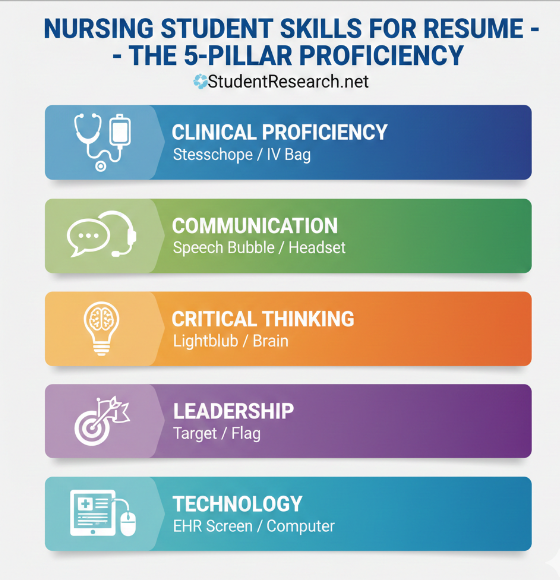
Highlighting Core Clinical Skills for Nursing Students on Your Resume
Clinical skills are the technical foundation of nursing practice, and recruiters prioritize candidates who can demonstrate practical mastery right away. Merely stating “I provided patient care” is insufficient; you must quantify and specify the competencies you honed in simulation labs and hospital environments. This section shows you how to transform your daily clinical tasks into powerful, measurable resume bullet points, proving you are ready for direct patient interaction.
Showcasing Proficiencies in Foundational Nursing Skills
Step #1 Hiring managers need assurance that you can handle standard clinical procedures with precision and confidence from day one.
- Specific Assessment and Monitoring Skills
- Executed comprehensive, systematic head-to-toe physical assessments on 5+ patients per shift, identifying and reporting subtle changes in condition.
- Routinely performed vital sign monitoring, including manual blood pressure assessment and basic telemetry/ECG strip interpretation.
- Utilized standardized tools (e.g., Wong-Baker, FLACC, Braden scale) for accurate pain management and risk assessment.
- Infection Control and Safety Protocols
- Maintained strict adherence to sterile technique during wound care, catheterization, and central line dressing changes.
- Successfully implemented and monitored isolation precautions (contact, droplet, airborne) across various unit types, ensuring unit safety.
- Followed strict needlestick prevention procedures and actively participated in unit safety audits during clinical rotations.
Medication Administration and Management Competence
Step #2 Medication administration is a high-stakes clinical skill. Your resume must prove a diligent, accurate, and safety-focused approach to pharmacology.
- Routes and Calculations
- Consistently demonstrated mastery of the Five Rights of Medication Administration across all patient encounters.
- Accurately calculated and prepared high-risk medications, including continuous IV drips and weight-based dosages, prior to administration.
- Administered medications via all common routes (PO, SubQ, IM, IV push) under direct supervision, meticulously documenting patient response.
- Documentation and Error Prevention
- Gained hands-on experience utilizing automated dispensing cabinets (e.g., Pyxis, Omnicell) for secure medication retrieval and tracking.
- Maintained meticulous electronic health record (EHR) documentation of medication administration times, patient education provided, and any adverse reactions.
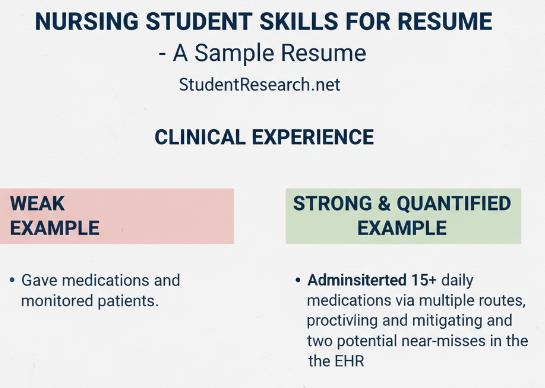
- Proactively identified and reported two potential medication errors/near-misses during clinical observation, showcasing a strong safety focus and proactive attitude.
Soft Skills for Nursing Resume Success: Communication and Interpersonal Abilities
Communication and interpersonal skills are not merely “nice-to-have” traits; they are fundamental safety skills that reduce errors and improve patient outcomes. Effective communication ensures clear therapeutic relationships with patients and seamless collaboration with the interdisciplinary team. By detailing your communication skills, you demonstrate your capacity to handle difficult conversations and provide holistic, patient-centered care.
Mastering Therapeutic Communication and Patient Education
Step #3 Therapeutic communication transforms empathy into professional action, fostering trust and compliance.
- Active Listening and Rapport Building
- Utilized active listening techniques during patient interviews to capture comprehensive psychosocial data and build strong patient rapport.
- Translated complex medical jargon into patient-friendly, accessible language to facilitate informed consent and treatment adherence.
- Demonstrated cultural competence by tailoring communication styles and educational materials for diverse patient populations.
- Conflict Resolution and De-escalation
- Managed difficult patient and family conversations with professionalism, maintaining neutrality and focused listening.
- Employed verbal de-escalation techniques in high-stress, agitated environments to protect both patient and staff safety.
Inter-Professional Communication and Handoffs
Step #4 The ability to communicate clearly with colleagues is critical to continuity of care and preventing handoff errors.
- SBAR/ISBAR Communication Protocol
- Executed proficient and concise handoffs using the standardized SBAR (Situation, Background, Assessment, Recommendation) framework during shift change.
- Efficiently communicated critical patient status changes (e.g., vital sign instability) to attending physicians and supervisory staff, prompting timely orders.
- Effective Documentation of Verbal Orders (Verbal/Telephone)
- Accurately transcribed and verified verbal or telephone orders in compliance with hospital policy (read-back verification).
- Documented follow-up actions and confirmed resolution of critical lab results, ensuring complete record keeping.
Critical Thinking in Nursing: The Problem-Solving Skills Employers Demand
Critical thinking is the engine of the professional nurse, allowing for rapid, evidence-based decision-making in unpredictable environments. Instead of simply following orders, a critical thinker synthesizes assessment data to identify priority problems and anticipate potential complications. Highlight your capacity to move beyond textbook knowledge to apply the nursing process effectively under pressure.
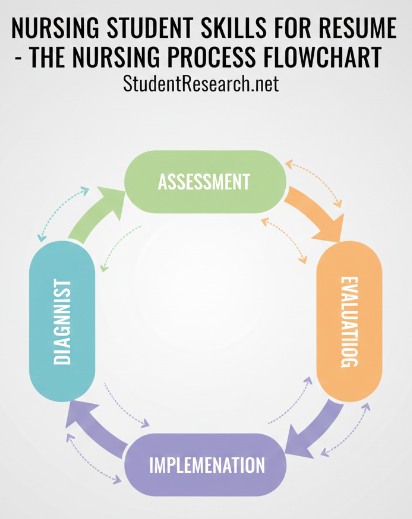
Applying the Nursing Process (Assessment to Evaluation)
Step #5 Systematic application of the nursing process showcases structured, goal-oriented care delivery.
- Prioritization and Time Management
- Successfully triaged patient tasks based on acuity (using Maslow’s Hierarchy and ABCs) to maximize safety and efficiency in a busy clinical setting.
- Efficiently managed holistic care plans for multiple assigned patients during clinical rotations, meeting all scheduled timelines and procedures.
- Data Synthesis and Clinical Judgment
- Identified subtle, worsening changes in patient status (e.g., increased respiratory effort) and proactively initiated appropriate, non-provider-dependent interventions.
- Formulated evidence-based nursing diagnoses by synthesizing subjective and objective data from patient assessments and laboratory results.
Handling High-Stress and Emergency Situations
Step #6 Recruiters look for calm, competent responders who can perform under extreme stress.
- Rapid Response and Delegation
- Participated actively in clinical simulation scenarios involving mock codes and rapid response team activation, demonstrating quick, organized action.
- Maintained current Basic Life Support (BLS) certification and contributed as an effective team member during simulated crises.
- Resource Utilization and Problem Solving
- Utilized unit resources (e.g., charge nurse, policy manuals) to quickly resolve unforeseen patient care issues or equipment malfunctions.
- Collaborated with social work and case management to identify and address systemic barriers to patient discharge or recovery goals.
Leadership and Teamwork: Demonstrating Collaboration and Initiative
Healthcare operates via teamwork, making the ability to collaborate, delegate safely, and take initiative essential for success. Demonstrating leadership potential, whether in a formal role or through professional advocacy, proves you are committed to improving unit function and patient care quality.
Evidence of Professional Leadership and Initiative
Step #7 Show how you have stepped up outside of the basic requirements of your clinicals.
- Mentorship and Delegation
- Provided mentorship and guidance to first-year nursing students during shared clinical time, enhancing their foundational understanding of unit flow.
- Successfully and safely delegated appropriate tasks to unlicensed assistive personnel (UAP), ensuring patient safety and regulatory compliance.
- Advocacy and Professional Engagement
- Served as an active member and committee representative within the Student Nurses Association (NSNA), contributing to educational programming.
- Acted as a strong patient advocate, ensuring patient rights were honored and voicing concerns about care delivery to the appropriate team members.
Teamwork and Accountability
Step #8 The resume should reflect reliability, ethical behavior, and a dedication to continuous professional growth.
- Constructive Feedback and Continuous Improvement
- Regularly sought and constructively utilized feedback from clinical instructors and preceptors to enhance technique and clinical judgment.
- Demonstrated professional accountability by promptly reporting and reflecting on errors or near-misses during clinical post-conference.
- Maintaining a Positive Professional Demeanor
- Contributed positively to the clinical environment by supporting team members and maintaining an adaptable, professional attitude across various rotations.
Technology and Documentation: EHR Competence for Nurses
In the modern hospital, digital literacy is a mandatory hard skill. Employers need assurance that new graduates can navigate Electronic Health Records (EHRs) efficiently and maintain compliance with data security protocols. Listing specific system experience (Epic, Cerner, etc.) is a major advantage.
Electronic Health Record (EHR) Proficiency and Documentation
Step #9 Proving familiarity with core EHR functions saves orientation time and improves accuracy.
- Data Entry and Retrieval
- Demonstrated proficiency in accurate and timely charting of assessments, interventions, and patient education within the EHR system (specify: Epic, Cerner, etc.).
- Efficiently accessed and reviewed patient medical history, laboratory values, imaging reports, and consultant notes to inform care planning.
- Order Entry and Verification
- Competently entered and verified medication and diagnostic orders following proper procedures within the EHR.
Healthcare Informatics and Digital Literacy
Step #10 Showcasing an understanding of technology beyond basic charting proves future readiness.
- Telehealth and Remote Monitoring
- Gained basic familiarity with telehealth platforms and virtual visit protocols (if applicable).
- Maintained strict adherence to HIPAA and organizational policies related to patient data security and digital privacy.
- Utilization of Clinical Tools
- Utilized point-of-care documentation devices (e.g., WOWs, handheld scanners) for patient identification and real-time charting.
- Proficiently used clinical decision support tools and digital drug references (e.g., UpToDate, Lexicomp) to verify clinical information.
Conclusion
The transition from student to professional is defined not just by certification, but by the ability to strategically articulate your value on paper. A truly effective resume successfully blends hard clinical nursing student skills for resume use—like sterile technique and complex calculations—with essential soft and cognitive abilities, such as leadership and professional communication. Remember, recruiters are not just reviewing a list of tasks; they are looking for a future colleague. To stand out, you must be quantifiable: use strong action verbs and specify your achievements (e.g., “managed 5 patients,” “reduced risk of x by doing y”). Master essential nursing student skills for resume success. Learn to showcase clinical competence, critical thinking, EHR proficiency, and leadership potential. By detailing your proficiencies across these five core pillars, you effectively showcase your readiness for a demanding and rewarding career. Now that you have this strategic framework, the next step is implementation. Download our exclusive resume template below or seek a professional review to maximize your chances of securing that vital first interview.
Tired of average grades dragging you down? StudentResearch.net connects you with expert writers dedicated to crafting original, top-tieracademic work guaranteed to elevate your grade profile. Achieve the marks you need today!

