

Embarking on a healthcare career is a noble pursuit, but navigating nursing fees in USA for international students can feel like an overwhelming challenge. Many aspiring nurses find that the financial landscape of American education is complex, yet understanding it is the first step toward a successful academic career. Whether you are aiming for a Bachelor of Science in Nursing (BSN) or a specialized certification, having a clear financial roadmap is essential for your success. At student research, we emphasize that preparation is key to turning your educational dreams into reality without compromising your financial stability.
The United States offers world-class clinical training and cutting-edge medical research opportunities, but these benefits come with significant price tags that require careful planning and foresight. By taking control of your financial planning early, you ensure that your focus remains on your clinical studies and patient care skills rather than on unexpected bills. This guide is designed to empower you with the clarity you need to thrive.
Understanding the Real Cost of Nursing School in the USA
Understanding the true financial commitment of your education is essential for long-term planning and peace of mind. Many international students underestimate the total cost by focusing only on tuition, ignoring the broader economic factors involved in American higher education. By breaking down these costs early, you can determine which programs align with your available resources and future goals. Developing a realistic budget requires deep analysis of institutional data and regional economic variations. Through diligent student research, you can identify the core competencies required to provide safe and effective care in diverse healthcare settings, but you must also balance these ambitions with your financial capacity.
Comparing Public University vs. Private College Rates
- Public Universities: Generally offer lower tuition rates for in-state residents, but international students often pay non-resident fees that bridge the gap toward private costs.
- Private Colleges: Often carry a higher “sticker price,” but they may offer more robust institutional scholarship packages that can reduce the overall cost significantly.
- Regional Variance: Fees fluctuate wildly between states; studying in a rural area often reduces your cost of living compared to major metropolitan hubs.
Calculating the Full Financial Commitment
- Tuition: The base rate for your credit hours.
- Registration Fees: Often mandatory per semester, regardless of the number of classes taken.
- Living Expenses: Housing, food, transport, and utilities that must be factored into your annual budget.
Additional Expenses: The “Hidden” Costs Checklist
Beyond the advertised tuition, international students often overlook the operational costs of maintaining their student status and clinical readiness. These expenses are rarely included in promotional brochures but are non-negotiable requirements for your participation in the program. Preparing for these costs now will prevent budget shortfalls during your most intensive clinical semesters. It is vital to categorize these as “non-negotiable” expenses in your financial spreadsheet.
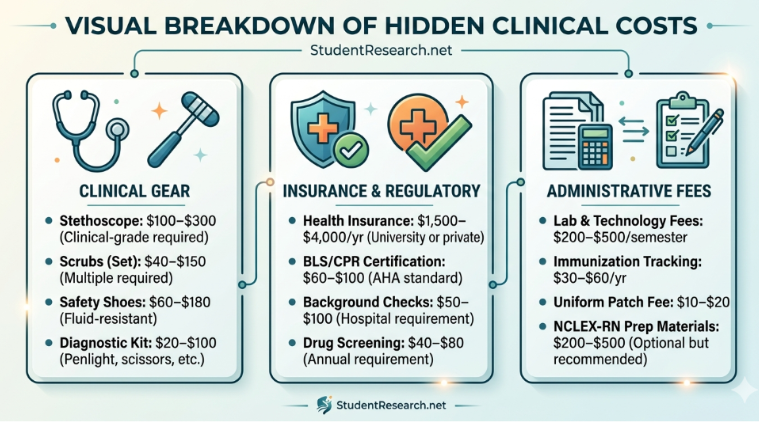
Mandatory Clinical Gear: Why Quality Matters
Clinical equipment is an investment in your safety and the quality of care you provide. You are not just buying tools; you are purchasing instruments that allow you to assess patients accurately and maintain hospital standards.
- Clinical-Grade Stethoscopes: Unlike basic models, clinical-grade stethoscopes are designed with high acoustic sensitivity. They are required for accurate cardiac auscultation, allowing you to differentiate between subtle heart sounds and lung murmurs during patient assessments.
- Professional Scrubs and Uniforms: Programs require specific uniforms to maintain infection control standards and ensure you are easily identifiable by patients and staff within the hospital environment.
- Supportive Footwear: Nursing involves long shifts on your feet. You must invest in fluid-resistant, closed-toe shoes that provide arch support to prevent musculoskeletal injuries and satisfy hospital safety protocols regarding blood and fluid protection.
- Diagnostic Kits: These include penlights (for neurological checks), medical shears (for dressing changes), and reflex hammers. These tools must be reliable, as you will use them multiple times throughout every clinical rotation.
Don’t let academic pressure dim your nursing aspirations. Access professional, expert-crafted nursing resources at StudentResearch.net. We specialize in nursing-specific content that ensures you meet every clinical standard and academic deadline with ease and confidence.
Estimated Cost Comparison: Standard vs. High-End Gear
When budgeting for your clinical kit, use this table to plan for the variety of price points you will encounter.
| Item | Standard Cost (USD) | High-End Cost (USD) | Why the Difference? |
| Stethoscope | $50 – $80 | $150 – $300 | Acoustic quality & durability |
| Scrubs (Set) | $40 – $60 | $100 – $150 | Fabric quality & antimicrobial tech |
| Safety Shoes | $60 – $90 | $120 – $180 | Ergonomic support & fluid resistance |
| Diagnostic Kit | $20 – $40 | $60 – $100 | Material longevity & illumination brightness |
Mandatory Regulatory and Compliance Costs
Before you are cleared to walk into a hospital unit, you must prove you meet the high safety and health standards of the institution. These are administrative fees that occur before and during your program.
- Background Checks & Fingerprinting: To ensure patient safety, hospitals require rigorous criminal background checks. These services often involve third-party processing fees that the student must pay upon entry and sometimes annually.
- Immunization Tracking Services: Nursing schools require you to upload your medical history, vaccination records, and titer results to an encrypted online database. There is typically a recurring subscription fee for these tracking platforms.
- BLS/CPR Certification: The American Heart Association (AHA) Basic Life Support (BLS) certification is a universal requirement. You will need to take this course before your first clinical rotation, and you will likely need to renew it every two years, incurring a recurring registration fee.
- Licensing and Exam Prep: While these occur closer to graduation, you should begin setting aside funds for your NCLEX-RN preparation course and the eventual state board of nursing registration fees.
3 Major Tuition Models for International Nursing Students
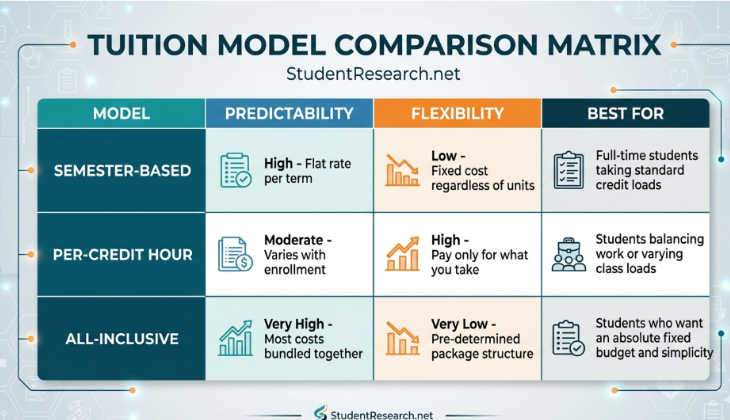
Different universities utilize various billing structures, and knowing how your specific school charges for credits will dramatically change your payment strategy. Some programs utilize a flat-rate model, while others charge based on the specific number of credit hours you enroll in each semester. Being aware of these models helps you avoid the shock of “surprise” bills when you add an elective or clinical rotation. Understanding these frameworks is a critical skill for any prospective student.
The Semester-Based Payment Structure
- Predictability: You pay a fixed amount each semester, making it easier to plan your finances months in advance.
- Course Load: This model often benefits students taking a full course load, as “extra” credits may not cost more.
Per-Credit Hour Pricing Explained
- Flexibility: You only pay for what you take, which is ideal if you are balancing part-time work or reducing your load.
- Complexity: Requires careful scheduling to ensure you finish your degree within your desired timeframe without accumulating late fees.
All-Inclusive Program Packages
- Bundled Costs: Includes tuition, lab fees, and sometimes even textbooks in one price.
- Transparency: Reduces the ambiguity of hidden fees, though the initial total might appear higher than a la carte pricing.
5 Proven Ways to Finance Your Nursing Degree Abroad
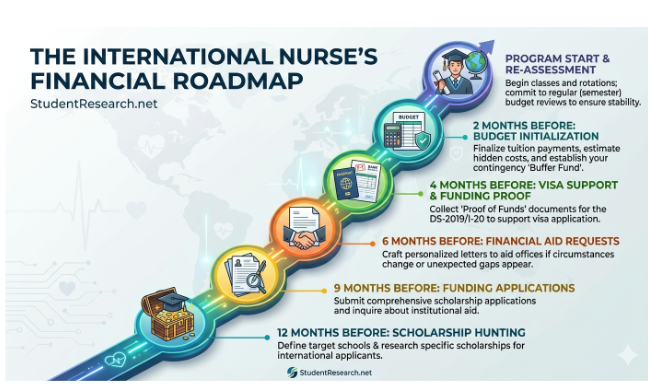
Financing an international nursing degree requires a proactive, multi-pronged approach that combines internal aid, external opportunities, and strategic planning. Most successful students do not rely on a single source of income; rather, they weave together savings, scholarships, and grants to create a stable financial cushion. By prioritizing student research into available funding streams at least 12 months before your intended start date, you position yourself to capture opportunities that others might miss.
The Scholarship Ecosystem: Understanding Your Options
Scholarships are the most sought-after funding source, but they are not one-size-fits-all. Understanding the specific categories helps you target your applications effectively.
- Merit-Based Scholarships: These are awarded based on your academic achievements, such as a high GPA, standardized test scores, or leadership roles. Universities often auto-consider applicants for these during the admission process, but some require separate applications.
- Need-Based Scholarships: These focus on your financial background. While international students often cannot file for federal aid in the USA, many universities have institutional “need-aware” or “need-blind” policies for international applicants. Always check the financial aid portal for “international student grants.”
- Professional-Based Scholarships: These are provided by nursing associations and healthcare foundations. Organizations like the American Association of Colleges of Nursing (AACN) or the Sigma Theta Tau International Honor Society of Nursing occasionally offer grants. These often require a commitment to a specific area of practice or proof of enrollment in an accredited program.
Navigating F-1 Visa Work Restrictions
Working while studying is a critical component of many financial plans, but international students must strictly adhere to U.S. Citizenship and Immigration Services (USCIS) regulations regarding F-1 visas.
- On-Campus Employment: You are permitted to work on-campus for up to 20 hours per week while school is in session and full-time during official school breaks. This includes jobs in the university library, cafeteria, or administrative offices.
- Curricular Practical Training (CPT): This allows you to work in a position that is an integral part of your curriculum (e.g., a required clinical internship). It requires approval from your university’s International Student Office and must be directly related to your nursing major.
- Optional Practical Training (OPT): This is typically used after completing your degree to work in your field for up to 12 months (or longer for STEM-designated programs). It allows you to gain real-world experience while earning a professional salary.
Pro-Tip: How to Negotiate Financial Aid
If your financial circumstances change (e.g., a family emergency, currency fluctuation, or loss of a sponsor), you have the right to request a financial aid review. Do not be afraid to reach out to the financial aid office; they often have mechanisms to assist students in good standing.
- Drafting Your Request: Be professional, concise, and objective.
- Subject: Request for Financial Aid Review – [Your Name] – [Student ID]
- Body: Briefly explain the change in your financial status. Attach documentation (e.g., proof of job loss or medical bills). Emphasize your commitment to the program and your academic success.
- The Follow-Up: If you do not hear back within 10 business days, send a polite follow-up email. Persistence, when coupled with professionalism, is a core value we promote in our student research initiatives.
External Grants and Nursing-Specific Funding
Do not limit yourself to what your university offers. The broader healthcare industry is invested in training the next generation of nurses.
- Global Health Foundations: Look for NGOs that sponsor students from specific regions to study healthcare in the West, with the goal of the student returning home to improve local health systems.
- Corporate Sponsorship: Some large healthcare systems offer tuition reimbursement or “sign-on” bonuses in exchange for a commitment to work at their facility post-graduation.
Strategies for Lowering Your Annual Nursing Education Expenses
Managing your day-to-day costs is just as important as securing tuition funding. Small, strategic changes to your lifestyle and academic planning can result in thousands of dollars of savings over the course of your degree. We encourage you to review resources like Nursing Jobs for International Students in USA to see how you can gain practical experience while simultaneously offsetting your living costs. This approach not only aids your budget but enhances your resume.
Maximizing Cost-of-Living Savings
- Housing: Opt for student housing or shared apartments near campus to utilize public transit rather than owning a vehicle.
- Meal Planning: Cooking at home is significantly cheaper than campus dining plans.
Leveraging Off-Campus Housing Options
- Subletting: Consider subletting from seniors who are moving for clinical rotations.
- Negotiation: If you sign a longer lease, ask for a discount or inclusive utilities.
Strategic Part-Time Work (CPT/OPT)
- Work Authorization: Ensure you fully understand your visa regulations regarding Curricular Practical Training (CPT) and Optional Practical Training (OPT).
- Career Integration: Seek roles that align with healthcare, such as patient care technician positions, which boost your clinical skills.
Start Your Journey: Creating a Personalized Financial Plan
You are now equipped with the knowledge to build a robust financial plan for your nursing education. A structured approach turns the abstract fear of “debt” into a manageable, measurable goal. For further guidance on setting objectives throughout your academic tenure, refer to Clinical Goals for Nursing Students, which will help you align your professional milestones with your financial ones. With careful planning, your path to becoming a licensed nurse in the USA is well within reach.
Focus on what truly matters: patient care. StudentResearch.net provides customized, high-quality nursing writing support that fits your busy schedule perfectly. Visit our site now to order your professional nursing guide and elevate your academic success today!
How to Build Your 4-Year Budget Spreadsheet
- Categorization: Split costs into Tuition, Rent, Food, Travel, and Miscellaneous.
- Contingency Fund: Always add a 10-15% buffer for emergency expenses.
When to Apply for Financial Review
- Timely Requests: Submit your financial aid documentation at least 6 months before the academic year starts.
- Annual Re-Assessment: Review your budget every semester to adjust for inflation or changes in your employment status.
A Practical Example: The 12-Month Financial Snapshot
To make these abstract figures tangible, consider the case of Aisha, an international nursing student living in a mid-sized U.S. city. Aisha’s budget is structured to prioritize her academic goals while maintaining a safety net for unexpected costs. Through her own student research, she determined that living off-campus and utilizing bulk-cooking strategies would be the most effective way to stretch her limited funds.
Sample Monthly Budget Breakdown (Aisha’s Plan)
| Expense Category | Monthly Cost (USD) | Strategy/Notes |
| Tuition (Amortized) | $1,200 | Based on annual cost divided by 12 months |
| Rent (Off-Campus) | $650 | Shared room to save 20% vs. campus dorms |
| Groceries | $300 | Bulk buying & cooking at home |
| Health Insurance | $150 | University-negotiated group rate |
| Books & Supplies | $100 | Digital versions & library rentals |
| Buffer/Misc Fund | $150 | Emergency fund for unexpected needs |
| Total Monthly Spend | $2,550 |
Analyzing the Variables in Aisha’s Budget
Aisha’s financial plan is successful because it is built on deliberate lifestyle choices rather than wishful thinking. She opted for off-campus housing, which allowed her to save 20% on rent compared to standard dormitory rates, and she strictly adheres to a “home-cooking” rule to keep her grocery bill under $300. By amortizing her annual tuition into a monthly figure, she avoids the panic of trying to find large lump sums of money when semesters begin. Perhaps most importantly, the $150 “Buffer Fund” acts as an insurance policy for her mental health; having a dedicated safety net means she can focus entirely on her clinical skills without the paralyzing anxiety of immediate financial collapse. This level of granular planning is a hallmark of the successful international nursing student.
Conclusion: Planning Your Financial Roadmap
Taking the first step toward your degree is a bold commitment to your future. By rigorously mapping out your finances, you remove the barriers that might otherwise stand in your way. Discover nursing fees in USA for international students with our 7-step guide. Learn to budget for tuition, living costs, and funding to start your journey. We hope this roadmap serves as a foundation for your student research and helps you graduate with confidence. Success in nursing school is not just about passing exams; it is about managing your life so you can focus on the care you are destined to provide.

