

Mastering the art of clinical feedback is the bridge between a novice learner and a seasoned professional, yet many instructors and preceptors find themselves staring at a blank page when it’s time to sign off on a rotation. Whether you are an educator looking to inspire or a learner seeking to understand your progress, using the right sample nursing student evaluation comments can transform a standard assessment into a powerful roadmap for professional growth. This guide provides actionable examples and strategic insights to ensure every evaluation is constructive, objective, and inspiring.
Navigating the Essentials of Nursing Student Clinical Evaluations
Effective clinical evaluations serve as a permanent record of a student’s competency, safety, and professional behavior during their hospital rotations. By utilizing high-quality nursing student evaluation comments, educators can provide specific evidence of a student’s ability to apply classroom theory to real-world patient care. This section explores the foundational components that make an evaluation both fair and legally sound for academic records.
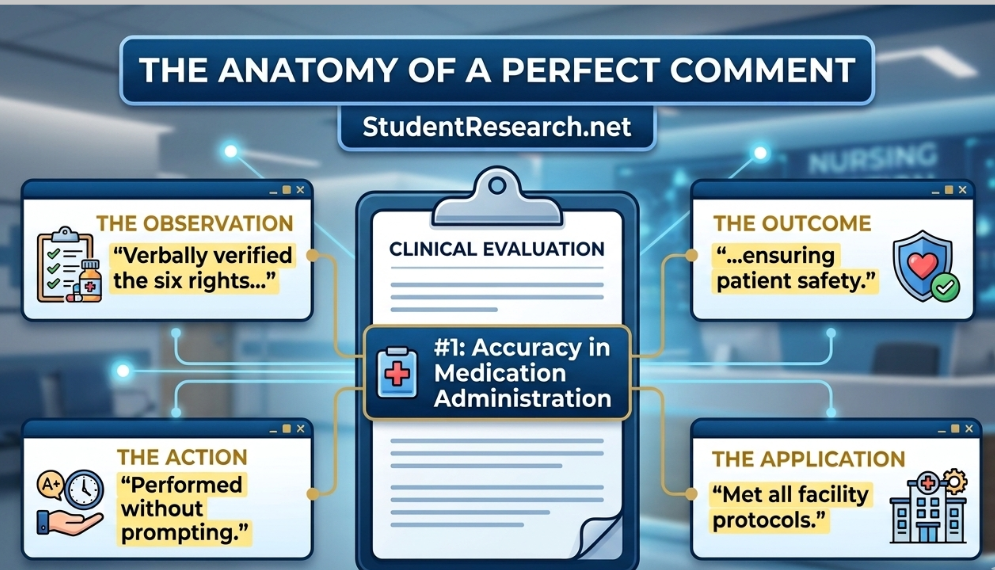
The Core Pillars of Constructive Feedback
- Objectivity: Focusing on observable behaviors rather than personality traits.
- Specificity: Identifying exact instances where clinical skills were demonstrated.
- Actionability: Providing a clear path for the student to improve in future rotations.
Detailed Breakdown of the 26 Evaluation Categories
To ensure these nursing student evaluation comments are effective, they must be backed by specific observations. Use the following expanded bullet points to provide context for each numbered evaluation point.
Clinical Competence and Safety (Comments #1 – #5)
- #1: Accuracy in Medication Administration
- Verifies patient identity using two unique identifiers before every administration.
- Demonstrates pharmacological knowledge by explaining drug indications and side effects to the patient.
- Correctly calculates dosage for complex IV medications without assistance.
- Maintains a distraction-free “no-interruption zone” during med-pass.
- Poorly Scripted: “Gave meds correctly.”
- Reason: This lacks evidence of the “six rights” or safety protocols followed.
- #2: Documentation Precision
- Charts real-time assessments, ensuring data is entered immediately after patient contact.
- Uses professional medical terminology and approved abbreviations exclusively.
- Notes reflect clear clinical changes, such as shifts in vital signs or mental status.
- Ensures all entries are signed and dated according to facility policy.
- Poorly Scripted: “Documentation was fine.”
- Reason: “Fine” is subjective and doesn’t confirm if the student met legal charting standards.
- #3: Prioritization of Patient Safety
- Maintains the clinical environment by keeping walkways clear and call lights within reach.
- Consistently performs hand hygiene before and after every patient interaction.
- Identifies potential environmental hazards, such as frayed equipment cords or spills.
- Properly applies PPE according to isolation precaution signage.
- Poorly Scripted: “Student is very safe.”
- Reason: Safe is a broad conclusion; it needs specific examples like hand hygiene or fall prevention.
- #4: Assessment Proficiency
- Performs systematic head-to-toe assessments within the first hour of the shift.
- Correctly identifies and reports “red flag” symptoms like asymmetric pupils or crackles.
- Tailors the physical exam to the patient’s specific admitting diagnosis.
- Utilizes appropriate tools (e.g., bladder scanner, Doppler) to confirm findings.
- Poorly Scripted: “Did a good physical exam.”
- Reason: Fails to specify if the assessment was systematic or if findings were accurate.
- #5: Emergency Response
- Recognizes early signs of physiological distress, such as tachycardia or tachypnea.
- Communicates clearly using SBAR during urgent situations.
- Locates and prepares the emergency crash cart or suction equipment quickly.
- Provides support to the primary nurse by performing chest compressions or recording events.
- Poorly Scripted: “Handled the code well.”
- Reason: Does not explain the student’s specific role or actions during the emergency.
Professionalism and Communication (Comments #6 – #8)
- #6: Interdisciplinary Collaboration
- Participates actively in “huddle” meetings to discuss patient discharge goals.
- Respectfully questions orders when they conflict with a patient’s known allergies.
- Coordinates with Physical Therapy to ensure patient pain is managed before sessions.
- Uses a professional tone when speaking with all members of the healthcare team.
- Poorly Scripted: “The team liked the student.”
- Reason: Focuses on likability rather than the professional skill of interdisciplinary coordination.
- #7: Therapeutic Communication
- Adjusts communication style to meet the developmental level of the patient.
- Uses non-verbal cues, such as eye contact and posture, to show engagement.
- Explains procedures in “layman’s terms” to ensure patient understanding.
- Provides emotional support during difficult diagnoses without giving false reassurances.
- Poorly Scripted: “Talks nicely to patients.”
- Reason: “Nicely” is not a clinical term; “therapeutic” implies a specific skill set with measurable outcomes.
- #8: Ethical Practice
- Ensures curtains are closed and patients are covered during bedside procedures.
- Refuses to share computer login credentials, adhering to IT security policies.
- Discusses patient cases only in private, clinical areas to protect HIPAA.
- Identifies when a patient’s autonomy is at risk and escalates to the preceptor.
- Poorly Scripted: “Is a good, ethical person.”
- Reason: Evaluations should judge professional behavior, not a person’s character or soul.
Quantitative Insights: Impact of Detailed Feedback on Student Retention
The quality of feedback received during clinical rotations is directly correlated with a student’s confidence and their likelihood of persisting in a nursing program. Data suggests that when nursing student evaluation comments are specific and timely, students are better equipped to overcome the “clinical gap.” The following table illustrates how structured feedback compares to generalized comments in various educational metrics.
Comparison of Feedback Styles and Student Outcomes
| Metric | Generalized Feedback (e.g., “Good Job”) | Structured Evaluation Comments |
| Student Retention Rate | 72% | 89% |
| Skill Acquisition Speed | Moderate | High |
| Clinical Confidence Score | 6.2/10 | 8.8/10 |
| NCLEX Pass Rate Correlation | Weak | Strong |
Strategies for Improving Student Research and Evidence-Based Practice
Integrating student research into clinical practice is a hallmark of a high-performing nursing student who looks beyond the “how” and asks the “why.” Evaluations should highlight when a student utilizes current literature or hospital protocols to justify their clinical decisions. Encouraging this habit through nursing student evaluation comments fosters a culture of continuous learning and evidence-based care.
Evidence-Based Practice and Research (Comments #9 – #12)
- #9: Application of Research
- Cites student research from peer-reviewed journals to support clinical interventions.
- Questions “we’ve always done it this way” mentalities using current data.
- Shares recent findings on catheter-associated UTI prevention with the unit staff.
- Applies a standardized “bundle” of care based on recent clinical guidelines.
- Poorly Scripted: “Likes to read about nursing.”
- Reason: Reading is a hobby; applying research to a patient is a clinical competency.
- #10: Protocol Adherence
- Double-checks the hospital policy manual before performing a new skill.
- Follows the “Chain of Command” when a clinical discrepancy arises.
- Adheres strictly to the facility’s skin breakdown prevention protocol.
- Ensures all verbal orders are read back and verified as per policy.
- Poorly Scripted: “Followed the rules.”
- Reason: Too vague; doesn’t specify which protocols (safety, clinical, or administrative) were met.
- #11: Inquiry-Based Learning
- Asks high-level “what if” questions regarding patient pathology.
- Seeks out the pathophysiology behind a patient’s laboratory results.
- Inquires about the rationale for specific medication titrations.
- Requests feedback after performing skills to refine their clinical technique.
- Poorly Scripted: “Asks a lot of questions.”
- Reason: Quantity of questions doesn’t equal quality. “Inquiry” suggests a focused search for knowledge.
- #12: Problem Solving
- Anticipates patient needs before they become urgent (e.g., preparing PRN meds).
- Troubleshoots malfunctioning equipment like IV pumps or monitors effectively.
- Suggests alternative methods for patient comfort when standard care is ineffective.
- Prioritizes tasks independently when managing multiple patient needs.
- Poorly Scripted: “Fixed things when they broke.”
- Reason: Too informal; lacks the professional framing of “critical thinking” or “troubleshooting.”
Formulating Remediation (Comments #13 – #14)
- #13: Time Management Concerns
- Focuses on minor tasks while delaying high-priority assessments.
- Struggles to organize the “brain sheet” for more than one patient.
- Requires frequent prompting to stay on schedule with medication passes.
- Fails to delegate or ask for help until tasks are overdue.
- Poorly Scripted: “The student is slow.”
- Reason: This is insulting rather than constructive. It doesn’t explain why or how to improve.
- #14: Communication Barriers
- Omitted vital information (e.g., new lab results) during the shift hand-off.
- Avoids eye contact or direct communication with the primary nurse.
- Does not provide clear instructions to patients regarding their care plan.
- Uses medical jargon that confuses patients and their family members.
- Poorly Scripted: “Bad at talking.”
- Reason: Lacks specificity regarding whether the issue is with patients, peers, or reporting.
Self-Evaluation and Reflection (Comments #15 – #16)
- #15: Goal Setting
- Identifies three specific skills to master by the end of the clinical rotation.
- Seeks out learning opportunities that align with their professional interests.
- Tracks progress toward personal clinical benchmarks throughout the semester.
- Adjusts goals based on mid-term evaluation feedback.
- Poorly Scripted: “Has goals.”
- Reason: Doesn’t explain if the goals are realistic, clinical, or being pursued.
- #16: Insight into Practice
- Describes the “lessons learned” after a challenging clinical encounter.
- Accurately identifies their own strengths and areas for future growth.
- Shows awareness of how their personal biases might affect patient care.
- Accepts constructive criticism without becoming defensive.
- Poorly Scripted: “Knows what they did wrong.”
- Reason: Sounds punitive. “Insight” is about the cognitive process of reflection, not just admitting a mistake.
Comparing Preceptor vs. Faculty Perspectives in Evaluations
There is often a slight variance in how bedside preceptors and clinical faculty view student performance, which can be reflected in the sample nursing student evaluation comments provided. While preceptors focus on task-oriented efficiency and teamwork, faculty often prioritize the application of theoretical concepts and nursing diagnoses. The T-table below compares these two essential viewpoints.
Perspectives on Clinical Performance
| Feature | Preceptor Focus (Clinical Site) | Faculty Focus (Academic) |
| Priority | Safety and Workflow Integration | Theory-to-Practice Linkage |
| Communication | “Handoff” and Team Rapport | Documentation and Care Planning |
| Skill Assessment | Efficiency and Speed | Technique and Rationale |
| Expectation | “Acts like a Nurse” | “Learns like a Student” |
Advanced Evaluation Comments for High-Achieving Students
For the student who consistently exceeds expectations, standard nursing student evaluation comments may feel inadequate to describe their contribution to the unit. These comments should emphasize leadership, complex critical thinking, and a proactive approach to patient care that goes beyond the basic requirements of the syllabus. Highlighting these traits helps these students stand out for future residency programs or student research fellowships.H3: Leadership and High Achievement (Comments #17 – #26)
#17: Exemplary Leadership
Volunteers to lead the post-clinical conference or student group discussion.
Models professional behavior for junior nursing students on the unit.
Coordinates peer support when the unit becomes exceptionally busy.
Takes initiative to restock supplies or assist the unit clerk during downtime.
Poorly Scripted: “A natural leader.”
Reason: “Natural” suggests it’s an unearned trait; evaluation should reward active leadership behaviors.
#18: Complex Care Management
Balances the care of patients with conflicting needs (e.g., isolation vs. high fall risk).
Maintains a calm demeanor while managing multiple IV infusions and drains.
Anticipates the discharge needs of a patient with complex social requirements.
Effectively utilizes the EHR to track multiple care plans simultaneously.
Poorly Scripted: “Good with busy shifts.”
Reason: Doesn’t highlight the student’s ability to manage clinical complexity, only their speed.
#19: Patient Advocacy
Ensures the patient’s “Right to Refuse” is respected while providing education.
Requests a social work consult for a patient lacking home resources.
Ensures the physician explains the surgical risks in a way the patient understands.
Protects the patient’s cultural or religious preferences during care.
Poorly Scripted: “Nice to the patients’ families.”
Best Practices for Writing Impactful Evaluation Summaries
Writing a final summary requires a synthesis of all daily interactions into a cohesive narrative using the best nursing student evaluation comments available. It is important to start with a summary of the student’s growth over the semester, followed by their current standing and a look toward their future as a Registered Nurse. This section provides a blueprint for an effective closing statement.
Structure of a Final Clinical Summary
- Opening: Acknowledge the student’s transition from the start to the end of the rotation.
- Body: Highlight 2-3 specific “wins” and 1 area for continued focus.
- Closing: A final statement on their readiness for the next level of the program.
Final Evaluation Indicators: Graduate Readiness and Technical Precision
In this final section, we delve into the nuances of the high-performing student. These nursing student evaluation comments are critical for references and job placements, as they highlight the student’s ability to function in a high-stakes environment.
Professional Readiness and Holistic Growth (Comments #20 – #23)
- #20: Holistic Growth
- Integrates psychosocial, spiritual, and cultural needs into the physical care plan.
- Demonstrates a significant reduction in task-focused anxiety since the start of the rotation.
- Views the patient as a person within a family system rather than a room number or diagnosis.
- Shows increased emotional intelligence when dealing with grieving or difficult family members.
- Poorly Scripted: “The student grew a lot this semester.”
- Reason: This is a “filler” comment; it doesn’t specify which domains (clinical, emotional, or professional) showed growth.
- #21: Readiness for Practice
- Functions at the level of a graduate nurse, requiring only minimal verification for routine tasks.
- Displays the organizational skills necessary to manage a full patient load by the end of the shift.
- Demonstrates the professional maturity to accept and implement feedback instantly.
- Exhibits “nurse-sense”—the ability to look at a patient and realize something is “not right” before vitals change.
- Poorly Scripted: “Ready to graduate.”
- Reason: Too conclusive without evidence. “Readiness” must be tied to specific competency benchmarks.
- #22: Commitment to Student Research and Lifelong Learning
- Regularly contributes to post-conference by sharing a relevant student research article.
- Seeks out certifications or extra-curricular learning (e.g., ACLS prep) outside of required hours.
- Demonstrates a “growth mindset” by viewing mistakes as essential learning opportunities.
- Identifies personal knowledge gaps and takes proactive steps to fill them via library or digital resources.
- Poorly Scripted: “Likes to learn new things.”
- Reason: Vague and informal; does not capture the professional obligation of continuing education.
- #23: Cultural Humility and Competence
- Requests a professional translator rather than relying on family members for medical consent.
- Incorporates the patient’s dietary or religious preferences into the daily care schedule.
- Shows awareness of social determinants of health that may impact the patient’s post-discharge recovery.
- Treats every patient with dignity, regardless of their background or socioeconomic status.
- Poorly Scripted: “Is nice to everyone.”
- Reason: “Nice” ignores the specific clinical and legal requirements of culturally competent care.
Technical Precision and Advanced Skills (Comments #24 – #26)
- #24: Technical Skill Precision
- Performs invasive procedures (IV starts, catheterization) with strict adherence to aseptic technique.
- Operates complex technology, such as telemetry monitors or PCA pumps, with high accuracy.
- Maintains a high level of manual dexterity during delicate wound care or suture removal.
- Consistently verbalizes the “why” behind each technical step to ensure safety and logic.
- Poorly Scripted: “Good at skills.”
- Reason: Does not identify which skills were mastered or if they were performed safely.
- #25: Quality Improvement and Systems Thinking
- Identifies a repetitive error in the unit’s supply chain and suggests a workflow fix.
- Participates in the unit’s “falls committee” or “skin rounds” to improve patient outcomes.
- Understands the financial impact of wasted supplies and practices cost-effective care.
- Reports “near-misses” through the proper channels to improve overall hospital safety.
- Poorly Scripted: “Follows safety rules.”
- Reason: Fails to recognize the student’s proactive role in improving the system rather than just following it.
Feeling overwhelmed by complex care plans or research papers? Let the experts at StudentResearch.net lighten your academic load. Our professional writers deliver high-quality, customized nursing assignments tailored to your specific rubric. Reclaim your time and achieve excellence today!
- #26: Professional Identity and Accountability
- Arrives to the unit early, prepared, and in a professional uniform that meets the dress code.
- Takes full ownership of their assigned patients, including their hygiene, comfort, and clinical status.
- Represents the nursing profession with integrity during all interactions with the public.
- Maintains professional boundaries with patients and families while remaining empathetic.
- Poorly Scripted: “Professional student.”
- Reason: This is a redundant statement; the evaluation should define how the student modeled that identity.
Conclusion: Elevating the Standard of Nursing Clinical Feedback
Providing thoughtful and accurate sample nursing student evaluation comments is an investment in the future of the healthcare workforce. By focusing on objective data, encouraging student research, and providing a clear path for improvement, you empower students to reach their full potential. Master these 26 comments to ensure your evaluations are a catalyst for excellence.
Meta Description: Master your assessments with these 26 sample nursing student evaluation comments. This guide provides actionable feedback to empower future nurses today.

