

Why Your Nursing Student Strengths Are Your Greatest Asset
What if the very qualities that make you feel overwhelmed in nursing school are the exact same ones that will make you an extraordinary nurse?
Every nursing student carries a unique set of abilities, instincts, and values that shape their journey from lecture hall to clinical floor. These nursing student strengths are not just academic advantages — they are the building blocks of safe, compassionate, and competent patient care. Yet too many students overlook or underestimate the powerful traits they already possess.
In a demanding field where burnout is real and stakes are high, recognizing your personal and professional strengths is not vanity — it is a survival strategy. Research in healthcare education consistently shows that self-aware nursing students perform better clinically, communicate more effectively, and transition to professional practice with greater confidence.
This guide unpacks 28 evidence-informed strengths that define outstanding nursing students, organized across 10 focused sections. Whether you are preparing for your first clinical rotation, facing a challenging semester, or building your professional nursing identity, this is your ultimate strength booster — a practical, in-depth companion for the journey ahead.
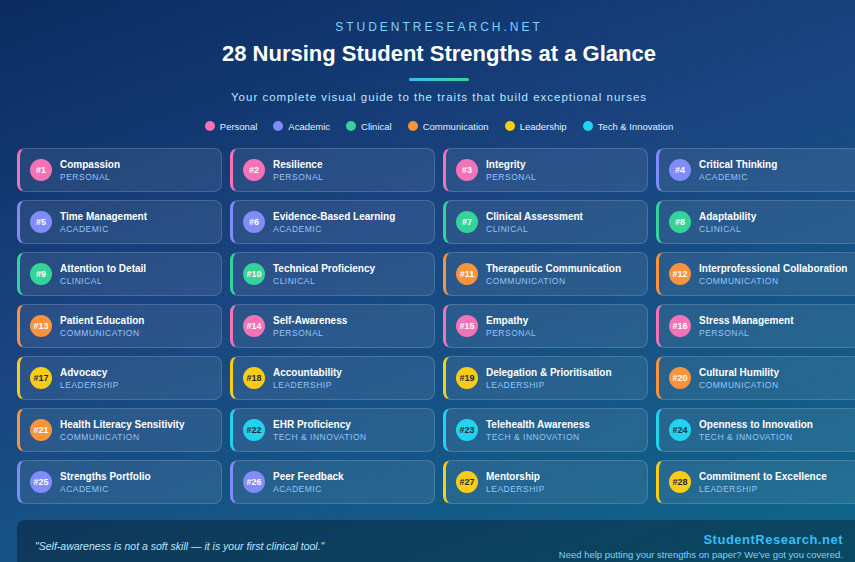
II. The Foundation: Core Personal Strengths Every Nursing Student Needs
Before clinical skills are ever mastered, a solid foundation of personal character traits lays the groundwork for every successful nursing student. These core attributes shape how you respond under pressure, connect with patients, and navigate the emotional demands of healthcare. Student research in nursing education has repeatedly demonstrated that personal character traits predict long-term professional success more reliably than grades alone.
Understanding your personal strengths as a nursing student empowers you to leverage them strategically in academic and clinical settings. The three foundational traits below are recognized universally across nursing literature, competency frameworks, and faculty evaluations as non-negotiable building blocks of nursing excellence.
#1 – Compassion: The Heart of Nursing Student Strengths
- Compassion drives patient-centered care — it helps you see beyond diagnoses to the human being in the bed.
- It fuels clinical resilience — compassionate students are more motivated during difficult rotations.
- It reduces patient anxiety — studies show compassionate communication lowers perceived pain and fear in hospitalized patients.
- Compassion fatigue is manageable — recognizing this strength early helps students develop healthy boundaries.
How to Cultivate Deeper Compassion in Clinical Settings
- Practice active listening without interrupting patients during assessments.
- Reflect daily on one patient interaction that moved you — journal it.
- Volunteer in underserved community health settings outside of required clinical hours.
#2 – Resilience: Bouncing Back Stronger in Nursing School
- Resilience is trainable — it is not a fixed trait but a learnable skill reinforced by reflection and support systems.
- It protects against academic burnout — resilient students recover faster from poor exam results or clinical setbacks.
- Peer support amplifies resilience — nursing cohorts that study together demonstrate higher collective resilience scores.
- Faculty mentorship is a resilience booster — students with strong faculty relationships navigate challenges more effectively.
Resilience-Building Habits for Nursing Students
- Use the STOP technique: Stop, Take a breath, Observe, Proceed mindfully.
- Create a “wins journal” — record one academic or clinical win per day, no matter how small.
- Connect with a peer mentor or nursing student support group.
#3 – Integrity: The Ethical Backbone of Aspiring Nurses
- Integrity shapes professional identity — it defines how you act when no one is watching.
- It underpins patient safety — honest reporting of errors and near-misses is a life-saving professional habit.
- Integrity builds trust quickly — patients and preceptors recognize and respond to it instinctively.
- It aligns with nursing codes of ethics — the ANA Code of Ethics for Nurses centers integrity as a core provision.
III. Academic Strengths That Set Nursing Students Apart in the Classroom
Nursing school is academically rigorous by design — because the knowledge you gain in the classroom directly protects lives in clinical practice. The strongest nursing students are not necessarily the ones with the highest GPAs, but rather those who develop a set of strategic academic strengths that make their learning efficient, deep, and transferable. These academic nursing student strengths form the intellectual backbone of safe nursing practice.
From pathophysiology to pharmacology, the academic demands of nursing require a special kind of intellectual flexibility. Students who cultivate the following strengths tend to perform better not only on exams but also during high-stakes simulations and NCLEX preparation.
#4 – Critical Thinking: The Academic Superpower of Nursing Students
- Critical thinking separates safe nurses from unsafe ones — it enables accurate clinical reasoning at the bedside.
- It improves NCLEX performance — the exam is fundamentally a test of applied critical thinking, not rote memorization.
- Case study practice builds it fastest — working through clinical scenarios sharpens analytical nursing instincts.
- It bridges theory and practice — students who think critically see why interventions work, not just what to do.
Strategies to Strengthen Critical Thinking in Nursing School
- Use concept mapping to connect pathophysiology, pharmacology, and nursing interventions visually.
- Apply the Socratic method — ask “why?” after every nursing action you study or observe.
- Engage with NCLEX-style questions from day one of nursing school, not just before the exam.
#5 – Time Management: Mastering the Nursing Student Schedule
- Strong time management directly prevents clinical errors — disorganized nurses miss medication windows and assessment cues.
- Prioritization is a learnable nursing skill — tools like the Eisenhower Matrix work powerfully in nursing school planning.
- Clinical time management differs from academic time management — both must be deliberately practiced.
- Technology can assist — scheduling apps, digital planners, and clinical prep templates reduce cognitive load.
#6 – Evidence-Based Learning: Applying Student Research to Patient Care
- Evidence-based practice (EBP) begins in nursing school — students who embrace research early become better clinical nurses.
- Student research skills translate directly to quality improvement roles — a growing area of nursing leadership.
- Knowing how to evaluate sources matters — not all healthcare information is equal; nurses must discern quality evidence.
- EBP reduces patient harm — interventions grounded in current research deliver better outcomes.
Struggling to turn your nursing strengths into standout assignments? Let the experts at StudentResearch.net craft evidence-based, clinically accurate academic papers tailored to your nursing program. Professional. Plagiarism-free. Delivered on time. Your grades deserve better.
IV. By the Numbers: How Nursing Student Strengths Impact Clinical and Career Outcomes
Numbers tell a powerful story about why investing in your strengths as a nursing student is one of the highest-return decisions you can make. The data below draws from recent nursing education research, workforce studies, and healthcare quality reports to illustrate just how directly nursing student strengths translate into real-world outcomes.
From retention rates to patient satisfaction scores, the evidence is consistent: students who actively develop their professional and personal strengths enter the workforce better prepared, stay longer in their roles, and deliver measurably safer care. Review this data as a mirror — see yourself in these numbers.
| Nursing Student Strength | Related Outcome / Statistic | Source / Context |
|---|---|---|
| Critical Thinking | Students scoring high in critical thinking pass NCLEX at a 91% first-attempt rate vs. 76% average | NCSBN, 2023 NCLEX Pass Rate Data |
| Compassion / Empathy | Nurses rated high in empathy correlated with 19% higher patient satisfaction scores | Press Ganey Nursing Report, 2022 |
| Resilience | Resilient nurses have a 34% lower rate of early career attrition (first 2 years) | Journal of Nursing Management, 2023 |
| Communication Skills | Poor communication is cited in 70% of sentinel events reviewed by The Joint Commission | The Joint Commission Sentinel Event Data, 2022 |
| Time Management | Nurses with strong time management skills report 28% less on-shift stress | American Nurse Journal, 2023 |
| Evidence-Based Practice (EBP) | EBP-trained nurses reduce hospital-acquired infections by up to 30% | Agency for Healthcare Research & Quality, 2022 |
| Leadership Skills | Nurses in leadership-track programs are 2.5× more likely to pursue advanced practice roles | AACN Workforce Data Report, 2023 |
| Cultural Competency | Culturally competent care reduces health disparities by 22% in underserved populations | Health Affairs Journal, 2023 |
*Statistics are based on published nursing education and workforce research. Always consult primary sources for clinical application.
V. Clinical Strengths: What Makes Nursing Students Shine on the Hospital Floor
The clinical setting is where nursing student strengths face their ultimate test — and where they shine most brightly. Moving from the simulation lab to an actual patient unit is one of the most transformative transitions in nursing education, and the students who thrive are those who have cultivated specific clinical competencies alongside their personal and academic strengths.
Clinical excellence is not just about performing skills correctly — it is about performing them confidently, adaptively, and safely in dynamic, unpredictable environments. The strengths below are consistently noted by clinical preceptors as markers of a student’s readiness for professional nursing practice.
#7 – Clinical Assessment Skills: Seeing What Others Miss
- Head-to-toe assessment is the nurse’s primary diagnostic tool — accuracy here prevents delayed interventions.
- Strong assessors catch early deterioration — recognizing subtle changes in a patient’s condition saves lives.
- Systematic approaches build consistency — students who use structured frameworks (like SBAR) assess more reliably under pressure.
- Practice on every patient, every shift — assessment strength grows through volume and reflection, not just instruction.
#8 – Adaptability: Thriving in the Unpredictable World of Clinical Nursing
- No two shifts are the same — adaptable nursing students adjust priorities fluidly as patient conditions evolve.
- Adaptability reduces clinical errors during emergencies — calm, flexible thinking outperforms rigid protocol-following in crises.
- Preceptors value adaptability highly — it signals readiness for independent practice.
- Cross-specialty rotations build adaptability fast — students should embrace unfamiliar units as learning opportunities.
Ways to Build Clinical Adaptability as a Nursing Student
- Volunteer for float or multi-unit experiences during clinical rotations.
- Debrief after every unexpected clinical event — ask what you would do differently.
- Shadow nurses in specialties outside your comfort zone (ICU, ED, NICU).
#9 – Attention to Detail: The Safety Strength of Exceptional Nursing Students
- Detail-orientation prevents medication errors — one decimal point mistake can be fatal.
- It improves documentation accuracy — precise charting protects patients and protects you legally.
- It enhances infection control compliance — small steps like hand hygiene timing are a product of attentive habits.
- Checklists amplify this strength — structured tools help students channel detail-orientation into consistent behavior.
#10 – Technical Proficiency: Building Confidence with Clinical Skills
- Technical skills build clinical confidence — students who practice in simulation labs enter clinical placements less anxious.
- Proficiency earns patient trust — patients feel safer when nurses handle equipment and procedures with visible competence.
- Technical skills degrade without practice — use every clinical opportunity to reinforce and refine hands-on abilities.
- Know your scope of practice — technical strength includes knowing when a skill is within your training level and when to ask for help.
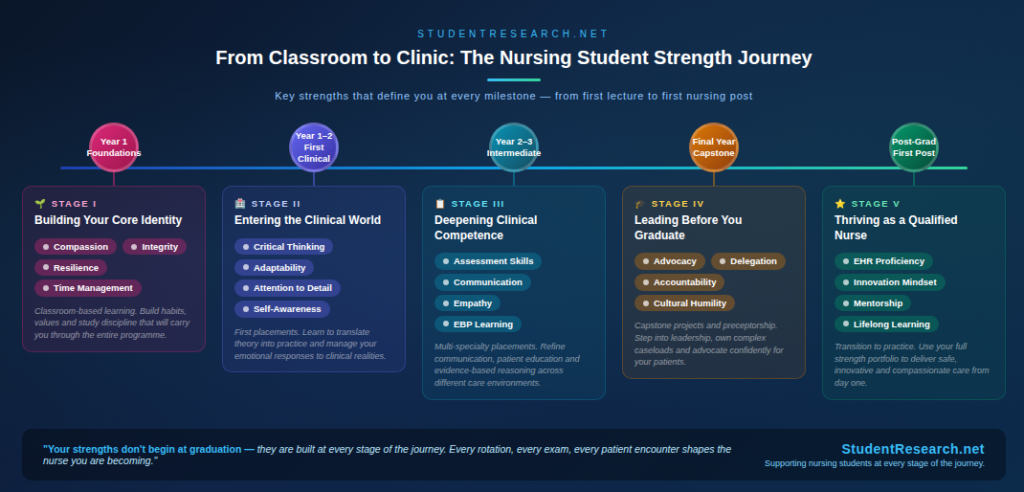
VI. Communication Strengths: How Nursing Students Connect, Collaborate, and Advocate
In nursing, what you say, how you say it, and when you say it can be the difference between life and death. Communication is arguably the single most consequential nursing student strength in terms of both patient outcomes and interprofessional collaboration. Effective nursing communicators advocate for their patients, coordinate with multidisciplinary teams, and educate families with clarity and empathy.
The Joint Commission reports that communication failures are implicated in the majority of serious adverse hospital events — making this a clinical safety imperative, not just a soft skill. Nursing students who invest in developing their communication strengths enter practice already one step ahead of the curve.
#11 – Therapeutic Communication: Speaking the Language of Healing
- Therapeutic communication is a clinical skill, not just a personality trait — it can and must be deliberately practiced.
- Open-ended questions yield richer patient histories — “Tell me more about your pain” outperforms “Is your pain a 7?”
- Non-verbal cues matter as much as words — eye contact, proximity, and tone shape how patients receive information.
- Silence is therapeutic — knowing when not to speak is as valuable as knowing what to say.
#12 – Interprofessional Collaboration: Communicating Across the Healthcare Team
- Nurses are the communication hub of the healthcare team — you interface with physicians, therapists, pharmacists, and families simultaneously.
- SBAR (Situation, Background, Assessment, Recommendation) is your collaboration tool — master it early.
- Assertive communication protects patients — students who speak up during clinical concerns prevent errors.
- Conflict resolution is a communication strength — learn to disagree professionally and escalate concerns appropriately.
#13 – Patient Education: Teaching as a Core Nursing Strength
- Discharge education directly reduces readmissions — nurses who teach effectively save healthcare systems billions annually.
- Health literacy awareness is essential — tailor your language to the patient’s understanding, not your own expertise.
- The teach-back method improves comprehension by up to 40% — ask patients to repeat instructions in their own words.
- Written materials supplement verbal teaching — always provide a reference patients can take home.
VII. Emotional Intelligence: The Hidden Nursing Student Strength That Changes Everything
Emotional intelligence (EI) is one of the most powerful — and most underrecognized — nursing student strengths in contemporary healthcare education. Unlike IQ, EI is highly malleable and grows with intentional practice, making it a strength that every nursing student can develop regardless of their starting point.
Defined by the four domains of self-awareness, self-management, social awareness, and relationship management, emotional intelligence determines how effectively you handle the emotional weight of patient suffering, team conflict, and your own clinical stress. Students with high EI are better nurses, better colleagues, and better advocates.
#14 – Self-Awareness: Knowing Your Emotional Triggers in Clinical Practice
- Self-aware students recognize when stress impairs their clinical judgment — and take corrective action before errors occur.
- Knowing your biases improves patient equity — unchecked assumptions about patients based on background or lifestyle can compromise care quality.
- Self-reflection is a professional requirement, not a personal luxury — many nursing programs require reflective practice journals for this reason.
#15 – Empathy vs. Sympathy: Understanding the Difference That Defines Nursing
- Empathy connects; sympathy distances — empathy says “I feel with you,” sympathy says “I feel sorry for you.”
- Empathic nurses have better patient outcomes — patients disclose more symptoms, follow care plans more consistently, and report higher satisfaction.
- Empathy must be balanced with professional boundaries — a nursing strength is knowing when to step back emotionally to remain effective clinically.
#16 – Stress Management: Protecting Your Greatest Clinical Instrument — Yourself
- Unmanaged stress impairs clinical decision-making — cognitively and emotionally exhausted nurses make more errors.
- Mindfulness practices have strong evidence in nursing wellness research — even 5-minute daily practices reduce perceived stress significantly.
- Peer support, supervision, and debriefing are protective factors — use your cohort as a resilience resource.
- Physical wellness is clinical safety — sleep, nutrition, and exercise directly affect nursing performance.
VIII. Leadership and Professional Strengths: The Nursing Student Who Leads Before Graduation
Leadership is not reserved for charge nurses and nursing managers — it begins in nursing school, on the first clinical day you speak up for a patient, mentor a struggling peer, or take initiative during a simulation. The nursing students who graduate as natural leaders are those who recognize and nurture their leadership strengths early, long before a title or position validates them.
Student research in leadership development within nursing programs shows that students who take on academic leadership roles — such as cohort representative, simulation team lead, or community health project coordinator — develop professional confidence that translates powerfully into clinical environments. These are nurses employers actively recruit.
#17 – Advocacy: The Leadership Strength That Starts at the Bedside
- Patient advocacy is a legal and ethical nursing obligation — it begins in nursing school and never stops.
- Advocacy means speaking up, escalating concerns, and challenging unsafe practices — even as a student.
- Community advocacy extends your impact — nursing students who engage in public health advocacy become leaders in population health.
- Advocacy builds professional courage — the habit of speaking up in school makes it easier to do so as a licensed nurse.
#18 – Accountability: Owning Your Actions as a Developing Nurse
- Accountable nurses report errors honestly — a culture of safety depends on this professional strength.
- Accountability accelerates learning — students who own their mistakes reflect on them more deeply and grow faster.
- It earns clinical trust rapidly — preceptors extend more autonomy to students who demonstrate accountability consistently.
#19 – Delegation and Prioritization: Thinking Like a Charge Nurse Before You Are One
- Learning to prioritize patient needs using frameworks like ABC (Airway, Breathing, Circulation) begins in theory — but becomes a life-saving skill on the floor.
- Delegation to unlicensed assistive personnel (UAPs) is a licensed nursing skill — practice the decision-making framework as a student.
- Priority-setting under load is a testable nursing competency — NCLEX Next Generation questions increasingly assess this domain.
IX. Cultural and Diversity Strengths: Nursing Students Who Care for All Patients Equitably
Modern healthcare is delivered to patients of every background, belief system, language, and lived experience — and the nurses who serve them best are those who bring genuine cultural humility and inclusive practice to every interaction. Cultural competence is not a single workshop or a checkbox; it is an ongoing nursing student strength built through curiosity, self-examination, and deliberate exposure to diverse perspectives.
Healthcare disparities remain a critical challenge in every healthcare system globally, and nursing students who cultivate cultural and diversity strengths become agents of equity in their communities. The ability to adapt care approaches across cultural contexts is increasingly recognized as a core clinical competency in nursing accreditation standards.
#20 – Cultural Humility: The Strength of Knowing What You Don’t Know
- Cultural humility is a lifelong practice — it replaces the idea of “mastering” another culture with ongoing respectful inquiry.
- It improves therapeutic relationships across cultural differences — patients feel seen and respected, which increases trust and care adherence.
- Implicit bias training is a starting point — nursing students who complete it report greater awareness in clinical encounters.
#21 – Linguistic and Health Literacy Sensitivity
- Language barriers increase patient risk — nurses who recognize and address communication gaps actively prevent errors.
- Professional medical interpreters must be used over family members for clinical conversations — an important competency standard.
- Simplified language and visual aids extend care access — strong health literacy sensitivity improves patient education outcomes across all populations.
- Written materials in patients’ preferred languages are a safety tool — not just a courtesy.
X. Tech-Savvy and Innovation Strengths: The Modern Nursing Student’s Edge
Today’s nursing students are the first generation to enter clinical practice in an era of artificial intelligence, telehealth, electronic health records, and precision medicine — and the students who embrace technology as a nursing strength will be the most future-proof professionals in the field. Digital fluency is rapidly becoming as essential as vital signs assessment in nursing practice.
Innovation in nursing is not about replacing human care with machines — it is about using technology to deliver safer, faster, and more equitable care. Nursing students who develop technological strengths now will be better positioned to lead clinical transformation initiatives, contribute to quality improvement projects, and shape the future of healthcare delivery.
#22 – Electronic Health Record (EHR) Proficiency
- EHR proficiency reduces documentation errors — sloppy or incomplete charting is a leading source of clinical miscommunication.
- Efficient EHR use saves bedside time — nurses who chart fluently spend more time with patients, not computers.
- EHR data supports evidence-based decisions at the point of care — students should learn to interrogate patient records critically, not just fill them in.
#23 – Telehealth and Remote Patient Monitoring Awareness
- Telehealth has permanently changed care delivery — nursing students who understand its scope enter practice ready for hybrid care models.
- Remote monitoring tools require clinical interpretation — not just technical operation but critical assessment of alerts and trends.
- Digital health equity matters — nurses must advocate for patients who lack access to technology or broadband.
#24 – Openness to Innovation and Continuous Learning
- The half-life of medical knowledge is shortening — nurses who commit to lifelong learning remain clinically current and competent.
- Continuing education begins in nursing school — develop the habit of reading nursing journals, attending webinars, and pursuing certifications early.
- Innovation mindset drives quality improvement — the nurse who asks “how can we do this better?” becomes an invaluable team asset.
XI. Strengths Assessment Tools: How Nursing Students Can Identify and Measure Their Own Strengths
Self-discovery is not guesswork — there are reliable, evidence-based tools designed to help nursing students identify, articulate, and build on their unique strengths. Incorporating formal strengths assessment into your nursing student journey transforms vague self-impressions into actionable professional development plans that you can present in interviews, portfolios, and clinical reflections.
Student research has shown that nursing students who use structured self-assessment tools demonstrate higher levels of professional identity development and career satisfaction in their first two years of practice. These tools are not just for career counseling offices — they are practical assets for every self-directed nursing student.
Top Strengths Assessment Tools for Nursing Students
| Tool | What It Measures | Best Use for Nursing Students |
|---|---|---|
| CliftonStrengths (Gallup) | 34 talent themes across executing, influencing, relationship-building, and strategic thinking | Professional identity development, leadership roles, team placement |
| DISC Assessment | Communication style: Dominance, Influence, Steadiness, Conscientiousness | Understanding team dynamics, improving patient communication |
| Myers-Briggs Type Indicator (MBTI) | Personality preferences across 4 dimensions | Understanding learning style, career specialty alignment |
| Emotional Quotient Inventory (EQ-i 2.0) | Five composite areas of emotional intelligence | Identifying empathy gaps, stress management development |
| NLN Nurse Educator Self-Assessment Tool | Teaching and facilitation competencies (for those pursuing education tracks) | Students considering nursing education as a specialty path |
| QSEN Self-Assessment | Quality and Safety Education for Nurses competencies | Direct mapping to clinical readiness and safety culture integration |
#25 – Building a Nursing Student Strengths Portfolio
- A strengths portfolio documents your growth narrative — it is powerful evidence of professional development for employers.
- Include clinical reflections, assessment results, peer feedback, and faculty evaluations — diversity of evidence builds credibility.
- Update it every semester — your strengths evolve with your clinical experience.
- Use it in job interviews — “I’ve assessed my strengths using CliftonStrengths and here’s what I found” makes you a standout candidate.
#26 – Peer Feedback as a Strengths Mirror
- Your cohort sees your strengths more clearly than you do — peer feedback is an underused gold mine of self-knowledge.
- Structured peer evaluation frameworks yield more useful feedback than open-ended praise — use rubrics or specific clinical competency checklists.
- Reciprocal feedback builds team trust — cohorts that give honest feedback to each other develop stronger collaborative nursing identities.
#27 – Mentorship: The Strength Amplifier Every Nursing Student Needs
- A mentor sees your potential before you do — great mentors accelerate strength development by providing targeted, real-time feedback.
- Formal mentorship programs outperform informal arrangements — seek programs with structured check-ins and goals.
- Alumni mentors bridge the gap between student life and professional practice — connect with nurses who graduated 2-5 years ago for highly relevant guidance.
- Be a mentor, not just a mentee — teaching a junior student consolidates your own understanding and builds leadership identity.
XII. Conclusion: Your Nursing Student Strengths Are the Future of Healthcare
You have now explored 28 essential nursing student strengths — from the compassion that warms a frightened patient’s night to the critical thinking that prevents a near-miss at 3 a.m. From the technical precision of a correctly placed IV to the cultural humility that makes a patient from a different world feel truly cared for. Each of these strengths belongs to you — waiting to be recognized, named, practiced, and grown.
Here is what the evidence, the research, and the lived experience of nurses around the world consistently confirms: nursing student strengths are not just personal qualities — they are patient safety tools, team assets, and professional capital. The student who knows their strengths is the nurse who leads with confidence, communicates with clarity, and cares with intention.
Your nursing journey is not a test of how much you can memorize — it is an unfolding revelation of who you already are, and who you are becoming. Every clinical rotation is a new chapter in your strengths story. Every difficult patient encounter is a classroom. Every moment of doubt is actually a moment of growth trying to happen.
#28 – Your Next Step: From Nursing Student Strengths to Nursing Excellence
- Take one strengths assessment this week — commit to knowing yourself as a professional, not just as a student.
- Choose one strength from this guide to actively develop this semester — focus beats breadth in professional development.
- Share this with a fellow nursing student — the nurse who lifts others up builds a stronger team for every patient they will ever serve.
- Return to this guide at every clinical milestone — your relationship with your strengths will deepen with every rotation, every exam, and every patient you are privileged to care for.
🌟 Discover More: Discover nursing student strengths that transform your career — 28 powerful traits every aspiring nurse needs to thrive in clinical practice and beyond. Your strength journey starts here, and it leads exactly where you are meant to go: to the bedside of a patient who needs the very best of you.
Now go — you have everything you need. And nursing has everything to gain from the strengths you bring to it.

