

Landing a spot in one of the premier nursing colleges in Canada is a transformative milestone for any aspiring healthcare professional. Canada offers a world-class education system, diverse clinical environments, and a clear pathway to permanent residency for dedicated international students. This ultimate guide explores the landscape of nursing colleges in Canada for international students, providing you with the essential tools to navigate your academic journey successfully.
Understanding the Landscape of Nursing Colleges in Canada
Navigating the various types of nursing colleges in Canada can be overwhelming due to the sheer number of specialized programs available. Most international students must choose between university-led degree programs and college-based diplomas depending on their career goals. This section breaks down the foundational structures you need to know before submitting your first application.
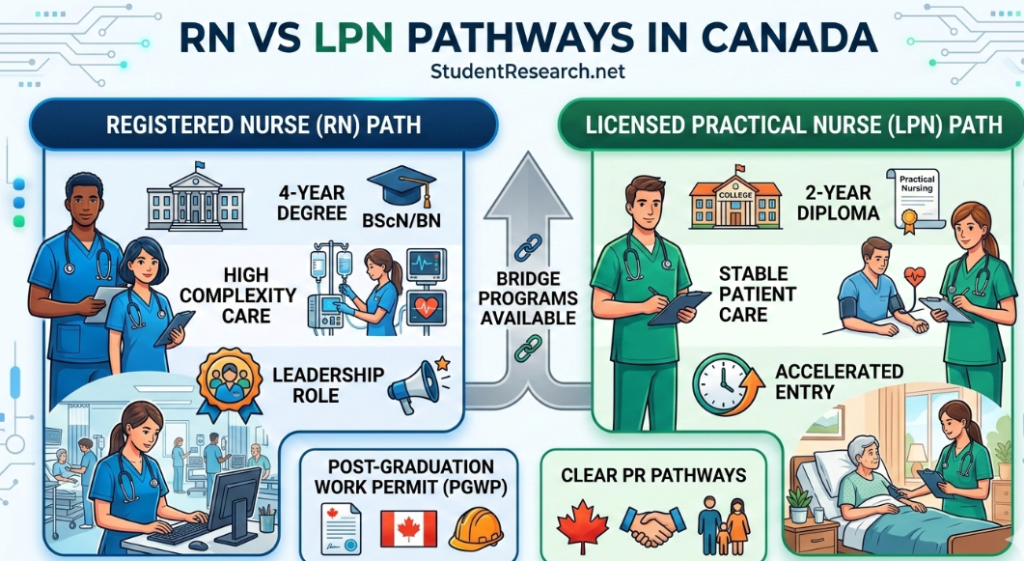
Types of Nursing Credentials Available
- Bachelor of Science in Nursing (BScN): A four-year degree required for Registered Nurse (RN) status.
- Practical Nursing Diploma: A two-year program leading to Licensed Practical Nurse (LPN) designation.
- Post-Graduate Nursing Certificates: Specialized 1-year programs for nurses who already hold a degree.
- Master of Nursing (MN): Advanced degrees for clinical specialization or student research roles.
Registered Nurse (RN) vs. Licensed Practical Nurse (LPN)
- Scope of Practice: RNs often handle more complex patient cases and leadership roles in hospitals.
- Education Duration: RN pathways typically require 4 years of university study at nursing colleges in Canada.
- Salary Expectations: RNs generally command higher starting salaries compared to LPN counterparts.
Top 27 Nursing Colleges in Canada for International Students
Choosing from the Top 27 institutions requires a balance of reputation, cost, and location. Many nursing colleges in Canada have specific quotas for international students, making the selection process highly competitive. The following list represents the elite tier of Canadian nursing education for 2026.
Elite Universities and Specialized Colleges
- #1. University of Toronto
- Link: Bloomberg Nursing Portal
- Fees: Approximately $66,000 CAD per year for international students.
- Eligibility: Completion of 2 years of undergraduate study with specific prerequisites.
- Focus: High emphasis on student research and clinical leadership.
- #2. University of British Columbia (UBC)
- Link: UBC Nursing Admissions
- Fees: ~$10,081 per year (Graduate) / ~$45,000+ (Undergraduate).
- Eligibility: Previous university experience required for the accelerated program.
- Duration: 20-month intensive program for the BSN.
- #3. University of Alberta
- Link: UofA Nursing Portal
- Fees: ~$31,000 – $35,000 CAD per year.
- Eligibility: Competitive high school average (85%+) or transfer GPA.
- Duration: 4-year Collaborative BScN.
- #4. McMaster University
- Link: McMaster School of Nursing
- Fees: ~$56,000 CAD annually for international applicants.
- Eligibility: CASPer test completion and high academic standing.
- Focus: Problem-Based Learning (PBL) methodology.
- #5. McGill University
- Link: Ingram School of Nursing
- Fees: ~$23,000 – $28,000 CAD per year.
- Eligibility: Strong performance in math and science prerequisites.
- Language: Bilingual environment (English and French).
Regional Leaders for International Applicants
- #6. University of Calgary
- Link: UCalgary Nursing
- Selection: Utilizes a lottery system for applicants meeting the competitive threshold.
- Competitive Average: 82% for high school applicants.
- #7. Dalhousie University
- Link: Dalhousie Nursing
- Fees: ~$16,569 CAD (Base) + Differential fees (Total ~$54,000+).
- Deadline: Priority deadline is February 15.
- #8. University of Ottawa
- Link: uOttawa Health Sciences
- Duration: 4-year BScN or 16-month second-entry.
- Requirement: Proficiency in English or French.
- #9. Western University
- Link: Western Nursing
- Programs: Compressed Timeframe (19 months) or 4-year Collaborative.
- #10. Queen’s UniversityQueen’s is renowned for its high NCLEX pass rates.
- Link: Queen’s School of Nursing
- Fees: Approximately $47,390 CAD per year.
Comparative Analysis of Top Nursing Programs
To help international students decide, we have compared the top-tier nursing colleges in Canada based on key metrics. This table highlights the estimated annual tuition and the primary focus of each institution’s curriculum. Understanding these differences is vital for your long-term career planning.
| Institution | Estimated Annual Tuition (CAD) | Primary Program Focus |
| University of Toronto | $66,350 | Student Research & Leadership |
| McMaster University | $56,000 | Clinical Reasoning (PBL) |
| University of Alberta | $31,000 | Clinical Practice & Community |
| McGill University | $26,000 | Global Health & Research |
| Centennial College | $21,000 | Practical Hands-on Skills |
Essential Admission Requirements for International Students
Securing admission into nursing colleges in Canada requires meeting stringent academic and linguistic benchmarks. International students must often provide proof of high school prerequisites in biology, chemistry, and mathematics. Additionally, English or French proficiency is non-negotiable for safety and communication in clinical settings.
Academic and Language Prerequisites
- Mathematics & Sciences: Minimum 75-85% average in Grade 12 Biology and Chemistry.
- English Proficiency: IELTS Academic score of 7.0 or TOEFL iBT score of 90+.
- CASPer Test: Many nursing colleges in Canada require this situational judgment assessment.
- Transcripts: Verified educational documents via services like WES or ICAS.
Provincial English Proficiency Checklist (Regulatory Standards)
Every province has a regulatory body that sets the bar for safety and communication. While most nursing colleges in Canada follow these benchmarks, some individual universities may have slightly higher requirements for their own internal admissions. Use this checklist to ensure your scores meet the 2026 standards for the specific province where you intend to practice.
Ontario (CNO) & British Columbia (BCCNM)
- IELTS Academic: Overall 7.0 (Speaking: 7.0, Listening: 7.0, Reading: 6.5, Writing: 6.5).
- CELBAN: Listening: 9, Reading: 8, Writing: 7, Speaking: 8.
- PTE Academic: Writing: 68, Speaking: 75, Listening: 73, Reading: 66.
- Validity: Test results must be no older than two years at the time of registration.
Alberta (CRNA) – Stricter Requirements
- IELTS Academic: Overall 7.0 (No individual band less than 7.0—stricter than Ontario).
- CELBAN: Listening: 9, Reading: 8, Writing: 7, Speaking: 8.
- Note: Alberta is one of the most competitive provinces; ensure your student research into specific schools like #6 University of Calgary accounts for these higher band requirements.
Nova Scotia (NSCN) & Newfoundland (CRNNL)
- IELTS Academic: Overall 7.0 (Speaking: 7.0, Listening: 7.0, Reading: 6.5, Writing: 6.5).
- OET (Occupational English Test): Minimum Grade B in Speaking and Listening; C+ in Reading and Writing.
- PTE Academic: Minimum overall score of 65 is often the baseline here.
Quebec (OIIQ) – Bilingual Focus
- French Proficiency: Most international students must pass the Office québécois de la langue française (OQLF) exam.
- English: Required primarily for clinical placements in English-speaking hospitals (like McGill’s network).
- Checklist: If you aren’t fluent in French, prioritize #5 McGill or explore other provinces.
The Importance of the CASPer Assessment
- Purpose: Measures non-cognitive skills like empathy, ethics, and communication.
- Format: An online, video-based scenario test taken during the application cycle.
- Weighting: Can account for up to 40% of the admission decision at some schools.
Cost of Studying at Nursing Colleges in Canada
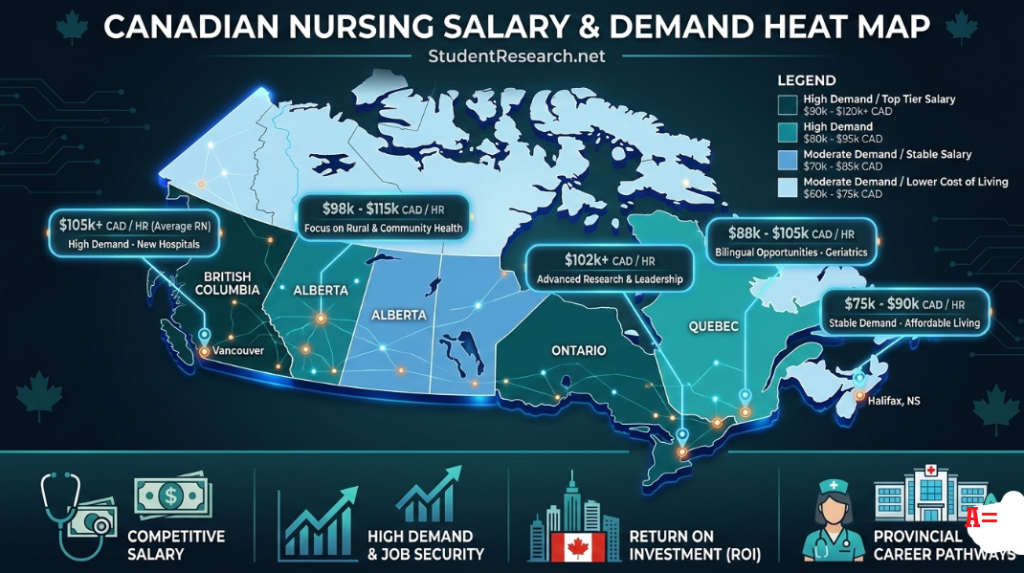
The financial commitment for international students attending nursing colleges in Canada varies significantly by province. Beyond tuition, you must factor in health insurance, textbooks, and the high cost of living in urban centers like Toronto or Vancouver. This section outlines the typical budget you will need to prepare.
Budgeting for Your Nursing Education
- Tuition Fees: Ranges from $18,000 to $66,000 CAD per year.
- Living Expenses: Estimated $15,000 – $20,000 CAD annually.
- Books & Supplies: Approximately $1,500 – $2,500 per year.
- Health Insurance: Mandatory fees ranging from $600 to $1,000 annually.
Hidden Costs to Consider
- NCLEX-RN Prep: Study materials and exam registration fees.
- Licensing Fees: Initial registration with provincial regulatory bodies.
- Uniforms & Equipment: Stethoscopes, scrubs, and clinical shoes (~$600).
Scholarship Opportunities for Aspiring Nurses
While the costs are high, many nursing colleges in Canada offer financial aid specifically for international students. Scholarships can be merit-based or need-based, significantly reducing the financial burden of your degree. Researching these opportunities early is key to a successful financial plan.
Types of Financial Aid Available
- Entrance Scholarships: Automatic awards based on high school GPA (e.g., $1,000 – $10,000).
- In-Course Awards: For students maintaining high grades during the program.
- Research Grants: Available for advanced student research initiatives.
- External Bursaries: Provided by organizations like the Canadian Nurses Foundation.
The Remaining Top Nursing Colleges in Canada (#11 – #27)
To round out our Top 27 list, we look at colleges that offer excellent value and high employment rates. These nursing colleges in Canada often provide more hands-on practical experience through community partnerships. They are excellent choices for international students looking for a more personalized learning environment.
Comprehensive Colleges and Mid-Sized Universities
- #11. Centennial College
- Link: Centennial Nursing
- Fees: ~$21,716 per year.
- Offerings: Practical Nursing (Diploma) and Bridging programs.
- #12. Conestoga College
- Link: Conestoga Health Sciences
- Specialty: Enhanced Practice for Internationally Educated Nurses.
- #13. Algonquin College
- Link: Algonquin Nursing
- Fees: ~$20,000 for BScN (Honours).
- #14. University of Victoria
- Link: UVic Nursing
- Focus: Social justice and geriatric care.
- #15. Memorial University (MUN)
- Link: MUN Nursing
- Fees: ~$22,500 per year (One of the most affordable).
Expanding your search to include these specialized nursing colleges in Canada offers a broader range of clinical environments and tuition price points. Many of these institutions are pioneers in student research and community-based health initiatives, providing a robust education for international students. Below is a detailed breakdown of the programs, fees, and eligibility for the remainder of our top-tier list.
- #16. University of New Brunswick (UNB)
- Link: UNB Nursing Portal
- Programs: 4-year Bachelor of Nursing (BN); Accelerated BN (2 years) for students with prior degrees.
- Fees: Approximately $21,000–$24,000 CAD per year for international students.
- Eligibility: High school diploma with minimum 75% in Chemistry, Biology, and Math; IELTS 7.0.
- Duration: 4 years (8 semesters).
- #17. University of Saskatchewan (USask)
- Link: USask College of Nursing
- Programs: Bachelor of Science in Nursing (BSN); Post-Degree BSN.
- Fees: ~$39,711 CAD per year for the nursing portion of the degree.
- Eligibility: Completion of a “Pre-Professional Year” (Year 1) with specific science credits is required before formal entry into the nursing program.
- Duration: 1+3 model (1 pre-professional year + 3 years of nursing).
- #18. Toronto Metropolitan University (TMU)
- Link: TMU Daphne Cockwell School of Nursing
- Programs: Collaborative BScN; Post-Diploma Degree Completion.
- Fees: ~$36,800–$38,200 CAD annually for international applicants.
- Eligibility: Grade 12 English (U), Math (U), Biology (U), and Chemistry (U) with a minimum 70% in each.
- Duration: 4 years.
- #19. York University
- Link: York Nursing
- Programs: 4-year Collaborative BScN; 2nd Degree Entry (2 years); Post-RN for Internationally Educated Nurses (IEN).
- Fees: ~$36,000 CAD per year.
- Eligibility: High school average in the mid-80s; CASPer test is mandatory for all applicants.
- Duration: 4 years (Collaborative) or 2 years (Accelerated/IEN).
- #20. University of Manitoba
- Link: UManitoba College of Nursing
- Programs: Bachelor of Nursing (BN).
- Fees: ~$24,600 CAD per year.
- Eligibility: Advanced entry only; requires at least 30 credit hours (1 year) of university study with a minimum GPA of 2.5.
- Duration: 28 months (after the initial university year).
- #21. St. Francis Xavier University (StFX)
- Link: StFX Rankin School of Nursing
- Programs: 4-year BScN; Accelerated BScN (2 years).
- Fees: ~$21,800 CAD per year for international students.
- Eligibility: Minimum 70% average in high school sciences; focus on leadership and community involvement.
- Duration: 4 years.
- #22. Laurentian University
- Link: Laurentian Nursing
- Programs: BScN (English or French stream).
- Fees: ~$29,500 CAD per year.
- Eligibility: Minimum 75% overall average in 6 Grade 12 U/M courses, including Biology and Chemistry.
- Duration: 4 years.
- #23. Nipissing University
- Link: Nipissing Nursing
- Programs: Collaborative BScN; RPN to BScN bridging; Scholar Practitioner Program.
- Fees: ~$20,000–$22,000 CAD per year.
- Eligibility: Strong grades in science prerequisites; IENs must have CNO eligibility.
- Duration: 4 years; 2 years for the Scholar Practitioner route.
- #24. University of Windsor
- Link: UWindsor Faculty of Nursing
- Programs: Collaborative Honours BScN.
- Fees: ~$35,000–$38,000 CAD annually.
- Eligibility: Minimum 70% average; English, Biology, Chemistry, and Math are compulsory.
- Duration: 4 years.
- #25. Ontario Tech University
- Link: Ontario Tech Nursing
- Programs: BScN (Honours); RPN to BScN Bridge.
- Fees: ~$33,800 CAD per year.
- Eligibility: Minimum 75% in prerequisites; CASPer test required.
- Duration: 4 years.
- #26. University of Regina
- Link: U of Regina Nursing
- Programs: Saskatchewan Collaborative Bachelor of Science in Nursing (SCBScN).
- Fees: ~$22,000–$25,000 CAD per year for international students.
- Eligibility: Minimum 70% average in Grade 12 prerequisites; bilingual options available.
- Duration: 4 years.
- #27. Fanshawe College
- Link: Fanshawe Nursing Programs
- Programs: Honours BScN (in collaboration with Western University); Practical Nursing (Diploma).
- Fees: ~$25,000 CAD per year (BScN); ~$16,000 per year (Practical Nursing).
- Eligibility: 4U English, Biology, Chemistry, and Math; competitive entry.
- Duration: 4 years (Degree) or 2 years (Diploma).
Clinical Placements and Practical Experience
Practical training is the backbone of any program at nursing colleges in Canada. Most international students begin their clinical rotations in their second year, gaining exposure to various hospital wards. This real-world experience is essential for developing the competency required to pass the national licensure exam.
What to Expect During Clinicals
- Hospital Rotations: Working in surgery, pediatrics, and emergency care.
- Preceptorship: Final-year 1-on-1 intensive mentorship.
- Simulation Labs: Using high-fidelity manikins for practice.
- Evaluation: Continuous assessment by clinical instructors.
Path to Licensure and Post-Graduation Work
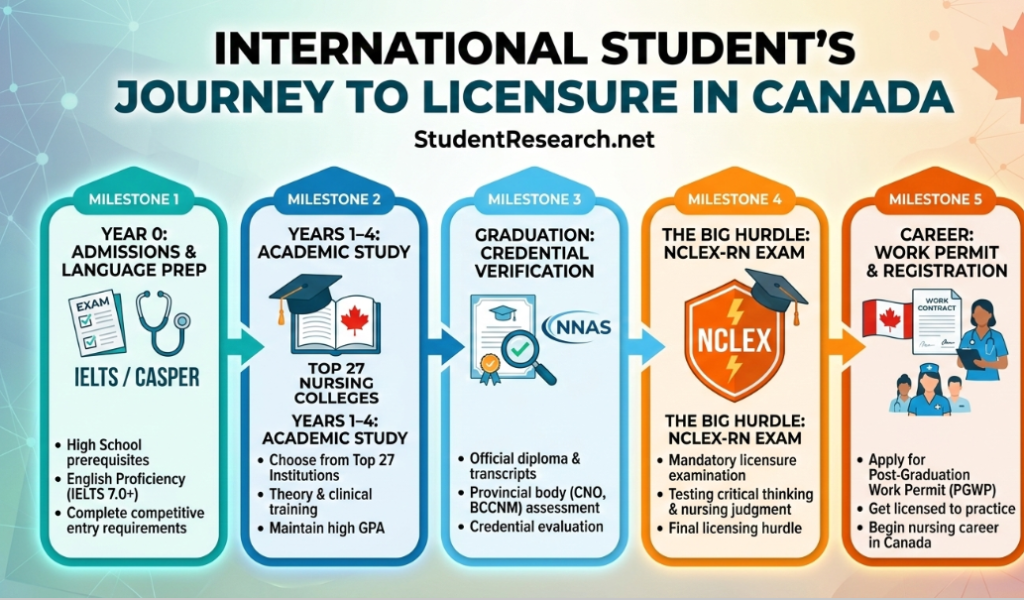
Graduating from nursing colleges in Canada is just the first step toward your professional career. International students must then successfully navigate the provincial licensing process and obtain a work permit. Canada’s Post-Graduation Work Permit (PGWP) is a significant advantage for those wishing to stay and work.
The Licensing Steps for Graduates
- NNAS Verification: Credential verification for foreign education.
- NCLEX-RN Exam: The mandatory national licensure exam.
- Provincial Registration: Applying to bodies like the CNO or BCCNP.
- PGWP: Applying for the work permit within 180 days of graduation.
Challenges Faced by International Nursing Students
While the rewards are great, attending nursing colleges in Canada comes with unique challenges. International students often struggle with cultural adjustments, different healthcare terminologies, and the intensity of the curriculum. Acknowledging these hurdles is the first step toward overcoming them.
Common Obstacles to Success
- Cultural Nuances: Adjusting to Canadian communication styles.
- Financial Burden: High tuition fees compared to domestic rates.
- Intensive Curriculum: High workload and academic rigor.
- Social Integration: Building a network in a new country.
Struggling to balance clinical rotations and heavy coursework? StudentResearch.net provides expert academic support to ensure your nursing essays and reports meet the highest standards. Secure your GPA while focusing on your practical skills with our professional writing services!
Expert Tips for a Successful Application
To stand out when applying to nursing colleges in Canada, you need more than just good grades. International students should showcase a well-rounded profile that includes volunteer work and a passion for caregiving. Following these expert tips can significantly increase your chances of acceptance.
How to Strengthen Your Profile
- Volunteer Experience: In hospitals or community centers.
- Early Submission: Apply as soon as portals open.
- Strong References: Academic and professional recommendations.
- Professional Statement: Clear, concise motivation for nursing.
Ready to join the elite? StudentResearch.net specializes in crafting compelling personal statements and admission essays that help you stand out. Let us help you secure your spot in one of the top nursing colleges in Canada with ease!
Conclusion: Your Future in Canadian Nursing
Choosing between the many nursing colleges in Canada is a pivotal decision that shapes your future career and life. By selecting one of the Top 27 institutions mentioned, you are ensuring a high-quality education that is respected globally. As international students, your contribution to the Canadian healthcare system is invaluable, and your journey starts with the right academic foundation.
Meta Description: Explore nursing colleges in Canada for international students with our guide to the Top 27 schools, tuition costs, and the path to a nursing career

