

A Dream Cut Short and the Defining Tragedy
It was the early hours of Wednesday, April 22, 2015, when a catastrophic multi-vehicle pileup unfolded on Interstate 16 in Bryan County, Georgia. Five dedicated, young women—all junior nursing students from Georgia Southern University—were traveling eastbound, eager for their final clinical rotations in Savannah, but instead, their lives were abruptly and brutally ended. The devastating accident that resulted in 5 Georgia Southern nursing students killed remains a defining and painful moment in the university’s history, immediately shocking the community and spurring intense safety debates nationwide. This post serves to remember their vibrant lives, detail the collision’s circumstances, examine the profound community response, and outline the critical safety reforms that followed in the wake of this profound tragedy.
The Victims and the Details of the I-16 Collision

The collision was not merely a statistic; it represented the loss of five bright futures dedicated to healthcare. These women, all in their junior year of the demanding nursing program, were known for their compassion and drive. Understanding the chain of events leading to the collision provides necessary context for the subsequent pursuit of justice and safety improvements.
The Five Lives Lost: Caitlyn, Morgan, Emily, Abbie, and Catherine
- Caitlyn Baggett (21, Millen, GA): Known for her big personality and strong desire to become a pediatric nurse.
- Morgan Bass (20, Leesburg, GA): A straight-A student and member of Alpha Omicron Pi who aspired to be a nurse anesthetist.
- Emily Clark (20, Powder Springs, GA): A respected student dedicated to her church and sorority (Alpha Delta Pi), celebrated for her thoughtful, helpful nature.
- Abbie Deloach (20, Savannah, GA): Described by friends and faculty as having a great spirit and a passion for helping others.
- Catherine “McKay” Pittman (21, Alpharetta, GA): President of Alpha Delta Chi, recognized for her determination and strong desire to help others through nursing.
- Two other students, Brittney McDaniel and Megan Richards, were severely injured but survived the crash, becoming central figures in the subsequent legal actions.
Collision Sequence and Driver Negligence
- The crash occurred around 5:45 AM, where traffic was backed up due to a prior, unrelated accident miles ahead on I-16.
- The students were traveling in two separate passenger vehicles (an SUV and a car) caught in the resulting slow or stopped traffic.
- A tractor-trailer, driven by John Wayne Johnson, failed to stop or slow down as it approached the halted line of vehicles.
- The massive truck slammed into the queue of cars at highway speed, initiating a catastrophic seven-vehicle chain-reaction pileup.
- One of the student’s cars was crushed and burst into flames due to the severity of the impact.
- The truck driver later admitted fault in depositions, stating he saw the stopped traffic ahead but, for unexplained reasons, failed to apply the brakes.
Struggling with a difficult topic? Use our custom assignments as a powerful study guide. StudentResearch.net provides expertly structured models and samples to improve your research, writing, and analytical skills for better grades. Start learning today!
The Grief, Response, and Lasting Memorials
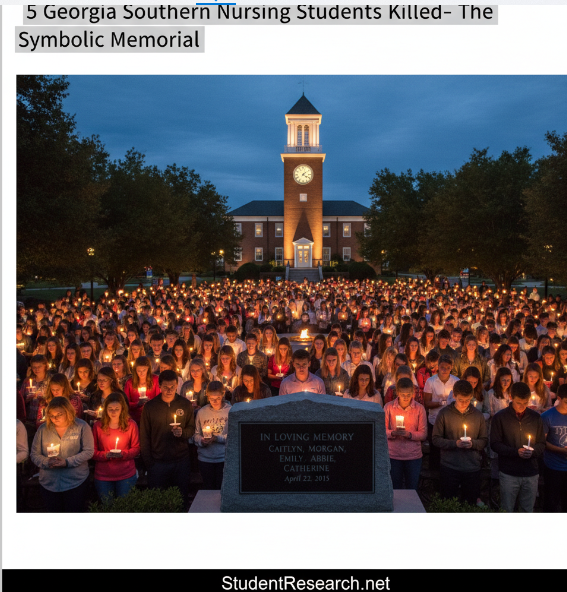
The loss of five students simultaneously created a wave of raw, collective grief that defined the university community for years. The response from “Eagle Nation” was immediate and massive, offering a profound display of unity and support for the victims’ families and classmates. This tragic event galvanized the university to create permanent memorials and support systems, ensuring the young women would never be forgotten.
The University’s Outpouring of Grief
- University President Brooks Keel issued a heartfelt statement, calling the loss “almost incomprehensible” and urging the “Eagle Nation” to hold on to each other.
- The university flag was immediately lowered to half-staff, and classes were modified or canceled to allow students and faculty time to mourn and regroup.
- Thousands of students, faculty, and community members gathered for an emotional candlelight vigil held on the central campus green, Sweetheart Circle.
- Grief counseling and immediate support services were offered campus-wide, particularly to students and staff within the close-knit School of Nursing.
- Social media accounts across the state and the country turned blue and white, displaying GSU’s colors and symbols in solidarity with the mourning community.
The Lasting Legacy of the “I-16 Five”
- The School of Nursing established the School of Nursing Students’ Memorial Fund to honor the five women, providing support for future nursing students.
- Annual memorial services and recognition events are held by the university to commemorate the anniversary of the crash, maintaining their memory within GSU’s traditions.
- The tragedy fostered an incredibly close and resilient bond among the surviving students and succeeding cohorts in the nursing program.
- The memory of the five young women continues to serve as an inspiration for current nursing students, representing the ideals of compassion, dedication, and service they were striving for.
Late night deadline panic? Get instant help anytime with your complex assignments. Our expert team offers round-the-clock support via chat, phone, or email, guaranteeing peace of mind. Visit StudentResearch.net and never stress over a deadline again
Legal Ramifications and the Push for Trucking Reform
The pursuit of justice for the five young women and the injured survivors became a multi-faceted legal battle. This tragic case brought to light serious issues regarding the regulation and safety practices of the commercial trucking industry. The resulting indictments and civil verdicts sent a powerful message about accountability in vehicular negligence.
Criminal Charges and Sentencing
- Truck driver John Wayne Johnson was indicted by a Bryan County grand jury on numerous felony charges, including five counts of first-degree homicide by vehicle.
- Johnson ultimately pleaded guilty to the criminal charges and received a sentence of five years in prison followed by five years of probation.
- Johnson’s employer, Total Transportation of Mississippi LLC, was also indicted, facing charges of criminal responsibility of corporations for allegedly employing an “unsafe truck driver.”
Civil Lawsuits and Financial Settlements
- The families of the deceased and the injured students filed massive civil lawsuits against the driver, his employer, and the parent company, U.S. Express.
- The families of four of the deceased settled their claims for reported totals exceeding $80 million.
- Survivor Megan Richards went to trial and was awarded $15 million in compensatory damages by a jury, who assigned 100% of the fault to the driver and the trucking company.
Calls for Safety Reform
- The public outcry surrounding the crash intensified national media scrutiny on the necessity of stricter Federal Motor Carrier Safety Administration (FMCSA) regulations.
- The case directly highlighted critical safety concerns regarding driver distraction, fatigue, and the dangers of negligent following distances in the commercial trucking sector.
- Safety advocates and legislators used the case as a powerful example to lobby for mandatory implementation of modern safety technology, such as Automated Emergency Braking (AEB) and collision avoidance systems, in all new commercial vehicles.

Conclusion: Remembering the Future Nurses
The devastating accident that claimed five promising lives remains a painful chapter in Georgia’s history. As we conclude, we must Remember the 5 Georgia Southern nursing students killed in 2015. Their tragic passing led to deep introspection and calls for change. We have sought to Analyze the I-16 truck crash, the immense community grief, the hard-fought legal outcomes, and the resultant safety impact on the trucking industry. The collective actions of their families and the university ensure the legacy of Caitlyn, Morgan, Emily, Abbie, and Catherine continues to inspire accountability, ensuring their memory pushes for safer roads and a future they were tragically denied.

