

Effective learning in clinical education requires more than just memorization; it demands a tactical approach to complex biological systems and patient care protocols. Many learners feel overwhelmed by the sheer volume of pharmacology, anatomy, and pathophysiology data they must master within a limited timeframe. By implementing evidence-based study techniques for nursing students, you can transform your academic performance and ensure you are prepared for the high-stakes environment of clinical practice.
Mastering the Rigors of Nursing Education
The transition from general education to the rigorous demands of a nursing program often feels like drinking from a firehose. To succeed, one must move beyond passive reading and embrace active recall and interval spacing to solidify long-term retention. This guide explores the most effective study techniques for nursing students to help you navigate your curriculum with confidence and precision.
2. Navigating the AI Landscape: Autopilot vs. Co-pilot in Nursing Research
As artificial intelligence becomes a staple in academic environments, understanding how to interact with these tools is a vital modern study technique for nursing students. The distinction lies in whether the AI is doing the thinking for you or simply enhancing your existing clinical reasoning and research capabilities. Utilizing AI as a secondary support system allows you to maintain the academic integrity required in healthcare education.
Identifying Your AI Interaction Style: Autopilot or Co-pilot
It is crucial to recognize when your reliance on technology shifts from helpful assistance to a replacement for critical thinking. Monitoring your engagement levels helps ensure that your study techniques for nursing students #1 remain grounded in personal effort and authentic learning.
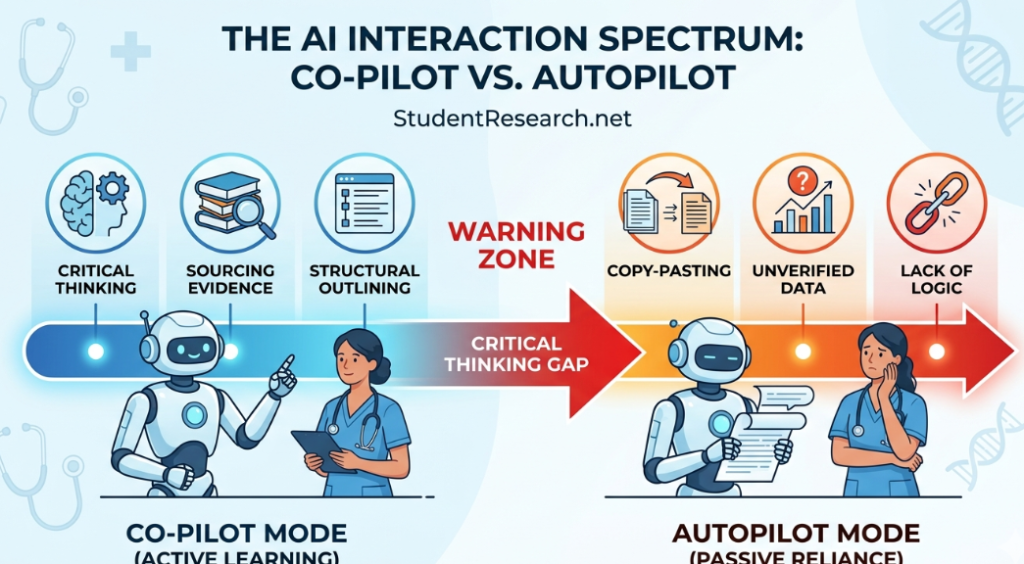
- The Autopilot Warning Signs:
- H4: Generating entire paragraphs without reviewing the clinical accuracy of the medical terminology.
- H4: Copying and pasting nursing care plans without understanding the underlying “why” behind the interventions.
- H4: Failing to verify drug dosages or contraindications against official pharmacopeia or textbooks.
- The Co-pilot Advantage:
- H4: Using AI to brainstorm outline structures for complex pathophysiology essays.
- H4: Prompting the tool to explain difficult concepts like the Renin-Angiotensin-Aldosterone System (RAAS) in simpler terms.
- H4: Requesting summaries of lengthy peer-reviewed journal articles to determine their relevance to your student research.
Overcoming the Autopilot Challenge in Clinical Writing
Overcoming the temptation to let AI take the lead requires a conscious shift back to manual synthesis and evidence-based practice. Integrating active reflection into your study techniques for nursing students #2 ensures that you remain the primary author of your academic and professional journey.
- Strategies for Active Engagement:
- H4: Setting “Manual-Only” zones where you draft your initial thoughts before using digital tools for refinement.
- H4: Verifying every AI-generated citation against your university library database to ensure they are real and peer-reviewed.
- H4: Asking the AI to “critique” your work rather than “write” it, forcing you to defend your clinical choices.
Struggling to balance AI tools with academic integrity? Let our experts at StudentResearch.net help you refine your drafts into polished, human-centered masterpieces. We specialize in evidence-based nursing content that satisfies strict faculty rubrics and plagiarism checks.
3. From Prompt to Product: A Step-by-Step AI Tool Process for Nursing Essays
Mastering the “Process to Product” pipeline is one of the most sophisticated study techniques for nursing students #3 available today. By treating AI as a sophisticated research assistant, you can streamline the development of complex nursing papers without sacrificing original thought or ethical standards. This systematic approach ensures your final product is a reflection of your own clinical competence and analytical skills.
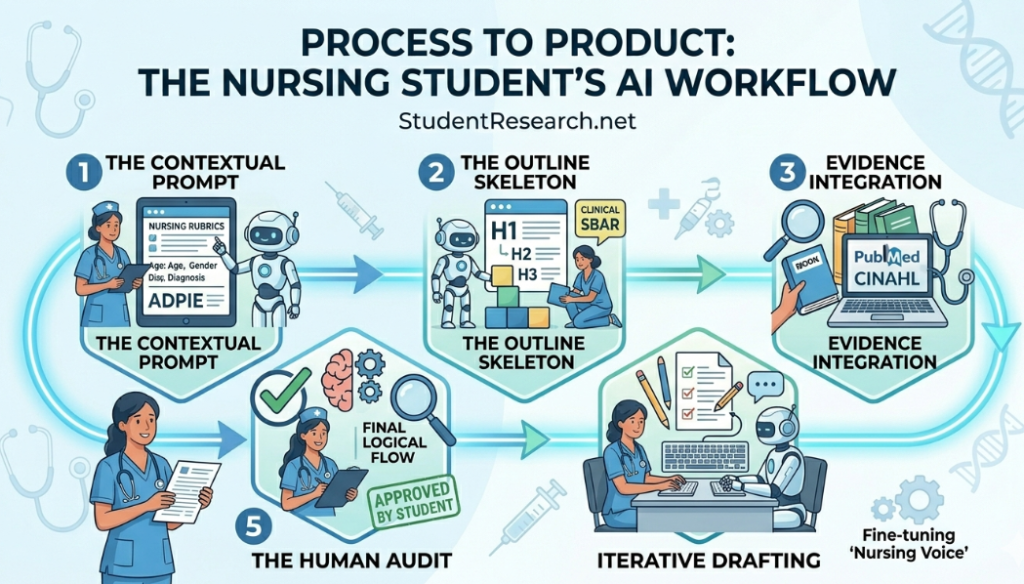
The Systematic Nursing Research Workflow
A structured workflow allows you to maintain control over the content while benefiting from the organizational power of AI. This method is particularly effective for large-scale student research projects that require extensive literature reviews and data synthesis.
- The 5-Step AI Integration Model:
- H4: Step 1: The Contextual Prompt – Provide the AI with your specific nursing rubric and the patient population you are focusing on.
- H4: Step 2: The Outline Skeleton – Generate a H1-H4 structure based on clinical guidelines like SBAR or ADPIE.
- H4: Step 3: Source Integration – Manually insert evidence from your textbooks and reputable sources like PubMed or CINAHL.
- H4: Step 4: The Iterative Draft – Feed your notes into the AI to help smooth out transitions and improve the professional tone of the writing.
- H4: Step 5: The Human Audit – Conduct a final read-through to ensure the “nursing voice” is present and the clinical logic is sound.
4. The Examiner’s Lens: How Faculty Detect AI in Nursing Submissions
Tutors and clinical examiners are increasingly trained to spot the “uncanny valley” of AI-generated content in nursing portfolios and essays. Understanding their detection methods is one of the essential study techniques for nursing students #4 to protect your academic reputation and ensure your work stands out for the right reasons. Faculty members look for specific markers that suggest a lack of genuine human experience and clinical intuition in the writing.
Common Red Flags in AI-Generated Clinical Work
AI often lacks the nuanced “clinical gut feeling” and specific classroom-contextual information that a human student possesses. When these elements are missing, it signals a reliance on automated study techniques for nursing students #5 rather than authentic engagement.
- Detection Markers Used by Faculty:
- H4: Hallucinated Citations: AI often invents plausible-sounding journal articles that do not actually exist in medical databases.
- H4: Perfectly Neutral Tone: A lack of personal reflection on clinical placements or specific patient interactions.
- H4: Repetitive Sentence Structures: AI tends to follow predictable linguistic patterns that differ from a student’s natural writing style.
Overcoming Detection through Authentic Voice and Personal Insight
The best way to “overcome” detection is to ensure your work is truly yours by layering in personal experiences and specific course concepts. This is a powerful study technique for nursing students #6 that makes your work unfalsifiable and deeply personal.
- Techniques for Authentic Submission:
- H4: Including specific anecdotes from your clinical rotations that relate to the essay topic.
- H4: Citing specific lectures, guest speakers, or lab sessions that occurred during your current semester.
- H4: Using “I” statements in reflective sections to describe your personal growth and clinical reasoning.
5. Comparative Analysis of Active vs. Passive Nursing Study Methods
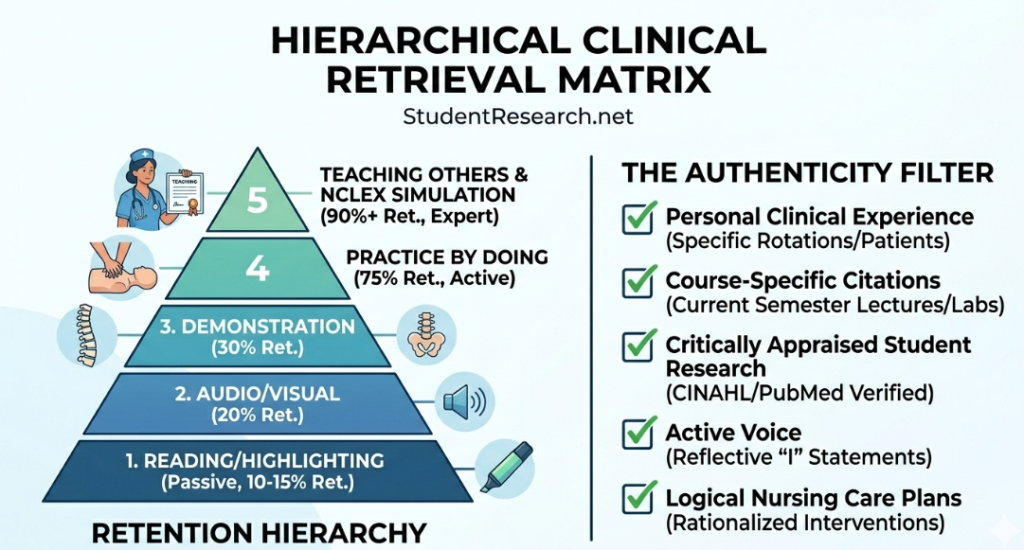
Choosing the right approach can significantly impact your NCLEX readiness and overall GPA. While many students default to rereading notes, evidence suggests that more dynamic study techniques for nursing students #7 yield better results in high-pressure environments. The following table provides a breakdown of how different methods compare in terms of effectiveness and time investment.
Table: Effectiveness of Clinical Learning Strategies
| Strategy Type | Method Example | Retention Rate | Complexity Level |
| Passive | Rereading Textbooks | 10% | Low |
| Passive | Highlighting Notes | 15% | Low |
| Active | Flashcards (Anki) | 70% | Medium |
| Active | Practice NCLEX Questions | 85% | High |
| Active | Teaching a Peer | 90% | High |
Comparison Review: Concept Mapping vs. Linear Note-Taking
When reviewing your study techniques for nursing students #8, it is helpful to contrast how you organize information visually versus textually. Concept mapping is often superior for nursing because it mirrors the interconnected nature of human body systems.
- Concept Mapping:
- H4: Visualizes the relationship between a diagnosis, symptoms, and nursing interventions.
- H4: Encourages holistic thinking and identifies gaps in your understanding of patient care.
- Linear Note-Taking:
- H4: Useful for recording chronological events or simple lists of medication side effects.
- H4: Can lead to “transcription mode” where you write without actually processing the information.
6. Advanced Memorization: Mnemonic Devices and Focused Recall
Nursing school requires the memorization of hundreds of “must-know” facts, from cranial nerves to electrolyte imbalances. Utilizing mnemonics and retrieval practice as core study techniques for nursing students #9 allows you to store this information in your long-term memory more efficiently. These tools act as mental hooks that make data retrieval much faster during exams and clinical shifts.
Leveraging Mnemonics for Pharmacological Mastery
Pharmacology is often cited as the most difficult subject, but it becomes manageable when broken down into creative memory aids. This is a cornerstone of professional student research and academic success in the medical field.
- Popular Nursing Mnemonics:
- H4: ADPIE: Assessment, Diagnosis, Planning, Implementation, Evaluation (The Nursing Process).
- H4: MONA: Morphine, Oxygen, Nitroglycerin, Aspirin (Treating Myocardial Infarction).
- H4: P-E-S: Problem, Etiology, Signs/Symptoms (The Nursing Diagnosis structure).
7. Conclusion: Integrating Your Personal Study Roadmap
In conclusion, achieving success in nursing school is a marathon that requires a diverse toolkit of learning strategies. By balancing technological assistance with rigorous critical thinking and active recall, you ensure that your knowledge is deep, durable, and ready for the bedside. Mastering these study techniques for nursing students will not only help you pass your exams but will also mold you into a competent, safe, and effective healthcare professional.
Student research shows that consistency is the key to mastering the nursing curriculum through active recall and AI co-piloting. Boost grades with these effective study techniques for nursing students. Apply these 9 proven methods to excel in your clinical rotations and NCLEX prep.
Meta Description:
Master the nursing curriculum through active recall and AI co-piloting. Boost grades with these effective study techniques for nursing students.
Need a perfectly structured nursing essay that guarantees results? Our professional writers at StudentResearch.net deliver high-quality, research-backed assignments tailored to your specific clinical requirements. Don’t let heavy workloads stall your progress; click here to order your custom paper now!

