

Introduction: Your Roadmap to Nursing School Success
Navigating nursing school requires more than just academic prowess—it demands a comprehensive student nursing handbook approach that addresses every aspect of your educational journey. Through dedicated student research and insights from successful nursing graduates, this guide provides you with proven strategies to excel in both clinical and academic settings.
What Is a Student Nursing Handbook and Why You Need One
What is a Student Nursing Handbook?
A student nursing handbook is your comprehensive companion throughout nursing school, serving as a centralized resource that combines academic strategies, clinical skills guidance, time management tools, and wellness practices. It’s a personalized roadmap that helps you navigate the complex demands of nursing education while maintaining your physical and mental health.
Why You Need One
- Reduces overwhelm by organizing critical information in one accessible place
- Improves time management through structured planning frameworks and scheduling tools
- Enhances clinical performance with skills checklists and evidence-based practice guidelines
- Supports mental wellness by incorporating self-care strategies into your daily routine
- Increases exam success through proven study techniques and NCLEX preparation methods
- Builds professional confidence with communication protocols and networking opportunities
The Challenge Every Nursing Student Faces
- Starting nursing school feels overwhelming with clinical rotations, theoretical coursework, and practical skills
- Students often struggle to balance academic demands with personal wellbeing
- Having a comprehensive handbook approach transforms chaos into manageable success
Benefits of Using a Structured Nursing Student Guide
Overview of Benefits
- Systematic approach to learning that addresses all competency areas simultaneously
- Time efficiency through pre-organized resources and proven study methods
- Reduced anxiety by having clear action plans for common nursing school challenges
- Better outcomes including higher grades, stronger clinical evaluations, and improved NCLEX pass rates
- Professional development that extends beyond graduation into your nursing career
- Peer-tested strategies that have helped thousands of nursing students succeed
What This Guide Offers
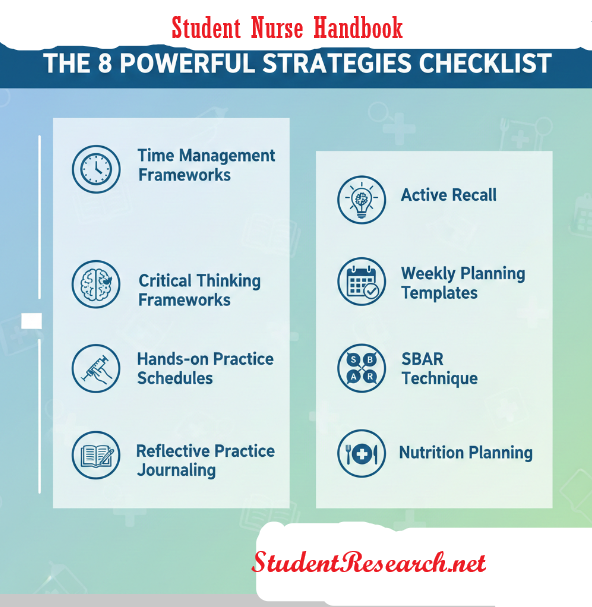
- #1. Time management frameworks specifically designed for nursing students:
- Block scheduling method that allocates specific time slots for lectures, clinical rotations, study sessions, and self-care
- Priority matrix system that helps you distinguish between urgent clinical preparations and important long-term projects
- Weekly review protocol ensuring consistent progress across all nursing courses
- Practical strategies tested by successful nursing graduates
- Evidence-based approaches to clinical and academic excellence
Understanding Your Learning Journey
This guide takes you through a structured pathway that mirrors the actual nursing school experience, from mastering academic content to developing clinical competence and maintaining wellness. Each section builds upon the previous one, creating a holistic approach to nursing education that prepares you not just to pass exams, but to become an exceptional healthcare professional.
Steps to Navigate This Guide
- Five comprehensive sections covering essential nursing school competencies
- Actionable advice you can implement immediately
- Resources to support your entire educational pathway
Section 1: How to Master Academic Excellence in Nursing Education
Academic success in nursing school requires strategic approaches to learning complex material while preparing for clinical practice. This section equips you with proven methods to excel in coursework, master NCLEX-style testing, and manage your time effectively throughout your program.
Ways to Master Nursing Theory and Coursework
- Connect theory to practice by relating pathophysiology concepts to real patient scenarios you’ll encounter
- Use active learning techniques instead of passive reading to increase retention rates
- Create visual learning aids like concept maps and flow charts for complex body systems
- Join or form study groups to benefit from collaborative learning and peer teaching
- Schedule regular review sessions using spaced repetition to combat the forgetting curve
- Seek help early from tutors or professors before falling behind in challenging subjects
Examples of Effective Study Techniques
- #2. Active recall methods that improve retention by 50% compared to passive reading:
- Self-quizzing using flashcards for drug classifications, lab values, and nursing interventions
- Teaching-back technique where you explain concepts aloud to solidify understanding
- Practice questions after each chapter to apply knowledge immediately
- Retrieval practice by writing out key concepts from memory before reviewing notes
- Creating concept maps to connect pathophysiology with nursing interventions
- Utilizing spaced repetition for pharmacology and medical terminology
Guide to Resource Utilization
- Leveraging textbooks, peer-reviewed journals, and digital databases
- Forming study groups that enhance collaborative learning
- Accessing tutoring services before you fall behind
Steps to NCLEX Test-Taking Success
- Master the nursing process (Assessment, Diagnosis, Planning, Implementation, Evaluation) as your foundation
- Practice priority-setting questions daily using ABC, Maslow’s hierarchy, and urgent vs. important criteria
- Develop test-taking strategies for eliminating wrong answers and identifying key words
- Complete practice questions consistently aiming for at least 75-100 questions per week
- Review rationales thoroughly for both correct and incorrect answers to understand reasoning
- Simulate testing conditions periodically with timed practice exams to build stamina
How to Answer NCLEX-Style Questions
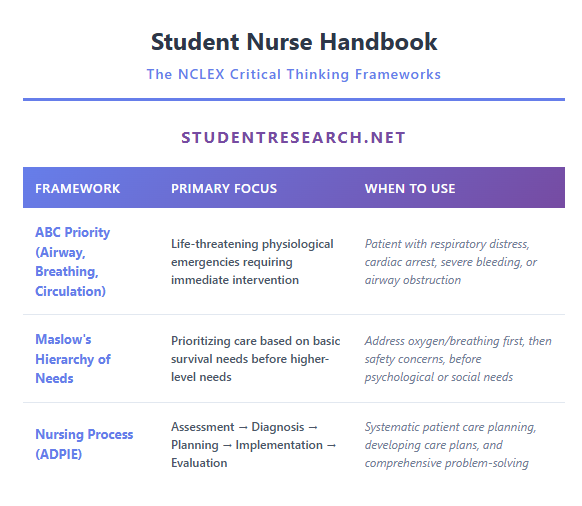
- #3. Critical thinking frameworks for analyzing multiple-choice questions:
- ABC priority framework (Airway, Breathing, Circulation) for physiological emergencies
- Maslow’s Hierarchy of Needs for determining priority interventions
- Nursing Process steps to identify what phase the question addresses
- Safety and Risk Reduction principles for identifying most appropriate actions
- Identifying priority-setting questions using ABC (Airway, Breathing, Circulation)
- Practice testing schedules that build confidence progressively
Ways to Manage Test Anxiety
- Breathing techniques and mindfulness practices:
- 4-7-8 breathing technique (inhale 4 counts, hold 7, exhale 8)
- Box breathing (inhale, hold, exhale, hold for 4 counts each)
- Progressive muscle relaxation starting from toes to head
- Mindful meditation for 10 minutes before studying or testing
- Positive self-talk and visualization strategies:
- Affirmations like “I am prepared and capable of succeeding”
- Visualization of yourself confidently answering questions
- Replacing negative thoughts with evidence of past successes
- Pre-exam ritual that includes calming music or aromatherapy
Guide to Time Management for Nursing Students
Time management is arguably the most critical skill for nursing students juggling lectures, clinical rotations, skills labs, and personal responsibilities. Effective scheduling prevents last-minute cramming and reduces stress while ensuring you meet all program requirements. A well-structured time management system allows you to maintain academic excellence without sacrificing your health or relationships.
How to Create Effective Study Schedules
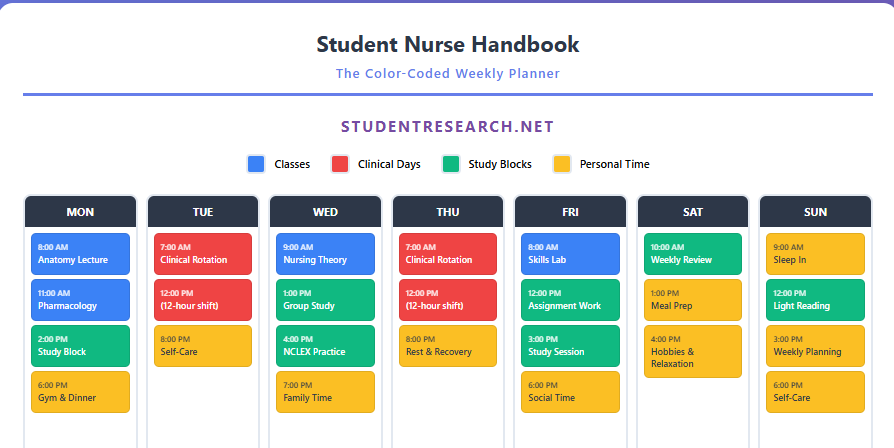
- #4. Weekly planning templates that accommodate clinical shifts and coursework:
- Color-coded calendar template: Assign different colors for classes (blue), clinical days (red), study blocks (green), and personal time (yellow) to visualize your week at a glance
- Time-blocking schedule: Divide your day into 2-3 hour focused blocks with specific tasks like “Pharmacology study 9-11am” or “Practice skills lab 2-4pm”
- Rolling weekly planner: Create a master template that repeats weekly but includes flexibility for exam weeks, clinical intensives, and personal commitments
- Prioritizing assignments using the Eisenhower Matrix (urgent/important, important/not urgent, urgent/not important, neither)
- Building buffer time for unexpected demands like extra clinical hours or family emergencies
Deadline in hours, not days? StudentResearch.net offers the fastest turnaround in the industry with our 3-hour rush option. When clinical rotations and exams collide, we’re your guaranteed solution for quality nursing papers delivered on time, every time. Don’t compromise—get expert help fast!
Steps to Maintain Work-Life Balance
- Set clear boundaries by designating study-free times for family, exercise, or hobbies
- Communicate your schedule with family and friends so they understand your availability
- Schedule self-care activities with the same importance as clinical rotations
- Learn to say no to commitments that don’t align with your educational priorities
- Take regular breaks using the Pomodoro technique (25 minutes focused work, 5-minute break)
- Protect your sleep schedule by maintaining consistent bedtimes even during busy weeks
- Build in flexibility by not over-scheduling every hour of every day
Section 2: How to Develop Clinical Skills and Professional Excellence
Clinical competence forms the foundation of nursing practice, requiring hands-on skill mastery and professional relationship building. This section guides you through developing essential clinical abilities while establishing the communication patterns and confidence needed for exceptional patient care.
Types of Essential Clinical Competencies
- Assessment skills: Comprehensive physical examinations, vital signs monitoring, and patient history collection
- Medication administration: Safe preparation, calculation, and delivery via multiple routes (oral, IV, IM, subcutaneous)
- Wound care management: Dressing changes, assessment of healing stages, and infection prevention
- IV therapy: Insertion, maintenance, and troubleshooting of intravenous access
- Patient hygiene and mobility: Bed baths, positioning, transfers, and fall prevention techniques
- Documentation proficiency: Accurate, timely, and legally sound charting in electronic health records
- Emergency response: CPR, choking intervention, and rapid response team protocols
Guide to Fundamental Nursing Skills
- #5. Hands-on practice schedules for mastering medication administration, wound care, and vital signs:
- Daily skills rotation: Practice one skill category each day (Monday: vital signs, Tuesday: medication administration, Wednesday: wound care) for 30-45 minutes
- Pre-clinical intensive week: Dedicate the week before clinical rotations to practicing all required skills 2-3 times daily in the simulation lab
- Peer practice partnerships: Schedule bi-weekly sessions with classmates to practice skills on each other, alternating between performing and observing roles
- Utilizing simulation lab time effectively by arriving prepared with procedural steps reviewed
- Creating personal skills checklists aligned with program objectives to track mastery levels
Steps to Documentation Excellence
- Master the fundamentals by understanding SOAP (Subjective, Objective, Assessment, Plan), DAR (Data, Action, Response), and narrative charting formats
- Practice concise writing that captures essential information without unnecessary details
- Use approved abbreviations only to prevent medication errors and miscommunication
- Document immediately after interventions to ensure accuracy and completeness
- Include objective measurements rather than vague descriptions (e.g., “blood pressure 148/92” not “elevated blood pressure”)
- Chart patient responses to interventions to demonstrate critical thinking and care effectiveness
- Understand legal implications by knowing that documentation serves as legal evidence in court proceedings
- Navigate electronic health records efficiently by learning keyboard shortcuts and templates
Struggling with APA citations and formatting guidelines? StudentResearch.net delivers perfectly formatted nursing papers with all referencing included—APA, MLA, Chicago, and more. Focus on learning while we handle the technical details. Get ready-to-submit assignments without citation stress!
How to Build Professional Relationships in Healthcare
Professional relationships in healthcare extend beyond clinical competence to encompass effective communication, collaborative teamwork, and mentorship connections. Building strong professional networks during nursing school creates support systems that benefit your entire career while improving patient outcomes through enhanced team coordination.
Ways to Communicate Effectively in Clinical Settings
- Use the SBAR technique consistently for clear, organized communication
- Practice active listening by maintaining eye contact and avoiding interruptions
- Ask clarifying questions when instructions are unclear rather than making assumptions
- Provide thorough handoff reports that include patient condition, recent changes, and pending tasks
- Communicate respectfully with all team members regardless of their role or position
- Document verbal orders by reading them back for confirmation before implementation
Benefits of Mentorship and Networking
- Gain insider knowledge about unit culture, procedures, and expectations from experienced nurses
- Receive constructive feedback in a supportive environment that accelerates skill development
- Access job opportunities through professional connections before positions are publicly posted
- Build confidence by having experienced professionals validate your clinical judgment
- Develop specialty interests through exposure to different nursing specialties and practice settings
- Create lasting professional relationships that provide support throughout your nursing career
- Join student nursing associations like National Student Nurses’ Association (NSNA) for leadership development
Steps to Build Clinical Confidence
- Prepare thoroughly before each clinical day by reviewing patient diagnoses, medications, and procedures
- Start with familiar tasks to build momentum before attempting more complex skills
- Request supervision for new or complex procedures until you feel competent
- Reflect on successes at the end of each clinical day to recognize your growth
- Accept that mistakes happen and view them as valuable learning opportunities
- Seek feedback actively from instructors and preceptors rather than waiting for evaluations
How to Overcome Imposter Syndrome
- Acknowledge your feelings without judgment, recognizing that most nursing students experience self-doubt
- Document your progress through reflective journaling to see concrete evidence of improvement
- Compare yourself to your past self rather than to classmates who may have different backgrounds
- Reframe negative thoughts by replacing “I can’t do this” with “I’m still learning this”
- Share your feelings with trusted classmates who likely experience similar doubts
- Focus on patient impact rather than perfect performance, remembering that caring presence matters
- Recognizing that mistakes are learning opportunities
- #7. Reflective practice journaling to track growth and insights through weekly entries about challenging situations, successful interventions, and lessons learned
- Seeking feedback constructively from instructors
Understanding Patient Safety Protocols
- Understanding medication rights: right patient, drug, dose, route, time, documentation, reason, response, and refusal
- Following infection control procedures including hand hygiene, PPE use, and isolation precautions
- Speaking up about safety concerns professionally using the chain of command when necessary
- Implementing fall prevention strategies based on patient risk assessments
Section 3: Guide to Self-Care and Wellness for Nursing Students
Self-care is not optional in nursing school—it’s essential for sustaining the physical and mental energy required for academic and clinical success. This section provides practical strategies for maintaining your health while managing the demanding workload of nursing education.
How to Maintain Physical Health During Nursing School
Physical health directly impacts your ability to think clearly, perform clinical skills safely, and manage stress effectively. Long clinical shifts, irregular schedules, and academic pressure can compromise your physical wellbeing if not addressed proactively. Prioritizing nutrition, sleep, and movement creates the foundation for sustained success throughout your nursing program.
Steps to Effective Energy Management
- Plan nutritious meals in advance using meal prep Sundays to ensure healthy options during busy weeks
- Pack clinical-day snacks including protein bars, nuts, and fruit for sustained energy during 12-hour shifts
- Stay hydrated by carrying a reusable water bottle and setting hourly drinking reminders
- Eat regular meals even when stressed, avoiding the temptation to skip breakfast or lunch
- Limit caffeine intake especially after 2pm to prevent sleep disruption
- #8. Nutrition planning for demanding clinical days and long study sessions, focusing on balanced macronutrients and avoiding excessive sugar
- Maintaining consistent sleep schedules despite rotating shifts by keeping bedtime within a 1-hour window
- Incorporating movement and exercise between classes through 15-minute walks, stretching, or yoga
Ways to Prevent Occupational Hazards
- Practice proper body mechanics by bending at the knees, keeping your back straight, and getting help with heavy patients
- Use assistive devices like slide sheets, lift equipment, and transfer belts rather than relying on back strength
- Wear supportive footwear with adequate cushioning for long clinical days
- Take micro-breaks to stretch your neck, shoulders, and back during shifts
- Report workplace injuries immediately, no matter how minor they seem
- Practice standard precautions consistently to prevent needlestick injuries and exposure to pathogens
- Maintain ergonomic study spaces with proper chair height and computer screen positioning
Ways to Maintain Mental and Emotional Wellbeing
- Establish boundaries between school responsibilities and personal time to prevent burnout
- Practice self-compassion by treating yourself with the same kindness you show patients
- Maintain social connections outside of nursing school for perspective and support
- Engage in enjoyable activities regularly, even if only for 30 minutes weekly
- Monitor stress levels and intervene early when you notice warning signs
- Seek professional help when stress becomes overwhelming or interferes with daily functioning
- Celebrate small wins rather than waiting for major milestones to acknowledge progress
Examples of Stress Management Techniques
- Box breathing (4-4-4-4 pattern) during exams or stressful clinical moments
- Progressive muscle relaxation before bed to improve sleep quality
- Guided meditation apps like Headspace or Calm for 10-minute daily practice
- Mindful walking between classes to clear your mind and reset focus
- Journaling for 5-10 minutes daily to process emotions and experiences
- Yoga or tai chi for combining movement with mindfulness practice
- Identifying personal stress triggers in clinical and academic settings
- Implementing mindfulness meditation, deep breathing, and progressive muscle relaxation
- Utilizing campus counseling services without stigma
Steps to Building Resilience
- Develop a growth mindset by viewing challenges as opportunities to strengthen your skills
- Create realistic expectations about what you can accomplish in a given timeframe
- Build a support network of classmates who understand nursing school demands
- Practice gratitude by listing three positive things from each clinical day
- Learn from difficult experiences rather than dwelling on what went wrong
- Maintain perspective by remembering why you chose nursing and your long-term goals
- Developing coping strategies for difficult patient outcomes
- Creating support networks with fellow nursing students
- Maintaining perspective during challenging semesters
Guide to Financial Wellness in Nursing School
Financial stress can significantly impact academic performance and mental health during nursing school. Understanding how to budget effectively and balance work with academic demands helps minimize financial anxiety. Strategic financial planning allows you to focus on learning rather than constantly worrying about expenses.
How to Budget for Nursing School
- Managing tuition, supplies, and certification exam costs by creating a comprehensive expense spreadsheet
- Exploring scholarships, grants, and loan forgiveness programs specific to nursing students
- Applying for emergency student loans or hardship funds when unexpected expenses arise
- Buying used textbooks or renting digital versions to reduce costs
- Sharing equipment purchases like stethoscopes and blood pressure cuffs with study partners
- Planning for hidden costs including background checks, drug screenings, immunizations, and uniforms
Ways to Balance Work and School
- Seek flexible employment in healthcare settings (CNA, patient care tech) that provide relevant experience
- Negotiate reduced hours during clinical-intensive semesters with your employer in advance
- Consider per-diem positions that allow you to pick up shifts around your school schedule
- Work strategically during semester breaks to build financial reserves
- Communicate your schedule to employers early so they can plan around your clinical rotations
- Prioritize school over work when conflicts arise, remembering that your education is the long-term investment
- Planning for income changes during unpaid clinical rotations by saving during lighter academic periods
Conclusion: Building Your Nursing Legacy
Understanding Your Growth Through This Journey
You’ve now explored a comprehensive student nursing handbook guide with 8 powerful strategies for clinical success, covering everything from time management and study skills to self-care in nursing school. This journey from novice student to competent practitioner requires patience, persistence, and the structured approach outlined in these sections. Your student nursing handbook isn’t a static document—it’s a living resource that evolves with your experiences, challenges, and triumphs throughout your educational journey.
What You’ve Learned from This Guide
- Reflecting on how academic excellence, clinical competence, and self-care interconnect to create sustainable nursing success
- Recognizing that your student nursing handbook is a living document that you’ll continuously refine based on your experiences
- Celebrating small victories throughout your educational pathway, from mastering your first IV insertion to passing your first pharmacology exam
- Understanding that every challenge you face builds the resilience and critical thinking skills essential for professional nursing practice
Steps to Take Action Today
- Choose one strategy from each section to implement this week rather than overwhelming yourself with everything at once
- Create your personalized handbook using a digital tool or physical binder to organize these strategies
- Share your goals with a trusted classmate or mentor for accountability
- Set weekly check-ins to assess what’s working and adjust approaches as needed
- Start small but start now—even 15 minutes of daily implementation creates momentum
How to Implement Your Plan
- Starting with one strategy from each section this week
- Adjusting approaches based on personal learning styles
- Remaining flexible as program demands evolve
Why Your Nursing Journey Matters
- You’re answering a calling that goes beyond a career to serve humanity during vulnerable moments
- Healthcare needs you—nursing shortages mean your dedication directly impacts community health
- Your unique perspective brings diversity to the profession and improves patient care outcomes
- You’re building expertise that can save lives, comfort families, and advocate for vulnerable populations
- The challenges you face now are preparing you for the rewarding career ahead
Benefits of Commitment to Excellence
- Patient impact: Every skill you master and every concept you learn translates to better patient outcomes and safer care
- Professional satisfaction: Commitment to excellence creates confidence, competence, and career fulfillment
- Career advancement: Strong foundations lead to leadership opportunities, specialty certifications, and advanced practice roles
- Personal growth: Nursing school develops critical thinking, emotional intelligence, and resilience that benefit all life areas
- Every nurse began where you are today—even the most experienced nurses were once overwhelmed nursing students
- Commitment to excellence creates exceptional healthcare providers who transform patient experiences
- Your dedication will impact countless lives throughout your career, creating a lasting legacy of compassionate care
- Trust the process and believe in your capabilities—you have everything you need to succeed
Want top marks on your nursing assignments? StudentResearch.net elevates your grade profile with expertly crafted papers designed to earn you the highest scores. Our professional writers understand nursing education standards and deliver excellence that strengthens your academic record. Invest in your future success today!

