

Entering the clinical environment as a student can be both exhilarating and overwhelming as you bridge the gap between classroom theory and bedside care. Understanding student nurse strengths and weaknesses examples is not just an academic exercise; it is a foundational step in developing professional competence. Research into nursing education highlights that students who engage in consistent self-assessment tend to demonstrate higher clinical reasoning skills over time. By identifying your personal assets and areas for growth early on, you can proactively shape your learning experience.
This comprehensive guide provides 25 proven traits to help you navigate your evaluations with confidence. Embracing this reflective journey ensures you provide the safest and most effective care to your patients while building a resilient career in healthcare.
Understanding the Importance of Self-Assessment: What is a Nursing Reflective Practice?
Why Clinical Instructors Value Student Nurse Strengths and Awareness
- Safety First: Instructors prioritize students who know their limits, as this prevents errors in the clinical setting.
- Professionalism: Demonstrating self-awareness shows a level of maturity and readiness for the responsibilities of a Registered Nurse.
- Efficiency: When you communicate your strengths, instructors can tailor your assignments to challenge you appropriately.
Setting SMART goals for specific clinical skills
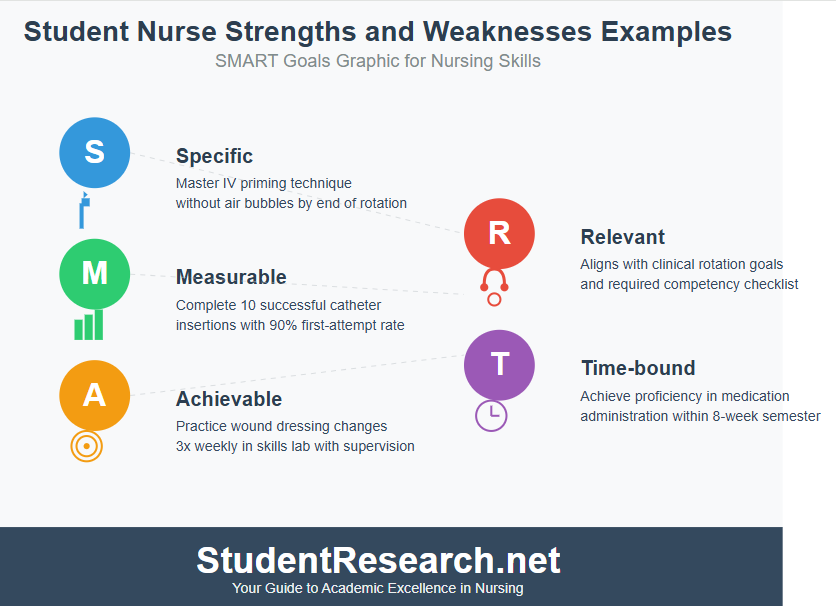
- Specific: Focusing on a single skill, such as priming an IV line.
- Measurable: Aiming for a set number of successful attempts.
- Achievable: Choosing goals within your current scope of practice.
- Relevant: Aligning goals with the current unit’s specialty
- Time-bound: Achieving the goal by the end of the clinical rotation.
Identifying gaps in clinical knowledge before they impact patient safety
- Proactive Questioning: Asking for clarification before performing an unfamiliar procedure.
- Pre-Shift Prep: Researching patient diagnoses and medications the night before clinical.
- Peer Review: Discussing clinical scenarios with classmates to uncover different perspectives.
How to Reflect on Your Performance: Steps to Achieve Clinical Growth
- Daily Debriefing: Spend five minutes after each shift identifying one success and one challenge.
- Journaling: Keep a log of “first-time” experiences to track your psychomotor skill development.
- Feedback Loops: Actively ask your preceptor, “What is one thing I could have done better during that handoff?”.
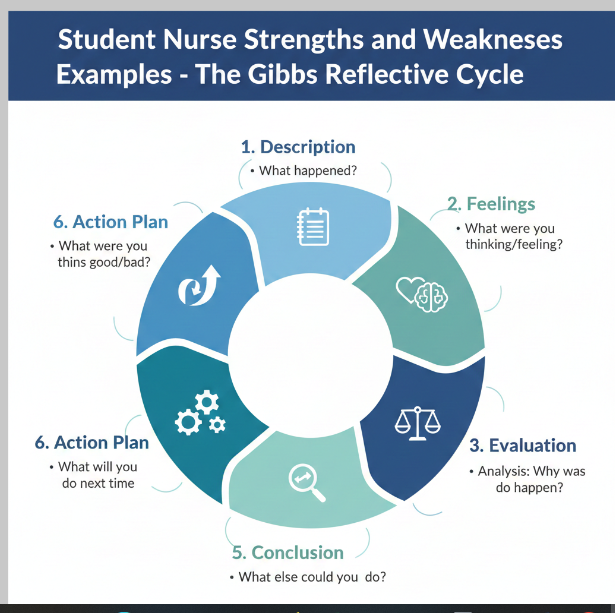
Using the Gibbs Reflective Cycle to analyze clinical encounters
- Description: Recalling exactly what happened during a specific event.
- Feelings: Acknowledging the emotions felt during the encounter.
- Evaluation: Determining what was good or bad about the experience.
- Analysis: Making sense of the situation using nursing theory.
- Conclusion: Deciding what else you could have done.
- Action Plan: Preparing how you would handle a similar situation in the future.
Trait #25: Evidence-Based Practice (EBP) application in daily reflection
- Validation: Ensuring your clinical decisions are backed by the latest research.
- Quality Improvement: Using EBP to suggest better ways of performing routine care.
- Critique: Comparing unit-specific protocols with the most current clinical guidelines.
Top 10 Student Nurse Strengths Examples and Practical Illustrations
Identifying your natural talents allows you to lean into these assets during high-pressure clinical situations. The following section highlights the core competencies that often set successful nursing students apart from their peers. Use these examples to articulate your value during mid-term evaluations and clinical debriefs.
Soft Skills and Emotional Intelligence: Benefits of Empathy in Care
- Improved Outcomes: Patients who feel heard and understood often experience lower stress levels
- Trust Building: Empathy is the foundation of the nurse-patient relationship, leading to better compliance with treatment plans.
- Conflict De-escalation: Emotional intelligence helps in managing frustrated patients or family members effectively.
Trait #1: Active Listening – Providing presence to anxious patients
- Eye Contact: Maintaining appropriate non-verbal connection.
- Clarification: Summarizing patient concerns to ensure understanding.
- Presence: Sitting at eye level with the patient rather than standing over them.
Trait #2: Cultural Competence – Respecting diverse healthcare beliefs
- Inclusivity: Adjusting care plans to respect dietary or religious needs.
- Humility: Asking patients about their traditions rather than making assumptions.
- Translation: Effectively utilizing medical interpreters for non-English speaking patients.
Trait #3: Empathy – Connecting with patients beyond a diagnosis
- Holistic Care: Treating the person, not just the room number or the illness.
- Validation: Acknowledging the patient’s pain or fear as legitimate.
- Comfort Measures: Providing small acts of kindness that enhance patient dignity.
Trait #4: Resilience – Maintaining focus during 12-hour shifts
- Stamina: Keeping high energy levels until the final handoff report.
- Recovery: Quickly bouncing back after a difficult clinical event or feedback session.
- Self-Care: Utilizing breaks to hydrate and reset mentally.
Trait #5: Adaptability – Pivoting when patient acuity changes
- Flexibility: Re-prioritizing tasks when a new admission arrives.
- Calmness: Staying level-headed when a patient’s condition deteriorates.
- Speed: Adjusting your workflow to meet the immediate needs of the unit.
Technical and Professional Strengths: Understanding Student Nurse Strengths in Action
- Clinical Competence: Demonstrating a solid grasp of nursing fundamentals.
- Safety Advocacy: Standing up for the patient when safety protocols are at risk.
- Collaboration: Working seamlessly with the broader healthcare team.
Tired of losing points on citations? StudentResearch.net guarantees flawless adherence to APA, MLA, Chicago, and Harvard styles. We ensure your papers meet strict university-specific formatting guidelines every time, so you can focus entirely on your clinical practice.
Trait #6: Attention to Detail – Meticulous medication administration
- The Six Rights: Consistently checking patient, drug, dose, route, time, and documentation.
- Lab Review: Checking potassium levels before giving diuretics.
- Vitals Check: Ensuring blood pressure is within range before giving antihypertensives.
Trait #7: Time Management – Balancing vitals, charting, and care
- Organization: Creating a “brain sheet” to track tasks throughout the shift.
- Pacing: Completing routine morning assessments on time to allow for midday tasks.
- Efficiency: Grouping care tasks to minimize frequent trips to the supply room.
Trait #8: Strong Communication – Providing clear SBAR handoffs
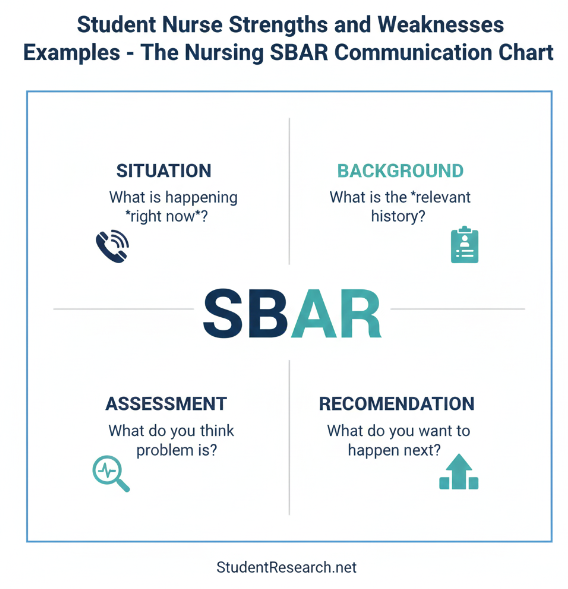
- Situation: Concisely stating the immediate problem.
- Background: Giving relevant patient history.
- Assessment: Sharing your current clinical findings.
- Recommendation: Suggesting the next steps for care.
Trait #9: Critical Thinking – Connecting pathophysiology to symptoms
- Anticipation: Understanding why a diabetic patient might have slow wound healing.
- Evaluation: Recognizing when a patient’s response to treatment is not as expected.
- Synthesis: Combining multiple lab results to see the “big picture” of patient health.
Trait #10: Eagerness to Learn – Proactively seeking new unit skills
- Initiative: Volunteering to watch or assist with a procedure in another room.
- Curiosity: Asking “why” behind specific provider orders.
- Growth: Actively seeking out the most challenging patient assignments.
Struggling with complex coursework? Whether you are in Nursing, STEM, or the Humanities, StudentResearch.net matches you with subject-matter experts tailored to your specific course requirements. Get high-quality, discipline-specific academic support across all fields of study today!
Common Student Nurse Weaknesses Examples: Troubleshooting Clinical Challenges
It is completely normal to have areas that require improvement during your transition from student to professional. Identifying these student nurse weaknesses examples early allows you to create a targeted plan for improvement with your instructor. Remember that acknowledging a weakness is the first step toward mastering it.
Overcoming Technical Inexperience: How to Improve Manual Skills
- Repetition: Requesting extra time in the skills lab to practice difficult tasks.
- Observation: Watching experienced nurses perform the skill multiple times before attempting it.
- Preparation: Reviewing the facility’s policy and procedure manual before starting.
Trait #11: Manual Skills – Improving confidence with IV starts and caths
- Hand-Eye Coordination: Practicing the steady movements required for sterile procedures.
- Equipment Mastery: Familiarizing yourself with different brands of supplies.
- Patient Positioning: Learning how to position patients for the best procedural success.
Trait #12: Charting Speed – Learning to document without missing data
- Focusing: Documenting “by exception” where appropriate to save time.
- Real-Time Entry: Attempting to chart immediately after an intervention.
- Templates: Utilizing EHR shortcuts and phrases to improve efficiency.
Trait #13: Pharmacology Knowledge – Memorizing drug classes/side effects
- Classification: Grouping medications by their mechanisms of action.
- Safety Flags: Memorizing “high-alert” medications and their specific antidotes.
- Application: Connecting the medication directly to the patient’s current symptoms.
Managing Internal Challenges: Reasons for Student Nurse Weaknesses
- Impatience: Wanting to be an expert before having the necessary experience.
- Anxiety: Fear of making a mistake in front of patients or staff.
- Over-Commitment: Saying “yes” to too many tasks and becoming overwhelmed.
Trait #14: Clinical Self-Confidence – Overcoming “imposter syndrome”
- Positive Affirmation: Reminding yourself of your academic achievements and successful clinical moments.
- Competence Building: Knowing that confidence follows competence—keep practicing!.
- Support Systems: Talking to fellow students about shared anxieties.
Trait #15: Delegation Skills – Working effectively with CNAs and techs
- Clear Instruction: Being specific about what needs to be done and when.
- Scope Awareness: Knowing exactly what tasks can and cannot be delegated.
- Closing the Loop: Following up to ensure the delegated task was completed safely.
Trait #16: Professional Boundaries – Avoiding emotional burnout
- Self-Awareness: Recognizing when a patient’s situation is affecting your mental health.
- Compartmentalization: Learning to leave work stress at the hospital.
- Setting Limits: Being empathetic without taking on the patient’s emotional burden.
25 Examples for Your Clinical Evaluation Form: Difference Between Strengths and Weaknesses
When it comes time for your clinical evaluation, being able to categorize your performance accurately is vital. Use the following T-column to see how different traits are classified. This visual guide helps you translate your clinical experiences into professional language for your instructors.
| Student Nurse Strengths | Student Nurse Weaknesses (Growth Areas) |
| Meticulous Attention to Detail | Developing Manual Skill Speed |
| Strong Cultural Competence | Refining Delegation Techniques |
| Proactive Learning Initiative | Improving Pharmacology Recall |
| Effective SBAR Communication | Balancing Charting with Bedside Care |
| High Resilience and Adaptability | Managing Clinical Anxiety/Confidence |
Ready-to-Use Phrases for Student Nurse Strengths
- Professionalism: “Consistently arrives prepared and maintains a professional demeanor with all staff”.
- Critical Thinking: “Accurately identifies clinical changes and reports them promptly to the preceptor”.
- Bedside Manner: “Develops rapport quickly with diverse patient populations”.
Trait #18: “Consistently prioritizes patient safety and infection control”
- Hand Hygiene: Following “gel-in/gel-out” protocols without reminders.
- Sterile Technique: Maintaining a sterile field during complex dressing changes.
- Patient ID: Always checking two identifiers before any intervention.
Trait #19: “Demonstrates proactive multidisciplinary collaboration”
- Team Engagement: Participating in interdisciplinary rounds with meaningful input.
- Respect: Valuing the contributions of physical therapy, pharmacy, and social work.
- Coordination: Assisting other team members when your own tasks are complete.
Trait #20: “Shows poise when communicating with difficult family members”
- De-escalation: Using a calm tone and open body language.
- Listening: Letting family members voice their concerns fully before responding.
- Directing: Knowing when to involve the nurse manager or chaplain.
Constructive Phrasing for Student Nurse Weaknesses
- Technical Skill: “Continues to refine psychomotor skills through repeated practice”.
- Knowledge Gap: “Actively working to bridge the gap between theory and clinical application”.
- Time Management: “Seeking strategies to improve workflow during high-acuity shifts”.
Trait #17: “Prioritization of Care – Developing a systematic approach”
- Triage: Learning which patient to see first in a multi-patient assignment.
- Urgency: Differentiating between “urgent” and “important” tasks.
- Re-evaluation: Checking your priority list throughout the shift as conditions change.
Trait #21: “Systematic Care – Refining the balance of speed and depth”
- Workflow: Creating a more logical sequence for morning assessments.
- Thoroughness: Ensuring speed does not compromise the quality of the assessment.
- Checklists: Using personal cues to ensure no steps are missed during routine care.
Trait #22: “Charting Thoroughness – Ensuring comprehensive data entry”
- Objectivity: Using clinical data rather than subjective opinions in notes.
- Accuracy: Double-checking intake and output (I&O) totals.
- Clarity: Ensuring that anyone reading the chart has a clear picture of the patient’s status.
Trait #23: “Psychomotor Skills – Seeking more practice in advanced tasks”
- Lab Practice: Returning to the lab for skills like NG tube insertion.
- Volunteerism: Asking to perform skills under supervision whenever they are there.
- Review: Studying the steps of a process.
Strategies to Turn Weaknesses Into Strengths: Ways to Accomplish Professional Goals
Turning a weakness into a strength requires a deliberate and organized approach to your clinical education. By implementing specific strategies, you can accelerate your growth and build lasting confidence. Use these methods to transform your challenges into the building blocks of your nursing career.
Creating a Development Plan: Guide to Mastering Nursing Competencies
- Self-Audit: Review your previous evaluations to find recurring themes.
- Objective Setting: Create three specific goals for every clinical shift.
- Progress Tracking: Use a checklist to mark off skills as you become comfortable with them.
Utilizing nursing simulation labs for low-stakes practice
- Safe Failure: Learning from mistakes where there is no risk to a real patient.
- Scenario Variety: Practicing for rare but critical events, like a code blue.
- Peer Observation: Learning by watching how your classmates handle simulation challenges.
Utilizing Mentorship: Why is Peer Support Important?
- Experience Sharing: Gaining insights from those who have recently been in your shoes.
- Networking: Building relationships that can lead to future job opportunities.
- Emotional Safety: Having a trusted person to talk to about the stressors of nursing school.
Finding a mentor who excels in your area of weakness
- Observation: Identifying a nurse on your unit who has the skills you want to learn.
- Ask Directly: Approaching a potential mentor and asking for their advice on specific tasks
- Shadowing: Requesting to shadow a specialist, like a wound care nurse, to deepen your knowledge.
Conclusion: Embracing Your Journey and Understanding the Path to RN
Mastering the balance between your student nurse strengths and weaknesses examples is a career-long endeavor. Our guide helps you excel in clinicals with tips for self-reflection and professional growth, ensuring you are prepared for the transition to independent practice. By staying committed to the 25 proven traits outlined here, you will build a solid foundation for clinical excellence.
The Lifelong Learning Aspect: Learn How to Transition from Student to Professional
- Continuing Education: Staying current with new medical technologies and research.
- Specialization: Using your strengths to find the nursing niche that fits you best.
- Mentoring Others: Preparing to become a preceptor yourself once you gain experience.
Viewing every “weakness” as a milestone for future expertise
- Mindset Shift: Seeing a mistake as a lesson rather than a failure.
- Patience: Giving yourself the grace to be a “novice” during your first few years.
- Dedication: Recognizing that expertise is built one shift at a time.
Final Encouragement: When to Seek Additional Support
- Academic Tutoring: Getting help if pharmacology or pathophysiology remains a struggle.
- Counseling: Seeking support if clinical stress impacts your mental well-being.
- Faculty Office Hours: Using one-on-one time with professors to clarify complex concepts.
Want full control over your project? At StudentResearch.net, you communicate directly with your assigned writer for real-time updates and collaborative input. This transparent process ensures your final paper perfectly reflects your unique voice and specific academic goals.

