

The journey to becoming a skilled Nurse Practitioner (NP) culminates in the preceptorship—the vital clinical phase where classroom knowledge transforms into hands-on expertise. This immersive experience, guided by an experienced preceptor, is the crucible for mastering the nuances of clinical practice, critical thinking, and patient management.
To maximize the immense value of this time, simply showing up isn’t enough. You need a roadmap for success. That’s why setting clear, measurable goals during your preceptorship is absolutely crucial. Without them, your learning can become unfocused and inefficient. Goals provide direction, motivation, and a tangible way to track your progress toward clinical excellence.
This informational resource is dedicated to helping you define that roadmap using the universally effective SMART goal framework. We’ll move past vague intentions and focus on specific, achievable targets. Get ready to explore a comprehensive list of Smart Goals for Nurse Practitioner Students During Preceptorship Examples, giving you 24 proven strategies to truly master your clinical rotation and confidently step into your future NP role.
Section 1 – Understanding SMART Goals for Nurse Practitioner Students During Preceptorship
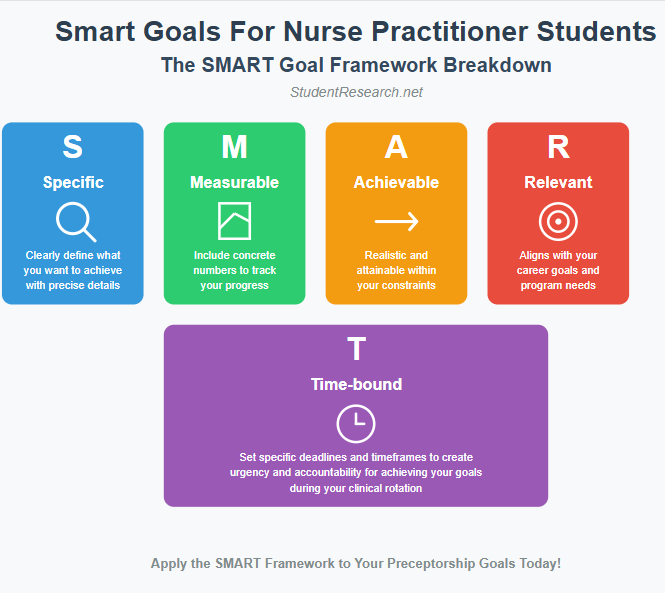
What Are SMART Goals in Nursing Education?
The SMART goal framework has become the gold standard for effective goal-setting in healthcare education:
- Specific: Clearly define what you want to accomplish rather than stating vague intentions like “get better at assessments”
- Measurable: Include concrete criteria for tracking progress, such as number of procedures performed or patients assessed
- Achievable: Challenge yourself while remaining realistic given your current skill level and rotation constraints
- Relevant: Align directly with your learning objectives, program requirements, and future career aspirations
- Time-bound: Include specific deadlines that create urgency and accountability throughout your rotation
Is your looming assignment deadline causing preceptor stress? Missed deadlines are not an option in nursing! StudentResearch.net guarantees on-time delivery or your money back, even on the tightest 3-hour assignments. We protect your academic schedule
For nurse practitioner students, the SMART framework transforms preceptorship from a passive observation period into an active, intentional learning journey. This structured approach helps you develop clinical competencies systematically while providing clear benchmarks to discuss with your preceptor during evaluations.
Why Nurse Practitioner Students Need Goals During Preceptorship
Preceptorship without clear objectives can feel overwhelming and directionless. Goals serve as your compass for several critical reasons:
- Bridge theory to practice: Identify specific situations where you’ll apply classroom concepts to real patient care
- Track progress systematically: Provide tangible evidence of your professional growth throughout the rotation
- Enhance preceptor communication: Establish shared expectations and facilitate more productive feedback conversations
- Manage limited time effectively: Prioritize the most impactful learning experiences during your clinical hours
- Build confidence progressively: Accomplish measurable milestones that validate your growing competence
Key Benefits of Setting SMART Goals During Clinical Rotations
Setting SMART goals during your preceptorship delivers multiple advantages:
- Focused learning objectives: Prevent feeling scattered across too many priorities by concentrating on specific competencies
- Better time management: Know exactly what you need to accomplish each week and plan accordingly
- Increased confidence: Check off completed goals and receive validation from your preceptor regularly
- Academic documentation: Provide essential evidence for clinical evaluations, portfolio development, and program requirements
- Lifelong learning foundation: Create habits of intentional professional development that extend throughout your nursing career
Clinical Skills: Smart Goals for Nurse Practitioner Students During Preceptorship Examples
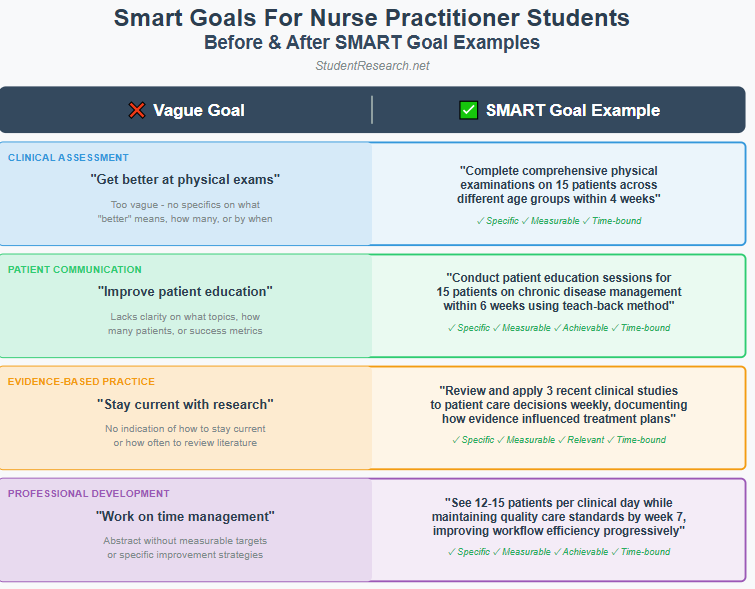
Patient Assessment Smart Goals Examples
Developing strong assessment skills forms the foundation of competent nurse practitioner practice. Here are concrete examples:
- Smart Goal #1: Complete comprehensive physical examinations on 15 patients across different age groups (pediatric, adult, geriatric) within 4 weeks, documenting findings using appropriate medical terminology
- Smart Goal #2: Perform focused cardiovascular assessments on 10 patients with 90% accuracy as verified by preceptor feedback by week 6 of rotation
Diagnostic Reasoning Smart Goals for NP Students
Critical thinking and diagnostic reasoning separate competent practitioners from excellent ones:
- Smart Goal #3: Develop differential diagnoses for 20 patient cases with preceptor feedback, achieving 80% alignment with final diagnoses by end of rotation
- Smart Goal #4: Accurately interpret 25 diagnostic tests (labs, imaging studies, EKGs) within 8 weeks, demonstrating understanding of clinical significance and implications
Procedural Skills Goals During Preceptorship
Hands-on procedural competency requires deliberate practice with measurable targets:
- Smart Goal #5: Successfully perform 10 common procedures (suturing, wound care, joint injections, pap smears) under direct supervision with competency sign-off
- Smart Goal #6: Demonstrate independent competency in 5 specialty-specific procedures relevant to your practice area by rotation completion
Documentation and Charting Smart Goals Examples
Efficient, accurate documentation is essential for legal protection and continuity of care:
- Smart Goal #7: Complete SOAP notes for 30 patients within 30 minutes per note by week 5, maintaining thoroughness and accuracy
- Smart Goal #8: Achieve 95% accuracy in billing and coding documentation for 20 patient encounters as verified by preceptor review
Patient Care: Smart Goals for Nurse Practitioner Students During Preceptorship Examples
Patient Communication Smart Goals for NP Students
Effective communication directly impacts patient outcomes, satisfaction, and adherence:
- Smart Goal #9: Conduct patient education sessions for 15 patients on chronic disease management (diabetes, hypertension, COPD) within 6 weeks using teach-back method
- Smart Goal #10: Improve patient satisfaction scores to 4.5/5 or higher through enhanced communication techniques, verified by anonymous patient feedback surveys
Treatment Planning Smart Goals Examples
Evidence-based treatment planning demonstrates your clinical reasoning and decision-making abilities:
- Smart Goal #11: Develop evidence-based treatment plans for 25 patients across 3 different conditions by week 8, incorporating current clinical guidelines
- Smart Goal #12: Prescribe medications safely for 20 patients with zero prescribing errors, demonstrating knowledge of drug interactions, contraindications, and appropriate dosing
Cultural Competency Goals During Preceptorship
Cultural sensitivity enhances patient trust and improves health outcomes across diverse populations:
- Smart Goal #13: Provide culturally sensitive care to patients from at least 5 different cultural backgrounds, adapting communication and treatment approaches appropriately
- Smart Goal #14: Implement language-appropriate patient education materials for 10 non-English speaking patients using interpreter services or translated resources
Patient Follow-Up Smart Goals for Nurse Practitioner Students
Continuity of care demonstrates your commitment to comprehensive patient management:
- Smart Goal #15: Coordinate follow-up care for 15 patients with chronic conditions within the 10-week rotation, including referrals and care transitions
- Smart Goal #16: Contact and assess outcomes for 10 discharged patients within 48-72 hours, documenting findings and adjusting care plans as needed
Professional Development: Smart Goals for Nurse Practitioner Students During Preceptorship Examples
Evidence-Based Practice Smart Goals Examples
Integrating research into clinical practice elevates the quality of care you provide:
- Smart Goal #17: Review and apply 3 recent clinical studies to patient care decisions weekly, documenting how evidence influenced your treatment recommendations
- Smart Goal #18: Present one evidence-based practice case study to preceptor and clinical team by week 6, demonstrating ability to critique research and apply findings
Interprofessional Collaboration Goals for NP Students
Healthcare delivery requires effective teamwork across multiple disciplines:
- Smart Goal #19: Participate in 5 interprofessional team meetings (with physicians, social workers, pharmacists, case managers) and document collaborative decisions made
- Smart Goal #20: Consult with specialists for 10 complex patient cases during the rotation, learning appropriate referral processes and collaborative care management
Time Management and Efficiency Smart Goals
Balancing thoroughness with efficiency is crucial in today’s healthcare environment:
- Smart Goal #21: See 12-15 patients per clinical day while maintaining quality care standards by week 7, improving workflow efficiency progressively
- Smart Goal #22: Reduce patient appointment time from 45 to 30 minutes while maintaining thoroughness in assessment, diagnosis, and treatment planning
Self-Assessment and Reflection Goals During Preceptorship
Reflective practice accelerates learning and promotes professional growth:
- Smart Goal #23: Complete weekly reflective journals documenting 3 learning points and 2 areas for improvement, identifying specific strategies for growth
- Smart Goal #24: Conduct mid-rotation and end-rotation self-evaluations using clinical competency rubrics, comparing self-assessment with preceptor feedback
Ready to order your paper, but concerned about risk? Order confidently with StudentResearch.net! We use secure payment gateways and offer a comprehensive money-back guarantee if the work doesn’t meet your assignment instructions. Your satisfaction is assured.
How to Create Your Own Smart Goals for Nurse Practitioner Students During Preceptorship
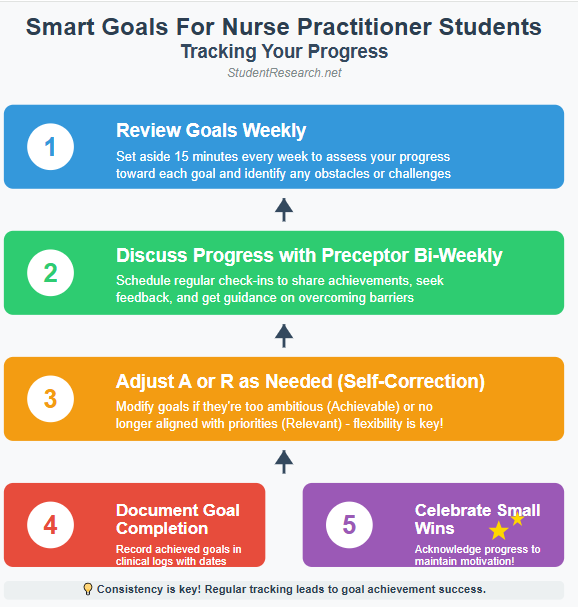
Step-by-Step Process for Setting Smart Goals as an NP Student
Creating personalized goals ensures your preceptorship addresses your unique learning needs:
Step 1 – Assess Your Current Competency Level
- Review your program’s clinical competency requirements and evaluation criteria
- Identify your strongest clinical skills and areas needing the most improvement
- Discuss expectations and available learning opportunities with your preceptor during orientation
- Consider feedback from previous clinical experiences and academic performance
Step 2 – Make Goals Specific and Measurable
- Use concrete numbers (how many patients, procedures, assessments) rather than vague descriptors
- Define exactly what success looks like with observable, verifiable criteria
- Include specific patient populations, conditions, or clinical scenarios relevant to your specialty
- Specify the quality standards or accuracy percentages you’re targeting
Step 3 – Ensure Goals Are Achievable and Relevant
- Consider your rotation length, typical patient volume, and clinical setting constraints
- Align goals with your specialty area, career interests, and program requirements
- Match goals to available resources, equipment, and patient populations at your site
- Challenge yourself appropriately without setting yourself up for frustration or failure
Step 4 – Set Realistic Time Boundaries
- Break larger goals into weekly or bi-weekly milestones for consistent progress tracking
- Account for your learning curve, especially when starting new rotations or procedures
- Build in time for preceptor feedback, skill refinement, and goal adjustment as needed
- Front-load simpler goals early in rotation while saving complex objectives for later weeks
Tips for Tracking Your Smart Goals During Preceptorship
Consistent monitoring ensures you stay on track and adjust as circumstances change:
- Use goal-tracking templates, apps, or spreadsheets to log daily progress toward each objective
- Schedule weekly 15-minute check-ins with your preceptor to review progress and obstacles
- Document achievements in clinical logs with specific dates, patient encounters, and outcomes
- Adjust goals mid-rotation if they prove too ambitious or too easy based on actual experience
- Celebrate completed goals to maintain motivation and acknowledge your professional growth
Conclusion
Implementing smart goals for nurse practitioner students during preceptorship examples transforms your clinical rotations from passive experiences into powerful learning opportunities. The 24 proven strategies outlined in this guide span clinical skills, patient care, and professional development goals, providing you with a comprehensive framework for success. By setting specific, measurable, achievable, relevant, and time-bound objectives, you’ll enhance your learning outcomes, build stronger relationships with your preceptors, and develop the competencies essential for confident practice. Remember that these examples serve as templates—adapt them to your specialty area, clinical setting, and individual learning needs.
Start by selecting 5-7 goals that address your most critical development areas, then expand as you gain confidence in the goal-setting process. Your preceptorship represents a limited window of intensive learning under expert guidance. Make every clinical hour count by approaching each rotation with clear intentions, measurable targets, and commitment to continuous improvement. Begin creating your personalized SMART goals today, and watch as your clinical competence, professional confidence, and career readiness soar to new heights.
Tired of surprise fees when ordering academic help? Get an instant, all-inclusive quote at StudentResearch.net. Our transparent price includes free formatting, bibliography, and title pages—no hidden charges. Achieve budget clarity and focus on your clinical excellence

