

Why Nursing Student Resume Templates Are Your Secret Weapon
Standing out in a competitive job market requires more than just clinical knowledge; it demands a polished professional narrative. Utilizing effective resume examples for nursing students allows you to transform standard academic history into a compelling showcase of your future potential. By leveraging structured templates, you ensure that recruiters immediately recognize your readiness for the fast-paced healthcare environment, effectively bridging the gap between your classroom theory and clinical application.
Understanding the hiring manager’s perspective
- Recruiters prioritize candidates who demonstrate “clinical maturity,” meaning the ability to translate book knowledge into bedside safety.
- Hiring managers scan for evidence that you understand unit-specific acuity, such as knowing the difference between stable Med-Surg patients and high-acuity ICU patients.
- They seek candidates who show initiative, reliability, and the ability to function as a dependable member of an interdisciplinary team.
- Your resume acts as a filter; highlighting the right experiences proves you can handle the emotional and physical demands of the nursing profession.
How your resume acts as your professional brand
- A clean, consistent design signals high attention to detail, a trait essential for medical documentation and safety.
- Using strong action verbs like “coordinated,” “monitored,” “assessed,” and “advocated” shifts your brand from “student” to “colleague.”
- Aligning your summary with the hospital’s mission statement demonstrates that you have researched their culture and values.
Bridging the gap between school and the clinic
- Emphasize how your Student Research projects prepared you for evidence-based practice and improved patient safety outcomes.
- Connect classroom coursework achievements to real-world clinical decision-making by explaining how you applied theory to bedside patient care.
- Frame your academic projects as contributions to the nursing profession rather than just “school assignments.”
Anatomy of a High-Converting Nursing Student Resume
A winning document is built on a foundation of clarity, relevance, and precise metrics. When drafting your content, focus on clearly articulated clinical rotations and academic honors that demonstrate your growth. This section explores how to organize your background to pass initial screenings and capture the attention of nursing managers.
Writing a compelling nursing professional summary
- State your clear intent to provide compassionate, high-quality, evidence-based care in a professional setting.
- Mention your specific interest area, such as Pediatrics, ICU, or Med-Surg, to show you have a clinical focus.
- Include your graduation date and your current status regarding NCLEX readiness or testing dates.
Structuring your education section for impact
- List your BSN degree, university name, and anticipated graduation date in a clear, bold format.
- Include Essential Skills for Clinical Rotation Success and any capstone projects that demonstrate advanced clinical leadership.
- If your capstone or final project requires a formal proposal, you may find this expert research proposal writing service helpful in refining your submission for maximum academic impact.
- If your GPA is 3.5 or above, include it to highlight your academic dedication and intellectual discipline.
Formatting your clinical rotation history
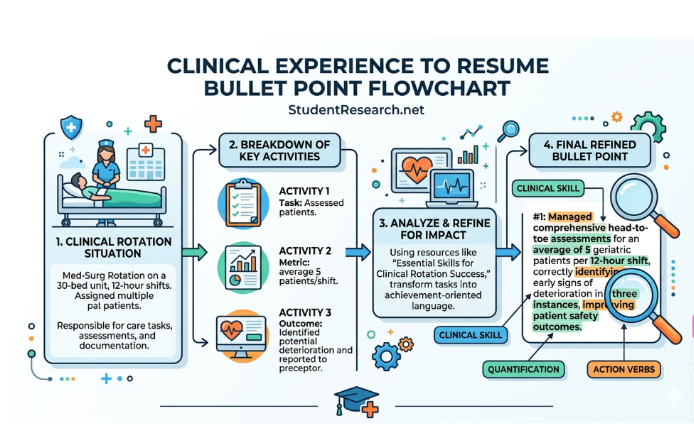
- Include your total clinical hours, the name of the facility, and the specific unit or department.
- Use bullet points to list specific tasks like medication administration, wound care, and patient monitoring.
- Quantify your experience by noting the average number of patients you managed during these shifts.
Leveraging specific clinical hours and unit focus
- Detail your experience with Electronic Health Records (EHR) systems like Epic or Cerner, as this saves hospitals training time.
- Highlight high-acuity interactions to show your exposure to complex care situations and emergency protocols.
30 Specific Examples: Categorized Nursing Skills & Experience
Providing concrete evidence of your abilities is essential for passing the initial resume screen. Below are categorized highlights that serve as perfect resume examples for nursing students to emulate when crafting their own experience sections.
Clinical skills examples for specialty rotations
- #1: Successfully performed IV insertions on 15+ patients per rotation, achieving a 90% first-stick success rate.
- #2: Assisted in wound debridement for patients with stage 3 ulcers, following strict sterile technique protocols to prevent infection.
- #3: Administered oral and subcutaneous medications under preceptor supervision, maintaining 100% adherence to the “Five Rights” of medication safety.
- #4: Monitored telemetry readings for 4 patients consistently throughout shifts, identifying and reporting arrhythmia changes within minutes.
- #5: Executed sterile field setup for minor bedside procedures, ensuring 100% compliance with hospital infection control guidelines.
- #6: Provided comprehensive head-to-toe assessments for geriatric patients, identifying early signs of delirium and pressure ulcers.
- #7: Collaborated with interdisciplinary teams during daily rounds to update patient care plans based on real-time assessments.
- #8: Managed Foley catheter insertion and maintenance protocols, resulting in zero catheter-associated urinary tract infections during the rotation.
- #9: Documented vitals accurately within the Epic charting system, maintaining high standards of data integrity and patient privacy.
- #10: Provided patient education on post-discharge insulin management, significantly improving patient understanding of self-administration techniques.
Soft skills that recruiters look for in new grads
- #11: Demonstrated high emotional intelligence during difficult family updates, providing comfort and clear information.
- #12: Exhibited adaptability by pivoting tasks during emergency codes, assisting the primary nurse with vital supply retrieval.
- #13: Showed strong time management by prioritizing tasks in high-acuity wards, ensuring all patient assessments were completed on time.
- #14: Maintained clear, SBAR-standardized communication with senior nurses, ensuring all handoffs were concise and accurate.
- #15: Acted as an empathetic advocate for non-English speaking patients, utilizing interpreter services to ensure informed consent.
- #16: Proved conflict resolution skills during collaborative group projects by facilitating compromise and clear goal setting.
- #17: Displayed high professional integrity by reporting minor medication errors immediately, prioritizing patient safety over personal pride.
- #18: Showed commitment to continuous learning by seeking feedback from preceptors after every clinical shift.
- #19: Maintained a positive, supportive attitude under extreme pressure, contributing to a collaborative team environment.
- #20: Demonstrated cultural competence when assisting diverse patient populations, respecting individual beliefs in care delivery.
Certifications and volunteer work that add value
- #21: Completed American Heart Association BLS and ACLS certification, staying current with the latest cardiac life support guidelines.
- #22: Certified in Pediatric Advanced Life Support (PALS), enhancing readiness for neonatal and pediatric emergency scenarios.
- #23: Volunteered 50+ hours at a local community vaccination clinic, managing patient flow and triage documentation.
- #24: Participated in a week-long medical mission trip to rural clinics, providing basic health screenings for underserved populations.
- #25: Served as a peer tutor for pharmacology and pathophysiology courses, demonstrating mastery of complex medical subjects.
- #26: Assisted with blood pressure screenings at community health fairs, educating participants on cardiovascular risk factors.
- #27: Completed specialized training for neonatal emergency care, gaining exposure to sensitive and critical infant care.
- #28: Earned certification in phlebotomy to enhance technical versatility and speed in laboratory specimen collection.
- #29: Volunteered as a student representative for the school nursing board, advocating for improved clinical resource access.
- #30: Organized a campus-wide student research initiative on patient safety, demonstrating leadership in evidence-based practice.
Integrating certifications into your profile
- Dedicate a specific, highly visible section to active licenses and certifications.
- Clearly include expiration dates, as this shows recruiters you are organized and prepared for compliance checks.
Customizing Your Resume for Different Nursing Specializations
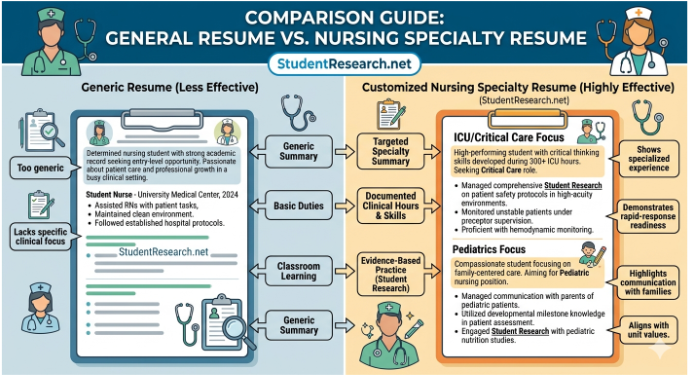
Generic resumes often fall short because they lack the specific keyword tailoring required for distinct clinical environments. Adapting your document shows that you understand the unique demands of different units, which significantly boosts your hireability.
Tailoring for ICU versus Pediatrics rotations
- For ICU roles, highlight your experience with ventilator support monitoring, hemodynamic stability checks, and complex medication drips.
- For Pediatrics, emphasize your understanding of child development milestones, pain management scales appropriate for age, and family-centered care communication.
- Tailor your clinical summary to explicitly mention the patient acuity levels you are comfortable managing.
Highlighting research experience for academic nursing roles
- List all peer-reviewed posters, research papers, or case studies you contributed to during your degree.
- For those needing additional guidance on structuring their academic contributions, check out this professional research paper writing resource to ensure your work meets scholarly standards.
- Clearly explain your role, whether it was data collection, literature reviews, or statistical analysis.
- Link these experiences to your commitment to evidence-based practice and lifelong learning.
Expert Tips for Optimizing Your Resume for ATS (Applicant Tracking Systems)
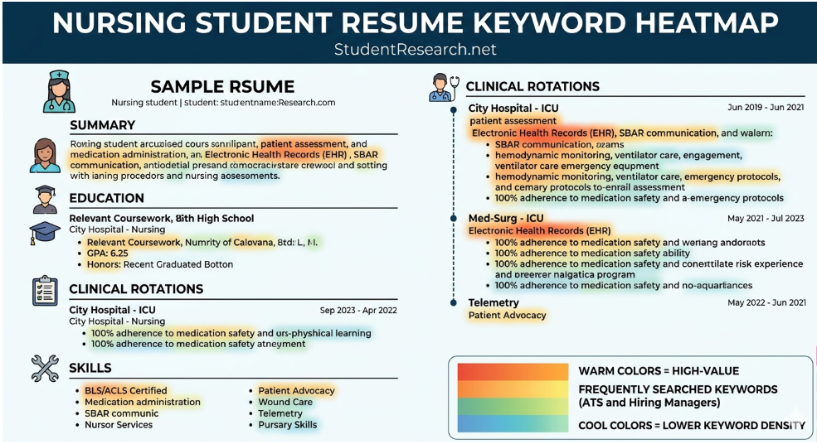
Many hospitals utilize automated tracking software to filter candidates, making ATS optimization a critical step in your job hunt. If your resume isn’t formatted correctly, it may never reach a human recruiter, regardless of your talent.
Using keywords from nursing job descriptions
- Carefully analyze the job description for specific phrases like “patient advocacy,” “multidisciplinary team,” or “rapid response.”
- Incorporate these exact keywords into your professional summary and experience sections to improve your keyword density scores.
- Focus on action verbs related to clinical tasks, such as “assessed,” “stabilized,” “monitored,” and “prevented.”
Correct formatting and file types to ensure visibility
- Use standard, professional fonts like Arial, Calibri, or Helvetica; avoid creative or decorative fonts that can confuse scanning software.
- Always submit your file in PDF format unless the job portal specifically requests a Word document.
- Remove complex graphics, icons, or nested tables, as these can obscure your text from automated parsers.
Avoiding Common Mistakes in New Graduate Resumes
Even the most accomplished students can inadvertently sabotage their chances by including irrelevant details or making simple technical errors. Taking a moment to refine these details ensures your application represents your true professional potential and readiness for clinical practice.
Filtering out irrelevant employment history
- Omit part-time service or retail jobs from your high school years; they do not reflect your current clinical capabilities.
- Replace these with professional development summaries, specialized training, or volunteer experiences that relate to healthcare.
Checking for common typos in medical terminology
- Double-check the spelling of every medication, physiological process, or medical acronym; one error can signal a lack of attention to detail.
- Ensure consistent capitalization of certifications and unit titles, as inconsistency looks unprofessional.
Why clinical accuracy reflects professional competency
- Errors in your documentation or resume may be perceived by hiring managers as a potential liability for patient safety.
- Thorough proofreading is not just about grammar; it is a demonstration of your commitment to the precision required at the bedside.
Your Next Steps: From Resume Submission to Clinical Interview
After optimizing your resume with these nursing student resume examples, you are ready to apply for positions with confidence. Remember that your resume is the key to opening doors, but your interview will ultimately secure the role.
Leveraging your resume during the interview process
- Keep a copy of your resume handy during interviews to use as a roadmap for discussing your clinical achievements.
- Prepare specific “STAR” method (Situation, Task, Action, Result) responses for every bullet point listed on your resume.
Preparing your portfolio to support your application
- Maintain a professional portfolio folder containing your clinical certifications, letters of recommendation, and copies of academic awards.
- Always bring several printed copies of your resume to interviews, even if you have already submitted it digitally.
Conclusion
Building your first CV is a challenging milestone, but utilizing these resume examples for nursing students provides a clear path forward. If you are struggling to build your first CV, explore our guide featuring effective resume examples for nursing students to help you land your dream clinical role. By focusing on your clinical rotations, certifications, and specific achievements, you will create a professional document that truly reflects your hard-earned skills. Start refining your application today to ensure you stand out as a top-tier candidate in a crowded field of graduates. Engaging in high-level student research and clinical practice will continue to set you apart as a lifelong learner and dedicated healthcare professional.

