

Transitioning from the classroom to the hospital floor requires more than just clinical knowledge; it requires a strategic presentation of your capabilities. Recent student research suggests that hiring managers spend less than ten seconds scanning a CV before deciding its fate. To stand out, you must master the art of displaying your nursing student resume skills to prove you are ready for the fast-paced medical environment. This guide provides the tactical blueprint you need to transform your academic experience into a professional clinical profile that lands interviews.
Understanding Nursing Student Resume Skills: What Managers Look For
Hiring managers in healthcare look for a specific blend of technical ability and emotional intelligence that ensures patient safety. They want to see that a candidate is not only trained in procedures but is also teachable and resilient under pressure. By understanding what these decision-makers prioritize, you can tailor your application to meet the specific needs of their unit. Your resume should serve as a bridge between your clinical rotations and your future role as a licensed professional.
Need expert help with your complex nursing assignments? From detailed lab reports and case studies to comprehensive dissertations and essays, StudentResearch.net provides a full range of academic services. Let our expert editors polish your presentations and research papers now!
What Managers Look For
- Clinical Competence: Evidence that you can safely perform basic nursing interventions.
- Adaptability: The ability to learn new Electronic Health Record (EHR) systems and hospital protocols quickly.
- Professionalism: A clean, error-free presentation that mirrors the precision required in nursing.
- Team Synergy: A history of working effectively within interdisciplinary healthcare teams.
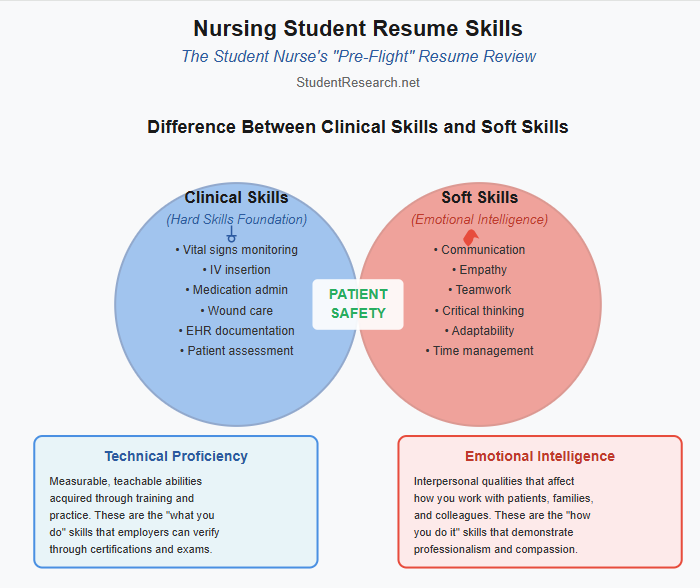
What is the Difference Between Clinical Skills and Soft Skills?
| Clinical (Hard) Skills | Soft (Interpersonal) Skills |
| Measurable technical abilities learned through training. | Personal attributes that dictate how you interact with others |
| Examples: Wound care, IV starts, and catheterization. | Examples: Empathy, active listening, and time management. |
| Essential for performing medical procedures safely. | Essential for patient satisfaction and team collaboration. |
Defining Clinical Competencies: Why Technical “Hard” Skills are Your Foundation
- Patient Safety: Technical mastery reduces the risk of medical errors during high-stakes procedures.
- Efficiency: Proficiency in hard skills allows you to manage your patient load more effectively.
- Legal Compliance: Proper execution of clinical tasks ensures adherence to healthcare regulations and standards
- Trust: Demonstrating technical skill builds immediate confidence with both patients and senior staff.
Understanding Soft Skills: Why Empathy and Communication are Non-Negotiable
- Patient Outcomes: Strong communication is linked to better patient compliance and recovery rates.
- De-escalation: Empathy helps in managing stressed families and difficult patient behaviors.
- Interprofessional Respect: Clear communication prevents errors during shift handovers and doctor consultations.
Tactic #1: Aligning Your Skills with the Specific Facility’s Mission Statement
- Targeted Research: Look for keywords in the hospital’s mission, such as “innovation,” “community-focused,” or “holistic”.
- Strategic Matching: If a hospital prides itself on “Compassionate Care,” prioritize your soft skills and volunteer work.
- Value Proposition: Explicitly state how your skills will help the facility achieve its specific goals in your summary statement.
Types of Nursing Skill Categories
- Hard Skills: Technical tasks like phlebotomy, medication administration, and vital sign monitoring.
- Soft Skills: Behavioral traits such as critical thinking, leadership, and cultural sensitivity.
- Transferable Skills: Skills from previous careers, like customer service or project management, applied to nursing.
- Specialty Skills: Knowledge specific to areas like Pediatrics, ICU, or Geriatrics.
How to Showcase Hard Clinical Skills for Maximum Impact
To make your resume truly effective, you must transition from listing general tasks to showcasing specific expertise that proves your readiness for a residency program. Hiring managers look for technical proficiency that minimizes the learning curve during orientation. By following these methods, you ensure your nursing student resume skills are both visible and verifiable to any clinical recruiter.
10 Examples of Essential Clinical Skills to List
- Direct Patient Care: Highlighting your ability to manage vitals, hygiene, and patient mobility assistance.
- Technical Proficiency: Listing specialized tasks like wound care, IV starts, and catheterization.
- Medication Administration: Safely performing the “six rights” of medication delivery.
- Phlebotomy & Specimen Collection: Accurate blood draws and lab prep.
- Respiratory Support: Managing oxygen therapy and nebulizer treatments.
- Post-Operative Care: Monitoring surgical sites and managing recovery protocols.
- Infection Control: Demonstrating strict adherence to aseptic techniques and PPE protocols.
- Triage & Assessment: Conducting head-to-toe assessments and identifying urgent changes in status.
- Point-of-Care Testing: Performing glucose checks and other bedside diagnostics.
- Advanced Technology: Operating infusion pumps, heart monitors, and specialized hospital beds.
Tactic #2: Using the “Numbers Rule” to Quantify Your Clinical Hours
- Total Exposure: State the total number of clinical hours completed across all rotations to show depth of experience.
- Specific Unit Volume: Mention how many patients you managed per shift on high-acuity units.
- Outcome Metrics: If applicable, note the frequency of specific procedures, such as successfully performing 15+ catheterizations.
Tactic #3: Categorizing Skills by “Proficiency Level” (Observed vs. Performed)
- Standardized Labels: Use clear headers like “Independently Performed” versus “Assisted/Observed” to maintain honesty and integrity.
- Skill Progression: Show how you moved from observing a skill in a lab to performing it in a high-pressure clinical setting.
- Competency Validation: Mention skills that were officially “signed off” by a preceptor or instructor.
H4 – Steps to Document Clinical Rotations
- Pharmacology & Med Admin Accuracy: Detail your experience with MAR systems and various administration routes like IV, IM, and PO.
- Emergency Response (BLS/ACLS) Verification: List your certification provider and expiration dates clearly.
- EHR/EMR Software Proficiency: Identify specific systems used, such as Epic, Cerner, or Meditech, to pass ATS filters.
Why Soft Skills are Important: The Key to Patient Safety
While technical prowess is vital, the ability to navigate human emotions and complex environments is what truly ensures patient safety. Soft skills represent the bridge between medical knowledge and the actual delivery of care in high-stress situations.
Ways to Demonstrate Emotional Intelligence on Paper
- Reflective Language: Use phrases that show you understand the “why” behind patient interactions.
- Active Listening Evidence: Mention your ability to gather comprehensive patient histories through rapport.
- Self-Regulation: Highlight your capacity to remain calm and focused during code blues or emergency situations.
- Social Awareness: Detail your experience in recognizing non-verbal cues from patients in distress.
Therapeutic Communication: Building Rapport with Patients and Families
- Effective Education: Describing how you simplified complex discharge instructions for patients with low health literacy.
- Empathy in Action: Using active listening to validate the concerns of anxious family members.
- Professional Boundaries: Demonstrating how to provide support while maintaining a professional nurse-patient relationship.
- Conflict De-escalation: Showing your ability to use verbal techniques to calm agitated patients.
Tactic #4: Mapping Critical Thinking Skills to Real-Life Clinical “Near-Misses”
- Proactive Identification: Describing a time you noticed a subtle change in vitals before a patient spiraled.
- Decision-Making Process: Explaining the steps you took to verify a questionable medication dosage with a preceptor.
- Action and Result: Clearly stating how your intervention prevented a potential medical error.
Tactic #5: Highlighting Cultural Competence Through Diverse Clinical Placements
- Diverse Populations: Listing rotations in urban, rural, or underserved community clinics.
- Language Services: Mentioning experience working with medical interpreters for non-English speaking patients.
- Inclusive Care: Adapting nursing care plans to respect a patient’s religious or dietary preferences.
Benefits of Strong Interpersonal Skills
- Conflict Resolution in Interdisciplinary Teams: Using SBAR (Situation-Background-Assessment-Recommendation) to resolve professional disagreements90.
- Time Management & Prioritization Tactics: Explaining how you manage a four-patient load by clustering care activities91.
- Patient Advocacy and Safety Initiatives: Documenting instances where you spoke up for a patient’s wishes during multidisciplinary rounds92.
Guide to Formatting: How Do I Organize My Resume?
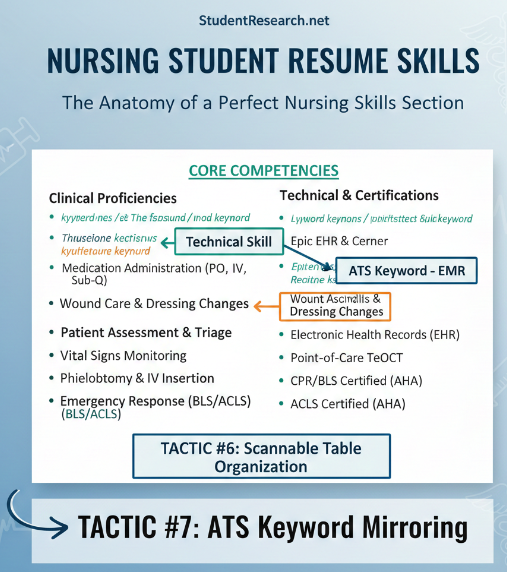
The structure of your document is just as critical as the content itself because a cluttered layout can hide your best attributes. As a student, your resume must be a model of organization, allowing recruiters to find your clinical hours and nursing student resume skills at a glance. By following professional formatting standards, you demonstrate the attention to detail required in a clinical setting.
Struggling to balance clinicals and coursework on a budget? StudentResearch.net offers competitive rates tailored for nursing students. Get professional writing help with exclusive first-time user discounts and seasonal promotions today. Quality academic support has never been more affordable
Steps to Achieve a Professional Resume Layout
- Logical Flow: Arrange sections by relevance, typically placing education and clinical rotations near the top.
- Consistent Typography: Use professional fonts like Arial or Calibri in 10-12 point sizes for readability.
- White Space Management: Ensure adequate margins so the page doesn’t look overcrowded or overwhelming.
- Chronological Order: List your most recent clinical experiences first to show your current level of training.
Tactic #6: Organizing Your Skills into a Scannable “Core Competencies” Table
- Instant Scannability: Use a three-column table or bulleted list to group your technical skills for quick review.
- Thematic Grouping: Categorize skills by “Clinical Skills,” “Technical Systems,” and “Certifications”.
- Efficiency: This format allows a recruiter to verify your baseline qualifications in seconds.
Tactic #7: Optimizing for ATS by Mirroring the Job Description’s Exact Keywords
- Direct Matching: Scan the job posting for specific terms like “IV Therapy” or “Patient Assessment” and include them exactly as written.
- Keyword Placement: Integrate these terms into both your skills list and your clinical rotation descriptions.
- System Success: Using the exact phrasing ensures the Applicant Tracking System (ATS) ranks your profile as a high-match candidate.
Learning the Skill of “Resume Real Estate”: What to Cut vs. What to Keep
- Prioritize Clinicals: Dedicate more space to your ICU or Med-Surg rotations than to non-healthcare part-time jobs.
- Remove Fluff: Eliminate generic objectives; replace them with a powerful professional summary.
- Relevance Check: Ask yourself if every bullet point proves you can perform the job duties of a registered nurse.
Fixing Common Resume Mistakes
- Action Verbs for Nursing Students: Replace passive phrases like “Responsible for” with “Administered,” “Coordinated,” or “Evaluated”.
- Correct Use of Credentials (SN vs. RN-Eligible): Clearly state if you are a “Student Nurse” (SN) or “RN Candidate” with an expected NCLEX date.
- Contact Information and Professional Header: Ensure your phone number, professional email, and LinkedIn profile are updated and accurate.
Conclusion
Mastering nursing student resume skills is easy with these 7 brilliant tactics. By strategically organizing your clinical rotations, quantifying your achievements, and aligning your profile with facility values, you transition from a student to a high-value professional candidate. Build a winning clinical profile and land your dream job now.
Next Steps: When to Send Your Resume and How to Follow Up
- Timing the Application: Submit your resume 3-4 months before graduation or as soon as residency cohorts open.
- The Digital Handshake: Follow up via LinkedIn or email within one week of submission to reiterate your interest.
- Interview Readiness: Prepare to discuss the specific clinical “near-misses” and skills highlighted in your tactics.
- Portfolio Assembly: Gather your BLS/ACLS cards and clinical evaluations to bring to your physical interview.

