

The transition from the classroom to the clinical floor is arguably the most exciting, yet nerve-wracking, phase of nursing school. This is where theory meets reality, and your skills are put to the ultimate test under the watchful eye of a clinical instructor. Success isn’t just about completing tasks; it’s about demonstrating consistent competence, safety, and critical thinking. Unfortunately, many students find clinical feedback vague or struggle to understand the core metrics that determine their final grade. This confusion often leads to uncertainty about how to improve. To bridge this gap, proactive student research is crucial. Understanding the why behind the evaluation criteria empowers you to be intentional about every action you take. This comprehensive guide is designed to clarify the standards, providing specific, actionable nursing student clinical evaluation examples that turn generic feedback into flawless performance. This is the ultimate tool for student research to help you secure an outstanding mark and confidently step into your future nursing career.
Understanding Core Domains of Safety and Professionalism
Patient Safety and Risk Management
Patient safety is not a goal; it is the fundamental responsibility that underpins every nursing action.
How to Achieve Medication Administration Compliance
- The “Five Rights” are non-negotiable for all medications.
- Always verify the MAR (Medication Administration Record) against the order and the patient’s wristband at the bedside.
- State the rationale (why you are giving the drug) before administration.
- Document immediately after administration, never before.
Infection Control Protocols
- Perform meticulous hand hygiene before and after every patient contact or task.
- Master the sterile field setup and strict aseptic technique.
- Select the appropriate PPE for isolation rooms and master the donning/doffing technique.
- Never recap used needles; utilize sharps containers correctly.
Professionalism and Ethics in Practice
Your professionalism dictates how effectively you integrate into the healthcare team and build patient trust.
Adherence to Dress Code and Punctuality
- Arrive 15 minutes early to review patient charts and prepare for the day.
- Ensure your uniform is clean, pressed, and worn according to school policy.
- Have all necessary supplies (pens, scissors, calculator) ready before shift change.
- View every clinical day as a job interview—your punctuality reflects your commitment.
- Complete all pre-clinical assignments before arriving on the unit.
Confidentiality (HIPAA/Privacy)
- Discuss patient cases only in designated, private areas.
- Ensure patient charts and computer screens are logged off when not in immediate use.
- Avoid taking photos or using personal devices near patients or in patient care areas.
- Never share Protected Health Information (PHI) with unauthorized individuals.
Clinical Judgment and Critical Thinking Explained
Clinical judgment is the essential bridge between textbook knowledge and effective bedside action. It moves you past simply performing a task to synthesizing patient data, identifying potential problems, and making sound, safe decisions under pressure.
Assessment and Data Collection Proficiency
Assessment is the start of the nursing process; your ability to collect and interpret data efficiently is key to preventing deterioration.
Steps to Comprehensive Head-to-Toe Assessments
- Perform the assessment systematically (e.g., Head-to-Toe or body system approach) to ensure no detail is missed.
- Complete the physical assessment efficiently within a designated time limit to maximize patient care time.
- Use your senses—palpation, percussion, and auscultation—to gather objective, concrete data.
Prioritizing Key Data Points
- Identify which data points are time-sensitive and critical (e.g., a drop in SpO2, severe pain increase, or change in level of consciousness).
- Immediately recognize deviations from the patient’s baseline (not just the “normal” range), as this often signals a critical change.
- Report critical changes immediately and directly to the supervising RN using a standardized format.
Care Planning and Intervention Application
The goal of clinical practice is translating assessment findings into meaningful, individualized care.
Developing Patient-Centered Goals
- Goals must be SMART (Specific, Measurable, Achievable, Relevant, Time-bound).
- Involve the patient and family in setting goals to ensure motivation and compliance.
- Focus goals on patient actions and measurable outcomes, rather than nursing actions.
Rationales for Interventions
- Never perform an intervention without understanding the underlying science or evidence base.
- Be prepared to articulate the physiological reason for every action (e.g., “I am repositioning the patient to 90 degrees to maximize lung expansion and prevent pooling of secretions.”).
Need extra study support? Clinical success requires great writing skills! Access free citation guides, APA resources, and academic writing tips from our expert portfolio. Go beyond basic assignments and elevate your learning with StudentResearch.net’s free educational support.
Communication and Interprofessional Collaboration
Nursing is a collaborative profession; your ability to communicate effectively determines both patient outcomes and team morale. This domain assesses your skill in building trust with patients and relaying critical information to the healthcare team.
Therapeutic Communication with Patients
Building rapport and trust while effectively gathering information is vital to successful patient interaction.
Active Listening and Empathy
- Use silence effectively to encourage the patient to elaborate without interrupting.
- Validate the patient’s feelings (“I understand this must be frightening”) without offering clichés (“Everything will be okay”).
- Maintain an open posture and appropriate eye contact to show you are fully present during the conversation.
Patient Education Effectiveness
- Assess the patient’s current knowledge level and preferred learning style before beginning instruction.
- Use simple, clear language, strictly avoiding complex medical jargon.
- Always use the “teach-back” method: ask the patient to explain the information in their own words to confirm comprehension.
Teamwork and Reporting Skills
Your integration into the unit depends on clear, organized communication with all members of the care team.
How to Ensure SBAR Reporting Accuracy
- Structure all reports (to RNs or physicians) using the SBAR format to ensure the information is clear, organized, and complete.
- Focus the Recommendation (R) section on the specific action you need the receiver to take (e.g., “I recommend an order for acetaminophen 500 mg”).
- Be concise and professional, respecting the receiver’s time and position.
Conflict Resolution and Feedback Acceptance
- When receiving constructive criticism, listen actively and avoid becoming immediately defensive.
- Acknowledge the feedback and state how you will apply the change immediately to your practice.
- If a conflict arises, address it respectfully and privately, focusing on the professional issue, not personal feeling.
Documentation and Organizational Excellence
Documentation is the legal record of the care you provide, making it as important as the clinical intervention itself. Organizational excellence demonstrates your readiness to handle the complex, fast-paced demands of a nursing unit.
Legal and Accurate Charting
Understanding that documentation is both a legal and communication tool is fundamental to nursing practice.
Timeliness and Clarity of Notes
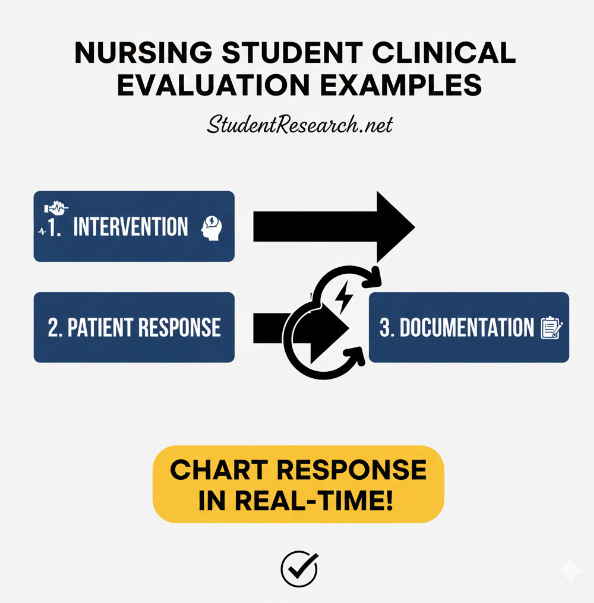
- Chart all interventions and assessments in real-time or as close to the time of the event as possible.
- Use objective, descriptive language; avoid subjective terms or personal opinions.
- Always document the patient status, the intervention performed, and the patient’s response to that intervention.
Using Appropriate Medical Terminology
- Use only approved, standard medical terminology and abbreviations for your clinical site.
- Review and strictly adhere to the facility’s “Do Not Use” abbreviation list to prevent critical communication errors.
Ways to Master Time Management and Prioritization
Learning to manage competing priorities under pressure is a core competency that evaluation seeks to measure.
Managing Multiple Patient Loads
- On arrival, create a written or mental timeline of critical tasks (e.g., 0900 meds, 1000 procedure, 1100 family meeting).
- Cluster care activities (e.g., checking blood sugar, giving insulin, performing a focused assessment, and repositioning all in one trip) to reduce wasted time.
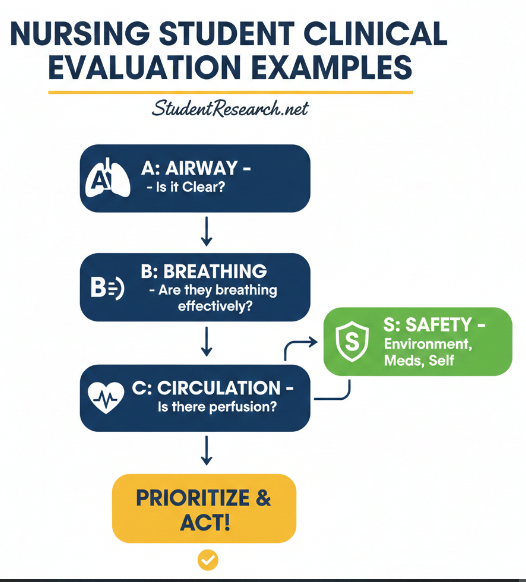
- Use the ABCs (Airway, Breathing, Circulation) plus Safety to guide priority setting for your patient assignments.
Pre-Clinical Preparation
- Review the Electronic Health Record (EHR) the night before (if possible) to flag time-sensitive orders or potential complications.
- Research unfamiliar medications, lab values, and complex procedures specific to your assigned patients.
- Develop a mental game plan for the morning rush, prioritizing the sickest or most acute patient first.
Are your papers error-free? Don’t risk a grade deduction due to overlooked errors. Our rigorous, multi-level editing includes grammar checks and fact verification before delivery. Achieve flawless quality with StudentResearch.net‘s comprehensive quality assurance process.
Specific Nursing Student Clinical Evaluation Examples and Scenarios
Evaluation often focuses on outliers—those moments where you either exceeded expectations or successfully rebounded from a misstep. This section provides specific nursing student clinical evaluation examples to help you understand what defines both excellent and deficient performance.
Achieving the “Excellent/Exceeds Expectations” Mark
To get the highest score, you must demonstrate proactive engagement and advanced critical thinking, often without prompting.
Initiative and Self-Correction Example
- Example: Identifying an abnormal trend in a lab value (e.g., decreasing potassium), consulting reliable resources, and proactively reporting the finding to the RN with a clear, researched recommendation (e.g., “I recommend we request a stat potassium replacement order due to the diuretic.”).
- Evaluation: This demonstrates independent thought, critical application of pharmacology, and proactive risk mitigation.
Exceeding Expectations in Patient Advocacy
- Example: Catching a systemic issue (e.g., a documentation error in the charting system or an incomplete order set) that could lead to harm, escalating the concern appropriately, and then following up to ensure the system error was corrected for all patients.
- Evaluation: This shows a commitment to the well-being of the unit and advanced systems thinking beyond a single patient assignment.
Fixing Clinical Deficiencies: Addressing the “Needs Improvement” Mark
Converting negative feedback into a constructive learning opportunity is a powerful metric of professionalism.
Recognizing Missed Opportunities
- Example: Instead of offering excuses, the student takes accountability and analyzes why the error occurred (e.g., “I realize I was distracted during my med pass and should have used the ‘no-interruption zone’ rules more strictly.”).
- Evaluation: The ability to self-reflect and state the root cause without deflection shows insight and maturity.
How to Develop an Effective Clinical Action Plan
- Example: The student should collaborate with their instructor to write a specific, time-bound plan (e.g., “I will perform a 15-minute chart review and create a written priority list before I touch the first patient for the next two shifts.”).
- Evaluation: Providing a tangible, measurable plan demonstrates a commitment to learning and improvement that transforms the “Needs Improvement” score into a temporary hurdle.
Worried about investment risk? Clinicals are stressful enough. We protect your investment with a 100% money-back guarantee for unsatisfactory work. We are confident in our quality, so your student budget is safe. Start achieving guaranteed academic success at StudentResearch.net.
Conclusion: Transforming Feedback into Future Success
The clinical evaluation process, while daunting, is ultimately designed to shape you into a safe, competent, and highly reflective nurse. We’ve covered the five pillars of clinical success: mastering Patient Safety, demonstrating Clinical Judgment, excelling at Communication and Teamwork, ensuring flawless Documentation, and learning from evaluation Scenarios. If you internalize these core competencies, you will not only meet but exceed expectations.
Remember that the ultimate goal is to master clinicals! Get clear, actionable nursing student clinical evaluation examples for safety, critical thinking, teamwork, and documentation success. This comprehensive approach ensures you are prepared for anything the unit throws at you.
The most crucial takeaway, however, is the power of self-reflection. If you receive a “Needs Improvement” mark, do not view it as a failure; view it as a map. Proactively schedule time with your instructor to ask clarifying questions about specific behaviors, not just the score, and immediately craft a definitive, measurable improvement plan. This demonstration of professional accountability is one of the highest marks of a future leader.
Now, take this guide, print out the key action points, and use these specific nursing student clinical evaluation examples as your proactive checklist before you step onto the unit. Approach every shift prepared, focused, and ready to learn, and clinical success will surely follow.

