

Writing meaningful clinical evaluations is one of the most critical yet challenging responsibilities nursing educators face. Every semester, instructors must translate complex observations of student performance into clear, constructive feedback that guides professional development. However, finding the right words to capture a student’s strengths while addressing areas for growth often feels overwhelming. This is where having access to nursing student clinical evaluation comments examples becomes invaluable.
Effective evaluation comments do more than fulfill administrative requirements—they shape the trajectory of future nurses’ careers. According to student research, clinical feedback significantly influences nursing students’ confidence, competence, and readiness for practice. Yet many educators struggle with crafting comments that are specific enough to be actionable while remaining encouraging and professional.
This comprehensive guide presents seven proven strategies for mastering the art of clinical evaluation feedback. You’ll discover practical nursing student clinical evaluation comments examples across multiple competency areas, learn what makes feedback truly effective, and gain templates you can adapt to various student scenarios. Whether you’re evaluating a first-semester student learning basic skills or a senior preparing for licensure, these strategies will help you provide feedback that inspires growth and excellence.
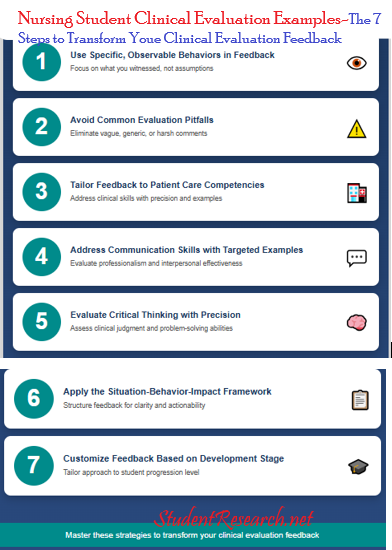
The Seven Strategies at a glace.
What Makes Effective Nursing Student Clinical Evaluation Comments
Understanding what distinguishes exceptional evaluation comments from mediocre ones is the foundation of effective feedback. Strong comments don’t just describe performance—they illuminate pathways for growth while acknowledging achievements. Let’s explore the characteristics that make evaluation comments truly impactful for student development.
Understanding Strong Evaluation Comment Characteristics
[#1 STRATEGY: Use Specific, Observable Behaviors in Feedback]
Effective evaluation comments share distinct qualities that maximize their educational impact:
- Specificity over generalization – Instead of “good communication skills,” write “effectively explained medication side effects using language appropriate for the patient’s health literacy level”
- Observable behaviors – Focus on what you actually witnessed: “Performed hand hygiene before and after each patient contact” rather than “understands infection control”
- Balanced perspective – Acknowledge strengths authentically before addressing growth areas: “Demonstrates excellent assessment skills in vital signs; would benefit from increased confidence in documenting abnormal findings”
- Objective language – Use factual descriptions: “Completed medication administration 30 minutes past scheduled time on two occasions” instead of “poor time management”
- Actionable guidance – Provide clear next steps: “Recommend reviewing cardiac assessment techniques and practicing with simulation lab resources” rather than vague suggestions
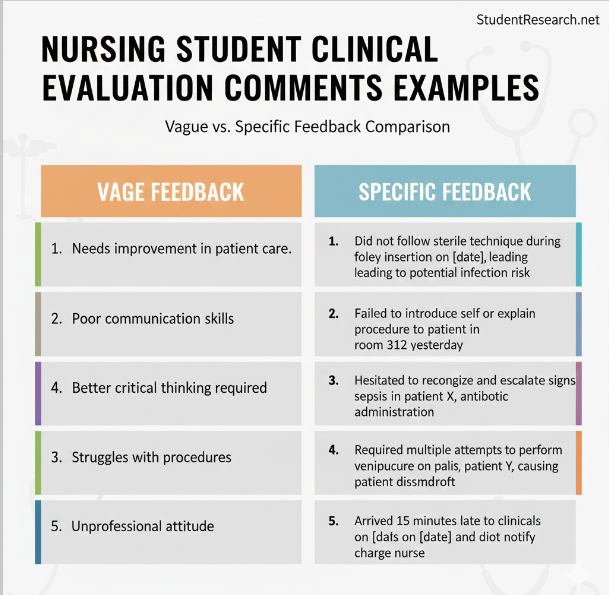
Examples of Specific vs. Vague Feedback
- Vague: “Needs improvement in patient care” Specific: “Should focus on completing head-to-toe assessments within the allocated 20-minute timeframe; currently averaging 35 minutes per assessment”
- Vague: “Great job this rotation” Specific: “Successfully managed care for four patients independently, prioritizing interventions based on acuity and anticipating patient needs before being prompted”
Common Mistakes to Avoid When Writing Clinical Evaluations
[#2 STRATEGY: Avoid Common Evaluation Pitfalls]
Even experienced educators fall into predictable traps when writing evaluations. Recognizing these pitfalls helps you craft more effective, professional feedback:
- Generic copy-paste comments – Recycling identical phrases for multiple students diminishes the value and authenticity of your feedback
- Exclusively negative focus – Comments highlighting only deficits demoralize students and miss opportunities to reinforce positive behaviors worth continuing
- Harsh or judgmental language – Phrases like “careless,” “lazy,” or “unprofessional” damage relationships and violate constructive feedback principles
- Jargon without context – Using technical terminology without explanation confuses students rather than educating them
- Absence of concrete examples – Failing to cite specific incidents makes feedback feel arbitrary and difficult to act upon
- Personality critiques – Commenting on inherent traits (“shy,” “anxious”) rather than changeable behaviors crosses professional boundaries
- Delayed documentation – Writing evaluations weeks after clinical experiences results in vague, inaccurate assessments lacking crucial details
Nursing Student Clinical Evaluation Comments Examples by Competency
This section provides ready-to-use evaluation comment examples organized by the three core competency areas nursing educators assess most frequently. Each category includes both exemplary performance samples and constructive feedback examples for students requiring additional development.
Patient Care and Clinical Skills Evaluation Examples
[#3 STRATEGY: Tailor Feedback to Patient Care Competencies]
Patient care skills form the foundation of nursing practice and require precise, skills-focused evaluation feedback.
Strong Performance Comment Examples
- Assessment skills: “Consistently performs comprehensive, systematic head-to-toe assessments; accurately identifies abnormal findings and recognizes their clinical significance. Demonstrated excellent auscultation technique when detecting irregular heart rhythms in a post-operative cardiac patient.”
- Medication administration: “Exhibits meticulous attention to the six rights of medication administration. Independently caught a potential drug interaction between warfarin and a newly prescribed antibiotic, appropriately notifying the prescriber before administration.”
- Technical procedures: “Demonstrates competent IV insertion technique with 85% first-attempt success rate. Maintains sterile technique throughout procedures and educates patients about what to expect, reducing anxiety and improving cooperation.”
Needs Improvement Comment Examples
- Time management: “Requires additional practice organizing patient care tasks efficiently. Currently completes morning care routines 45 minutes past target times. Recommend creating a prioritized task list at shift start and seeking preceptor guidance on time-saving techniques.”
- Documentation accuracy: “Clinical documentation often lacks required detail, particularly regarding pain reassessments and patient education provided. Needs to review facility documentation standards and ensure entries include all mandated elements before end of shift.”
- Procedure execution: “Demonstrates understanding of catheterization procedure steps but requires continued supervision to maintain sterile field integrity. Would benefit from additional skills lab practice before attempting independently in clinical setting.”
Struggling with discipline-specific nursing assignments? StudentResearch.net connects you with subject-specialist writers across all academic fields—from healthcare and humanities to STEM disciplines. Our experts match your exact course requirements, delivering custom papers that demonstrate true mastery of your subject area. Excellence, specialized for you.
Communication and Professionalism Evaluation Examples
[#4 STRATEGY: Address Communication Skills with Targeted Examples]
Communication and professional behavior are essential competencies that directly impact patient safety and team effectiveness.
Exemplary Communication Feedback Samples
- Nurse-patient communication: “Establishes excellent therapeutic rapport with patients across diverse age groups and cultural backgrounds. Uses teach-back method effectively to verify patient understanding, adjusting explanations based on individual comprehension levels.”
- Team collaboration: “Actively participates in interprofessional rounds, contributing relevant patient observations and asking clarifying questions when appropriate. Demonstrates respect for all team members’ expertise and maintains professional composure during high-stress situations.”
- Professional demeanor: “Consistently arrives prepared, in proper attire, and ready to engage. Accepts constructive feedback graciously and implements suggested improvements in subsequent clinical experiences. Shows initiative by volunteering for learning opportunities.”
Areas for Development Comment Examples
- Therapeutic communication: “Tends to use closed-ended questions that limit patient disclosure. Should practice open-ended interview techniques: ‘Tell me about your pain’ rather than ‘Does it hurt?’ Review therapeutic communication strategies before next rotation.”
- Conflict resolution: “Became visibly frustrated when a patient refused morning medications, responding with impatience rather than exploring concerns. Needs to develop strategies for managing difficult situations professionally, perhaps through role-playing scenarios.”
- Professional boundaries: “Shares excessive personal information with patients, which can shift focus from patient-centered care. Recommend reviewing professional boundary guidelines and maintaining conversations focused on therapeutic goals.”
Critical Thinking and Clinical Judgment Examples
[#5 STRATEGY: Evaluate Critical Thinking with Precision]
Critical thinking represents the highest level of nursing competency and requires careful evaluation that captures complex cognitive processes.
Strong Clinical Reasoning Comment Samples
- Problem-solving abilities: “Demonstrated excellent clinical reasoning when a patient’s condition deteriorated unexpectedly. Systematically assessed possible causes, recognized signs of sepsis early, and initiated appropriate interventions while simultaneously notifying the healthcare team.”
- Prioritization skills: “Effectively manages multiple competing priorities, consistently addressing high-acuity needs first while ensuring routine care isn’t neglected. When assigned five patients of varying acuity, appropriately delegated tasks to nursing assistants and organized workflow to ensure medication timing.”
- Evidence-based practice application: “Independently researched current best practices for pressure injury prevention after observing a Stage 1 wound. Proposed evidence-based interventions to preceptor and implemented turning schedule that aligned with current clinical guidelines.”
Growth-Oriented Critical Thinking Comments
- Clinical reasoning development: “Identifies patient problems but struggles to anticipate potential complications. For example, didn’t recognize fall risk factors in an elderly patient with new confusion. Recommend using clinical reasoning frameworks to analyze patient situations more comprehensively.”
- Decision-making under pressure: “Becomes hesitant when situations deviate from routine, requiring significant preceptor guidance during unexpected events. Would benefit from simulation experiences involving emergent scenarios to build confidence in rapid decision-making.”
- Recognizing patient status changes: “Needs to develop stronger pattern recognition for subtle clinical changes. Missed early signs of respiratory distress (increased respiratory rate, restlessness) that became obvious 30 minutes later. Practice trending vital signs and identifying concerning patterns.”
How to Write Clinical Evaluation Comments: Best Practices Guide
Mastering the structure and approach to evaluation writing ensures your feedback achieves its intended purpose. These final two strategies provide frameworks you can apply immediately to enhance every evaluation you write.
Steps to Structure Effective Feedback
[#6 STRATEGY: Apply the Situation-Behavior-Impact Framework]
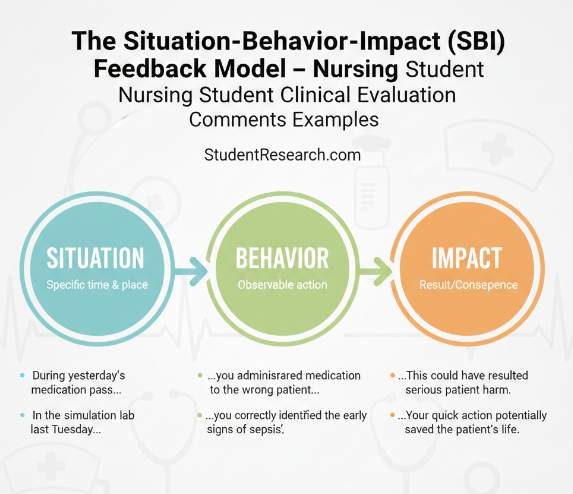
The situation-behavior-impact (SBI) framework provides a proven structure that makes feedback clear, specific, and actionable:
- Start with positive observations – Begin with genuine strengths to establish a constructive tone: “Your attention to patient comfort was evident throughout the shift, particularly when you took extra time to reposition Mrs. Chen to minimize her post-surgical pain.”
- Address growth areas constructively – Frame development needs as opportunities: “To strengthen your assessment skills further, focus on documenting your cardiovascular findings with greater anatomical precision, specifying exactly where you auscultated heart sounds.”
- Provide the situation context – Describe when and where the behavior occurred: “During Wednesday’s medication pass, when you were administering insulin…”
- Describe the specific behavior – State exactly what you observed: “…you recalculated the dosage three times and verified it with your preceptor before administering.”
- Explain the impact – Connect the behavior to outcomes: “…which demonstrated excellent safety consciousness and prevented a potential medication error.”
- End with encouragement and recommendations – Close constructively: “Continue this cautious approach with high-alert medications. To build efficiency, practice dosage calculations during skills lab to increase your confidence.”
Template Examples for Different Scenarios
- First clinical rotation: “[Student name] is developing foundational clinical skills appropriate for a beginning nursing student. Shows enthusiasm for learning and asks thoughtful questions. Focus areas for next rotation include: [specific skill] and [specific skill]. Recommend [specific resources/practice opportunities].”
- Mid-semester evaluation: “[Student name] demonstrates growing independence in [competency area]. Particularly strong in [specific examples]. To progress toward end-of-semester goals, concentrate on [specific development areas with measurable targets].”
Worried about citation styles and formatting requirements? StudentResearch.net guarantees flawless adherence to APA, MLA, Chicago, Harvard, and all university-specific formatting guidelines. Our meticulous attention to academic standards ensures your papers meet every professor’s expectations. Perfect formatting, every single time—because details matter.
Ways to Tailor Comments to Student Development Levels
[#7 STRATEGY: Customize Feedback Based on Development Stage]
Students at different program stages require different evaluation approaches that match their developmental readiness and learning objectives.
- Early clinical students (First-year/fundamentals) – Emphasize foundational skills and building confidence: “Successfully performed first bed bath independently while maintaining patient dignity and comfort. Initially nervous but relaxed as procedure progressed. Encourage continued practice with basic care skills to develop fluidity and efficiency.”
- Mid-program students (Second-year/intermediate) – Focus on integration and increasing independence: “Demonstrates ability to connect pathophysiology to clinical presentation. When caring for a diabetic patient, appropriately linked elevated blood glucose to increased urination and thirst. Ready to manage 3-4 patients with moderate supervision next rotation.”
- Senior students (Final year/preceptorship) – Address transition-to-practice readiness: “Functions at the level expected of a new graduate nurse. Independently manages full patient assignment, delegates appropriately to unlicensed personnel, and communicates effectively in handoff reports. Requires minimal guidance; is ready for entry-level practice upon licensure.”
- Individualize based on learning needs – Recognize that students progress at different rates: “While [student name] entered this rotation behind peers in IV skills, dedicated extra practice time resulted in successful competency demonstration. Continue building on this strong work ethic to strengthen remaining skill gaps.”
Conclusion
Writing effective clinical evaluation comments is both an art and a science that directly impacts nursing students’ professional development. Throughout this guide, you’ve explored nursing student clinical evaluation comments examples with 7 proven strategies designed to transform your feedback as a nursing educator now.
From using specific, observable behaviors and avoiding common pitfalls to tailoring feedback across competency areas and development stages, these strategies provide a comprehensive framework for evaluation excellence. The situation-behavior-impact model offers a practical structure you can implement immediately, while the provided examples serve as templates you can customize for your unique student situations.
Remember that thoughtful, well-crafted evaluations do more than assess performance—they inspire growth, build confidence, and shape the future of nursing practice. By investing time in meaningful feedback, you’re not just fulfilling an educational requirement; you’re contributing to the development of competent, compassionate nurses who will provide excellent patient care for years to come. Start applying these seven strategies in your next clinical evaluation, and witness the positive transformation in both your feedback quality and your students’ professional development
Want control over your academic writing process? StudentResearch.net offers direct communication with your assigned writer for real-time clarifications, progress updates, and collaborative input. Stay involved, provide feedback, and shape your paper throughout development. Your project, your voice—enhanced by expert guidance.

