

Are you looking to pivot your education toward a rewarding healthcare career? Finding nursing schools that accept transfer students can be a daunting task, as many programs have rigid “lock-step” cohorts that make entry difficult for outsiders. However, in 2026, the demand for nurses is at an all-time high, and top-tier institutions have streamlined their pathways to welcome talented transfers.
Whether you are moving from a community college, transitioning from a different major within a four-year university, or relocating to a new state, this guide highlights the most transfer-friendly programs and the exact steps you need to take to secure your spot.
Why Transferring Into Nursing is a Smart Move in 2026
The landscape of nursing education has shifted dramatically over the last few years. The nursing shortage has led to a surge in accelerated and flexible transfer pathways. Transferring allows you to leverage your existing general education credits, potentially shortening your time to graduation and getting you into the workforce where you are needed most.
Maximizing Your Previous Credits
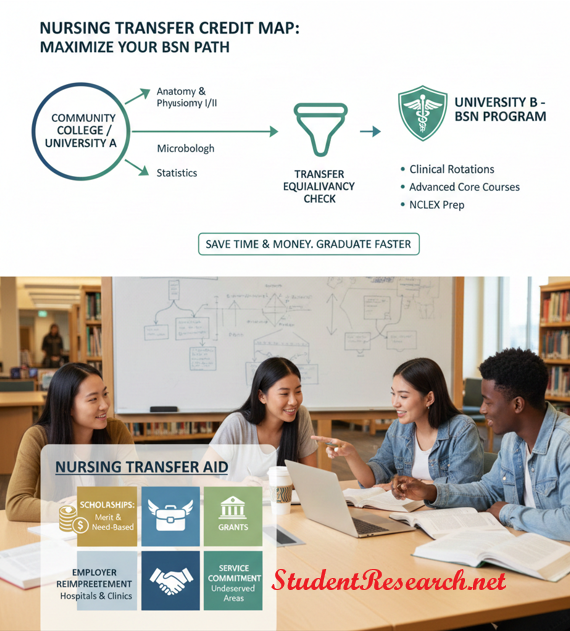
Most nursing schools allow you to transfer between 30 and 90 credit hours. By completing your “Science Prerequisites” (like Anatomy and Physiology) at a community college, you can significantly reduce your tuition burden before entering a premium BSN program. In 2026, many universities have also started accepting “Life Experience” credits for those who have worked as Medical Assistants or EMTs, further bridging the gap between experience and education.
Strategic Academic Pivoting
Many students realize after their first or second year of college that their original major doesn’t offer the job security or fulfillment they desire. Transferring into a nursing program as a “Sophomore Transfer” or “Junior Transfer” allows you to course-correct without starting from zero. This is not just a change in major; it is a strategic move into one of the most stable and respected professions in the global economy.
Top 13 Nursing Schools That Accept Transfer Students
Based on 2026 data regarding transfer-friendliness, accreditation (CCNE/ACEN), and NCLEX pass rates, here are 13 standout institutions that offer clear paths for transfer students.
| Rank | Institution | Key Feature | Transfer Max |
| 1 | Arizona State University | Robust “Transfer Pathways” agreements | Up to 75% |
| 2 | Southern New Hampshire Univ. | Most flexible online RN-to-BSN transfer | 90 Credits |
| 3 | University of Michigan | Dedicated “Sophomore Transfer” entry | 40 Credits |
| 4 | Chamberlain University | No waitlists and year-round starts | Varies |
| 5 | New York University (NYU) | Prestigious urban clinical placements | Case-by-case |
| 6 | CSU Fullerton | Upper-Division Transfer BSN specialist | 60-70 Units |
| 7 | Azusa Pacific University | 2-year transfer BSN with high-tech labs | 48+ Units |
| 8 | University of Portland | Seamless internal and external transfer | 53+ Units |
| 9 | Western Governors University | Competency-based, fast-track model | High |
| 10 | Galen College of Nursing | Multiple start dates, very transfer-heavy | High |
| 11 | University of Washington | 98% completion rate for transfers | Varies |
| 12 | Herzing University | Bridge programs for ADN and LPN | High |
| 13 | San Diego State University | Competitive but clear prerequisite map | 60 Units |
Spotlight on High-Transfer Institutions
Schools like Arizona State University (ASU) have pioneered the use of “Transfer Maps.” These digital tools allow you to plug in your current courses to see exactly how they fit into a BSN degree plan. Meanwhile, Chamberlain University remains a top choice for students who need to start their clinicals immediately without the typical two-year wait found at state colleges.
Understanding the Transfer Requirements
Not all credits are created equal in the eyes of a nursing admissions committee. To be a competitive applicant, you must meet specific academic benchmarks and ensure your previous coursework aligns with the rigorous standards of the nursing field.
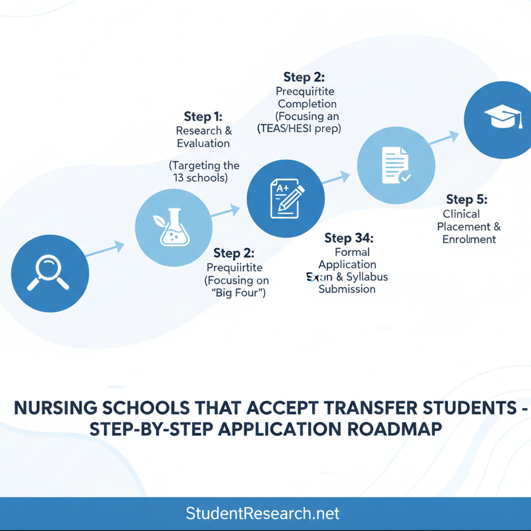
The “Big Four” Prerequisites
To transfer into the clinical phase of nursing, you generally need a 3.0 GPA or higher in these specific core courses:
- Anatomy & Physiology I & II (with Lab): These are the foundations of all nursing knowledge.
- Microbiology (with Lab): Essential for understanding infection control and pharmacology.
- Chemistry (Organic or General): Provides the chemical basis for how medications interact with the body.
- Statistics: Necessary for evidence-based practice and interpreting medical research.
Struggling with complex nursing theory? Get help from the pros! At StudentResearch.net, your papers are crafted by degree-holding professionals with advanced qualifications. We ensure subject matter expertise and academic rigor to help you succeed in every nursing course.
The Recency Requirement
Many schools, like St. Joseph’s and USF, require that your science credits be earned within the last 5 to 7 years. Because medical knowledge evolves so rapidly, schools want to ensure your understanding of human biology is current. If your credits are older, you may need to retake these core classes, often referred to as “refreshers.”
Grade Minimums
While a 3.0 overall GPA is often the baseline, many nursing schools that accept transfer students require at least a “B” grade in every science prerequisite. A “C” in Anatomy may require a retake at many top-tier institutions to prove you can handle the rigors of the BSN curriculum.
Navigating the Application Timeline for 2026
Timing is everything in nursing admissions. Missing a deadline by even one day can set your career back by an entire year because many programs only admit one “transfer cohort” annually.
Key Deadlines to Circle
- Early Action (August – October 2025): Best for schools like the University of Portland or private institutions with limited spots.
- Standard Deadlines (January – February 2026): This is the peak window for NYU, Michigan, and most California State University (CSU) schools for Fall 2026 entry.
- Rolling Admissions: Schools like Chamberlain, Galen, and WGU accept students year-round, making them ideal for students who finish their prerequisites mid-semester.
The “Shadow” Timeline
You should begin your transfer search at least 12 months before you intend to start. This gives you enough time to order official transcripts (which can take weeks) and complete any supplemental entrance exams like the TEAS or HESI.
3 Tips to Make Your Application Irresistible
With nursing school acceptance rates often hovering between 10% and 30%, you need to stand out as more than just a set of grades on a page.
1. Submit Course Syllabi Early
Don’t just send transcripts. Every school has different course codes. Provide full syllabi for your science courses so the registrar can see that your “Bio 101” at a community college actually covers the same depth as their “Biology for Health Sciences.” This can prevent you from having to retake a class you’ve already mastered.
Worried about academic integrity? We have you covered! StudentResearch.net guarantees 100% original content created from scratch. We provide detailed plagiarism reports with every order, addressing your primary concerns and ensuring your work remains authentic and ethically sound throughout your degree.
2. Highlight Healthcare Experience
Admissions committees love to see that you know what the nursing profession actually entails. Mention any:
- Volunteer work in a hospital or hospice setting.
- CNA (Certified Nursing Assistant) or Phlebotomy certifications.
- Shadowing experience or even “informational interviews” with working nurses.
3. Acing the TEAS/HESI
Most transfer-friendly schools require an entrance exam—usually the TEAS (Test of Essential Academic Skills). This exam covers reading, math, science, and English usage. In the competitive 2026 cycle, aim for a score above 85% to ensure you are at the top of the pile.
Financial Aid and Scholarships for Transfer Students
Many students fear that transferring means losing out on “Freshman-only” institutional aid. While some merit scholarships are reserved for first-year students, the nursing field offers unique financial incentives for transfers.
Specialized Funding and Grants
In 2026, programs like the Providence Scholars or HRSA (Health Resources and Services Administration) grants specifically target transfer students who commit to working in underserved areas or “critical shortage facilities” after graduation.
Employer Tuition Reimbursement
If you are already working in a hospital as a tech or aide, many facilities offer tuition assistance that can be applied to your BSN. This is a common path for students transferring from an Associate degree (ADN) to a Bachelor’s degree (BSN).
Conclusion: Your Path to the RN License
Starting your journey at one school and finishing at another is a common and strategic way to enter the nursing profession. By targeting nursing schools that accept transfer students, you can save money, find a better cultural fit, and get into the workforce faster. Remember that the “best” school is the one that respects your previous hard work and provides the clinical support you need to pass the NCLEX on your first try.
Find nursing schools that accept transfer students with our 2026 guide. Explore 13 top programs, credit tips, and pathways to start your RN career.
The road to becoming a Registered Nurse is a marathon, not a sprint. If your current institution isn’t serving your goals, don’t be afraid to make the move. The healthcare world is waiting for you.

