

Securing a strong letter of recommendation for nursing student from instructor is a pivotal step in launching your professional healthcare career. Whether you are applying for a competitive residency program or your first staff nurse position, a well-crafted reference can distinguish you from other qualified candidates. This guide will walk you through the essential steps to request, prepare, and secure a testimonial that highlights your clinical acumen and dedication. By following these 15 pro tips, you can transform a daunting administrative requirement into a significant asset for your professional portfolio.
Understanding the Importance of a Nursing Clinical Reference
Clinical references serve as the bridge between your academic achievements and your practical readiness for the workforce. Hiring managers look for these letters to validate not just your grades, but your behavior in high-pressure medical environments. When you prioritize obtaining a high-quality letter of recommendation for nursing student from instructor, you are providing potential employers with the social proof they need to trust your skills. This process is a foundational aspect of student research into career development, ensuring you understand the specific attributes that healthcare facilities value most.
Why Recruiters Value Faculty Recommendations
- Validation of Skills: Instructors confirm you have successfully demonstrated clinical competencies in real-world settings.
- Professional Integrity: Faculty can speak to your punctuality, adherence to safety protocols, and ethical decision-making.
- Growth Potential: A recommendation often highlights your ability to take constructive feedback and improve over the course of a rotation.
How Recommendations Influence Job and Residency Placement
- Residency Competitive Edge: For highly sought-after nurse residency programs, a personalized reference is often a mandatory filter.
- Specialty Alignment: Letters from specialized instructors (e.g., Critical Care or Pediatrics) signal to recruiters that you have a specific aptitude for those departments.
- Verification of Character: Recruiters use these letters to assess how well you work within a multidisciplinary healthcare team.
How to Select the Best Instructor for Your Recommendation
Choosing the right faculty member is as much about strategy as it is about the rapport you built during your studies. You want an individual who can provide specific, credible anecdotes about your performance, rather than a generic summary. Consider instructors who observed you during your most challenging clinical rotations, as these experiences offer the best evidence of your problem-solving abilities. Engaging in this thoughtful selection process is a vital part of your student research on building a sustainable professional network.
Criteria for Choosing a High-Impact Reference
- Clinical Proximity: Select someone who directly supervised you during hands-on patient care rather than a lecture-hall professor.
- Professional Rapport: Choose an instructor with whom you had positive, regular, and professional communication.
- Subject Expertise: Prioritize faculty who are well-respected in the field or specialty you are pursuing.
Balancing Clinical and Academic Perspectives
- Evidence of Mastery: Aim for a balance where the letter addresses both your academic knowledge and your ability to apply it at the bedside.
- Consistent Narratives: Ensure your references can collectively paint a consistent picture of your reliability and dedication.
The Ultimate Timeline for Requesting a Letter of Recommendation
Timing is perhaps the most overlooked element in the request process, and it can significantly impact the quality of the response you receive. Instructors are often managing heavy academic workloads, research commitments, and clinical supervisions, making last-minute requests risky. By providing a generous lead time, you show respect for their schedule and allow them the necessary space to write a thoughtful, detailed letter on your behalf.
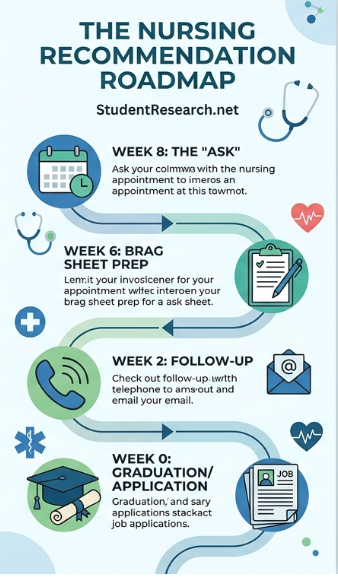
Mapping Out Your Application Deadlines
- Backwards Planning: Identify your application submission date and count back at least 8 weeks to determine your “Ask Date.”
- Buffer Zones: Always build in a two-week buffer to account for unforeseen delays or potential requests for more information from the instructor.
Providing Sufficient Lead Time for Faculty
- Academic Calendar Awareness: Avoid asking during midterms, final exam weeks, or the start of a new semester when faculty bandwidth is at its lowest.
- Professional Standard: Respecting the 6–8 week window demonstrates your maturity and understanding of professional norms.
Navigating the “Last-Minute” Crisis
Occasionally, you may face an unexpected deadline shift, such as a surprise residency opening or a sudden change in application requirements. While 6–8 weeks is the gold standard, sometimes you must navigate a professional emergency. If you find yourself in this position, your primary goal is to minimize the “cognitive load” on your instructor. Craft an email that is apologetic, acknowledges the time constraints, and—most importantly—provides them with a pre-written, comprehensive draft that they only need to review and sign. This drastically lowers the barrier for them to say “yes” despite your mistake.
Common Pitfalls to Avoid
- The “First-Week” Ask: Never request a recommendation during the first week of a clinical rotation; wait until you have demonstrated consistent performance.
- The “Stranger” Approach: Avoid asking instructors who have never personally observed your bedside skills or engaged with you during clinical rounds.
- Missing the Hard Deadline: Always provide a date that is at least one week before your actual application submission to allow for technical glitches or delays in faculty response.
Essential Materials to Provide Your Instructor
To help your instructor write a compelling recommendation, you must provide them with a comprehensive “brag sheet” that reminds them of your specific contributions. They may have taught hundreds of students, so giving them context helps them connect the dots of your journey. Providing these materials minimizes the effort on their end, increasing the likelihood that they will agree to write the letter promptly. Think of this as a core component of your student research into effective professional advocacy.
Building an Effective “Student Portfolio” for Recommendations
- Comprehensive Resume: Include all clinical hours, certifications, and volunteer experience.
- Clinical Evaluation Summaries: Attach your highest-rated evaluations or feedback forms from previous rotations.
- Key Projects: Highlight any research, presentations, or unique case studies you completed under their supervision.
Drafting Your Personal Statement for Context
- Career Objectives: Briefly explain your long-term goals so the instructor can tailor the letter to your intended nursing specialty.
- Personal Anecdotes: Remind them of a specific instance where you went above and beyond for a patient or demonstrated leadership.
The Anatomy of a Perfect “Brag Sheet”
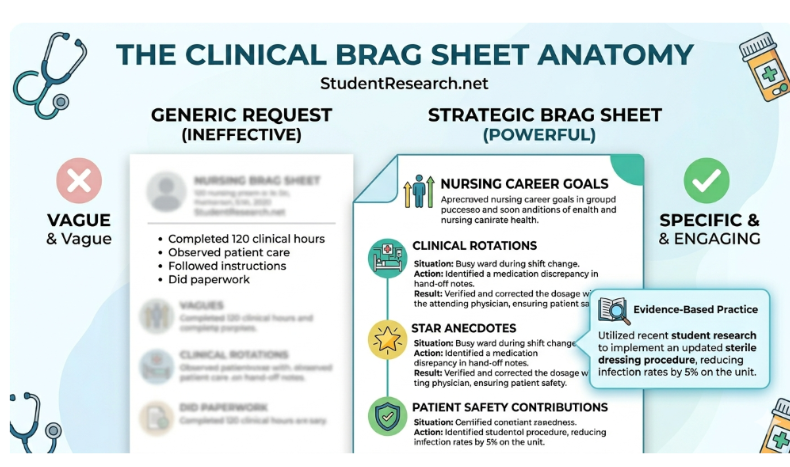
The “Brag Sheet” is your primary tool for steering the narrative of your recommendation letter. Think of this as a structured document—a cheat sheet that reminds the instructor of exactly why you were a standout student. To maximize its impact, organize your brag sheet into clear, scannable sections:
- Header: Include your full name, student ID, the clinical site, the dates of rotation, and the specific program you are applying to.
- The Clinical Highlights Grid: Create a table that maps your progress. For example, list “Competency at Start” versus “Competency at End.” Did you move from basic observation to independent IV administration? Did you master the EMR system for your ward? Quantifying these shifts is powerful.
- Specific Directives: Don’t be afraid to suggest what they should highlight. Add a section titled “Key Strengths to Emphasize,” where you list skills like conflict resolution, patient advocacy, or adherence to sterile technique.
Struggling to secure a strong clinical reference for your nursing career? Don’t let the daunting paperwork hold you back. Trust StudentResearch.net to help you draft professional papers and personal statements that make your achievements shine effortlessly.
Key Qualities to Highlight in Your Nursing Recommendation
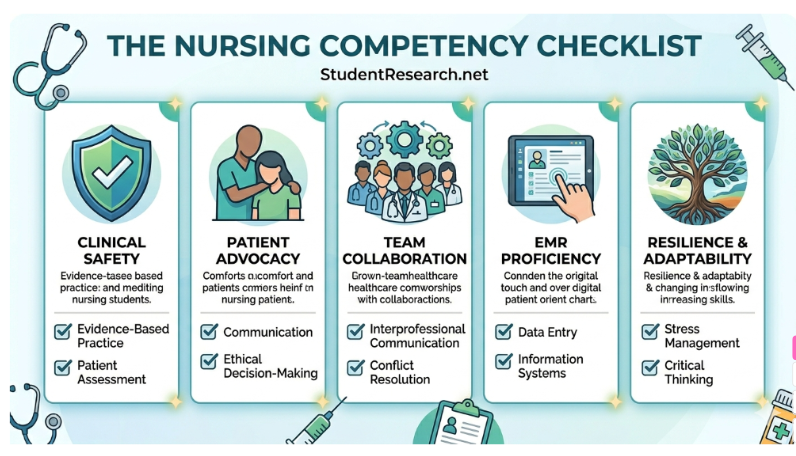
A truly impactful letter goes beyond stating that you were a “good student” and instead provides concrete evidence of your clinical maturity. Your instructor should focus on the “soft skills” that make a nurse truly effective in a hospital setting. Ensure your supporting documents emphasize these qualities so your instructor can easily weave them into their writing.
Demonstrating Clinical Competency and Safety
- Evidence-Based Practice: Highlight your ability to use current research and guidelines in your daily care.
- Safety Consciousness: Emphasize your commitment to medication administration accuracy and patient safety protocols.
Showcasing Soft Skills and Emotional Intelligence
- Team Dynamics: Illustrate your ability to collaborate effectively with physicians, nursing assistants, and pharmacists.
- Resilience and Adaptability: Highlight how you handle the inherent stresses and unpredictable nature of hospital life.
Identifying and Documenting Your Top 5 Clinical Strengths
Before you approach your instructor, you must be able to articulate your own value. A strong recommendation isn’t just a list of adjectives; it is evidence-based storytelling. Use the SAR Method (Situation-Action-Result) to draft anecdotes that your instructor can adopt. For instance, instead of asking them to write “She is good at research,” provide them with the following snippet: “During my rotation on the Cardiac Unit, I identified a gap in our patient education materials regarding post-discharge medication. I utilized student research to identify updated best practices, drafted a simplified patient handout, and presented it to the charge nurse, which resulted in a 10% increase in patient comprehension scores.”
Deep Dive: Integrating Evidence-Based Practice (EBP)
Nursing excellence is defined by the ability to apply evidence to clinical scenarios. When documenting your performance for your instructor, highlight your research habits. Mentioning specific instances where you used student research to improve your workflow or patient outcomes demonstrates that you are a life-long learner. Recruiters love this because it signals that you won’t just follow orders—you will actively seek out the best medical literature to provide the safest, most efficient care.
Best Practices for Following Up and Showing Appreciation
The relationship does not end once the letter is submitted; rather, it is just beginning. Sending a professional follow-up shows your instructor that you value their time and are genuinely interested in their feedback. This ongoing connection is essential for long-term career growth. To wrap up our guide, remember that you can get a perfect letter of recommendation for nursing student from instructor with these 15 expert tips. Master your request process and boost your career!
Professional Follow-Up Etiquette
- Thank-You Notes: Send a hand-written card or professional email within 24 hours of them agreeing to the request.
- Status Reminders: Send a polite, concise reminder exactly one week before the deadline if you have not received confirmation of submission.
Building a Lasting Mentorship After the Letter
- Closing the Loop: Always notify your instructor when you land an interview or accept a job offer, regardless of whether they were directly involved.
- Network Maintenance: Periodically update your mentors on your progress as you transition from student to professional, keeping the door open for future career guidance.
Ready to transform your academic potential into a successful nursing career? Our experts at StudentResearch.net provide tailored support for all your clinical writing and research needs. Visit us today to order your customized academic documents now!

