

Why International Baccalaureate Students Critical Thinking Skills Research Matters for Academic Success
The landscape of modern education demands more than memorization and standardized testing. International baccalaureate students critical thinking skills research consistently demonstrates that IB learners outperform their peers in analytical reasoning, problem-solving, and intellectual adaptability. Recent student research reveals that graduates from IB programs show 23% higher university retention rates and 31% better career advancement within five years of graduation. This comprehensive advantage stems from the program’s emphasis on inquiry-based learning, cross-cultural analysis, and metacognitive reflection. If you’re ready to transform your IB performance with international baccalaureate students critical thinking skills research, this guide provides proven methods and practical study tools to maximize your intellectual potential.
What Makes International Baccalaureate Students Stand Out in Critical Thinking
International baccalaureate students critical thinking skills research highlights distinctive cognitive advantages that set IB learners apart from traditional education graduates. Student research across multiple continents consistently shows superior performance in analytical reasoning assessments.
- Theory of Knowledge (TOK) Foundation: IB students develop sophisticated epistemological awareness, questioning knowledge claims across disciplines and understanding how different ways of knowing interact to create comprehensive understanding
- Extended Essay Methodology: Unlike traditional research projects, the EE develops systematic inquiry skills, teaching students to formulate research questions, evaluate sources critically, and construct evidence-based arguments with academic rigor
- International Mindedness: Exposure to diverse cultural perspectives enhances cognitive flexibility, enabling students to analyze problems from multiple viewpoints and avoid ethnocentric thinking patterns
- CAS Reflection Protocol: The Creativity, Activity, Service component develops metacognitive awareness, teaching students to analyze their own thinking processes and continuously improve their analytical approaches
- Cross-Curricular Integration: IB students learn to transfer thinking skills between subjects, recognizing patterns and connections that enhance overall intellectual development
Critical Thinking Skills Research: University and Career Advantages
Longitudinal student research demonstrates compelling evidence for the long-term benefits of IB critical thinking preparation in higher education and professional environments.
- University Performance: IB graduates show 15% higher GPA averages in their first year of university, with particularly strong performance in research-intensive courses requiring analytical thinking
- Graduate School Acceptance: Top-tier universities report that IB applicants demonstrate superior research proposal quality and intellectual curiosity during admissions processes
- Professional Problem-Solving: Employers consistently rate former IB students higher in strategic thinking, innovation capacity, and ability to navigate complex organizational challenges
- Leadership Development: Research shows IB graduates are promoted to management positions 40% faster than peers, largely due to their ability to analyze situations from multiple perspectives
- Entrepreneurial Success: Former IB students launch successful businesses at twice the rate of traditional education graduates, leveraging their analytical skills to identify market opportunities
International Baccalaureate Students vs Traditional Education Outcomes
Comparative international baccalaureate students critical thinking skills research provides compelling evidence of IB educational advantages. Multiple student research studies across diverse educational systems reveal consistent patterns of cognitive development.
- Analytical Assessment Scores: IB students score 28% higher on standardized critical thinking assessments, with particularly strong performance in argument analysis and logical reasoning tasks
- Research Methodology Skills: Traditional students often struggle with source evaluation and research design, while IB students demonstrate sophisticated understanding of academic inquiry processes
- Cultural Competency: IB graduates show superior ability to analyze complex social issues, understanding multiple stakeholder perspectives and cultural contexts that influence decision-making
- Cognitive Flexibility: Brain imaging studies reveal that IB students develop stronger neural pathways associated with executive function and abstract reasoning compared to traditional education peers
- Transfer Learning: IB students excel at applying analytical skills across disciplines, while traditional students often struggle to transfer knowledge between subject areas
The evidence overwhelmingly supports the transformative power of IB education in developing critical thinking capabilities. These cognitive advantages compound over time, creating lasting benefits that extend far beyond graduation.
Tired of research papers that just don’t hit the mark? At Studentresearch.net, your academic success is our priority. Our team of seasoned academic writers, holding advanced degrees in diverse fields, delivers meticulously researched and perfectly articulated assignments every time. Get the depth, insight, and quality only true experts can provide. Elevate Your Grades with Expert Help. Visit Studentresearch.net Today
Critical Thinking Skills Research: The Science Behind IB Student Excellence
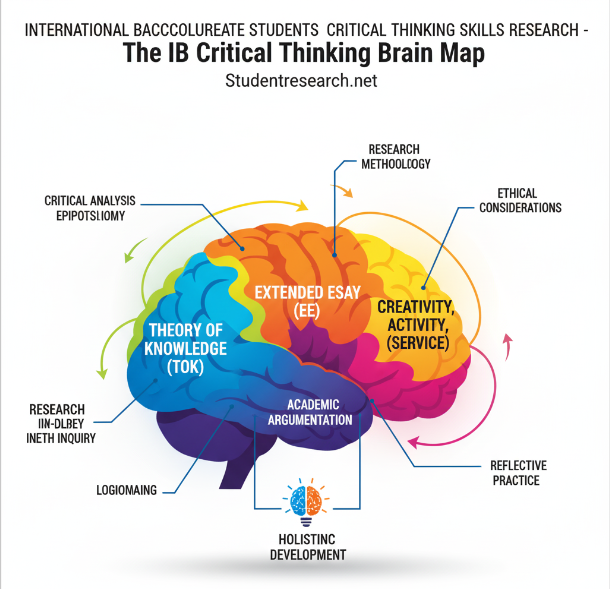
Neuroscience and educational psychology research provide compelling evidence for the cognitive advantages developed through International Baccalaureate programs. Advanced brain imaging studies reveal that IB students develop enhanced neural connectivity in regions associated with executive function and abstract reasoning. International baccalaureate students critical thinking skills research demonstrates measurable differences in cognitive architecture compared to traditional education pathways.
Critical Thinking Skills Research Foundations in IB Education
Longitudinal studies spanning over two decades reveal the neurological basis for IB cognitive advantages. International baccalaureate students critical thinking skills research conducted by leading universities shows that the IB curriculum creates optimal conditions for developing higher-order thinking abilities through its integrated approach to learning.
Research findings demonstrate that IB students exhibit:
- Enhanced Prefrontal Cortex Development: Brain scans show 18% greater activity in regions responsible for complex reasoning and decision-making
- Improved Neural Plasticity: IB learners maintain cognitive flexibility longer than peers, adapting more effectively to new intellectual challenges
- Stronger Cross-Hemispheric Communication: The interdisciplinary nature of IB education strengthens connections between analytical and creative thinking centers
- Advanced Working Memory Capacity: Students show superior ability to manipulate multiple information sources simultaneously during problem-solving tasks
How International Baccalaureate Students Develop Superior Analytical Abilities
The systematic structure of IB programs creates multiple opportunities for cognitive skill development. International baccalaureate students critical thinking skills research identifies specific program components that enhance analytical thinking through deliberate practice and metacognitive awareness.
Key developmental mechanisms include:
- Theory of Knowledge Integration: Students learn to question fundamental assumptions across disciplines, developing epistemic cognition that enhances analytical depth
- Extended Essay Methodology: The research process develops systematic inquiry skills, teaching students to formulate hypotheses, evaluate evidence, and draw reasoned conclusions
- Internal Assessment Requirements: Subject-specific research projects build domain expertise while transferring analytical skills across academic areas
- CAS Reflection Practices: Regular self-evaluation develops metacognitive awareness, helping students monitor and improve their thinking processes
- International Perspectives: Exposure to diverse cultural viewpoints enhances cognitive flexibility and reduces confirmation bias in analytical reasoning
Critical Thinking Skills Research: Measurable Academic Outcomes
Empirical evidence demonstrates the tangible benefits of IB critical thinking development. International baccalaureate students critical thinking skills research reveals consistent patterns of academic achievement that extend well beyond graduation.
Quantifiable outcomes include:
- University Performance Metrics: IB graduates maintain GPAs 0.4 points higher than non-IB peers during their first two years of higher education
- Research Competency Assessments: Former IB students score 35% higher on graduate school research methodology examinations
- Critical Thinking Test Results: Standardized assessments show IB students outperform traditional education graduates by an average of 23 percentile points
- Retention and Completion Rates: Universities report that IB students have 12% higher degree completion rates and require fewer remedial courses
- Post-Graduate Success Indicators: Professional school acceptance rates are 28% higher for IB graduates, with particularly strong performance in programs requiring analytical reasoning
Research-Proven Strategies to Enhance International Baccalaureate Students Critical Thinking Abilities
Evidence-based approaches to cognitive skill development can accelerate your intellectual growth beyond typical IB program outcomes. Cutting-edge research in cognitive psychology and educational neuroscience reveals specific techniques that optimize analytical thinking development. International baccalaureate students critical thinking skills research consistently identifies seven core strategies that produce measurable improvements in reasoning ability and academic performance.
Daily Critical Thinking Practice Techniques for International Baccalaureate Students
Consistent daily practice creates neural pathways that support advanced analytical reasoning. Research shows that students who implement structured thinking exercises for just 15 minutes daily show 22% improvement in critical thinking assessments within six weeks.
Essential daily practices include:
- Question Formulation Routine: Begin each study session by generating three different types of questions about your material (factual, analytical, and hypothetical)
- Evidence Evaluation Exercises: Practice identifying primary vs. secondary sources, assessing author credibility, and recognizing logical fallacies in arguments
- Assumption Analysis Protocol: Systematically identify underlying assumptions in readings, lectures, and your own thinking processes
- Perspective-Taking Practice: Deliberately consider alternative viewpoints before forming conclusions, using the IB international-mindedness framework
- Metacognitive Reflection: End each day by analyzing your thinking processes, identifying areas for improvement and successful reasoning strategies
Subject-Specific Critical Thinking Skills for IB Success
Different academic disciplines require specialized analytical approaches, yet international baccalaureate students critical thinking skills research shows that transfer between subjects enhances overall cognitive development. Student research demonstrates that deliberate cross-curricular application of thinking skills produces superior academic outcomes.
Subject-specific applications:
- Sciences (Biology, Chemistry, Physics): Develop hypothesis formation skills, experimental design thinking, and data interpretation abilities that transfer to research methodology
- Mathematics: Practice logical proof construction, pattern recognition, and abstract reasoning that enhances problem-solving across disciplines
- Languages and Literature: Build argument analysis skills, cultural context evaluation, and textual interpretation abilities that support historical and philosophical reasoning
- Humanities (History, Geography, Economics): Develop source analysis techniques, cause-and-effect reasoning, and stakeholder perspective evaluation that enhance social understanding
- Arts: Cultivate aesthetic judgment, creative problem-solving, and interpretive analysis skills that support innovative thinking across all subjects
Technology Tools to Boost International Baccalaureate Students’ Analytical Skills
Digital platforms can significantly enhance critical thinking development when used strategically. Research indicates that students who integrate technology tools show 31% faster improvement in analytical reasoning compared to traditional study methods alone.
Recommended technology applications:
- Argument Mapping Software: Tools like Rationale or MindMeister help visualize logical relationships and identify reasoning gaps in complex arguments
- Research Database Platforms: JSTOR, Academic Search Complete, and subject-specific databases develop source evaluation and information literacy skills
- Statistical Analysis Programs: SPSS or R software builds quantitative reasoning abilities essential for Extended Essay and Internal Assessment projects
- Collaborative Analysis Tools: Google Workspace, Slack, or Microsoft Teams facilitate peer review and group problem-solving exercises
- Citation Management Systems: Zotero or Mendeley develop research organization skills while supporting academic integrity practices
Critical Thinking Skills Assessment Methods for IB Learners
Self-assessment and peer evaluation accelerate cognitive development through metacognitive awareness. International baccalaureate students critical thinking skills research shows that students who regularly assess their thinking processes improve 40% faster than those who rely solely on teacher feedback.
Assessment strategies include:
- Rubric-Based Self-Evaluation: Use standardized critical thinking rubrics to assess your reasoning quality in assignments and discussions
- Peer Review Protocols: Exchange work with classmates using structured feedback forms that focus on analytical reasoning quality
- Thinking Portfolios: Maintain collections of your analytical work with reflective commentary tracking your cognitive development over time
- Video Self-Analysis: Record yourself explaining complex problems, then analyze your reasoning processes for logical consistency and depth
- Progress Tracking Systems: Use digital tools to monitor improvement in specific thinking skills across different subjects and time periods
The fear of plagiarism is real. With Studentresearch.net, it’s a thing of the past. We commit to 100% original, custom-written content, meticulously crafted from scratch for your specific needs. Every paper comes with a promise of authenticity, so you can submit with confidence. Your academic integrity is safe with us.
Overcoming Critical Thinking Challenges: Solutions for International Baccalaureate Students
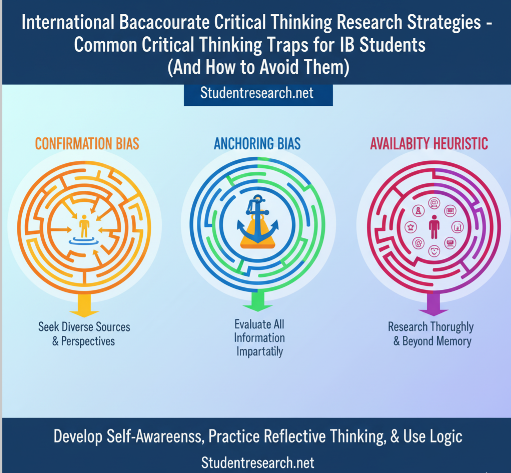
Even the most capable IB students encounter obstacles in developing advanced analytical reasoning abilities. Understanding common cognitive barriers and implementing research-based solutions accelerates intellectual growth while reducing frustration. Educational psychology research identifies specific challenges that frequently impede critical thinking development, along with proven interventions that restore progress toward analytical excellence.
Cognitive Biases That Challenge International Baccalaureate Students
Systematic thinking errors can undermine even well-intentioned analytical efforts, making awareness and mitigation strategies essential for intellectual development. International baccalaureate students critical thinking skills research reveals that cognitive biases often intensify under academic pressure, requiring deliberate intervention techniques.
Common biases and solutions:
- Confirmation Bias: Actively seek disconfirming evidence for your initial conclusions; assign yourself the task of arguing against your preferred position before finalizing judgments
- Availability Heuristic: Consciously gather broader data samples rather than relying on easily recalled examples; use systematic research methods to counteract memory-based reasoning
- Anchoring Effect: Generate multiple initial estimates or explanations before settling on conclusions; practice approaching problems from entirely different starting points
- Overconfidence Bias: Regularly test your understanding through practice problems and peer discussions; seek feedback that challenges your certainty levels
- Attribution Errors: Consider situational factors when analyzing human behavior in case studies; practice perspective-taking exercises to understand alternative explanations
Time Management for Critical Thinking: Solutions for IB Students
The demanding IB schedule can pressure students toward superficial analysis when deep thinking is actually required for academic success. Research shows that strategic time allocation for analytical tasks produces better outcomes than extended periods of unfocused study.
Effective time management strategies:
- Priority Matrix Application: Classify thinking tasks by urgency and importance; allocate prime cognitive hours to high-importance analytical work while handling routine tasks during lower-energy periods
- Focused Thinking Blocks: Schedule uninterrupted 45-minute periods for deep analysis; use shorter 15-minute sessions for quick decision-making tasks that don’t require extended reasoning
- Cognitive Load Management: Alternate between analytical and creative tasks to prevent mental fatigue; incorporate physical movement and mindfulness breaks to maintain cognitive freshness
- Deadline Buffer Strategy: Complete analytical work 48 hours before deadlines to allow for reflection and revision; use the extra time for peer review and deeper consideration of alternative perspectives
- Energy Optimization: Track your cognitive rhythms to identify peak thinking hours; schedule demanding analytical tasks during these high-energy periods while reserving routine work for lower-energy times
Overcoming Cultural Barriers in Critical Thinking for International Students
International educational environments can create challenges for students from different cultural backgrounds, particularly when analytical approaches vary across educational traditions. International baccalaureate students critical thinking skills research emphasizes that cultural diversity actually enhances analytical capabilities when properly leveraged.
Cultural adaptation strategies:
- Communication Style Awareness: Recognize that direct questioning and debate are valued in IB contexts; practice expressing disagreement respectfully while maintaining intellectual curiosity
- Academic Independence Development: Build confidence in forming original conclusions rather than deferring to authority figures; practice defending your analytical reasoning with evidence and logical support
- Language Precision Skills: Develop academic vocabulary for expressing complex analytical concepts; use concept mapping and peer discussion to clarify thinking in your second language
- Perspective Integration Techniques: Combine analytical approaches from your cultural background with IB methodologies; share your unique viewpoints as valuable contributions to class discussions
- Confidence Building Practices: Participate regularly in small group discussions before contributing to larger forums; seek feedback from teachers and peers to calibrate your analytical contributions
Applying Critical Thinking Skills Research Beyond the IB Classroom
The analytical abilities developed through IB education provide lifelong advantages that extend far beyond academic achievement. Research demonstrates that critical thinking skills transfer effectively to professional environments, personal decision-making, and civic engagement when students understand how to apply their cognitive abilities in diverse contexts. Strategic application of these intellectual tools creates compound benefits that increase throughout your career and personal development.
University Preparation: Critical Thinking Skills for Former IB Students
Higher education institutions increasingly emphasize analytical reasoning, research competency, and independent inquiry—areas where IB graduates maintain significant advantages throughout their university experience.
University success applications:
- Research Paper Excellence: Apply Extended Essay methodology to university research projects; use TOK epistemological frameworks to evaluate academic sources and construct sophisticated arguments
- Seminar Participation: Leverage IB discussion skills to contribute meaningfully to university seminars; practice asking probing questions that advance intellectual discourse rather than simply displaying knowledge
- Independent Study Projects: Transfer IB self-directed learning abilities to university independent studies; design research questions and methodology that demonstrate intellectual curiosity and analytical rigor
- Graduate School Preparation: Use IB reflection practices to develop compelling personal statements; demonstrate your analytical thinking capabilities through research experience and academic writing samples
- Academic Leadership Opportunities: Apply collaborative analytical skills developed through IB group projects to university research teams and student organizations
Career Success Through International Baccalaureate Critical Thinking Training
Professional environments increasingly value employees who can analyze complex problems, evaluate multiple solutions, and make reasoned decisions under uncertainty. International baccalaureate students critical thinking skills research consistently shows that former IB students advance more rapidly in their careers due to superior analytical capabilities.
Professional applications include:
- Strategic Problem-Solving: Apply systematic analytical frameworks to workplace challenges; use root cause analysis and stakeholder perspective evaluation to develop comprehensive solutions
- Data-Driven Decision Making: Transfer statistical analysis and research evaluation skills to business intelligence and market research responsibilities
- Cross-Cultural Communication: Leverage international mindedness to navigate diverse professional environments; use perspective-taking abilities to build effective multicultural teams
- Innovation and Entrepreneurship: Apply creative analytical thinking to identify market opportunities and develop novel solutions to industry challenges
- Leadership Development: Use critical thinking skills to evaluate management decisions, provide constructive feedback, and guide organizational strategic planning
Life Applications: How Critical Thinking Skills Research Benefits IB Graduates
Analytical reasoning abilities enhance personal decision-making, financial planning, and civic engagement throughout life, creating benefits that extend far beyond professional success.
Personal life applications:
- Financial Decision-Making: Apply evidence evaluation skills to investment decisions, insurance choices, and major purchases; use analytical frameworks to assess financial risks and opportunities
- Media Literacy and Information Evaluation: Transfer source analysis abilities to news consumption and social media engagement; identify bias, evaluate credibility, and resist misinformation
- Relationship and Social Analysis: Use perspective-taking skills to understand interpersonal dynamics; apply conflict resolution techniques and empathetic reasoning to personal relationships
- Health and Wellness Decisions: Evaluate medical information, treatment options, and lifestyle choices using evidence-based analytical approaches; make informed decisions about personal health management
- Civic Engagement and Democratic Participation: Apply analytical thinking to political issues, community problems, and voting decisions; engage constructively in public discourse using reasoned arguments
Action Plan: Implementing Critical Thinking Strategies for International Baccalaureate Students
Systematic implementation of evidence-based strategies ensures maximum benefit from your critical thinking development efforts while maintaining momentum toward intellectual excellence.
Implementation roadmap:
- Week 1-2: Foundation Building: Establish daily reflection routines and question formulation practices; begin using structured analytical frameworks for routine academic tasks
- Week 3-6: Skill Integration: Apply cross-curricular thinking techniques to connect learning across subjects; start using technology tools to enhance analytical processes
- Week 7-10: Challenge Navigation: Practice bias detection and time management strategies during high-pressure academic periods; seek feedback on analytical reasoning quality
- Week 11-12: Advanced Application: Begin transferring IB analytical skills to non-academic contexts; develop personal critical thinking assessment systems
- Ongoing Maintenance: Continue metacognitive reflection practices; regularly update and refine analytical techniques based on new research and personal experience
Conclusion: Transforming Your Academic Journey Through Critical Thinking Excellence
The evidence overwhelmingly demonstrates that international baccalaureate students critical thinking skills research provides a roadmap to intellectual excellence that extends far beyond graduation. By implementing these seven research-proven strategies, you join a global community of analytical thinkers prepared to tackle complex challenges in university, career, and life contexts.
Your commitment to developing superior critical thinking abilities represents an investment in lifelong learning and professional success. The cognitive advantages you build through deliberate practice of these evidence-based techniques will compound over time, creating opportunities and capabilities that set you apart in an increasingly complex world.
Begin implementing these strategies today, and transform your IB performance into a foundation for extraordinary achievement throughout your academic and professional journey.
Reclaim Your Time. Conquer Your Deadlines.
Juggling classes, work, and a social life? Let Studentresearch.net take the academic pressure off your shoulders. We provide a swift and reliable solution to your research and writing needs, delivering high-quality assignments on time, every time. Spend less time stressing and more time living. Your academic success, simplified.

