

Why Your Stethoscope Matters in Nursing School
Choosing a good stethoscope for nursing students is one of the most important investments you’ll make during your training. This essential diagnostic tool becomes an extension of your clinical abilities, helping you master physical assessments and build confidence during patient interactions. According to recent student research, nursing students who invest in quality stethoscopes early in their training demonstrate improved auscultation skills and greater diagnostic accuracy during clinical rotations.
Your first stethoscope represents more than just a piece of medical equipment—it’s a symbol of your professional commitment and a critical learning tool that will accompany you through countless clinical hours. Student research consistently shows that the right stethoscope can significantly impact your ability to detect subtle heart murmurs, abnormal lung sounds, and other vital clinical findings that are essential to patient care.
Your stethoscope matters because:
- Clinical Performance: Quality acoustics help you accurately hear and identify heart, lung, and bowel sounds during assessments
- Professional Confidence: A reliable stethoscope builds your confidence during high-pressure clinical situations and instructor evaluations
- Learning Foundation: Clear sound transmission is essential for developing your auscultation skills and diagnostic reasoning
- Career Investment: The right stethoscope will serve you from nursing school through your professional career
- Patient Care Quality: Accurate assessments depend on your ability to detect subtle abnormalities through quality equipment
- Time Efficiency: A dependable stethoscope saves time during busy clinical shifts and helps you complete assessments more effectively
What Is a Good Stethoscope: Understanding the Basics for Nursing Students
Before investing in your first stethoscope, it’s essential to understand what separates a quality instrument from a basic model. A good stethoscope combines superior acoustic performance, durable construction, and ergonomic design to support accurate patient assessments. Understanding these fundamental components will help you make an informed decision that balances quality with your student budget.
Key Components of a Stethoscope Explained
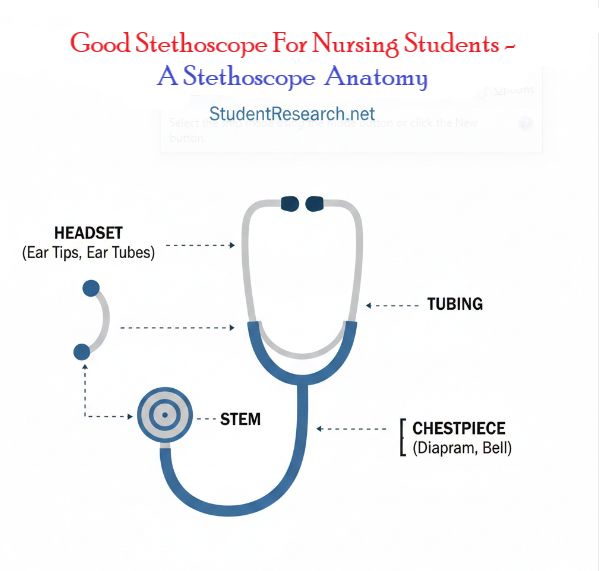
Every stethoscope consists of several key parts that work together to transmit sound from the patient’s body to your ears. Knowing how each component functions will help you evaluate different models and understand what features matter most for nursing practice.
What Does the Chestpiece Do (Diaphragm vs Bell)
The chestpiece is the part of the stethoscope that makes contact with the patient’s body, and it typically comes in two configurations:

| Aspect | Diaphragm | Bell |
| Sound Frequency | High-frequency sounds (lung sounds, normal heart sounds, bowel sounds) | Low-frequency sounds (heart murmurs, bruits, abnormal heart sounds) |
| Application Method | Pressed firmly against skin | Held lightly against skin |
| Best For | Respiratory assessments, blood pressure, routine examinations | Cardiac assessments, detecting subtle abnormalities |
| Design | Flat, larger surface area with tunable membrane | Small, cup-shaped hollow chamber |
| Common Use | General nursing assessments and daily clinical practice | Specialized cardiovascular examinations |
Single vs. Dual-Head Designs:
- Single-head: Features one side (usually diaphragm only), lighter weight, simpler for beginners
- Dual-head: Offers both diaphragm and bell, provides versatility for comprehensive assessments
Understanding Tubing Length and Material
The tubing serves as the acoustic pathway, and its quality directly impacts sound transmission:
- Length considerations: Standard 27-inch tubing offers flexibility and comfort for most nursing tasks, while 22-inch tubes provide better acoustic performance but less maneuverability
- Material quality: Thick-walled rubber or PVC tubing reduces external noise interference and maintains sound clarity over time
- Single vs. dual lumen: Single-lumen tubing (one internal channel) provides superior acoustics, while dual-lumen designs offer traditional aesthetics
Earpieces and Headset: Why They Matter
The earpieces and headset are critical for both comfort and acoustic performance. Here’s why they matter:
- Acoustic seal: Properly fitted ear tips create an airtight seal that blocks ambient noise and maximizes sound clarity during assessments
- Comfort during long shifts: Soft, angled ear tips reduce ear fatigue during 8-12 hour clinical rotations and multiple patient assessments
- Adjustable tension: Quality headsets allow you to adjust the spring tension for a secure yet comfortable fit that won’t cause headaches
- Hygiene maintenance: Replaceable ear tips enable proper infection control and maintain optimal acoustic performance over time
- Anatomical design: Angled earpieces align with your ear canal’s natural direction, improving both comfort and sound transmission
Acoustic Performance vs. Budget
Understanding the relationship between cost and performance helps you make a smart investment without overspending on unnecessary features.
What nursing students need:
- Clear transmission of heart, lung, and bowel sounds for basic physical assessments
- Ability to distinguish between normal and abnormal findings during clinical rotations
- Durable construction that withstands daily use in various healthcare settings
- Comfortable design for extended wear during clinical shifts
What you don’t need as a student:
- Advanced cardiology-grade acoustics designed for detecting rare cardiac abnormalities
- Electronic amplification unless you have documented hearing impairment
- Premium aesthetic features or luxury materials that don’t improve clinical performance
Balancing quality with student budget:
- Entry-level models ($30-$50) provide adequate performance for learning basic assessment skills
- Mid-range options ($50-$100) offer the best value with professional-grade acoustics that will serve you through graduation
- Premium models ($150+) may be worth considering if you plan to specialize in cardiology or critical care
Types of Stethoscopes: Essential Features Nursing Students Need
Not all stethoscopes are created equal, and understanding the essential features that support effective nursing practice will help you choose the right model. The best stethoscope for your needs balances acoustic quality, durability, comfort, and practical design elements that enhance your clinical performance. These four key features form the foundation of a reliable nursing stethoscope that will serve you well throughout your training and beyond.
What Is Acoustic Quality and Why Does It Matter
Acoustic quality refers to a stethoscope’s ability to accurately transmit body sounds from the patient to your ears with clarity and precision. This fundamental characteristic directly impacts your ability to perform accurate assessments and develop strong clinical skills.
Key acoustic considerations:
- Sound transmission clarity: High-quality acoustics allow you to hear subtle differences between normal and abnormal heart, lung, and bowel sounds
- Frequency range: A good stethoscope captures both high-frequency sounds (respiratory sounds, S1/S2 heart sounds) and low-frequency sounds (murmurs, S3/S4 heart sounds)
Why acoustic quality matters for nursing students:
- Skill Development: Clear sound transmission is essential for learning to identify normal versus abnormal findings during your training
- Clinical Accuracy: Superior acoustics help you detect subtle abnormalities that might indicate serious conditions requiring immediate intervention
- Instructor Evaluation: During clinical checkoffs, you need to accurately identify sounds your instructor asks you to assess
- Patient Safety: Missing critical findings due to poor acoustics can compromise patient care and delay necessary treatments
- Confidence Building: When you can clearly hear what you’re assessing, you’ll feel more confident in your clinical judgment and documentation
- Time Efficiency: Clear acoustics mean less time repositioning the stethoscope or second-guessing what you’re hearing during busy shifts
Durability and Build Quality Explained
Durability refers to a stethoscope’s ability to withstand the demanding conditions of nursing school and clinical practice without compromising performance. Build quality encompasses the materials, construction methods, and overall craftsmanship that determine how long your stethoscope will last.
Why nursing students need rugged construction:
- Daily Wear and Tear: Your stethoscope will be used multiple times per shift, dropped accidentally, stuffed in pockets, and exposed to various cleaning agents
- Clinical Environment Hazards: Healthcare settings expose stethoscopes to potential damage from equipment, patient movements, and constant handling
- Budget Protection: A durable stethoscope prevents the need for costly replacements during your already expensive nursing education
- Consistent Performance: Quality construction maintains acoustic integrity even after months of heavy use and regular disinfection
- Professional Reliability: You need equipment that won’t fail during critical moments like clinical exams, code situations, or important patient assessments
- Long-Term Investment: A well-built stethoscope purchased in nursing school can serve you for years into your professional career
Struggling with nursing research papers? StudentResearch.net delivers excellence through our rigorous multi-level editing process. Every assignment undergoes comprehensive grammar checks, thorough fact verification, and stringent quality control before delivery. Your academic success is our guarantee—professionally crafted, meticulously verified.
Common wear-and-tear scenarios:
- Tubing cracking or stiffening from frequent disinfection with alcohol-based cleaners
- Earpieces breaking or losing their seal after repeated adjustments and cleaning
- Diaphragm membrane tearing or loosening from constant pressure and temperature changes
- Chestpiece scratching or denting from drops on hard hospital floors
Benefits of Comfort for Extended Use
Comfort becomes critical when you’re wearing your stethoscope for 8-12 hour clinical shifts, performing multiple patient assessments throughout the day. An uncomfortable stethoscope can cause physical strain and distract you from focusing on patient care.
Benefits of comfort for extended use:
- Reduced Physical Fatigue: Lightweight designs and soft ear tips prevent neck strain and ear soreness during long clinical days
- Improved Focus: When your equipment is comfortable, you can concentrate fully on patient assessment rather than adjusting an ill-fitting stethoscope
- Better Acoustic Seal: Comfortable, properly-fitted earpieces create a better seal, which improves sound quality and reduces ambient noise interference
- Increased Wear Time: A comfortable stethoscope encourages you to keep it around your neck, ensuring it’s always accessible when needed
- Professional Appearance: When you’re not constantly adjusting your stethoscope, you present a more confident, professional image to patients and instructors
Design considerations:
- Lightweight materials: Models weighing 4-6 ounces reduce neck and shoulder strain compared to heavier cardiology-grade options
- Soft ear tips: Silicone or rubber ear tips conform to your ear canal shape and provide cushioning during extended wear
Guide to Tube Length and Flexibility
Understanding tubing specifications helps you select a stethoscope that offers the right balance of acoustic performance and practical maneuverability for nursing assessments.
Tube length options:
- 27-inch standard length: Provides comfortable distance from patients, easier positioning around IV lines and medical equipment, ideal for general nursing practice
- 22-inch pediatric/short length: Offers slightly better acoustic transmission due to shorter sound pathway, but can feel restrictive during certain patient positions
Flexibility and maneuverability:
- Clinical versatility: Longer, flexible tubing allows you to assess patients in various positions (sitting, lying, semi-Fowler’s) without awkward positioning
- Equipment navigation: In busy hospital rooms with IV poles, monitors, and ventilators, flexible tubing helps you maneuver around obstacles
- Storage convenience: Flexible tubing coils easily in your bag or pocket without kinking or damaging the acoustic pathway
Types of Stethoscopes for Nursing Students: 9 Proven Options
Now that you understand the essential features, let’s explore specific stethoscope models that consistently perform well for nursing students. These nine proven choices span different price points and feature sets, ensuring there’s an option that fits your budget and clinical needs. Each recommendation has been selected based on acoustic quality, durability, student feedback, and overall value.
Classic Lightweight Stethoscopes: Best for Budget-Conscious Students
Lightweight stethoscopes offer an excellent entry point for nursing students who need reliable performance without breaking the bank. These models prioritize essential features while keeping costs manageable for student budgets.
When to Choose Lightweight Models
Ideal scenarios for choosing lightweight stethoscopes:
- Budget constraints: When you’re working with a limited budget and need to allocate funds for textbooks, uniforms, and other nursing school expenses
- First clinical rotations: During your initial semesters when you’re still learning basic assessment techniques and don’t yet need advanced features
- General nursing practice: If you’re pursuing general medical-surgical nursing rather than specializing in cardiology or critical care
- Multiple stethoscope needs: When you want a backup stethoscope to keep in your car or locker in case your primary one goes missing
- Weight sensitivity: If you experience neck or shoulder discomfort from heavier models during long clinical shifts
- Basic skill building: During the learning phase when you’re primarily focusing on identifying normal sounds before progressing to complex abnormalities
Examples of Top Lightweight Stethoscopes
Choice #1: 3M Littmann Classic III
The 3M Littmann Classic III represents the gold standard for nursing students, offering professional-grade acoustics in a lightweight, durable design. This dual-sided chestpiece features tunable diaphragms that allow you to hear both high and low-frequency sounds without flipping the chestpiece.
Key Features:
- Superior acoustic sensitivity for accurate assessment of heart, lung, and blood pressure sounds
- Tunable diaphragm technology eliminates the need for a separate bell
- Next-generation tubing resists skin oils and alcohol for longer life
- Dual-lumen design reduces ambient noise interference
- Available in 40+ colors to match your personal style
Why This for California/Neighboring States?
California nursing students benefit from this model’s exceptional durability in diverse clinical environments—from busy urban hospitals to rural community health centers. The stethoscope performs consistently in California’s varied climates, and its resistance to skin oils and cleaning agents makes it ideal for the state’s rigorous infection control standards. Additionally, many California nursing programs recommend or require Littmann stethoscopes, ensuring compatibility with instructor expectations.
Choice #2: MDF Instruments MD One
The MDF MD One offers impressive acoustic performance at a fraction of the Littmann’s price, making it an attractive alternative for cost-conscious students. This stethoscope features a lightweight aluminum chestpiece and comes with MDF’s free-parts-for-life program.
Key Features:
- Dual-head design with adult and pediatric sides
- Acoustic pyramid chamber design enhances sound transmission
- Lifetime warranty with free replacement parts
- Latex-free materials suitable for sensitive users
- Includes extra diaphragm and two pairs of eartips
Why This Is a Good Investment:
The MDF MD One’s lifetime warranty and free replacement parts program transform it from a budget purchase into a long-term investment. While you save money upfront, you’re protected against wear and tear throughout nursing school and beyond. The company’s commitment to free parts means you’ll never pay for replacement diaphragms or ear tips, significantly reducing the total cost of ownership. For students who want quality without the premium price tag, this stethoscope delivers exceptional value that extends far beyond graduation.
Choice #3: Welch Allyn Harvey Elite
The Welch Allyn Harvey Elite occupies a unique position as a lightweight stethoscope with near-cardiology-grade acoustics. Originally designed for cardiology training, this model provides exceptional sound quality for students interested in advancing their assessment skills.
Key Features:
- Triple-head chestpiece with corrugated diaphragm for enhanced acoustic sensitivity
- Rotating head design allows quick switching between diaphragm and bell
- Heavy-walled vinyl tubing blocks ambient noise effectively
- Binaural spring design provides optimal ear seal
- Ideal for detecting subtle heart murmurs and lung abnormalities
Key Takeaway:
The Harvey Elite bridges the gap between student-grade and professional cardiology stethoscopes, making it ideal for ambitious nursing students who want to develop advanced auscultation skills early in their training. While priced slightly higher than basic lightweight models, its superior acoustic performance helps you distinguish subtle differences in heart sounds that other stethoscopes might miss—a crucial advantage during clinical assessments and NCLEX preparation.
Cardiology-Grade Stethoscopes: Which Option Is Better for Long-Term Use
Cardiology-grade stethoscopes represent a step up in acoustic performance, designed to detect subtle cardiac abnormalities and provide superior sound clarity. While more expensive, these models offer professional-level features that can serve you throughout your entire nursing career.
Benefits of Cardiology-Grade Acoustics
Why invest in cardiology-grade acoustics:
- Enhanced Frequency Response: Captures the full spectrum of body sounds with greater precision, making it easier to identify subtle heart murmurs and lung abnormalities
- Professional Performance: Delivers the same acoustic quality used by cardiologists and physicians, preparing you for advanced practice roles
- Career Longevity: Built to professional standards that will serve you from student through advanced nursing roles
- Specialty Preparation: Essential for students interested in ICU, cardiac, emergency, or critical care nursing specialties
- Learning Advantage: Superior acoustics accelerate your learning curve by making it easier to distinguish between normal and abnormal findings
- Diagnostic Confidence: When you can clearly hear subtle abnormalities, you’ll feel more confident in your clinical assessments and patient advocacy
Popular Models and Investment Value
Choice #4: ADC Adscope 615 Platinum Clinician
The ADC Adscope 615 Platinum offers cardiology-level acoustics at a mid-range price point, making professional performance accessible to nursing students. This model features AFD (Adscope Frequency Design) technology that enhances acoustic performance across all frequency ranges.
Key Features:
- AFD technology provides exceptional sound clarity for cardiac and pulmonary assessment
- Proprietary valve mechanism eliminates membrane shift for consistent acoustic performance
- Includes three interchangeable chestpiece fittings (adult, pediatric, infant)
- Lifetime warranty demonstrates manufacturer confidence in durability
- Non-chill diaphragm retaining ring improves patient comfort
Why This Is an Investment:
The ADC 615 Platinum’s combination of cardiology-grade acoustics and lifetime warranty makes it a smart investment that protects your money while delivering professional performance. Unlike entry-level stethoscopes that you’ll outgrow, this model scales with your advancing skills from student nurse through experienced professional. The included pediatric and infant chestpieces add versatility without additional cost, making it ideal for students who plan to work in family practice, pediatrics, or emergency departments where you’ll assess patients across all age groups.
Choice #5: Eko DUO/ES1/ES3
The Eko digital stethoscope line represents the intersection of traditional auscultation and modern technology. These models amplify sounds up to 40x and connect to a smartphone app for advanced analysis, recording, and visualization.
Key Features:
- Active noise cancellation reduces ambient sound interference
- Digital amplification makes sounds clearer and louder
- Integrated ECG capability (DUO model) allows simultaneous heart sound and rhythm analysis
- Recording and playback features help you review assessments and learn from instructors
- AI-powered heart sound analysis assists in detecting abnormalities
Why These Work:
Eko stethoscopes work exceptionally well for tech-savvy nursing students and those with hearing challenges. The amplification feature compensates for noisy clinical environments or mild hearing loss, ensuring you never miss critical sounds. The recording capability allows you to capture unusual findings to share with instructors or review later for learning purposes. While the price point is higher, the technology investment pays dividends in learning acceleration and clinical confidence, particularly for students struggling with traditional auscultation or pursuing careers in cardiac specialties.
Choice #6: Omron Sprague Rappaport
The Omron Sprague Rappaport features a classic multi-tubing design that’s been trusted by healthcare professionals for decades. This versatile stethoscope includes five interchangeable chestpiece fittings for comprehensive patient assessment.
Key Features:
- Dual-tube design reduces ambient noise and enhances sound transmission
- Five interchangeable fittings include three bells and two diaphragms (adult and pediatric)
- Chrome-plated brass chestpiece provides excellent acoustic resonance
- Affordable price point makes professional features accessible
- Non-chill rim prevents patient discomfort during assessment
Key Features for Long-Term Use:
The Sprague Rappaport’s modular design ensures long-term usability—when parts wear out, you simply replace them rather than buying a new stethoscope. The five interchangeable chestpieces provide versatility for any clinical situation, from neonatal ICU to adult cardiac assessment. Its proven design has remained largely unchanged for decades because it works, offering reliability that newer models struggle to match. The affordable replacement parts and robust construction mean this stethoscope can literally last your entire nursing career with minimal maintenance investment.
Electronic vs Traditional Stethoscopes: Understanding the Difference
Electronic and digital stethoscopes represent the latest evolution in auscultation technology, offering features that traditional acoustic models cannot match. Understanding these differences helps you decide whether the additional investment aligns with your needs and learning style.
| Aspect | Electronic/Digital Stethoscopes | Traditional Acoustic Stethoscopes |
| Sound Amplification | 5x-40x amplification with adjustable volume | Natural sound transmission without amplification |
| Ambient Noise | Active noise cancellation reduces background sounds | Ambient noise can interfere with auscultation |
| Battery Requirement | Requires charging/battery replacement | No power source needed—always ready to use |
| Price Range | $200-$500+ depending on features | $25-$200 for quality models |
| Recording Capability | Can record and play back sounds for review | No recording—must assess in real-time |
| Learning Features | Visual waveforms, AI analysis, telemedicine compatibility | Traditional hands-on learning without technological assistance |
| Durability | Electronics can malfunction; requires careful handling | Fewer failure points; extremely reliable |
| Maintenance | Software updates, battery management, electronic troubleshooting | Simple cleaning and occasional part replacement |
When to Consider Digital Stethoscopes
Situations where digital stethoscopes excel:
- Hearing Impairment: If you have any degree of hearing loss, amplification can make the difference between missing and catching critical sounds
- Noisy Environments: Emergency departments, ICUs, and busy medical-surgical floors benefit from active noise cancellation
- Learning Enhancement: Recording capabilities allow you to review sounds with instructors or compare findings over time
- Technology Integration: If you’re comfortable with smartphone apps and want to leverage AI-assisted diagnosis
- Telemedicine Interest: For students interested in remote healthcare, digital stethoscopes enable sound sharing with remote physicians
- Advanced Specialties: Critical care and cardiology nursing benefit from the enhanced clarity and recording features
- Documentation Needs: When you need to save recordings as part of patient charts or quality improvement initiatives
What to Know Before Upgrading
Important considerations before investing in digital technology:
- Battery Dependency: Digital stethoscopes require charged batteries—a dead battery means no stethoscope until you can recharge
- Learning Curve: You’ll need time to learn the device’s features, app interface, and optimal settings for different assessments
- Higher Cost: Electronic models cost 2-5x more than comparable acoustic stethoscopes, which may strain student budgets
- Technology Obsolescence: Digital devices may become outdated as technology advances, while acoustic stethoscopes remain functional indefinitely
- Instructor Preferences: Some clinical instructors prefer students learn with traditional stethoscopes before introducing technology
- Reliability Concerns: Electronics can malfunction or break more easily than simple mechanical acoustic models
Choice #7: 3M Littmann CORE Digital Stethoscope
The Littmann CORE combines the trusted Littmann acoustic design with cutting-edge digital technology. This model amplifies sounds up to 40x while maintaining the familiar form factor nursing students know.
Key Features:
- 40x amplification with adjustable volume for personalized listening
- Active noise cancellation reduces ambient sound by up to 85%
- Bluetooth connectivity to Eko software for recording and visualization
- 12-hour battery life supports full clinical shifts
- Compatible with traditional Littmann accessories
Key Features & Benefits:
The CORE’s seamless integration with traditional Littmann design means minimal learning curve—it feels like your familiar Classic III with enhanced capabilities. The exceptional battery life ensures you won’t be caught without power during critical moments. The Eko app integration provides powerful learning tools including sound recording, waveform visualization, and AI-assisted analysis that help you develop expert auscultation skills faster than traditional methods alone.
Choice #8: Eko DUO ECG + Digital Stethoscope
The Eko DUO uniquely combines digital stethoscope functionality with single-lead ECG capability, providing simultaneous heart sound and rhythm analysis in one device.
Key Features:
- Simultaneous ECG and heart sound recording for comprehensive cardiac assessment
- FDA-cleared AI algorithms detect AFib and heart murmurs automatically
- 9-hour battery life with fast-charging capability
- TrueSound technology provides pure acoustic sound alongside amplification
- HIPAA-compliant cloud storage for patient recordings
Key Features:
The DUO’s integrated ECG capability sets it apart from standard digital stethoscopes, making it particularly valuable for students interested in cardiac nursing or emergency medicine. The AI-assisted detection serves as a valuable learning tool, confirming your findings or alerting you to abnormalities you might have missed. This dual functionality means you’re investing in two diagnostic tools for approximately the price of one high-end digital stethoscope, making it an efficient choice for students pursuing advanced cardiac assessment skills.
Choice #9: Eko CORE 500™ Digital Stethoscope
The Eko CORE 500 represents Eko’s flagship digital stethoscope, offering the most advanced features for students who want the absolute best in digital auscultation technology.
Key Features:
- 100x amplification—the highest available in consumer digital stethoscopes
- Three sound modes: amplification, active noise cancellation, and pure acoustic
- 20+ hours of continuous battery life
- Premium titanium construction for exceptional durability
- Advanced filters allow customization for cardiac, pulmonary, or general use
Advanced Digital Option for Tech-Forward Students:
The CORE 500 suits ambitious nursing students who embrace technology and want professional-grade digital capabilities from day one. Its three sound modes let you choose traditional acoustic learning when appropriate while having amplification available when needed. The exceptional battery life means you can use it for several days without recharging—addressing the primary concern many students have about digital stethoscopes. While this is the most expensive option, its advanced features and premium construction make it a potential last-stethoscope-you’ll-ever-need investment for tech-oriented students entering demanding specialties.
How to Choose a Good Stethoscope on a Budget: Smart Buying Guide
Smart shopping strategies can help you find a quality stethoscope without exhausting your student budget. Understanding what to expect at different price points and how to maximize value ensures you make an informed investment. This guide breaks down the best options across all budget ranges, helping you balance quality with affordability while meeting your clinical needs.
Top 3 Best Stethoscopes Under $50: What to Expect
Budget-friendly stethoscopes can provide adequate performance for nursing students, especially during your early clinical rotations. While they may not offer the acoustic refinement of premium models, these options deliver reliable basic functionality at prices that won’t strain your finances.
1. FriCARE Dual Head Stethoscope ($25-$35)
Key Features:
- Dual-head design with adult diaphragm and bell
- Lightweight aluminum chestpiece
- Non-chill rim for patient comfort
- Available in multiple colors
- Latex-free construction
What to Expect: The FriCARE offers surprisingly good sound quality for its price point, making it excellent for learning basic heart, lung, and bowel sounds. While it lacks the acoustic sensitivity for detecting subtle abnormalities, it’s perfectly adequate for fundamental skill development and general assessments.
Trade-offs: Less durable tubing that may crack with frequent alcohol disinfection; acoustic performance won’t match mid-range models; may need replacement within 1-2 years.
2. ADC Adscope Lite 619 ($35-$45)
Key Features:
- Ultra-lightweight design (3.2 oz) reduces neck strain
- Single-head chestpiece with adult diaphragm
- Nylon tubing resists staining and oils
- Antimicrobial coating reduces bacterial growth
- Limited lifetime warranty
What to Expect: This ultra-light model excels in comfort during long clinical shifts. The antimicrobial coating provides added protection in healthcare settings, and ADC’s warranty offers peace of mind despite the low price.
Trade-offs: Single-head design limits versatility; lighter construction may feel less substantial; acoustic performance adequate but not exceptional for complex assessments.
3. ADC Adscope 608 Convertible Clinician ($40-$50)
Key Features:
- Convertible chestpiece works for adult and pediatric patients
- AFD (Adscope Frequency Design) technology enhances acoustics
- Includes pediatric diaphragm conversion kit
- Durable construction with quality materials
- One-year warranty
What to Expect: The 608’s convertible design offers excellent versatility, allowing you to assess patients across age groups without purchasing multiple stethoscopes. The AFD technology provides better acoustics than most sub-$50 models.
Trade-offs: Slightly heavier than ultra-lightweight models; may require purchasing replacement parts sooner than premium brands; warranty period shorter than higher-end options.
What to expect at this price point:
- Adequate sound transmission for learning basic assessment skills
- Suitable durability for 1-2 years of regular student use
- Basic features without advanced acoustic technology
- Limited warranty coverage compared to premium brands
- Good value for tight budgets and supplementary backup stethoscopes
Mid-Range Options ($50-$100): Steps to Find the Best Value
The $50-$100 range represents the sweet spot for nursing students, offering professional-grade performance at reasonable prices. These models provide the acoustic quality and durability to serve you from nursing school through your early career years.
Steps to finding the best value in this range:
- Prioritize acoustic quality over aesthetics – Choose models with proven sound transmission technology rather than trendy colors
- Verify warranty coverage – Look for lifetime or multi-year warranties that protect your investment
- Consider long-term durability – Invest in models with replaceable parts and robust construction
- Test before purchasing – When possible, try different models to find the best fit and comfort
- Research student discounts – Many manufacturers offer 10-20% discounts with valid nursing student ID
Top 5 Mid-Range Recommendations:
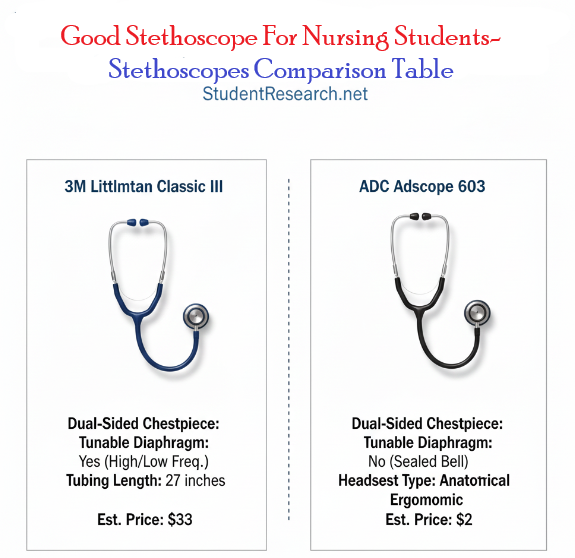
1. 3M Littmann Classic III ($80-$100)
Why It’s the Best Value: The Classic III is the gold standard for good reason—it offers cardiology-level acoustics in a durable, comfortable package. The tunable diaphragm technology and superior sound transmission justify the investment, and the 5-year warranty demonstrates Littmann’s confidence in quality.
Features that justify the price: Next-generation tubing resists cracking; tunable diaphragms eliminate need for separate bell; acoustic performance matches models costing twice as much; available in 40+ colors without premium pricing.
2. MDF Acoustica Deluxe Lightweight ($60-$75)
Why It’s the Best Value: MDF’s lifetime warranty and free-parts-for-life program transform this mid-range purchase into a potentially lifetime investment. The acoustic quality rivals the Littmann Classic III at a lower price point.
Features that justify the price: Free replacement parts forever; handcrafted stainless steel chestpiece; CardioSeal silicone eartips provide superior comfort; lifetime warranty covers everything except tubing cuts or tears.
3. ADC Adscope 615 Platinum Clinician ($70-$90)
Why It’s the Best Value: This model delivers cardiology-grade acoustics with AFD technology at a competitive price. The inclusion of three interchangeable chestpiece fittings adds versatility without additional cost.
Features that justify the price: Professional-level acoustic performance; lifetime warranty; multiple chestpiece options included; proprietary valve mechanism improves sound clarity; non-chill rim enhances patient comfort.
4. Omron Sprague Rappaport ($45-$65)
Why It’s the Best Value: The classic Sprague design offers exceptional versatility with five interchangeable fittings at an affordable price. This proven design has served healthcare professionals for decades.
Features that justify the price: Five interchangeable bells and diaphragms; dual-tube design reduces noise; chrome-plated brass provides excellent acoustic resonance; replacement parts readily available and inexpensive.
5. MDF MD One Stainless Steel ($55-$70)
Why It’s the Best Value: This model combines professional aesthetics with practical performance and MDF’s legendary warranty. The stainless steel construction offers durability that outlasts many competitors.
Features that justify the price: Full stainless steel construction; dual-head versatility; free-parts-for-life program; acoustic pyramid chamber enhances sound; latex-free materials.
When to Invest More: Why Premium Models Matter
While budget and mid-range stethoscopes serve most nursing students well, certain situations justify investing $150+ in premium models. Understanding when higher-end stethoscopes provide genuine advantages helps you make smart decisions aligned with your career goals.
Scenarios where spending $150+ makes sense:
- Specialty career paths: If you’re committed to cardiology, critical care, or emergency nursing where detecting subtle abnormalities is crucial
- Hearing challenges: When you have any degree of hearing loss that would benefit from electronic amplification
- Long-term investment: If you want one stethoscope to serve your entire career from student through advanced practice
- Academic excellence: When you’re pursuing honors programs or competitive residencies where superior diagnostic skills set you apart
Long-term career considerations:
- Premium stethoscopes often last 10-15+ years with proper care, making the higher upfront cost economically sound
- Advanced features help you develop expert-level auscultation skills that benefit your entire career
- Professional-grade equipment can enhance your confidence and credibility in clinical settings
Why premium models matter:
- Superior Acoustic Engineering: Premium stethoscopes use advanced materials and design principles that significantly improve sound transmission and clarity
- Enhanced Durability: High-end models feature construction quality that withstands decades of daily professional use without performance degradation
- Career Versatility: Premium stethoscopes perform equally well across all specialties, from pediatrics to cardiology, eliminating need for specialty-specific purchases
- Resale Value: Quality brands like Littmann retain significant resale value if you decide to upgrade or change specialties
- Professional Credibility: Using recognized premium brands signals professional commitment and attention to quality in patient care
- Warranty Protection: Premium models typically include extensive warranty coverage that protects your significant investment for years
What to Avoid When Buying Your First Nursing Stethoscope: Common Mistakes
Learning from common purchasing mistakes helps you avoid costly errors and buyer’s remorse. Understanding these pitfalls before shopping ensures you make a decision based on practical considerations rather than superficial factors. These insights come from experienced nursing students and professionals who’ve learned what truly matters in clinical practice.
Why Prioritizing Looks Over Function Fails
While aesthetic appeal matters for personal satisfaction, making it your primary decision factor often leads to disappointment with your stethoscope’s actual performance in clinical settings.
Why this approach fails:
- Acoustic Performance Matters Most: A beautiful stethoscope that can’t clearly transmit heart sounds won’t help you pass clinical checkoffs or provide quality patient care
- Durability Over Design: Trendy colors and patterns won’t matter when the tubing cracks after six months or the diaphragm membrane tears during critical assessments
- Clinical Functionality: Features like tunable diaphragms and acoustic enhancement technology impact your daily work far more than visual aesthetics
- Professional Longevity: You’ll use your stethoscope thousands of times; choosing based on looks means sacrificing features that genuinely improve your clinical experience
- Instructor Expectations: Clinical instructors evaluate your assessment skills based on accuracy, not whether your stethoscope matches your scrubs
Better approach: Choose a model with proven acoustic quality and durability first, then select your preferred color from available options within that model line.
Reasons Not to Go Too Cheap
Extreme budget consciousness can backfire when it results in purchasing inadequate equipment that must be replaced quickly or hinders your learning and clinical performance.
The false economy of extremely low-priced stethoscopes:
- Poor Acoustic Quality: Sub-$20 stethoscopes often can’t transmit sounds clearly enough for accurate assessment, forcing you to second-guess your findings
- Rapid Deterioration: Cheap materials fail quickly—cracked tubing, broken earpieces, and torn diaphragms may require replacement within months
- Learning Interference: When you can’t hear what you’re supposed to be learning, you fall behind peers using better equipment
- Double Spending: Replacing a failed cheap stethoscope means you ultimately spend more than if you’d invested in quality initially
- Clinical Confidence: Unreliable equipment undermines your confidence during high-pressure situations when accuracy matters most
Impact on learning and clinical performance:
- Missing subtle abnormalities during assessments that could indicate serious patient conditions
- Struggling to complete clinical checkoffs because you can’t hear the sounds instructors expect you to identify
- Spending extra time repositioning the stethoscope instead of efficiently completing patient assessments
- Developing poor auscultation techniques to compensate for inadequate equipment
- Facing potential clinical failure or delayed graduation due to assessment skill deficiencies
Why Testing Before Buying Matters
Purchasing a stethoscope without hands-on evaluation increases the risk of selecting a model that doesn’t fit properly or meet your specific needs, leading to discomfort and potential replacement costs.
Why hands-on testing is important:
- Fit Verification: Everyone’s ear anatomy differs—what fits your classmate perfectly may be uncomfortable for you
- Comfort Assessment: You can’t determine if a stethoscope will cause ear fatigue during 12-hour shifts without wearing it
- Acoustic Preference: Sound quality perception varies by individual; what sounds clear to one person may seem muffled to another
- Weight Consideration: A stethoscope’s weight on paper doesn’t convey how it actually feels around your neck during long clinical days
- Chestpiece Size: The chestpiece must work with your hand size and positioning technique for comfortable, effective assessments
Importance of hands-on evaluation when possible:
- Visit medical supply stores where you can try multiple models before purchasing
- Ask clinical instructors if you can briefly test their stethoscopes to compare different brands
- Attend nursing school welcome fairs where vendors often provide demonstration models
- Borrow classmates’ stethoscopes (with permission) to experience different types
Return policy considerations:
- Always purchase from retailers with generous return policies (30+ days)
- Keep original packaging until you’re certain the stethoscope meets your needs
- Test thoroughly during the return window—use it in clinical settings, not just at home
- Understand restocking fees or return shipping costs before purchasing
- Buy from authorized dealers to ensure warranty validity and return option availability
How to Care for Your Stethoscope: Maintenance Guide for Nursing Students
Proper maintenance extends your stethoscope’s lifespan and ensures consistent acoustic performance throughout nursing school and beyond. Regular care prevents costly repairs or premature replacement while maintaining optimal functionality. These maintenance practices take minimal time but deliver significant long-term benefits for both your equipment and your patients’ safety.
Steps to Proper Cleaning and Disinfection
Infection control protocols require regular stethoscope disinfection, but improper cleaning techniques can damage your equipment and reduce its lifespan.
Proper infection control protocols-The Steps
Step 1: Wipe down the entire stethoscope with 70% isopropyl alcohol wipes after each patient contact, paying special attention to the chestpiece that contacts patient skin.
Step 2: Clean ear tips daily with alcohol wipes and allow them to air dry completely before next use to prevent ear infections.
Step 3: Disinfect the tubing weekly with approved medical-grade disinfectant wipes, avoiding harsh chemicals that can cause cracking.
Step 4: Remove and clean the diaphragm monthly by gently removing it, washing with mild soap and water, and ensuring it’s completely dry before reassembly.
Step 5: Sanitize the entire stethoscope at the end of each clinical shift with hospital-approved disinfectant to prevent pathogen transmission.
Products to use:
- 70% isopropyl alcohol wipes (safe for daily use)
- Medical-grade disinfectant wipes approved by your facility
- Mild soap and water for deep cleaning
- Soft, lint-free cloths for drying
Products to avoid:
- Bleach or chlorine-based cleaners (cause tubing deterioration)
- Hand sanitizer with moisturizers (leaves residue affecting acoustics)
- Harsh chemical solvents (damage rubber and plastic components)
- Abrasive materials that scratch the chestpiece
Frequency of cleaning in clinical settings:
- After every patient contact: Quick chestpiece wipe-down
- Daily: Comprehensive cleaning of all surfaces
- Weekly: Deep cleaning including tubing and hard-to-reach areas
- Monthly: Disassembly and thorough cleaning of all components
Ways to Protect Your Stethoscope Investment
Beyond cleaning, proper storage and handling practices prevent damage and maintain your stethoscope’s acoustic integrity throughout its lifespan.
Preventing damage in clinical bags:
- Use a dedicated hard-shell stethoscope case to prevent crushing and tangling
- Keep stethoscope separate from pens, scissors, and other sharp objects that could puncture tubing
- Avoid placing heavy textbooks or equipment on top of your stethoscope
- Store in an easily accessible pocket to reduce handling and potential drops
- Consider a clip or holder that attaches to your bag for quick access without burial
Avoiding extreme temperatures:
- Never leave your stethoscope in hot cars where temperatures exceed 120°F, as heat degrades tubing elasticity
- Avoid storing near heating vents or in direct sunlight for extended periods
- Don’t expose to freezing temperatures that can make tubing brittle and prone to cracking
- Allow stethoscope to return to room temperature before use if exposed to temperature extremes
- Store in climate-controlled environments whenever possible
Replacing worn parts (ear tips, diaphragms):
- Inspect ear tips monthly for cracks, tears, or hardening that reduces acoustic seal
- Replace ear tips every 6-12 months or when they show visible wear
- Check diaphragm for cracks, holes, or loosening that affects sound transmission
- Replace diaphragm immediately if you notice decreased acoustic quality
- Keep spare parts in your clinical bag for emergency replacement
- Order replacement parts from authorized dealers to ensure compatibility
- Consider stethoscopes with free replacement part programs to reduce maintenance costs
Additional protection strategies:
- Hang stethoscope around your neck rather than stuffing in pockets where it can be damaged
- Avoid yanking or pulling on tubing when removing from around your neck
- Don’t wrap tubing too tightly when storing, as this can cause permanent kinks
- Remove stethoscope before eating or drinking to prevent spills and contamination
- Use a name tag or engraving to prevent theft or mix-ups in busy clinical areas
Conclusion: How to Make Your Final Decision with Confidence
Selecting the right stethoscope represents an important milestone in your nursing education journey. By now, you’ve discovered the best good stethoscope for nursing students in 2026, compared top picks across different categories, explored essential features that matter most, and reviewed budget-friendly options for success at every price point.
Recap of key considerations for nursing students:
The decision ultimately comes down to balancing three critical factors: acoustic quality for accurate assessments, durability to withstand rigorous clinical use, and comfort for extended wear during long shifts. Your choice should align with your budget constraints while meeting the minimum performance standards necessary for effective learning and patient care.
Prioritize acoustic quality and comfort:
Remember that a good stethoscope for nursing students must first and foremost help you hear clearly. No amount of aesthetic appeal or technological features compensates for poor sound transmission. Similarly, an uncomfortable stethoscope that causes ear pain or neck strain will distract you from patient care and reduce your willingness to use it consistently.
Final recommendation framework based on budget and needs:
- If you have $30-$50: Choose the ADC Adscope 608 Convertible for versatility or FriCARE Dual Head for basic functionality
- If you have $50-$100: Invest in the 3M Littmann Classic III for gold-standard performance or MDF Acoustica Deluxe for lifetime warranty protection
- If you have $100-$150: Consider the ADC Adscope 615 Platinum for cardiology-grade acoustics at mid-range pricing
- If you have $150+: Explore digital options like the Eko CORE 500 or Littmann CORE for advanced features and amplification
- If you’re unsure: Start with a mid-range model that offers upgrade potential rather than a budget option you’ll quickly outgrow
Call-to-action: Invest in a quality stethoscope as an investment in clinical skills
Your stethoscope is more than just a tool—it’s an investment in your clinical competence, professional confidence, and ultimately, the quality of care you’ll provide to patients. Choosing wisely now means you’ll spend less time struggling with inadequate equipment and more time developing the expert assessment skills that define excellent nursing practice.
Where to purchase (authorized retailers, student discounts):
Purchase from authorized retailers to ensure authenticity, warranty validity, and return options. Major medical supply stores like Scrubs & Beyond, Uniform Advantage, and AllHeart offer student discounts of 10-20% with valid nursing school ID. Online retailers like Amazon and manufacturer websites also provide competitive pricing, but verify seller authorization to avoid counterfeit products. Many nursing schools partner with specific vendors for group discounts—check with your program coordinator before purchasing.
Take the time to research, test when possible, and invest thoughtfully. The right stethoscope will serve you faithfully from your first clinical rotation through graduation and into your nursing career. Your patients—and your future self—will thank you for making a well-informed choice today.

