

Introduction- Why are Clinical Goals Important?
Entering clinical rotations is the moment the classroom theory transforms into real-world patient care, but without clear direction, these precious learning opportunities can be wasted. This section lays the groundwork by emphasizing the crucial role goal-setting plays in ensuring your success, resilience, and ultimate proficiency as a future Registered Nurse. Setting specific goals for student nurses in clinicals is the first step toward instantly acing your rotation.
Understanding the Critical Role of Clinicals in Nursing Education
Clinical rotations are the crucible where theoretical knowledge is forged into practical competence. By setting actionable objectives, you gain maximum benefit from every shift, transforming passive observation into intentional, active learning.
Here are at least 5 reasons why setting clinical goals is important:
- Bridges the Gap: Goals help connect textbook knowledge with the unpredictable realities of patient care, making learning practical and tangible.
- Enhances Focus: They provide a clear framework for each shift, preventing you from becoming overwhelmed by the complex hospital environment.
- Boosts Confidence: Successfully meeting specific objectives, even small ones, builds self-efficacy and reduces anxiety when performing new procedures.
- Facilitates Feedback: Clear goals give your preceptors and instructors tangible metrics to provide targeted, constructive feedback.
- Prepares for NCLEX and Practice: Clinical goals reinforce critical thinking and prioritization skills, which are essential for licensure and autonomous practice.
How to Master Core Knowledge and Clinical Skills
This section is your practical guide to turning theoretical knowledge into verifiable hands-on competence. Mastering clinical skills and developing sharp critical thinking are non-negotiable foundations for safety and success.
Here is a preview of the “how-to” methods you must focus on during your clinical rotations:
- Prioritize Safety First: Focus intensely on procedures that directly impact patient well-being, like sterile technique and medication administration.
- Think Like a Nurse: Move beyond simple data collection to interpreting findings and anticipating potential patient changes.
- Seek Repetition: Actively volunteer to perform skills you feel less confident in, maximizing muscle memory and precision.
Steps to Mastering Foundational Nursing Procedures
Achieving procedural competence requires more than just knowing the steps; it demands unwavering attention to safety and detail.
How to Achieve Proficiency in Aseptic Techniques
- Review the procedure and supply list before entering the patient’s room.
- Practice opening sterile wrappers without contaminating the field multiple times.
- Verbalize the “sterile principle” to your preceptor while performing the task.
- Set up a clean field and a sterile field in separate areas to avoid confusion.
Ensuring Accurate Medication Administration: The Six Rights Explained
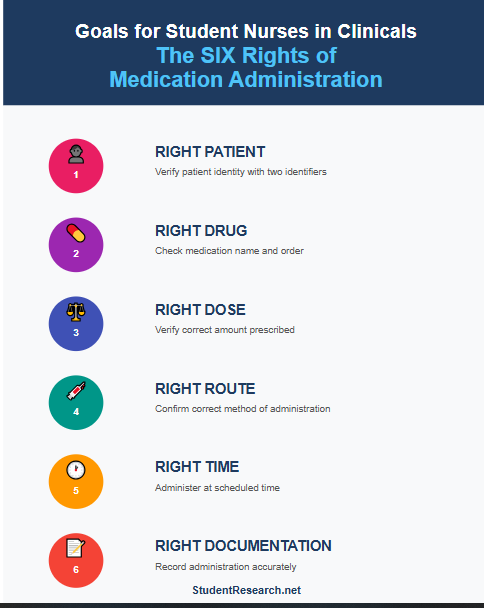
- Always verify the MAR (Medication Administration Record) against the physician’s order.
- Check the medication label against the MAR three times: when pulling it, when preparing it, and before administering it to the patient.
- Educate the patient on the medication before administration. In contemporary clinical practice right documentation is now recognized as the the sixth right.
STEP #1: ACHIEVE MEDICATION AND PROCEDURE SAFETY by adhering strictly to the “Five Rights” of medication administration and maintaining rigorous aseptic technique in all procedural tasks.
Developing Clinical Reasoning Skills: What is Expected?
Clinical reasoning is the mental process used to analyze a situation and make judgments. You are expected to synthesize patient data, identify problems, and formulate nursing interventions.
Here is what is expected when developing clinical reasoning:
- Identify Patterns: Look beyond individual vital signs; note trends or changes over time.
- Connect the Dots: Link a patient’s diagnosis to their current physical symptoms and potential complications.
- Prioritize: Determine which problems are most life-threatening or urgent (e.g., airway over comfort).
- Anticipate: Predict potential problems based on the patient’s condition (e.g., a patient with pneumonia is at risk for respiratory distress).
- H4: Guide to Targeted Head-to-Toe and Focused Assessments
- Develop a consistent, logical system for performing your head-to-toe assessment (e.g., always start with neurological, then cardiac/pulmonary).
- Tailor your assessment based on the patient’s chief complaint (e.g., spend extra time on the lower extremities for a patient with CHF).
- STEP #2: MASTER EFFICIENT AND ACCURATE ASSESSMENT by developing a consistent, systematic approach that allows you to collect comprehensive patient data quickly and reliably.
Ways to Recognize and Escalate Status Changes
- Know the normal ranges and critical values for the patient population you are working with.
- Establish a baseline for your assigned patient early in the shift.
- Understand the facility’s Early Warning Score (EWS) system, if applicable.
- Immediately report and document sudden, unexpected changes in mentation, heart rate, respiratory rate, or blood pressure.
- STEP #3: DEVELOP CRITICAL REASONING AND ESCALATION SKILLS by actively monitoring for subtle changes in your patient’s condition and knowing exactly when and how to appropriately notify the appropriate senior staff.
Essential Benefits of Communication and Professionalism Goals
Clinical competency isn’t just about successful venipuncture; it’s fundamentally about how you interact with patients and the healthcare team. Achieving your communication and professionalism goals is critical because these are the soft skills that prevent errors, build trust, and define your reputation as a nurse.
Here are the benefits of focusing on communication and professionalism goals:
- Error Reduction: Clear reporting (e.g., SBAR) minimizes misunderstanding during hand-offs, enhancing patient safety.
- Team Cohesion: Professionalism fosters mutual respect among staff, leading to a more supportive and efficient work environment.
- Improved Patient Outcomes: Effective therapeutic communication leads to better compliance and satisfaction.
- Ethical Integrity: Developing accountability ensures you act as a responsible patient advocate and uphold the nursing code.
How to Use Effective Therapeutic Communication with Patients
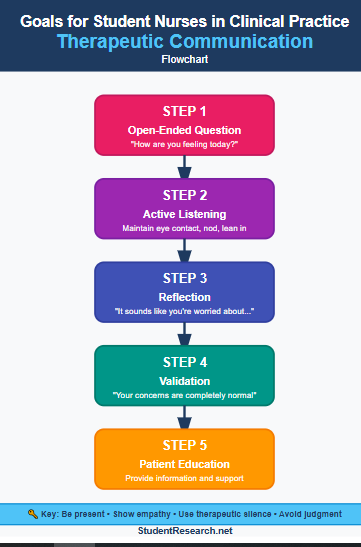
Communication is a procedure as vital as any skill, requiring deliberate practice.
Here are a few ways to master therapeutic communication:
- Ask open-ended questions that encourage patients to elaborate on their concerns.
- Maintain a non-judgemental posture and make appropriate eye contact.
- Use reflective listening to confirm you understood the patient’s feelings or needs.
- Difference Between Active Listening and Open-Ended Questions
| Active Listening | Open-Ended Questions |
| Goal: Demonstrate genuine interest and hear the patient’s full message. | Goal: Elicit detailed, narrative responses beyond “yes” or “no”. |
| Technique: Summarizing, paraphrasing, and non-verbal cues (nodding). | Technique: Start with words like “How,” “What,” or “Tell me about…”. |
| Focus: Processing and validating the patient’s existing communication. | Focus: Encouraging the patient to introduce new, relevant information. |
STEP #4: BUILD THERAPEUTIC RAPPORT AND EDUCATE PATIENTS by utilizing techniques like active listening and the “teach back” method to ensure understanding and mutual trust.
Steps to Clear and Compassionate Patient Education
- I. Assess the patient’s current knowledge level and readiness to learn.
- II. Use simple, non-medical language appropriate for their literacy level.
- III. Focus on no more than three key points at a time.
- IV. Use the “Teach Back” method to verify their understanding.
Interprofessional Collaboration vs. Independent Practice
While independence is a future goal, clinicals require strong collaboration. Collaboration is working effectively with the team (doctors, therapists, aides), while independent practice is managing your own assigned patient load.
Guide to Structured Reporting and Hand-off Communication (SBAR)
- SBAR (Situation, Background, Assessment, Recommendation) ensures all necessary information is conveyed concisely.
- Always gather necessary data (vitals, intake/output, recent events) before initiating the SBAR report.
STEP #5: PERFECT INTERPROFESSIONAL HAND-OFF COMMUNICATION by using structured communication tools like SBAR to deliver concise, accurate, and relevant reports to the care team.
What Does Accountability and Ethical Practice Mean?
- Accountability means taking responsibility for your actions, errors, and omissions.
- Ethical practice involves maintaining patient confidentiality and acting as a patient advocate, especially when complex moral decisions arise.
Is your privacy secure when using online services? Protect your identity and academic integrity with our guarantee. All personal information and order details remain strictly confidential, supported by secure payment systems. Trust StudentResearch.net.
Types of Goals for Self-Improvement and Future Readiness
Clinical rotations are not just about meeting competencies; they are about preparing you for the demands of the nursing profession, which requires continuous learning and excellent self-management.
Ways to Improve Prioritization and Time Management Strategies
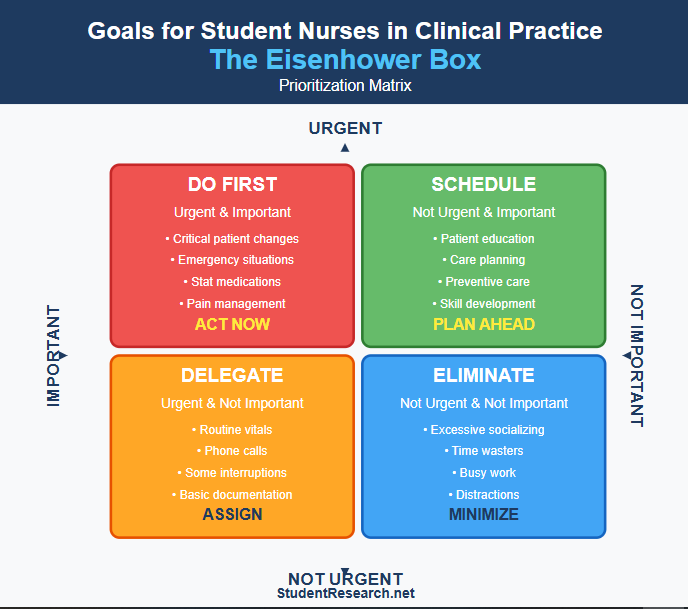
Efficient time management is the single most important non-clinical skill for a successful nurse.
Here are ways to improve prioritization and time management:
- The ABCs: Always handle Airway, Breathing, and Circulation issues first.
- Batching Tasks: Group patients in the same geographical area for simultaneous care (e.g., getting all morning vital signs and initial assessments done together).
- “Do Now” vs. “Do Later”: Triage tasks into immediate needs, urgent needs, and tasks that can wait.
- Plan Ahead: Set up supplies for complex procedures (e.g., dressing changes) during a slower time before they are needed.
Worried about your fast-approaching assignment deadline? Our service guarantees on-time delivery for all academic writing orders, including rush requests, respecting your submission schedule. Never miss a due date again! Visit StudentResearch.net today.
Examples of Efficient Shift Planning
- Create a handwritten timeline of mandatory events (med passes, labs) and slot in other patient care activities around them.
- Immediately delegate appropriate tasks to CNAs/Techs after getting morning report.
STEP #6: IMPLEMENT PRIORITIZATION AND TIME MANAGEMENT SYSTEMS by planning your shift using the ABCs and batching tasks to ensure all patient needs are met efficiently and safely.
Learning to Utilize Self-Reflection and Feedback
Reflection is the key to converting experience into expertise, ensuring you learn from every success and mistake.
How to Proactively Seek and Implement Feedback
- Specifically ask, “What is one thing I could improve on during tomorrow’s shift?”
- Document the feedback and the specific actions you will take to address it.
- Follow up with your preceptor the next day to show you implemented the changes.
- Avoid becoming defensive; view feedback as a professional growth opportunity.
STEP #7: PROACTIVELY SEEK AND APPLY CONSTRUCTIVE FEEDBACK by viewing all critique as a path to professional growth and documenting your follow-through on suggestions.
Need peace of mind for perfect grades? We offer unlimited free revisions until you are completely satisfied with your paper. Our commitment to quality ensures your academic success and satisfaction. Get the commitment you deserve at StudentResearch.net.
Why Focus on Career and NCLEX Preparation Now?
Clinical rotations are your chance to test-drive specialties and reinforce the concepts that appear on the NCLEX.
Here are reasons to focus on NCLEX and career preparation now:
- Contextual Learning: Seeing a disease (e.g., Diabetes) in a real patient setting makes the textbook content stick for the NCLEX.
- Specialty Exploration: You can determine which fields (ICU, Med-Surg, Peds) you enjoy, informing your job search.
- Networking: Building positive relationships with staff and managers can lead directly to job offers.
Conclusion – How to Carry Your Clinical Momentum Forward
You’ve explored seven brilliant steps to maximize your learning and success during clinicals, but the process doesn’t end when your shift does. Carrying this momentum forward means continually setting new, challenging goals that drive you toward competence and professionalism.
Here are ways to carry your clinical momentum forward:
- Document the three most challenging skills you performed this week and set a goal to perform them twice next week.
- Identify one system (e.g., charting flow, specific protocol) that confused you and research it before your next shift.
- Maintain a portfolio of positive feedback received from preceptors.
The Importance of Intentional Practice
Every student nurse is striving for success, but only those who approach their shifts with clear, intentional objectives truly shine. Ready to ace your rotations? Learn the essential, actionable goals for student nurses in clinicals, covering core skills, communication, and professionalism. By applying the seven steps outlined in this guide, you won’t just get through your clinicals—you will thrive in them, setting yourself up for a long and brilliant career in nursing.

