

Mastering Your Nursing Journey with SMART Planning
The path to becoming a registered nurse is as demanding as it is rewarding, requiring both clinical precision and unwavering dedication. Without a structured roadmap, even the most passionate students can find themselves overwhelmed by the sheer volume of pharmacology, clinical rotations, and academic assignments. By implementing the SMART goal framework, you can transform daunting academic requirements into actionable, manageable steps that propel your professional development forward, using these examples of smart goals for nursing students as your guide.
Understanding the SMART Framework in Clinical Education
The SMART acronym provides a concrete blueprint for success by ensuring your objectives are Specific, Measurable, Achievable, Relevant, and Time-bound. In the high-stakes environment of nursing school, this framework helps distinguish between vague aspirations and actionable milestones that contribute to your competence. When you apply this methodology to your studies, you align your daily actions with the rigorous standards required by modern healthcare systems.
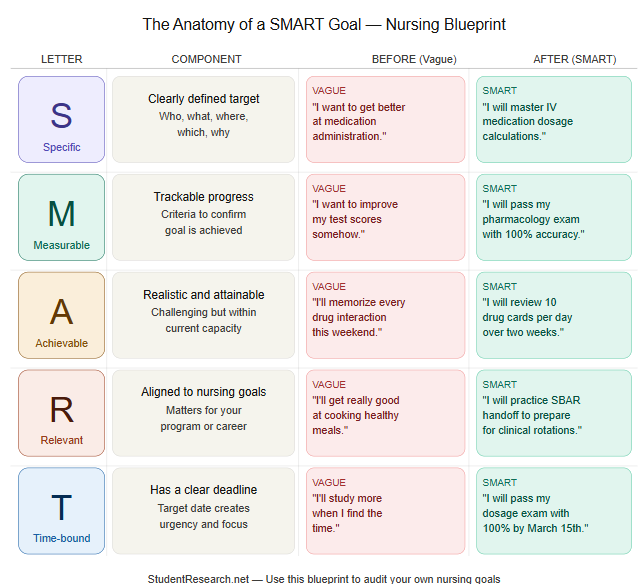
Why SMART Goals are Essential for Nursing Success
- Targeted Competence: Focuses your limited study time on critical clinical skills rather than passive reading.
- Reduced Anxiety: Breaks down massive semester requirements into small, predictable, and manageable daily tasks.
- Data-Driven Progress: Provides clear metrics to evaluate whether your study techniques are actually improving your test scores.
15 Insightful Examples of SMART Goals for Nursing Students
Setting goals that are too broad often leads to burnout, whereas SMART goals provide the structure needed for consistent, incremental growth. Below are categorized objectives that address the diverse demands of nursing education, from technical proficiency to soft-skill development. These examples serve as a template to help you structure your own ambitions for the 2026 academic year.
Clinical Rotation and Skill Acquisition Goals
- IV Insertion Proficiency: Perform 15 successful peripheral IV insertions under supervision by the end of the 8-week medical-surgical rotation.
- Documentation Accuracy: Complete all patient charting within 30 minutes of assessment for every shift to ensure real-time clinical documentation.
- Medication Administration Safety: Achieve a 100% accuracy rating on the “five rights” of medication administration during all simulated lab assessments this semester.
Pharmacology and Academic Performance Objectives
Mastering Complex Drug Classes
- Anticoagulant Knowledge: Create a comprehensive flashcard deck for 20 common anticoagulants by next Friday, achieving a 90% score on a self-administered mock quiz.
- Dosage Calculation Fluency: Dedicate 30 minutes every morning to solving five complex pediatric dosage calculations until achieving perfect scores consistently.
- Pharmacology Integration: Link medication mechanisms of action to patient pathology in care plans for all assigned cases during the upcoming month.
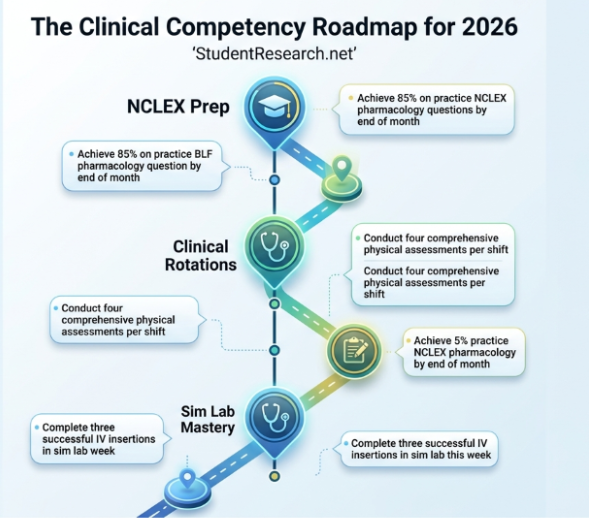
Critical Care and Advanced Assessment Milestones
- Head-to-Toe Assessment Efficiency: Conduct a comprehensive, systematic head-to-toe physical assessment on three patients per shift, completing the process in under 15 minutes by the end of week four.
- Laboratory Value Interpretation: Review the Metabolic Panel and CBC results for every assigned patient, identifying at least two clinical implications for each result to discuss with the preceptor during mid-shift rounds.
- Triage Prioritization: Correctly identify the primary nursing diagnosis for five high-acuity patients within the first 10 minutes of the shift for the duration of the emergency department rotation.
Professionalism and Interdisciplinary Communication
Refining the SBAR Technique
- Structured Handover Reports: Utilize the SBAR (Situation, Background, Assessment, Recommendation) framework for 100% of nurse-to-physician communications to improve clarity and reduce medical errors.
- Interdisciplinary Collaboration: Attend and actively participate in at least one interdisciplinary team meeting (including PT, OT, and Social Work) per week to understand holistic patient discharge planning.
- Conflict Resolution: Practice “crucial conversations” techniques once per week when addressing scheduling or clinical disagreements with peers to build professional emotional intelligence.
Strategies for Integrating AI Tools into Your Study Workflow
Modern nursing students have access to sophisticated AI co-pilots that can assist in summarizing dense medical literature and practice exam generation. However, using these tools requires a disciplined approach to ensure you are developing deep clinical understanding rather than relying on automated shortcuts. You can effectively leverage AI as a tutor to test your recall and explain challenging pharmacological interactions in real-time.
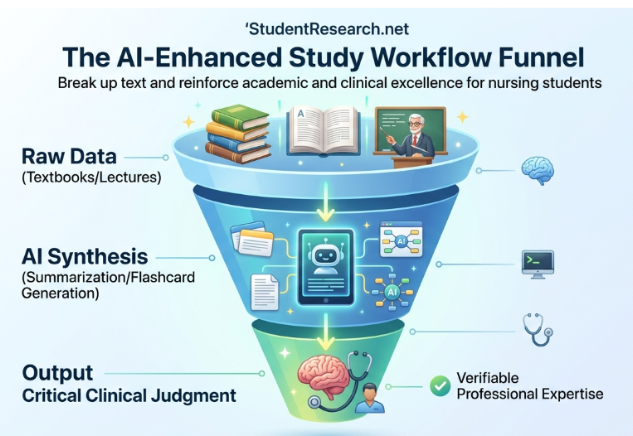
Balancing Automation and Critical Thinking
- AI for Knowledge Retrieval: Use AI to generate practice scenarios for clinical cases, then manually write out the care plans to ensure retention.
- Ethical Usage Boundaries: Utilize AI tools solely for explaining complex concepts, ensuring all final assignments and patient data analyses are your own work.
- Verification Protocols: Cross-reference any AI-provided medical data against peer-reviewed journals or official nursing textbooks to ensure clinical accuracy.
Leveraging Technology for NCLEX-RN Readiness
- Predictive Analytics: Use AI-driven test prep platforms to complete 50 adaptive practice questions daily, maintaining a “probability of passing” score of 85% or higher over 30 consecutive days.
- Case Study Synthesis: Input complex patient scenarios into a secure AI tool to generate five potential “Next Gen NCLEX” style questions, then solve them to test your clinical judgment.
- Concept Mapping: Use digital mind-mapping software to link five physiological systems to a single chronic illness (e.g., Diabetes Mellitus) to visualize multisystem impacts for exam preparation.
Time Management and Digital Productivity
Optimization of the Nursing Study Schedule
- The Pomodoro Technique: Implement 50-minute deep-work study blocks followed by 10-minute breaks for all pharmacology memorization sessions to prevent cognitive fatigue.
- Digital Calendar Syncing: Synchronize all clinical rotation dates, lab practicals, and exam deadlines into a cloud-based calendar with 48-hour “early warning” alerts for all major assignments.
- Resource Curation: Organize a digital library of 20 high-quality, peer-reviewed nursing journals and clinical guidelines by the end of the month to use as a primary reference for all care plans.
Feeling overwhelmed by complex nursing research assignments? You are not alone. At StudentResearch.net, we provide expert guidance to help you craft impeccable academic papers that meet rigorous clinical standards. Elevate your grades and regain your peace of mind today.
Tracking Your Milestones and Adjusting for Growth
The ability to audit your progress is just as important as the initial goal-setting process, as it allows for mid-course corrections based on your performance. Nursing school is dynamic, and your priorities may shift during clinical rotations, necessitating a flexible approach to your established goals. Regularly reviewing your progress ensures that you remain aligned with your ultimate objective of becoming a competent and confident nurse.
Periodic Performance Reviews
- Weekly Goal Audits: Spend 15 minutes every Sunday evening reviewing which tasks were completed and identifying the blockers for incomplete ones.
- Peer Accountability Groups: Share your weekly SMART goals with a study partner to foster mutual support and maintain high levels of motivation.
- Outcome Refinement: If a goal consistently feels unattainable, revise the scope or timeline immediately to prevent discouragement and maintain momentum.
Overcoming Common Hurdles in Nursing School Goal Setting
Even with the best intentions, nursing students often encounter barriers such as unpredictable clinical hours and overwhelming exam schedules. Recognizing these challenges early allows you to build “buffer time” into your goal structure, ensuring that one busy week does not derail your entire semester’s plan. Resilience in the face of these setbacks is a hallmark of a professional nurse who can prioritize patient safety under pressure.
H3: Managing the Emotional Toll of Clinical Practice
- Debriefing Protocols: After every high-stress clinical encounter, spend 10 minutes documenting your emotional response and clinical takeaways in a private reflective journal.
- Self-Care Implementation: Commit to 30 minutes of physical activity or meditative practice four times per week to maintain the mental stamina required for 12-hour clinical shifts.
- Resilience Training: Identify one “clinical failure” or mistake each month and write a three-step corrective action plan to turn the setback into a measurable learning milestone.
Financial and Resource Management for Students
Budgeting for Professional Development
- Certification Planning: Save $25 per month specifically for post-graduation certification fees (such as CCRN or PCCN) to ensure financial readiness upon entering the workforce.
- Textbook ROI: Conduct a monthly audit of required vs. supplemental reading materials to prioritize study time on resources that directly impact GPA and clinical safety.
- Networking Outreach: Reach out to one nursing professional in your desired specialty (e.g., NICU or Oncology) via LinkedIn each month to conduct a 15-minute informational interview.
Conclusion: Achieving Your Nursing Potential
The consistent application of SMART goals turns the daunting journey of nursing school into a series of achievable, celebrated victories. By setting clear objectives, you take command of your education and develop the disciplined mindset required for a successful and long-lasting healthcare career. As you look toward 2026, embrace these examples of smart goals for nursing students to transform your potential into verified professional expertise. Master your nursing degree with these 15 examples of smart goals for nursing students. Plan your path to clinical excellence and success in 2026 today.
Ready to balance clinical rotations with demanding writing tasks? StudentResearch.net offers specialized academic support tailored for nursing students. Save valuable time while ensuring your work reflects true professional excellence. Visit us now to place your order today!

