

What is a Clinical Evaluation?
Clinical evaluation serves as a cornerstone of the nursing curriculum, providing a structured way to measure a learner’s progression from theory to practice. When educators provide clear examples of nursing student evaluation comments, they offer a roadmap that helps students navigate complex healthcare environments. Effective student research into clinical standards ensures that these evaluations remain objective and aligned with current evidence-based practices. Furthermore, consistent student research into self-assessment allows future nurses to reflect deeply on their own clinical milestones.
Understanding the Purpose of Clinical Feedback
- Identifies Strengths: Highlights areas where the student excels, reinforcing positive clinical behaviors.
- Pinpoints Gaps: Detects specific skills or knowledge areas that require further development or remediation.
- Ensures Patient Safety: Acts as a quality control measure to confirm that student actions meet safety standards.
- Facilitates Communication: Provides a formal channel for dialogue between the preceptor and the learner.
- Tracks Progress: Documents the student’s growth over the course of a clinical rotation.
Why is Specific Evaluation Important for Student Success?
- Clarity of Expectation: Specificity removes ambiguity, ensuring the student knows exactly what “proficient” looks like.
- Actionable Insights: Detailed feedback allows students to create concrete plans for improvement.
- Motivation: Recognizing specific achievements boosts student confidence and encourages continued professional engagement.
- Standardized Assessment: High-quality comments ensure that evaluations are fair and consistent across different clinical sites.
Defining the Core Competencies of Nursing Education
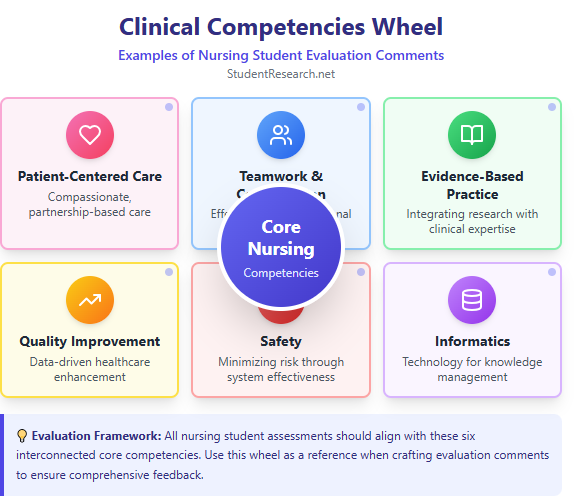
Core competencies represent the essential knowledge, skills, and attitudes that every nursing student must demonstrate to provide safe and effective care.
- Patient-Centered Care: Recognizing the patient as the source of control and a full partner in providing compassionate care.
- Teamwork and Collaboration: Functioning effectively within nursing and inter-professional teams.
- Evidence-Based Practice (EBP): Integrating the best current evidence with clinical expertise and patient values.
- Quality Improvement (QI): Using data to monitor outcomes and continuously improve healthcare systems.
- Safety: Minimizing risk of harm to patients and providers through system effectiveness and individual performance.
- Informatics: Using information and technology to manage knowledge and mitigate error.
Examples of Nursing Student Evaluation Comments for Clinical Performance
Clinical performance serves as the practical application of classroom theory, where students must prove their ability to handle real-world medical scenarios with precision. This section provides a comprehensive look at how to evaluate technical skills, ensuring that students meet the high standards required for hospital settings. Precise feedback here is vital, as it offers direct linkage to Types of Clinical Safety Protocols and Infection Control, which are the non-negotiable foundations of patient care.
Types of Clinical Safety Protocols and Infection Control
- Standard Precautions: Consistent use of personal protective equipment (PPE) and hand hygiene for all patient contacts.
- Transmission-Based Precautions: Implementation of airborne, droplet, or contact precautions based on specific diagnoses.
- Aseptic Technique: Maintaining a germ-free environment during invasive procedures like catheterization.
- Environmental Safety: Managing sharps disposal, spill protocols, and equipment sterilization.
- Patient Safety Measures: Utilizing bed alarms, side rails, and fall risk assessments to prevent injuries.
How to Document Proper Hand Hygiene and Sterile Field Maintenance
- Observation of Technique: Monitoring the duration and thoroughness of hand scrubbing before and after patient interaction.
- Aseptic Integrity: Evaluating the student’s ability to open sterile kits without contaminating internal contents.
- Example 1: “Student demonstrates excellent hand hygiene, consistently washing for the recommended 20 seconds between tasks.”
- Example 2: “Maintains an impeccable sterile field during Foley catheter insertion, ensuring no contamination occurs.”
- Example 3: “Displays proactive awareness by replacing sterile gloves immediately after an accidental touch of a non-sterile surface.”
- Example 4: “Educates patient and family members on the importance of hand hygiene to prevent cross-contamination.”
- Example 5: “Effectively organizes the sterile work area to prevent reaching across the field, maintaining high safety standards.”
Steps to Evaluate Patient Identification and Medication Safety
- Verification Process: Checking two unique patient identifiers (e.g., name and DOB) against the MAR.
- The Six Rights: Assessing adherence to right patient, drug, dose, route, time, and documentation.
- Example 6: “Consistently verifies patient identity using the wristband and verbal confirmation before every medication pass.”
- Example 7: “Meticulously performs the three checks of medication administration to ensure 100% accuracy.”
- Example 8: “Demonstrates safe administration of insulin by having a second nurse double-check the dose as per protocol.”
- Example 9: “Correctly identifies a potential drug-to-drug interaction and consults the pharmacist before proceeding.”
- Example 10: “Clearly explains the side effects of new antihypertensive medication to the patient, ensuring their understanding.”
Practical Illustrations of Physical Assessment Skills
- Example 11: “Performs a systematic head-to-toe assessment, accurately documenting findings in the electronic health record.”
- Example 12: “Identified abnormal breath sounds in a post-operative patient and reported findings to the preceptor immediately.”
- Example 13: “Demonstrates proficiency in assessing peripheral pulses and edema in patients with congestive heart failure.”
- Example 14: “Effectively uses a pain scale to assess patient discomfort and reassesses the score 30 minutes after intervention.”
- Example 15: “Shows great attention to detail when assessing skin integrity, identifying a Stage 1 pressure injury on the coccyx.”
Ways to Evaluate Communication and Interpersonal Excellence
Effective communication is the lifeblood of nursing, acting as the bridge between clinical expertise and patient trust. In this section, we explore how to measure a student’s ability to build rapport and exchange vital information within the healthcare team. We look specifically at how students navigate high-pressure conversations and emotional interactions. Through structured feedback, educators can guide learners toward mastery in professional dialogue. This evaluation provides direct linkage to examples of therapeutic communication with patients, highlighting the student’s ability to provide holistic support.
Examples of Therapeutic Communication with Patients
- Active Listening: Uses non-verbal cues and silence to allow the patient to express concerns fully.
- Example 16: “Uses open-ended questions effectively to encourage the patient to share their feelings regarding their diagnosis.”
- Example 17: “Demonstrates empathy by validating the patient’s anxiety prior to a surgical procedure.”
- Example 18: “Utilizes therapeutic touch appropriately to provide comfort to a grieving family member.”
- Example 19: “Avoids medical jargon, explaining the care plan in terms the patient and family can easily understand.”
- Example 20: “Maintains appropriate eye contact and a calm demeanor even when the patient is frustrated.”
How do I Evaluate Professional Collaboration Using SBAR?
- Situation: Assesses if the student clearly states the immediate reason for the communication.
- Background: Evaluates the ability to provide relevant clinical history and context.
- Assessment: Checks if the student offers a professional opinion on the current status
- Recommendation: Monitors if the student suggests a clear next step or intervention.
Practical Phrases for Reporting to the Interdisciplinary Team
- Conciseness: Provides a brief yet thorough update during multidisciplinary rounds.
- Example 21: “Presents patient data using the SBAR format during shift handoff, ensuring no critical details are missed.”
- Example 22: “Collaborates effectively with the physical therapist to coordinate post-op mobility for the patient.”
- Example 23: “Correctly identifies when to escalate a change in patient status to the attending physician.”
- Example 24: “Actively participates in discharge planning meetings, advocating for the patient’s home care needs.”
Methods for Assessing Conflict Resolution and De-escalation
- Emotional Regulation: Monitors the student’s ability to remain professional during heated exchanges.
- Boundary Setting: Observes how the student maintains professional limits with demanding individuals.
- Example 25: “Remains composed and uses a lowered voice to de-escalate an upset family member in the hallway.”
- Example 26: “Addresses a disagreement with a peer privately and professionally to maintain a positive unit culture.”
- Example 27: “Identifies early signs of patient agitation and implements non-pharmacological soothing techniques.”
Critical Thinking Explained: Assessing Clinical Judgment
Clinical judgment represents the complex process where a nurse synthesizes data, recognizes patterns, and acts decisively to improve patient outcomes. This section explores how to evaluate a student’s mental agility in high-stakes environments, moving beyond rote memorization to true cognitive application91. Strong clinical judgment is often best observed through a guide to assessing prioritization and time management, as it reveals how a student organizes care based on medical urgency.
Guide to Assessing Prioritization and Time Management
- Urgency Categorization: Evaluates the ability to distinguish between life-threatening issues and routine care.
- Task Sequencing: Observes the logical order in which a student completes daily responsibilities.
- Example 28: “Correctly prioritized the care of a post-operative patient with declining oxygen saturation over routine vital signs.”
- Example 29: “Demonstrates the ability to cluster nursing care activities to minimize patient fatigue and maximize efficiency.”
- Example 30: “Recognized the need to delegate a stable bed bath to a CNA to focus on a new admission assessment.”
- Example 31: “Proactively prepared for morning medication pass by reviewing lab results 30 minutes ahead of time.”
- Example 32: “Maintained a calm, organized approach even when managing three simultaneous patient discharges.”
Reasons for Evaluating Application of Theoretical Knowledge
- Bridging the Gap: Confirms the student can apply classroom pathophysiology to the actual patient.
- Safety Verification: Ensures the student understands the “why” behind an intervention to prevent mechanical errors.
- Critical Synthesis: Highlights the student’s ability to interpret lab values and diagnostic tests in context.
Examples of Linking Pathophysiology to Symptoms
- Example 33: “Effectively connects the patient’s fluid volume excess to their underlying renal pathology during clinical rounds.”
- Example 34: “Accurately identified that the patient’s confusion was a secondary symptom of a burgeoning urinary tract infection.”
- Example 35: “Explained the rationale for holding a beta-blocker based on the patient’s current bradycardic heart rate.”
Benefits of Independent Decision-Making Observations
- Confidence Building: Noticing independent acts reinforces the transition from learner to practitioner.
- Autonomy Assessment: Identifies if a student is ready for more complex, less-supervised assignments.
- Example 36: “Recognized early signs of hypoglycemia and initiated the facility protocol before instructor intervention.”
- Example 37: “Independently implemented non-pharmacological pain relief measures, such as repositioning and heat therapy.”
- Example 38: “Noticed a trending downward blood pressure and proactively increased the frequency of monitoring.”
Racing against a ticking clock for your next submission? Trust StudentResearch.net for guaranteed on-time delivery, even for your most urgent rush orders.
We respect your schedule and ensure you never miss a critical deadline again
Professionalism and Ethical Practice: A Comprehensive Guide
Professionalism in nursing extends beyond technical proficiency, encompassing the values, ethics, and integrity that define the healthcare vocation. This section focuses on evaluating the student’s character, their adherence to ethical standards, and their ability to maintain a professional identity even under stress.
Understanding Accountability and Student Initiative
- Ownership of Tasks: Takes full responsibility for assigned care and follows through on all interventions.
- Example 39: “Shows great initiative by seeking out new learning opportunities, such as observing a PICC line insertion or complex wound debridement.”
- Example 40: “Consistently arrives early for shift to review patient charts and prepare for the day’s responsibilities.”
- Example 41: “Displays high accountability by immediately reporting a self-identified charting error to the clinical instructor.”
- Example 42: “Demonstrates a professional appearance and punctual attendance throughout the clinical rotation.”
Difference Between Emotional Intelligence and Clinical Skill
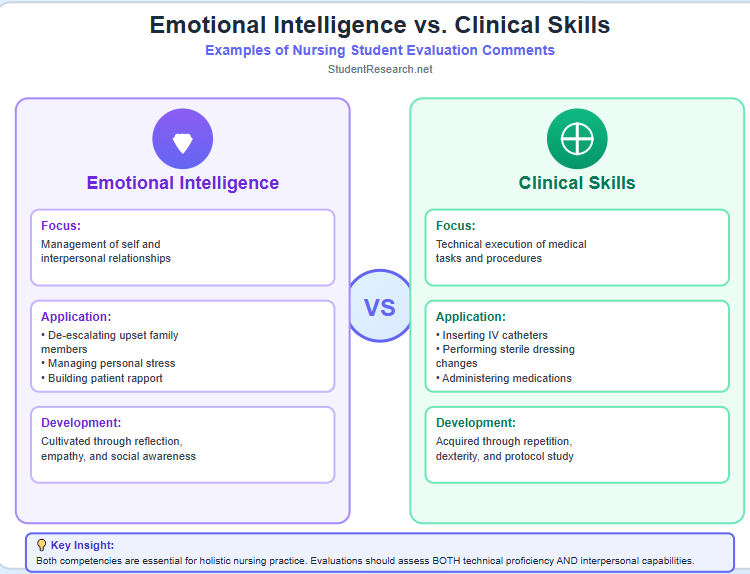
| Aspect | Emotional Intelligence | Clinical Skill |
| Focus | Management of self and interpersonal relationships. | Technical execution of medical tasks and procedures. |
| Application | De-escalating an upset family member or managing personal stress. | Inserting an IV catheter or performing a sterile dressing change. |
| Development | Cultivated through reflection, empathy, and social awareness. | Acquired through repetition, dexterity, and protocol study. |
How to Phrase Feedback on Response to Constructive Criticism
- Receptivity: Evaluate if the student listens actively without becoming defensive.
- Example 43: “Accepts feedback with a growth mindset and shows immediate improvement in subsequent tasks.”
- Example 44: “Demonstrates professional maturity by asking for specific ways to improve after a difficult clinical encounter.”
- Example 45: “Effectively utilizes peer and instructor feedback to refine their physical assessment technique.”
Examples of Ethical Advocacy in Student Nursing
- Example 46: “Advocated for patient’s pain management needs when the patient was unable to vocalize their discomfort.”
- Example 47: “Ensured patient privacy was maintained during a crowded multidisciplinary rounding session.”
- Example 48: “Identified an ethical concern regarding a patient’s informed consent and brought it to the attention of the charge nurse.”
Troubleshooting Poor Performance: Addressing Areas of Improvement
Identifying areas where a student struggles is a vital step in ensuring clinical competency and professional safety. This section focuses on diagnosing the root causes of performance gaps, whether they stem from a lack of confidence, insufficient preparation, or technical difficulty.
Fixing Issues with Technical Skill Development
- Targeted Remediation: Focuses on specific manual tasks that require repetition.
- Example 49: “Student needs to focus on streamlining the setup of IV pumps to improve time management during medication passes.”
- Example 50: “Recommendation for additional practice in the simulation lab to increase dexterity with sterile gloving techniques.”
- Example 51: “Requires further supervision when performing tracheostomy care to ensure all safety steps are followed in order.”
Why Isn’t the Student Showing Autonomy? Causes and Comments
- Confidence Gaps: Often caused by a fear of making mistakes in a high-stakes clinical environment.
- Example 52: “While proficient in technical skills, the student should work on projecting more confidence when communicating with the medical team.”
- Example 53: “Encouraged to take more initiative in daily rounding rather than waiting for direct instructions from the preceptor.”
Benefits of High-Quality Nursing Evaluations
Meaningful evaluations are the bridge between being a student and becoming a professional nurse. Master student assessments with our guide. Apply these 50+ examples of nursing student evaluation comments to improve feedback and boost clinical growth.
Steps to Achieving Long-term Educational Growth
- Reflective Practice: Encouraging students to journal or self-evaluate based on instructor comments.
- Continuous Goal Setting: Updating clinical objectives every week to ensure steady progression.
- Open Dialogue: Maintaining a transparent relationship where feedback is a two-way street.
Burning the midnight oil on a complex assignment? At StudentResearch.net, our dedicated support team is available 24/7 to handle your urgent revisions and consultations across every time zone. We are always here when you need us!
Conclusion
Providing high-quality examples of nursing student evaluation comments is essential for shaping competent healthcare providers. Detailed, actionable feedback ensures that students understand their strengths while receiving a clear roadmap for professional improvement. These comments serve as a permanent record of a student’s journey toward clinical excellence.

