

Pharmacology is often cited as the most daunting hurdle in nursing school, but it doesn’t have to be. By leveraging structured drug cards for nursing students, you can transform overwhelming lists of medications into actionable, bite-sized knowledge. This ultimate guide will equip you with the exact strategies to memorize drug classes, side effects, and nursing interventions with ease.
Understanding the Importance of Drug Cards for Nursing Students
Pharmacology requires moving beyond rote memorization to truly understanding how medications interact with human physiology. Developing a consistent system for organizing your study material is the cornerstone of clinical competence and patient safety. When you master these tools early, you reduce exam anxiety and increase your confidence during high-stakes clinical rotations.
The Role of Pharmacology in Nursing Practice
- Safety First: Understanding pharmacokinetics prevents medication administration errors.
- Clinical Application: Linking drug mechanism of action to real-world patient assessment findings.
- Foundation for NCLEX: Providing a solid knowledge base for safe, effective nursing care across the lifespan.
Essential Components of Effective Drug Cards
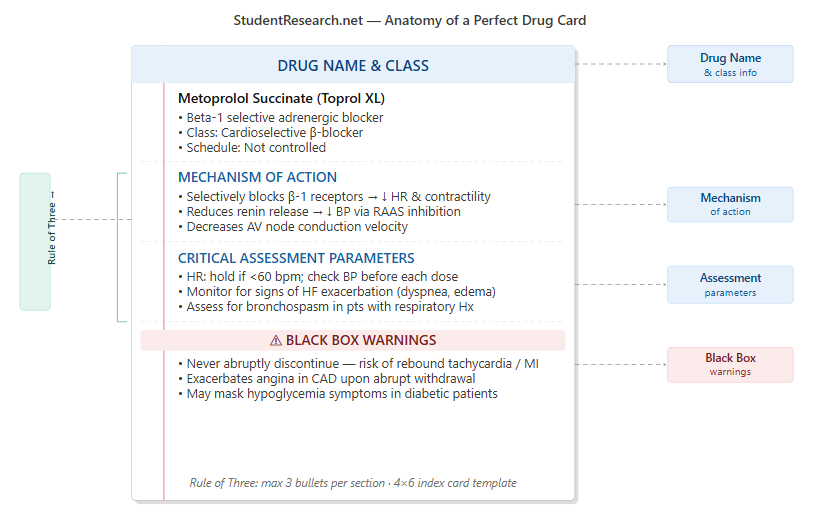
Every high-quality card must be standardized to ensure you are capturing the data that matters most for exams and clinical practice. Focus on the core pillars of pharmacology—the “why” and “how” behind every medication—to maximize your study efficiency. A well-constructed card serves as a quick-reference guide that bridges the gap between the textbook and the bedside.
Must-Have Data Points for Your Cards
- Drug Name and Classification: Both generic and trade names, along with the therapeutic class.
- Mechanism of Action: A simplified explanation of how the drug works in the body.
- Key Nursing Implications: Essential assessment parameters and monitoring needs before and after administration.
Top 15 Strategies for Creating Organized Drug Cards
Creating drug cards for nursing students is a refined art that balances breadth of information with cognitive clarity. The most successful students utilize a blend of visual organization, active recall, and spaced repetition to ensure long-term retention. These 15 strategies are designed to help you synthesize complex pharmacological data into manageable, high-yield study assets.
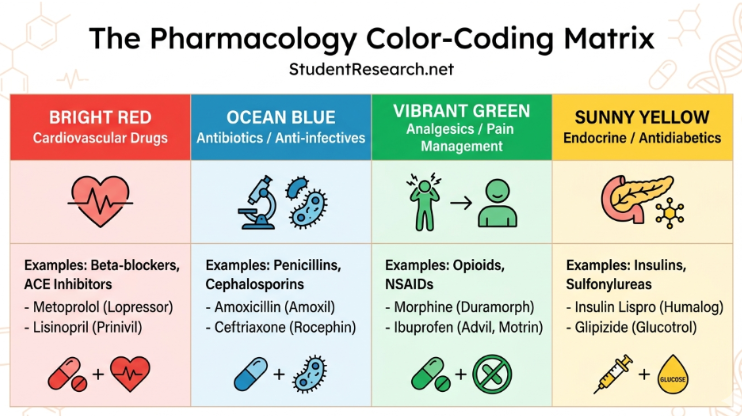
1. Color-Coding by Pharmacological Class
- Visual Categorization: Assign specific colors (e.g., Red for Cardiac, Blue for Antibiotics) to instantly narrow your cognitive search.
- Rapid Association: When an NCLEX question mentions an antihypertensive, your brain will automatically trigger the color associated with that class.
- Pattern Recognition: Use highlighters or colored cardstock to group medications that belong to the same therapeutic family.
2. The “Rule of Three” for Side Effects
- Prioritize Criticality: Focus on the three most life-threatening adverse effects that require immediate nursing intervention.
- Simplify Data: Avoid cluttering your cards with every possible side effect; stick to the ones that show up most on exams.
- Commonality vs. Danger: If you have extra space, list the most common minor side effect alongside the two most dangerous ones.
3. Leverage Concept Mapping Connections
- Visualizing Pathophysiology: Draw simple arrows showing how a drug impacts a specific organ system or physiological pathway.
- Chain of Causality: Connect the drug’s mechanism to the expected patient assessment finding in one fluid motion.
- Integrated Learning: Linking the “Why” to the “What” turns a static fact into a functional piece of clinical knowledge.
4. Emphasize Generic Over Trade Names
- Standardization: The NCLEX and professional clinical environments prioritize generic names to avoid medication errors.
- Consistency: Trade names change by manufacturer, but the generic name remains the universal constant for safety.
- Simplified Memorization: Focus on the suffix (e.g., -lol, -pril, -statin) to identify the drug class instantly.
5. Incorporate “Black Box” Warning Highlights
- Safety Priority: Explicitly label any drug that carries a FDA Black Box Warning to ensure patient safety compliance.
- Exam High-Yield: Examiners love testing on these because they represent the highest risks to patient outcomes.
- Clinical Vigilance: These warnings serve as your primary indicators for what to monitor during your clinical shift.
6. Designate “Before” vs. “After” Assessment Parameters
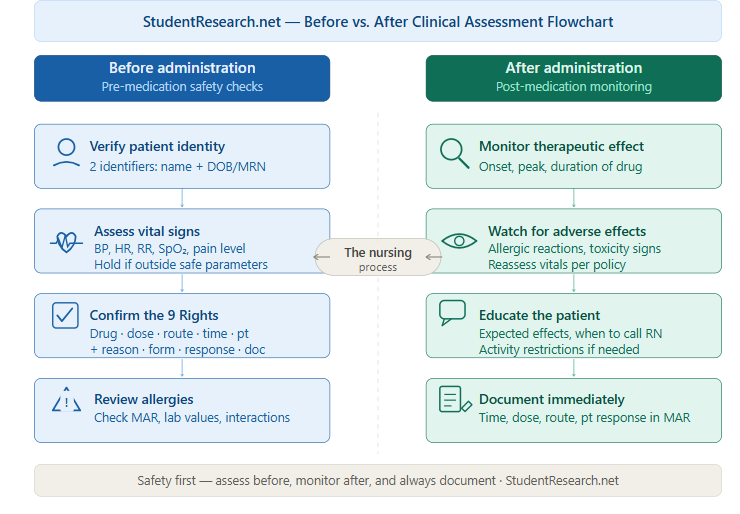
- Time-Bound Interventions: Split your card into two zones: assessments needed before administration and monitoring required post-dose.
- Actionable Data: This forces you to think about the nursing process: Assessment, Diagnosis, Planning, Implementation, Evaluation.
- Safety Net: Knowing what to check prevents you from administering a medication when the patient’s vitals are contraindicated.
7. Implement Spaced Repetition Schedules
- The Forgetting Curve: Use a physical or digital system to review cards at increasing intervals (1 day, 3 days, 1 week, 1 month).
- Cognitive Strengthening: The struggle to recall information right before you forget it is where true long-term memory is formed.
- Efficient Time Management: Spend your energy reviewing cards you are struggling with rather than wasting time on ones you already know.
8. Use Mnemonic Devices for Difficult Classes
- Creative Associations: Create silly acronyms or phrases to memorize long lists of contraindications or side effects.
- Information Retrieval: When you are under pressure during a test, these “mental anchors” are much easier to recall than raw data.
- Personalization: The weirder or more personal the mnemonic, the easier it will be to lock into your long-term memory.
9. Focus on the “Why” Behind the Mechanism
- Conceptual Mastery: Instead of memorizing “it lowers blood pressure,” learn “it blocks the ACE enzyme to prevent vasoconstriction.”
- Logical Deduction: If you understand the mechanism, you can often deduce the side effects without having to memorize them individually.
- Foundation for Synthesis: This is the difference between a student who survives pharmacology and one who thrives in advanced practice.
10. Keep Cards Portable and Durable
- Study Anywhere: Use a binder ring or a compact card case so you can pull out your deck during elevator rides or lunch breaks.
- Material Quality: Use cardstock or laminate your cards to ensure they survive the rigors of your clinical bag for the entire semester.
- Instant Access: Your cards are useless if they are sitting on your desk at home when you have a free moment at the hospital.
11. Add Lab Value Correlations
- Clinical Integration: Note which lab values (e.g., Potassium, INR, Creatinine) must be checked before giving a specific drug.
- Data-Driven Decisions: This reinforces your ability to interpret lab results in the context of the patient’s active medication list.
- Exam Readiness: NCLEX questions often present a patient with a specific lab value and ask if the nurse should hold the dose.
12. Create “Red Flag” Contraindication Markers
- Immediate Identification: Use a distinct symbol (like a skull or red dot) to mark conditions where the medication is strictly forbidden.
- Critical Thinking: This prevents “blind” administration and forces you to scan the patient’s history for conflicting diagnoses.
- Preventative Care: Identifying these contraindications is one of the most vital roles of a registered nurse.
13. Peer-Review and Study Swaps
- Collective Wisdom: Swap your deck with a peer to see if your card is clear enough for someone else to understand.
- Identify Knowledge Gaps: If your peer asks a question you can’t answer from your card, you know exactly what needs to be added.
- Collaborative Learning: Explaining a drug class to a classmate is one of the most effective ways to solidify your own understanding.
14. Add Patient Education “Soundbites”
- Communication Skills: Write down the 1-2 sentence explanation you would give to a patient to explain why they are taking this drug.
- Practical Application: Being able to simplify complex pharmacology for a patient is a core nursing competency that will serve you well in clinicals.
- Empowerment: You are preparing yourself to educate your patients, which is a major part of the nursing scope of practice.
15. The “Active Recall” Cover Method
- Self-Testing: When reviewing, cover the side effects/nursing actions and force yourself to recite them aloud before looking.
- Continuous Feedback: If you can’t say it aloud, you don’t know it well enough yet; place that card in the “needs review” pile.
- Confidence Building: Mastering this method eliminates the “illusion of competence” where you think you know it just because you recognize the words on the page.
How to Optimize Your Study Sessions
Success in nursing school is defined by study quality rather than raw volume of hours spent with your head in a book. By optimizing your environment and your cognitive approach, you can significantly improve your retention of pharmacology concepts. Incorporating these techniques will help you transition from passive reading to active, exam-ready mastery.
Maximizing Cognitive Load
- Spaced Repetition: Use apps to trigger review cycles for older drug cards to prevent the “forgetting curve.”
- Active Recall: Cover the back of your card and test yourself on the mechanism of action before flipping.
- Interleaving Topics: Study different drug classes in a single session to mirror the diversity of NCLEX questions.
Struggling to balance pharmacology exams with never-ending clinical assignments? Let StudentResearch.net handle the heavy lifting of your academic writing. Our expert team ensures your projects are meticulously researched, professionally formatted, and delivered on time, every single time.
Integrating Digital Tools for Pharmacology Success
In 2026, the best nursing students are utilizing technology to streamline their study workflows and make information portable. Whether you prefer custom-built digital decks or specialized nursing apps, integrating these tools is a game-changer for busy students. We recommend pairing your manual card creation with digital flashcard platforms to ensure you are never without your study materials.
Leveraging Tech for Efficiency
- Flashcard Apps: Utilize platforms like Anki or Quizlet for mobile-friendly, on-the-go review during clinical downtime.
- Pharmacology Databases: Cross-reference your card data with official clinical apps to ensure your information is current.
- Digital Concept Boards: Build collaborative boards with your peers to crowdsource the most important drug facts.
Commercial Spotlight: High-Quality Pre-Made Study Aids
While creating your own cards is highly effective for deep learning, professional pre-made sets can provide the perfect structural foundation. These sets are meticulously designed by experienced educators to ensure they highlight the most commonly tested NCLEX pharmacology concepts. Investing in a trusted, professionally curated set can save you dozens of hours of organizational labor.
Why Choose Professional Sets
- Expert Vetting: Information is reviewed for accuracy against current clinical guidelines and pharmacopeia.
- Standardized Layouts: Cleaner, more readable formats that prevent eye strain during long study sessions.
- NCLEX-Focused Content: Curated specifically to mirror the high-priority questions found on the national board exam.
Applying Drug Card Knowledge in Clinical Rotations
The ultimate test of your pharmacology knowledge occurs at the bedside, not in the library. Using your prepared drug cards during clinicals allows you to verify dosage, side effects, and patient assessments in real-time, safely and efficiently. Always remember that your goal is to utilize these tools to enhance your clinical reasoning, not just to complete a check-off list.
Translating Theory to Practice
- Pre-Shift Prep: Review the medications for your assigned patients using your card system before you step onto the unit.
- Prioritization: Use your cards to identify which patient needs their antihypertensive prioritized based on recent blood pressure readings.
- Patient Education: Use the simplified language on your cards to explain medication regimens to your patients clearly.
Identifying High-Yield Pharmacology Concepts
Not all drugs are created equal in terms of exam frequency and clinical necessity. You must learn to distinguish between niche, rare medications and the “bread and butter” drugs that you will encounter daily in the hospital. Focusing your limited study time on these high-yield areas will yield the highest return on your investment.
Core Areas to Master
- Emergency Medications: Epinephrine, atropine, and vasopressors must be memorized with absolute precision.
- Common Chronic Meds: Insulin, beta-blockers, and anticoagulants that you will manage for nearly every patient.
- Infection Control Agents: Understanding antibiotic spectrums to help prevent antibiotic resistance.
Common Mistakes to Avoid in Pharmacology Study
Even diligent students can fall into traps that hinder their progress and lead to inefficient study patterns. Recognizing these common pitfalls early is essential for maintaining your motivation and keeping your GPA high. By shifting your approach to avoid these errors, you will find that your study sessions become more productive and less draining.
Pitfalls to Watch Out For
- Over-Indexing on Trade Names: Always anchor your knowledge in generic drug names, as this is how they will appear on the NCLEX.
- Writing Too Much: Avoid transcribing textbooks onto your cards; if it doesn’t fit on a 4×6 card, it’s too much detail.
- Neglecting Contraindications: Forgetting the “when not to give” is just as dangerous as not knowing the “when to give.”
Conclusion and Final Study Recommendations
Mastering pharmacology through structured drug cards is a journey that pays off in both academic excellence and future patient safety. By adopting the high-yield habits outlined here, you are well on your way to becoming a confident and competent nurse. Drug cards for nursing students are the best way to master pharmacology, improve NCLEX scores, and ensure safe patient care. The Ultimate Guide in 2026 for nursing students to conquer pharmacology and boost their clinical success.
Your Path Forward
- Stay Consistent: Build your card library one drug class at a time rather than trying to cram everything at once.
- Refine Your Process: Continually update your cards as you learn new clinical pearls from your instructors and preceptors.
- Trust the System: You have the tools, the strategy, and the drive—now go out and dominate your pharmacology exams.
Ready to elevate your nursing essays to a professional standard? Trust the academic specialists at StudentResearch.net to deliver high-quality, plagiarism-free content that meets your strict requirements. Don’t let deadlines compromise your grades—visit our site and order today!

