
What Nursing Students Need to Know About Free Education
Nursing education costs have surged beyond $40,000 annually at many institutions, leaving students drowning in debt before their careers even begin. Community health ambassador scholarships offer a transformative solution—covering tuition, books, and sometimes living expenses in exchange for meaningful community health service. Unlike traditional scholarships that simply reward academic achievement, these programs create a powerful partnership: you gain debt-free education while addressing critical healthcare gaps in underserved communities. This guide reveals everything you need to know about qualifying, applying, and thriving as a community health ambassador.
What is a Community Health Ambassador Scholarship?
How This Scholarship Works: The Core Concept
Community health ambassador scholarships represent a unique model of educational funding that connects nursing students with meaningful community service opportunities. At their foundation, these scholarships operate on a service-exchange principle where students receive financial support while actively contributing to healthcare improvement in their communities.
The scholarship concept explained:
- These programs fund your nursing education in exchange for committed community health service during and sometimes after your studies
- Unlike loans, there’s no financial repayment—your service to underserved populations fulfills the obligation
- Programs are typically sponsored by healthcare organizations, government agencies, or philanthropic foundations focused on health equity
- The model addresses two critical needs simultaneously: student debt relief and community healthcare access
Connection between community health and nursing education:
- You gain hands-on experience in real-world healthcare settings while still in school
- Clinical skills develop faster through consistent community engagement
- Understanding social determinants of health becomes practical, not just theoretical
- Cultural competency grows naturally through diverse community interactions
The ambassador role brings education and service together:
- You serve as a bridge between healthcare systems and underserved populations
- Health education, outreach, and advocacy become part of your professional identity
- Leadership skills develop through organizing community health initiatives
- Your nursing education gains deeper purpose through immediate community impact
Worried About Academic Integrity? StudentResearch.net delivers 100% original, custom-written papers crafted from scratch. Every submission includes a verifiable Turnitin-compatible plagiarism report, fully referenced citations, and guaranteed authenticity. Your academic reputation is our priority—never compromise on integrity.
What You Get: Benefits Beyond Tuition
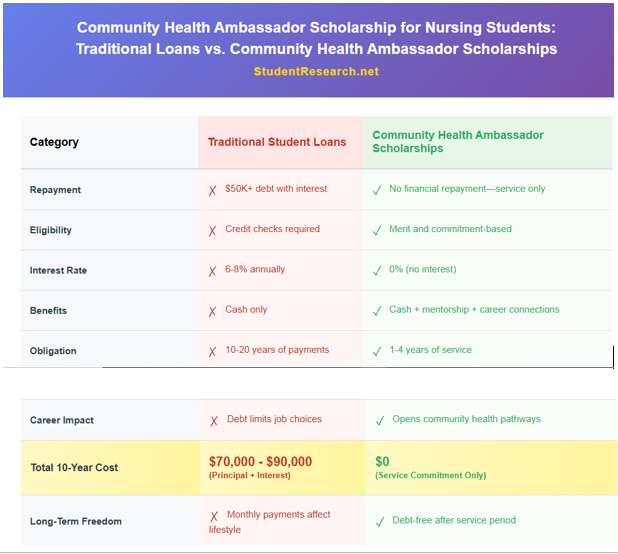
The financial and professional rewards of community health ambassador scholarships extend far beyond basic tuition coverage, creating comprehensive support systems that set you up for career success.
Financial coverage details you can expect:
- Full or partial tuition coverage ranging from $5,000 to $40,000 annually depending on the program
- Textbook stipends typically covering $500-$1,500 per academic year
- Some programs include living expense stipends of $1,000-$2,000 monthly
- Clinical supplies, uniforms, and equipment allowances
- Conference attendance funding for professional development
- No interest accumulation or credit checks required unlike traditional loans
Professional development opportunities included:
- Structured mentorship from experienced nurses and healthcare leaders
- Access to specialized training in community health, health equity, and cultural competency
- Leadership development workshops and seminars
- Resume-building experience that distinguishes you from other graduates
- Presentation opportunities at health fairs and community events
- Certificate programs in areas like health education or community organizing
Networking and mentorship components:
- Direct connections with healthcare organizations and potential employers
- Alumni networks of former ambassadors in diverse nursing specialties
- Relationships with community leaders and advocacy organizations
- Regular meetings with program coordinators who support your career trajectory
- Peer cohorts providing mutual support throughout your nursing journey
Understanding post-graduation obligations:
- Service commitments typically range from one to four years depending on funding amount
- Some programs require working in underserved areas or community health settings
- Geographic restrictions may apply—often serving the community that funded your education
- Flexibility varies by program; some allow various community health roles while others specify exact placements
- Financial penalties may apply if you cannot fulfill service requirements, though most programs work with you to find suitable alternatives
What Are the Requirements? Understanding Eligibility and How to Apply
What Scholarship Committees Look For: Eligibility Essentials
Understanding eligibility criteria helps you assess your candidacy and prepare a competitive application. While requirements vary by program, most community health ambassador scholarships share common expectations.
Academic benchmarks and realistic GPA expectations:
- Minimum GPA requirements typically range from 2.5 to 3.5 on a 4.0 scale
- Most competitive programs prefer 3.0 or higher, but don’t let a 2.7-2.9 discourage you
- Enrollment status matters: full-time students (12+ credits) usually receive priority
- Must be admitted to or enrolled in an accredited nursing program (BSN, ADN, or accelerated programs)
- Some scholarships target specific nursing degree levels (undergraduate vs. graduate)
- Academic potential and upward grade trends can offset a lower GPA
How community service experience counts:
- Most programs require 20-100 hours of documented volunteer or community service
- Healthcare-related volunteering carries more weight (hospitals, clinics, health fairs)
- Non-medical community service still counts: food banks, tutoring, homeless shelters
- Quality matters more than quantity—sustained commitment to one organization impresses committees
- Leadership roles in service organizations demonstrate initiative
- Recent service (within past 2 years) is more relevant than older experiences
Why leadership and cultural competency matter:
- Programs seek students who can inspire and mobilize communities
- Examples include: student organization officers, volunteer coordinators, team captains, peer mentors
- Cultural competency demonstrates your ability to serve diverse populations effectively
- Language skills (especially Spanish, Mandarin, or other community languages) are highly valued
- Experience working across different cultural, economic, or social groups
- Understanding health disparities and social determinants of health shows readiness for the ambassador role
Understanding geographic and institutional restrictions:
- Many scholarships serve specific states, counties, or metropolitan areas
- Some require you to attend particular nursing schools or university systems
- Rural healthcare scholarships may require service in designated shortage areas
- Urban programs might focus on specific neighborhoods or community health centers
- Residency requirements vary—some need state residency, others don’t
- Check if scholarships prioritize students who plan to remain in the funding community
Common myths about who can’t apply:
- Myth: “I’m a second-degree student, so I don’t qualify” — Many programs welcome career changers
- Myth: “My GPA isn’t perfect” — Holistic reviews consider your entire profile
- Myth: “I don’t have healthcare volunteer experience” — Community service of any kind often qualifies
- Myth: “I’m not a U.S. citizen” — Some programs accept permanent residents and DACA recipients
- Myth: “I already have other scholarships” — Most ambassador scholarships can stack with other aid
Need Expert Help With Your Nursing Essays? StudentResearch.net connects you with Master’s and PhD-qualified writers in your field. Choose specialists who understand your subject—nurses write nursing papers, educators write education assignments. Get matched with true experts today.
How to Apply Successfully: Step-by-Step Strategy
Strategic preparation significantly increases your chances of securing a community health ambassador scholarship. Understanding what’s required and how to present yourself effectively makes all the difference.
What documents you must prepare:
- Official transcripts from all colleges attended (request these early—processing takes 1-2 weeks)
- Completed FAFSA form (Free Application for Federal Student Aid) for most programs
- Two to three letters of recommendation from professors, volunteer supervisors, or healthcare professionals
- Current resume highlighting education, community service, leadership, and relevant healthcare experience
- Personal statement or essay (usually 500-1,000 words)
- Proof of nursing program acceptance or enrollment
- Some programs require additional items: writing samples, health certificates, or background checks
Expert tips on writing a personal statement that wins:
- Open with a compelling story that illustrates your commitment to community health
- Connect your personal experiences to your passion for serving underserved populations
- Be specific about which communities you want to serve and why
- Demonstrate understanding of health disparities and your role in addressing them
- Show how the scholarship aligns with your long-term career goals
- Address any academic weaknesses honestly, focusing on growth and resilience
- Avoid generic statements—committees read hundreds of essays saying “I want to help people”
- Proofread multiple times and have mentors review before submitting
- Stay within word limits—respecting guidelines shows professionalism
What to expect in interviews and how to prepare:
- Not all programs require interviews, but prepare as if yours does
- Common questions: Why community health? Describe a challenging service experience. Where do you see yourself in five years?
- Practice your answers aloud, but avoid sounding scripted or rehearsed
- Research the sponsoring organization thoroughly—know their mission and communities served
- Prepare thoughtful questions about the program, mentorship, and ambassador responsibilities
- Dress professionally even for virtual interviews
- Follow up with thank-you emails within 24 hours
Understanding timelines and key deadlines:
- Most applications open in fall (September-November) for the following academic year
- Deadlines typically fall between December and March
- Start preparing 3-6 months before deadlines to gather materials without stress
- Request recommendation letters at least 4-6 weeks before they’re due
- Some programs have rolling admissions—applying early improves your chances
- Award notifications usually arrive in spring (March-May)
- Create a spreadsheet tracking multiple applications, requirements, and deadlines
Pro tip for tracking multiple applications efficiently:
- Use a master checklist with all requirements across programs
- Set phone reminders for each deadline
- Keep all application materials in one digital folder with consistent naming conventions
- Apply to 5-10 programs to maximize your chances
- Tailor each application to the specific program—avoid copy-paste applications
What Will You Do? Understanding Ambassador Responsibilities and Impact
What Your Role Involves: Duties During Your Studies
Community health ambassador roles vary by program, but all involve meaningful engagement with communities while you develop as a nursing professional. Understanding these commitments helps you prepare for a rewarding but demanding experience.
How community outreach programs work in practice:
- Conducting health screenings at community centers, churches, schools, or mobile clinics
- Providing basic health education on topics like diabetes management, hypertension, nutrition, and preventive care
- Participating in vaccination drives and immunization campaigns
- Door-to-door outreach in underserved neighborhoods to connect residents with healthcare resources
- Organizing or staffing health fairs that offer free screenings and health information
- Creating culturally appropriate health education materials in multiple languages
- Real example: Monthly blood pressure clinics at senior centers where you screen residents and provide lifestyle counseling
What health education initiatives look like:
- Leading workshops on chronic disease management for community groups
- Teaching CPR and first aid classes to schools, churches, or community organizations
- Developing and presenting age-appropriate health curricula for youth programs
- Creating social media campaigns about health topics relevant to your community
- Facilitating support groups for conditions like diabetes, obesity, or mental health
- Translating complex medical information into accessible, culturally sensitive content
- Addressing health literacy gaps through one-on-one patient education
- Example initiatives: Teen pregnancy prevention workshops, smoking cessation groups, maternal health classes
Understanding collaboration with local health organizations:
- Partnering with community health centers, free clinics, and federally qualified health centers (FQHCs)
- Working alongside public health departments on disease surveillance and health promotion
- Coordinating with schools for student health initiatives and school-based clinics
- Collaborating with faith-based organizations that serve as trusted community anchors
- Supporting non-profits focused on specific populations: homeless services, refugee assistance, senior programs
- Attending coalition meetings with diverse stakeholders addressing community health priorities
- Building relationships with local leaders, advocates, and grassroots organizations
- These partnerships provide networking opportunities and expose you to various healthcare career paths
Time reality check—weekly and monthly commitment expectations:
- Typical requirement: 5-15 hours per week during the academic year
- Some programs require monthly minimums (20-40 hours per month) rather than weekly
- Intensity may increase during school breaks when you can dedicate more time
- Summer commitments might involve full-time (40 hours/week) immersion experiences
- Expect flexibility around exams and major nursing school deadlines
- Most programs work with your school schedule—communicate your availability clearly
- Track your hours diligently using logs or apps provided by the program
- Peak commitment periods: health fairs, community events, vaccination campaigns
How to balance ambassador duties with coursework:
- Treat ambassador hours like clinical rotations—non-negotiable but manageable
- Integrate community health projects into nursing school assignments when possible
- Use time management tools: digital calendars, weekly planning sessions, priority matrices
- Communicate with faculty advisors about your scholarship commitments—many are supportive
- Connect with fellow ambassadors to share strategies and moral support
- Remember that community work enhances your nursing skills rather than competing with studies
- Self-care is essential: maintain sleep, nutrition, exercise, and stress management routines
- Many successful ambassadors report that community work energizes rather than drains them
Why This Matters: How the Experience Transforms Your Career
The community health ambassador experience provides advantages that extend far beyond debt-free education, shaping you into a more competitive and fulfilled nursing professional.
What career pathways open up specifically:
- Public health nursing roles in local, state, or federal health departments
- Community health center positions with organizations like Planned Parenthood, migrant health centers, or FQHC networks
- School nursing positions requiring strong health education and community engagement skills
- Case management roles coordinating care for vulnerable populations
- Nurse navigator positions helping patients access resources and overcome healthcare barriers
- Leadership opportunities in health equity initiatives at hospitals and health systems
- Global health nursing with organizations working in underserved international communities
- Advanced practice roles focusing on underserved populations (family nurse practitioners in community clinics)
- Many sponsoring organizations offer preferential hiring to their scholarship recipients
How you build cultural competence and health equity skills employers want:
- Direct experience working with diverse racial, ethnic, linguistic, and socioeconomic communities
- Understanding how poverty, housing instability, food insecurity, and discrimination affect health outcomes
- Developing communication skills for patients with limited English proficiency
- Learning to provide trauma-informed care for populations experiencing violence, addiction, or homelessness
- Gaining competency in addressing implicit bias and health inequities in healthcare delivery
- These skills are increasingly required in job descriptions across all nursing specialties
- Cultural competence certifications obtained through ambassador programs boost your resume
- Employers prioritize candidates who can serve their diverse patient populations effectively
Understanding the community relationships and networks you’ll create:
- You become a known, trusted face in the communities you serve
- Relationships with community health workers, promotoras, and patient navigators
- Connections with healthcare administrators who may become future employers or references
- Mentors who guide your career trajectory long after the scholarship ends
- Fellow ambassadors who form a professional support network throughout your career
- Community members who share their stories, teaching you invaluable lessons about resilience
- These relationships provide job opportunities, collaborations, and lifelong friendships
Conclusion
You’ve now discovered how community health ambassador scholarship for nursing students covers tuition through service, explored eligibility requirements, understood the benefits, and learned application tips. Now it’s time to transform this knowledge into action that can reshape your nursing education journey.
Final thought—understanding your role in community-centered nursing’s future:
- Healthcare is shifting from hospital-centered to community-centered models
- Social determinants of health are now recognized as crucial to patient outcomes
- Nurses with community health expertise will lead this transformation
- Your decision to pursue this scholarship positions you at the forefront of nursing’s evolution
- The communities you’ll serve need you—your unique background, perspective, and commitment
- Debt-free education is just the beginning; the relationships, skills, and purpose you gain will define your career
The path to becoming a community health ambassador begins with a single step: deciding that your nursing career will be defined not just by clinical excellence, but by commitment to the communities that need you most. Take that step today.
Scholarship Deadline Tomorrow? StudentResearch.net guarantees on-time delivery, even with 6-12 hour turnaround options. Never miss another submission deadline. Reliable, fast, and stress-free—we deliver when you need it most. Submit with confidence every single time.

