

Have you ever walked into a hospital for the first time as a nursing student and felt completely overwhelmed — not knowing where to go, who to ask, or what was expected of you? You are not alone. Navigating clinical sites for nursing students is one of the most critical — and most misunderstood — parts of nursing education. This blog unpacks 21 proven, comprehensive strategies to help you maximize every placement, build confidence, and graduate ready to thrive.
Clinical training separates theoretical knowledge from real-world nursing competence, and the environments where students train matter enormously. Whether you are entering your first pediatric ward, your first ICU rotation, or a community health clinic, this guide covers everything you need to succeed. By the end, you will understand not just where to train, but how to extract maximum value from every nursing clinical placement site you encounter.
Understanding Clinical Sites for Nursing Students
#1 — What Are Clinical Sites for Nursing Students and Why Do They Matter?
Clinical placement sites are partner healthcare facilities — hospitals, clinics, community centers, and specialty units — where student nurses complete supervised, hands-on training as part of their accredited curriculum. These environments are central to developing the clinical judgment, technical skills, and interpersonal communication that textbooks simply cannot replicate. Understanding their structure and purpose is the first step to performing well in them.
Types of Nursing Clinical Placement Sites
- Acute care hospitals — large teaching hospitals with diverse patient populations
- Community health centers — focus on preventive care and underserved populations
- Long-term care facilities — nursing homes and rehabilitation centers
- Specialty clinics — oncology, cardiology, pediatrics, women’s health
- Mental health and psychiatric units — behavioral and psychological care settings
- School and occupational health sites — non-traditional but growing placement options
Key Roles at a Clinical Placement Site
- Clinical preceptor — a licensed nurse who directly mentors the student
- Clinical coordinator — manages scheduling and site logistics
- Faculty clinical supervisor — bridges the academic institution and the site
- Charge nurse — oversees daily operations and patient assignments
- Interdisciplinary team members — physicians, PTs, pharmacists who enhance student learning
The Landscape of Nursing Clinical Training Environments
#2 — Exploring the Full Spectrum of Nursing Student Training Environments
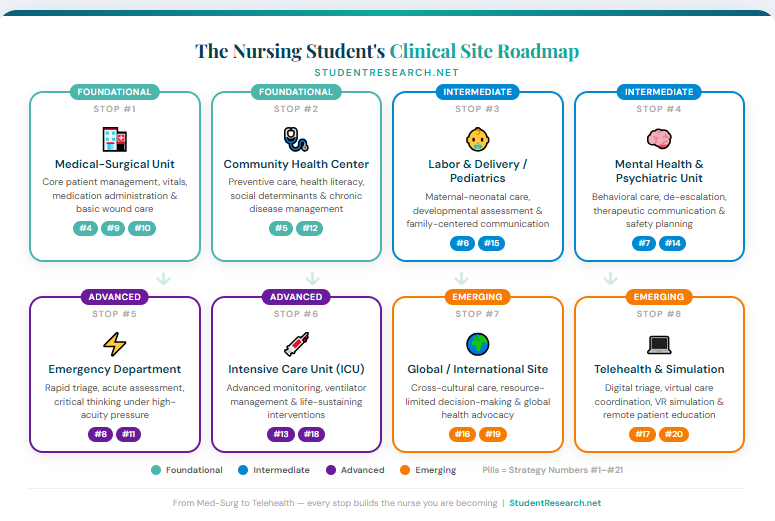
Not all clinical sites for nursing students offer the same learning opportunities, and understanding the landscape helps students and educators alike make strategic placement decisions. From urban trauma centers to rural primary care clinics, the range of available environments is broader than most students realize. Student research shows that diverse placement experiences consistently correlate with stronger NCLEX pass rates and higher employer satisfaction.
Hospital-Based Clinical Sites
- Emergency Departments (ED) — fast-paced triage, acute assessment, and critical thinking
- Medical-Surgical units — foundational clinical skills and patient management
- Intensive Care Units (ICU/NICU/PICU) — advanced monitoring and life-sustaining interventions
- Labor and Delivery (L&D) — maternal and neonatal nursing care
Community and Outpatient Clinical Placement Sites
- Federally Qualified Health Centers (FQHCs) — serve low-income and uninsured populations
- School health programs — pediatric and adolescent primary care
- Telehealth and virtual clinics — an emerging and increasingly accepted placement option
- Home health agencies — independent patient assessment in non-clinical settings
Statistics on Clinical Site Availability and Student Demand
#3 — Current Statistics on Clinical Placement Sites for Nursing Students
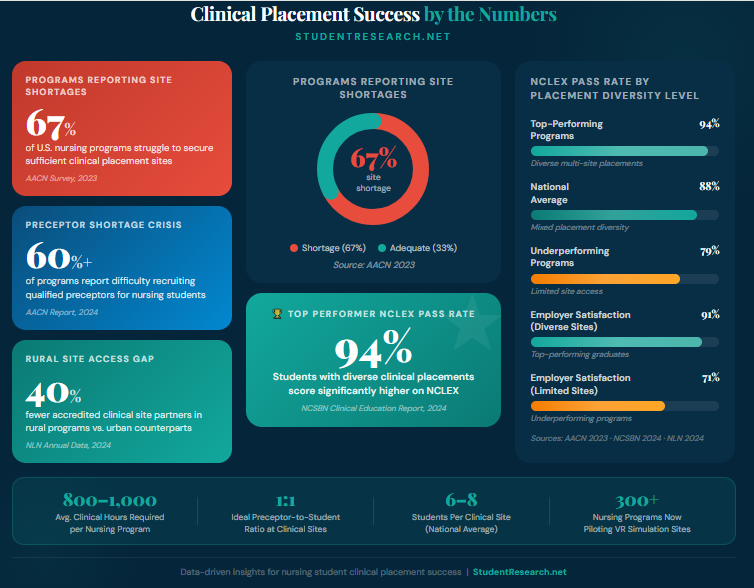
The shortage of available clinical placement sites is a growing national crisis that directly impacts nursing workforce pipelines. Understanding the data behind site availability, preceptor ratios, and placement outcomes helps both students and programs advocate more effectively. The numbers below reflect the most current landscape of nursing clinical training sites across the United States.
Comparative Statistics Table — Clinical Site Access and Outcomes
| Metric | National Average | Top-Performing Programs | Underperforming Programs |
|---|---|---|---|
| Students per clinical site | 6–8 students | 4–5 students | 10–12 students |
| Average clinical hours required | 800–1,000 hrs | 1,000+ hrs | 600–750 hrs |
| Programs reporting site shortages | 67% | 22% | 89% |
| NCLEX pass rate (diverse placements) | 88% | 94% | 79% |
| Employer satisfaction (diverse sites) | 82% | 91% | 71% |
| Preceptor-to-student ratio (ideal) | 1:1 | 1:1 | 1:3+ |
Sources: AACN 2023 Survey, NCSBN 2024 Clinical Education Report, NLN Annual Data Report 2024
Two-Column Comparison — Hospital vs. Community Clinical Sites
| Feature | Hospital-Based Sites | Community-Based Sites |
|---|---|---|
| Patient acuity | High | Low to Moderate |
| Skill exposure | Procedural and technical | Holistic and preventive |
| Preceptor availability | Often strained | More 1:1 time |
| Student stress levels | Higher | Moderate |
| Cultural competence training | Moderate | High |
| Scheduling flexibility | Rigid shift-based | More variable |
How to Find and Secure the Best Clinical Placement Sites
#4 — Proven Strategies #4–#8 for Finding Top Nursing Clinical Placement Sites
Securing a high-quality clinical site as a nursing student is increasingly competitive, and a proactive, organized approach dramatically improves outcomes. Many students passively wait for their school to assign placements, not realizing they often have more agency than they think. Student research on placement satisfaction reveals that students who actively engage in the site selection process report significantly higher learning outcomes.
#4 — Networking to Unlock Hidden Clinical Site Opportunities
- Attend nursing career fairs and introduce yourself to facility recruiters
- Connect with alumni nurses currently working in facilities you admire
- Join the Student Nurses Association (SNA) for referral networks
- Follow hospitals and health systems on LinkedIn for partnership announcements
#5 — Working With Your School’s Clinical Placement Coordinator
- Schedule early appointments — site slots fill months in advance
- Communicate your specialty interests clearly and in writing
- Ask about partnership agreements your school already holds
- Request feedback on your file to address any gaps before submission
#6 — Preparing a Student Clinical Portfolio
- Include current immunization records, CPR certification, and background check clearances
- Attach academic transcripts and any honors or recognitions
- Write a brief personal statement expressing your clinical goals
- Keep everything in a professional digital format (PDF portfolio)
#7 — Leveraging Simulation Centers as Supplemental Sites
- High-fidelity simulation labs are increasingly recognized alongside traditional nursing training facilities
- Simulation hours count toward clinical requirements in many states post-2022
- Virtual reality (VR) platforms are being piloted at over 300 nursing programs nationally
- Use simulation to build confidence before entering high-acuity hospital environments
#8 — Understanding State and Accreditation Requirements for Clinical Hours
- Review your state Board of Nursing (BON) minimum clinical hour mandates
- Verify that your placement site is approved by your program’s accrediting body (ACEN/CCNE)
- Understand that international clinical experiences may require additional documentation
- Track hours meticulously using a clinical log approved by your institution
Maximizing Learning at Your Nursing Clinical Site
#5 — Strategies #9–#13: How to Excel at Any Nursing Student Clinical Site
Showing up to a clinical site for nursing students is only the beginning — what you do with your time there determines everything. Students who approach each shift with clear learning objectives, proactive communication, and reflective practice consistently outperform their peers. Student research in clinical education confirms that intentional engagement during placement is the single strongest predictor of clinical competency development.
#9 — Setting SMART Learning Objectives for Each Rotation
- Specific — “I will perform three IV insertions this week with supervision”
- Measurable — track completions in your clinical log
- Achievable — calibrate goals to your current skill level
- Relevant — align with your current course learning outcomes
- Time-bound — set weekly and rotation-level milestones
#10 — Building a Productive Relationship With Your Preceptor
- Arrive 10–15 minutes early and introduce yourself to the oncoming shift
- Ask your preceptor their preferred communication and feedback style
- Request brief daily debriefs to review what went well and what to improve
- Express gratitude consistently — preceptors are volunteering their expertise
#11 — Clinical Documentation Skills That Impress Site Supervisors
- Learn the facility’s EHR system (Epic, Cerner, Meditech) before your first shift if possible
- Observe documentation patterns before attempting independent entries
- Always clarify documentation permissions with your preceptor
- Practice SBAR (Situation, Background, Assessment, Recommendation) for handoff reports
#12 — Developing Cultural Competence Across Diverse Clinical Sites
- Approach every patient interaction with cultural humility, not assumption
- Use facility-approved interpretation services — never rely on family members as interpreters
- Reflect on how social determinants of health shape your patients’ experiences
- Ask your preceptor how the unit addresses health equity in daily practice
#13 — Managing Clinical Fatigue and Student Burnout at Placement Sites
- Prioritize sleep — clinical shifts require peak cognitive performance
- Debrief emotionally after difficult patient encounters with peers or counselors
- Identify early warning signs of compassion fatigue
- Use your school’s student wellness resources proactively, not reactively
Drowning in nursing assignments while juggling clinical rotations? StudentResearch.net delivers expertly crafted, plagiarism-free academic papers tailored for nursing students. Reclaim your time, ace your coursework, and focus on what matters most — your patients.
Specialty Clinical Sites and Emerging Placement Opportunities
#6 — Strategies #14–#17: Specialty and Non-Traditional Nursing Training Sites
Beyond traditional hospital floors, a growing number of specialty and non-traditional clinical sites for nursing students are transforming how future nurses develop competencies. Programs that expose students to correctional health, military settings, and global health placements produce graduates with exceptional adaptability. Student research on specialty placement outcomes shows that students with at least one non-traditional site experience report 30% higher confidence in independent clinical decision-making.
H3: #14 — Correctional and Justice-Involved Health Facilities
- Unique population requiring de-escalation and non-judgmental care skills
- Exposure to chronic disease management in resource-limited settings
- Builds resilience and adaptability under pressure
- Growing demand for nurses trained in correctional healthcare settings
#15 — Pediatric and School-Based Clinical Placement Sites
- Developmental assessment from neonatal through adolescent stages
- Vaccination programs, mental health screening, and chronic disease management
- High family engagement and health literacy education components
- Excellent preparation for community and public health nursing roles
#16 — Global and International Clinical Site Experiences
- Builds cross-cultural communication and resource-limited critical thinking
- Requires additional institutional approvals, health clearances, and travel documentation
- Many programs partner with NGOs for structured international placements
- Increasingly valued by graduate nursing programs and global health employers
#17 — Telehealth as an Emerging Clinical Placement Site
- Post-pandemic recognition of telehealth as a legitimate clinical environment
- Students practice health history, triage, and care coordination remotely
- Requires digital literacy and strong verbal communication skills
- Growing regulatory acceptance across state nursing boards since 2021
Challenges Facing Clinical Sites for Nursing Students and Solutions
#7 — Strategies #18–#20: Overcoming the Biggest Barriers at Nursing Clinical Sites
Clinical placement sites across the United States are under significant pressure, with preceptor shortages, limited site capacity, and post-pandemic restructuring creating real obstacles for nursing students. These challenges are not insurmountable, but they require informed, collaborative responses from students, educators, and healthcare institutions alike. Understanding these barriers — and the solutions being implemented — helps students navigate the current landscape with greater confidence.
#18 — The Preceptor Shortage Crisis and What Students Can Do
- Over 60% of U.S. nursing programs report difficulty securing adequate preceptors (AACN 2024)
- Students can volunteer to co-coordinate preceptor appreciation events at their school
- Advocate for your program to offer CEU credits or tuition benefits to preceptor nurses
- Be the student preceptors want to teach — prepared, grateful, and engaged
#19 — Geographic Inequity in Clinical Site Access
- Rural nursing programs average 40% fewer accredited clinical site partners than urban programs
- Distance learning programs increasingly use local site agreements to address this gap
- Mobile simulation units are being piloted in underserved regions
- Students in rural areas should explore regional health system partnerships proactively
#20 — Navigating Clinical Site Cancellations and Last-Minute Changes
- Always maintain a backup list of approved alternative sites through your coordinator
- Keep all personal compliance documents current so rescheduling is seamless
- Develop flexibility as a professional competency — employers notice this disposition
- Communicate placement disruptions to your academic advisor immediately and in writing
Struggling to balance clinical hours with research papers and care plans? Let StudentResearch.net handle the writing pressure. Our nursing-specialist writers deliver accurate, timely, and high-quality academic work — so your grades never suffer while you train.
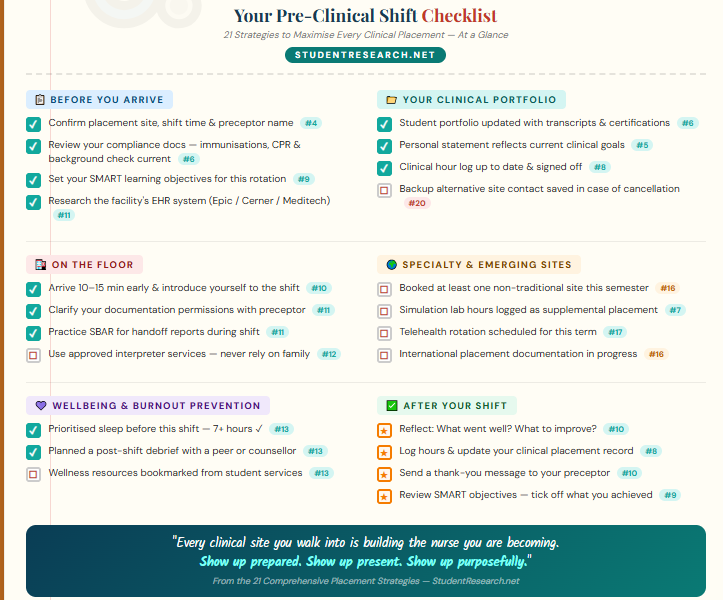
Conclusion — Your Roadmap to Clinical Placement Success
#21 — Conclusion: Making the Most of Clinical Sites for Nursing Students
Discover clinical sites for nursing students, placement tips, and 21 strategies to maximize your hands-on training and launch a thriving nursing career — and that discovery begins the moment you commit to approaching every rotation with purpose, preparation, and professional intentionality. Clinical training is not a box to check on the way to your nursing license; it is the crucible in which a competent, compassionate nurse is forged. Every ward you walk into, every patient whose hand you hold, and every skill you practice under supervision is building the practitioner you are becoming.
From understanding the types of available nursing student clinical training environments, to navigating preceptor relationships, specialty placements, telehealth sites, and geographic barriers, these 21 strategies give you a comprehensive roadmap. Student research consistently confirms that nursing graduates who engaged deeply and intentionally with their clinical sites outperform their peers in licensure examinations, employer evaluations, and long-term career satisfaction. The clinical site is not just a requirement — it is your most powerful classroom

