

The journey through nursing school—balancing didactic coursework, high-pressure exams, and rigorous, irregular clinical rotations—can feel less like a curriculum and more like an unrelenting chaos engine. The sheer volume of information, coupled with demanding on-the-floor training, quickly overwhelms generic organizational systems. This intense, multi-faceted schedule is why the single most crucial tool for academic success isn’t another textbook or flashcard deck, but finding the best planners for nursing students. This article is the culmination of extensive student research, analyzing what truly differentiates a helpful organizer from one that fails the moment clinical rotations begin. We’re moving beyond basic calendars to explore the 10 proven tools—both paper and digital—that provide dedicated sections for skills check-offs, patient report organization, and integrated study schedules. Through meticulous student research, we’ve identified the essential features that help you manage the unpredictable nature of healthcare training, ensuring you not only survive the program but succeed in mastering the demands of your schedule.
Why Traditional Planning Fails
A standard academic calendar or a generic weekly planner, while useful for other majors, often fails spectacularly when confronted with the reality of nursing school. The primary issue stems from the fact that nursing curricula operate on two parallel, often conflicting, tracks: the predictable rhythm of classroom lectures and the highly unpredictable schedule of clinical placements. Without a system designed to handle this dual reality—where a 12-hour hospital shift instantly nullifies your typical study day—you risk double-booking, missing critical deadlines, and, worst of all, suffering from burnout. A specialized planner is essential because it is built to manage these unique complexities from the ground up.
Understanding the Unique Scheduling Challenges for Nursing Students
The scheduling demands of clinicals require flexibility and foresight that standard student planners simply don’t offer.
When to Study- Scheduling the Irregular Clinical Rotation
- Clinical shifts are typically 8 to 12 hours long, often falling on non-traditional days (including weekends, evenings, or holidays).
- You need a planner layout that allows you to clearly mark these long, physically draining shifts and then strategically allocate recovery and study time around them.
- Knowing when to start reviewing pre-clinical patient notes versus post-clinical reflection is crucial for efficiency.
Integrating Didactic (Class) Study Blocks
- Lectures provide the foundational theory, but effective student research requires dedicated, uninterrupted blocks of review time.
- A good planner helps you visually separate “lecture time” from “deep study time” for pharmacology, pathophysiology, and skills review.
Tracking Skills Check-Offs and Simulation Dates
- These are high-stakes, pass/fail events that require dedicated preparation time and cannot be missed.
- Your planner must have specialized checklist sections to track mandatory requirements and practice hours before your official performance assessment.
- Worry about academic integrity? Every paper is custom-written from scratch, guaranteed 100% original. We include a full plagiarism report with every order. Secure your grade with confidence at StudentResearch.net today
The Benefits of Dedicated Time Blocking for Anti-Burnout
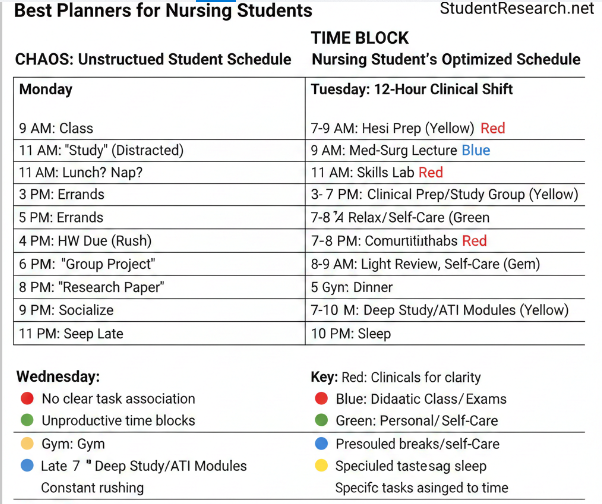
Time blocking is the most effective way to protect your mental health and prevent the chronic stress associated with nursing school.
Preventing Over-Commitment and Procrastination
- By assigning specific tasks to specific time slots, you eliminate decision fatigue and reduce the urge to procrastinate on large assignments.
- Visually seeing when you are heavily scheduled helps you confidently decline commitments that would lead to exhaustion.
How to Create Non-Negotiable Self-Care Slots
- Use the planner to block out “recovery” or “life” time just as firmly as you block out clinicals.
- This is the actionable step for scheduling exercise, meals, sleep, and social activities—making them non-negotiable appointments with yourself.
What Makes a Planner “Nursing-Ready”? –The Essential Features
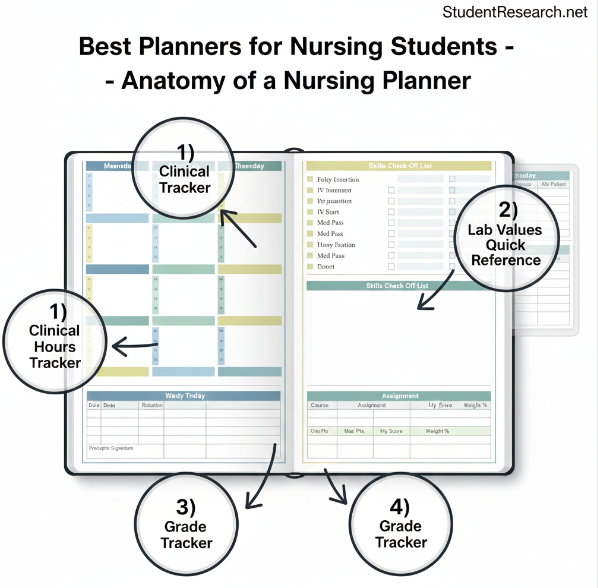
Before diving into the specific tools, it’s vital to understand the structural differences between a generic academic planner and one tailor-made for healthcare students. A “nursing-ready” planner goes beyond simple dates; it incorporates dedicated space for the unique data points and documentation required in clinical settings. When evaluating any planner—paper or digital—you must look for these specific layout and tracking features to ensure it can keep up with the demands of your program.
Types of Specialized Scheduling Views
The ability to switch perspective from a month-long overview to an hourly breakdown is necessary for managing two distinct types of schedules.
Monthly “Big Picture” Spread
For visualizing all major exams, papers, and clinical blocks.
- Allows you to see conflict points months in advance, such as two major exams scheduled a day after a difficult clinical rotation.
- Essential for long-term project and paper planning.
Weekly Vertical/Hourly Layout:
Necessary for detailed time blocking.
- Vertical layouts are best for the nursing student, as they allow for precise hourly tracking of classes, study sessions, and clinical duties.
- Look for time slots that extend past the standard 5 PM to accommodate late study sessions or evening clinical shifts.
Examples of Critical Dedicated Tracking Sections
These specialized pages are what truly elevate a nursing planner above a standard commercial option.
- Assignment and Grade Trackers:
To log scores and calculate progress.
- This section helps you visualize your running average and identify which courses need more dedicated study time.
- How to effectively manage a course load of up to six or seven classes simultaneously requires this centralized data.
Deadline crushing you? We specialize in rush orders and high-stakes papers. Our guarantee is simple: we deliver on time, every time, so you never miss a submission. Get reliable help now at StudentResearch.net.
How to Log Clinical Hours and Patient Observations
- Many programs require logging a certain number of clinical hours and documenting specific patient experiences.
- A dedicated page simplifies the tracking of hours, specific procedures performed, and reflective practice notes.
Quick-Reference Nursing Cheat Sheets Explained
Having essential data immediately accessible saves valuable time that would otherwise be spent searching online.
Integrated Lab Values and Pharmacology Guides
- Look for pages that include normal adult lab values (e.g., Sodium, Potassium) and common drug classifications.
- These are invaluable for quick pre-clinical review without opening a textbook.
Space for Important Faculty Contact Information
- Centralizing contact details for professors, clinical instructors, and lab staff ensures you can address issues quickly and professionally.
Which Paper Planner Option is Best for Student Nurses?
For students who prefer the tactile experience of writing and the proven memory retention benefits of pen and paper, these four tools stand out as the most reliable choices for a nursing curriculum. They are categorized by whether they are explicitly designed for nursing or are highly customizable academic options.
Dedicated Nursing Planners Explained
These options are created by current or former nurses and are specifically structured to handle clinical and class duality.
#1 The Complete Nursing School Planner (NurseInTheMaking):
- Highlighting its integrated study tips.
- Key Feature: Includes dedicated pages for patient care plans, pathophysiology notes, and a pharmacology review section.
- Why it Works: It anticipates the documents and data points you need for clinical paperwork.
#2 Nursing School Study Planner (Level Up RN):
- Focusing on its structure by nurse educators.
- Key Feature: Often includes a “Brain Sheet” template section, which is critical for organizing shift reports and patient data in a high-pressure environment.
- Why it Works: Its structure encourages organized information intake during class and clinical.
Highly Customizable Academic Planners
These planners are versatile and offer flexible layouts that can be adapted to the nursing school schedule with a little personalization.
#3 The Erin Condren LifePlanner:
- Discussing customization options (layouts, size).
- Key Feature: Offers vertical, hourly layouts and numerous accessories (stickers, tabs) to customize color-coding systems for classes vs. clinicals.
- Why it Works: The high level of customization allows you to create the exact format needed for your specific program requirements.
#4 The Passion Planner:
- Highlighting its holistic goal-setting and hourly breakdown.
- Key Feature: Features a “Good Things That Happened” section and dedicated space for personal and professional goals (GameChanger).
- Why it Works: Excellent for holistic anti-burnout planning, forcing the student to schedule self-care alongside academic tasks.
A Guide to the Best Digital Planning Solutions for Nursing School
Digital planning solutions offer unmatched portability, searchability, and the flexibility of unlimited paper replacement, making them ideal for the busy student who carries a tablet or laptop everywhere. Digital tools excel at group collaboration and real-time reminders, which are essential for staying synchronized with study groups and clinical rotation changes.
Digital Planner Applications for Tablets
These apps allow you to import and annotate digital planner templates, blending the feel of paper with digital efficiency.
: #5 GoodNotes:
- How to use the app for unlimited templates and digital planning.
- Benefit: Allows users to handwrite notes and schedules on digital templates, which retains the memory benefits of writing while keeping everything backed up to the cloud.
: #6 Notability:
- How to use the app for annotation and note-taking integration.
- Benefit: Known for its superb audio recording linked to handwritten notes, ideal for capturing every detail during rapid-fire pharmacology lectures.
: #7 Notion:
- Understanding this tool for complex documentation and knowledge management.
- Benefit: Functions as an all-in-one database for tracking grades, assignments, reading materials, and even creating a searchable index of study notes.
#8 Trello:
- Using this tool for group project management and visual organization.
- Benefit: The ultimate tool for collaborative assignments, allowing study groups to visualize progress on large projects using Kanban boards.
Calendar Tools for Real-Time Syncing
For pure scheduling and reminder functionality, cloud-based calendars are essential for any nursing student.
#9 Google Calendar:
- The benefits of cloud syncing and notification reminders.
- Benefit: Instantly shares schedules with study partners and sends multiple automated reminders, making missed deadlines nearly impossible.
#10 Outlook Calendar:
- Integrating with school-provided email/scheduling systems.
- Benefit: Often integrates seamlessly with university email and LMS platforms, automatically populating lecture times and official appointments.
Hybrid Approach: Combining Physical and Digital Planning
- Use a digital calendar (#9 or #10) for reminders and official appointments, but rely on a paper planner (#1–#4) for detailed time blocking and reflection.
Need help at 3 AM? Our writers and support team are available 24/7, across all time zones, for urgent consultations, questions, and revision requests. Expert support is always awake at StudentResearch.net.
Which is Better for Nurses? – Paper vs. Digital Planners
The perennial debate between physical and digital organization centers on a few key areas: cognitive function, portability, and flexibility. Neither format is inherently “better”; the choice depends entirely on your learning style and specific needs throughout the program. Making the right choice requires weighing the benefits of tactile engagement against the power of real-time syncing and search functionality.
Difference Between Physical and Digital Note-Taking
The method you use to record information has a measurable impact on retention and recall.
Advantages of Writing by Hand (Tactile Memory Retention)
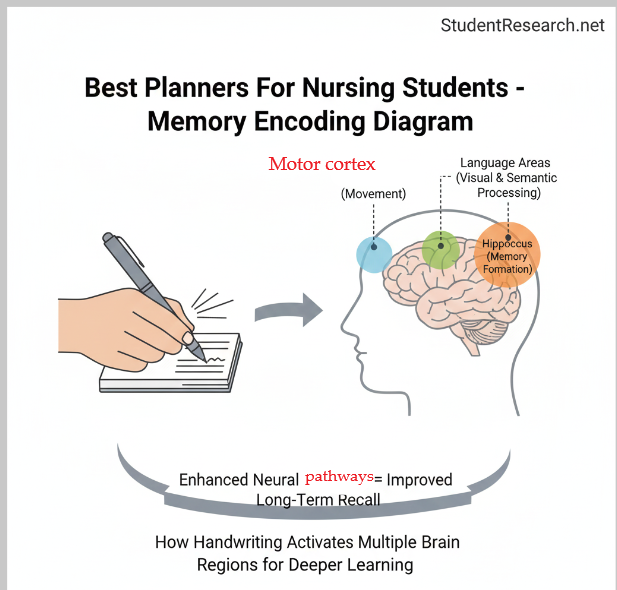
- Studies suggest that the act of physically writing information stimulates deeper encoding in the brain, improving memory of complex concepts like drug names or lab values.
- Paper provides a distraction-free environment crucial for intense study sessions.
The Ease of Correction and Portability of Digital Formats
- Digital notes and schedules can be edited, reorganized, and searched instantly, saving time when looking up a past assignment.
- Cloud backups mean you never have to worry about losing your entire organizational system.
Troubleshooting Planning Obstacles
The most common reason for planner failure is not the planner itself, but inconsistency in use.
Fixing the Issue of Planner Procrastination
- Break down overwhelming tasks (like “Study for Midterm”) into small, time-boxed actions in your planner (e.g., “Review Renal System 7:00-8:00 PM”).
Why Isn’t My Current Planner Working? (Root Cause Analysis)
- Look for signs that your layout is too small, too cumbersome, or too generic to handle the two-track nursing schedule. If it lacks dedicated tracking sections, it’s time to upgrade to one of the 10 tools listed above.
Steps to Maximize Planner Efficiency and Time Management
Once you’ve chosen your tool—be it #1 or #10—the final step is implementing proven systems to extract maximum value from your planning ritual. Two key strategies, color-coding and intentional self-care scheduling, will transform your planner from a mere calendar into a comprehensive productivity tool that actively fights burnout.
How to Color-Code Your Planner for Instant Clarity
A consistent color system allows you to scan a page in seconds and instantly identify urgent priorities or essential categories.
Assigning Specific Colors to Academic, Clinical, and Personal Tasks
- Example System: Use Red for Clinicals/Hospital; Blue for Didactic Classes/Exams; Green for Personal/Social; Yellow for Deep Study/Research.
- This visual organization prevents mixing up a study appointment with a clinical duty.
Using Symbols or Highlighters for Urgency and Priority
- Reserve a single, bright color (like pink) for absolute, non-negotiable deadlines like paper submission or check-off dates.
Steps to Integrate Self-Care and Reflection
This process ensures your planner supports your long-term mental health, not just your grades.
Scheduling Non-Negotiable Downtime and Wellness Activities
- Treat a workout session or a dinner date with friends as an appointment that you cannot cancel, writing it in pen (or digitally blocking it) just like a lecture.
Weekly Reflection and Adjustments (Process-Oriented Learners)
- Take 15 minutes every Sunday night to look back at the week. Note what worked and what didn’t (e.g., “Tried to study immediately after clinical—too tired”).
- Adjust your schedule for the upcoming week based on these observations.
Conclusion
The best planner for nursing students is ultimately the one you commit to daily, transforming your schedule from a source of anxiety into a roadmap for success. We’ve explored the systems and strategies needed for survival in this demanding field. Now, find the best planners for nursing students: 10 proven tools, including digital apps, to flawlessly master clinicals and class work. It’s time to take control of your study schedule and graduate with confidence.

