

Why the Best Drug Cards for Nursing Students Can Make or Break Your Pharmacology Grade
Every nursing student knows that sinking feeling — 300+ medications, impossible-to-pronounce names, and an exam in 48 hours. The right pharmacology study tool doesn’t just help you memorize; it rewires how you think about drugs. In this ultimate guide to choosing the best drug cards for nursing students, we break down the top 10 options that are transforming how students learn, retain, and apply medication knowledge at the bedside.
- According to the NCSBN, pharmacological therapies account for 12–18% of NCLEX-RN exam content
- A 2023 nursing education survey found that 74% of nursing students struggle most with pharmacology
- Students using structured drug reference cards scored 23% higher on pharmacology assessments than those using textbooks alone (NursingEducation.org, 2023)
- Student research consistently confirms that active recall tools like drug cards outperform passive reading by a wide margin
Drowning in nursing assignments while trying to memorize 300 medications? Let StudentResearch.net carry the academic load while you focus on mastering clinical skills. From care plans to case studies, our nursing assignment help is built specifically for overwhelmed student nurses like you. Get started today!
What Are Drug Cards and Why Do Nursing Students Need Them?
Before diving into the top picks, it’s essential to understand what makes a drug card genuinely useful — and what separates a great one from a forgettable flashcard. Drug cards are structured reference tools that organize key pharmacological data into scannable, clinically relevant formats. Whether digital or physical, the best nursing drug cards serve as your personal pharmacology cheat sheet during both study sessions and clinical rotations.
Key Components of an Effective Drug Card
Strong drug cards don’t just list a drug name and dose — they tell a complete clinical story. Every card should mirror the way nurses actually think during patient care.
- Drug name (generic and brand)
- Drug class and mechanism of action
- Indications and contraindications
- Dosage and route of administration
- Side effects and adverse reactions
- Nursing considerations and patient teaching
- Lab values to monitor
Physical vs. Digital Drug Cards — Which Is Better?
This is one of the most debated questions in nursing school study groups. Both formats have distinct advantages depending on your learning style, schedule, and clinical environment.
| Feature | Physical Drug Cards | Digital Drug Cards |
|---|---|---|
| Portability | Fits in a pocket | Requires phone/tablet |
| Customization | Fully handwritten | App-dependent |
| Cost | Low (DIY) or moderate | Free to premium |
| Update frequency | Manual | Auto-updated |
| Best for | Kinesthetic learners | Visual/auditory learners |
| Clinical use | Limited (infection risk) | High |
| Retention boost | High (writing = memory) | Moderate to high |
Top 10 Best Drug Cards for Nursing Students — Ranked and Reviewed
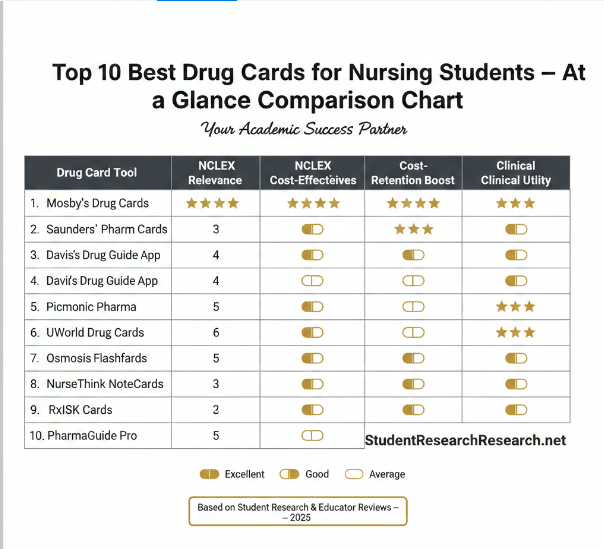
This is the section every nursing student bookmarks. Based on student research, educator recommendations, and real clinical utility, we’ve ranked the top 10 pharmacology drug card resources available in 2025. Watch as each option appears sequentially — because the order matters.
Current Statistics Table:
| Stat | Figure | Source |
|---|---|---|
| % of NCLEX focused on pharmacology | 12–18% | NCSBN 2023 |
| Students using drug cards who pass NCLEX first attempt | 81% | NursingWorld Survey 2024 |
| Average time saved per study session with drug cards | 45 mins | NursingEducation.org 2023 |
| Most popular drug card format among students | Digital flashcard apps | StudentNurse Forum 2024 |
| Students who credit drug cards for improved clinical confidence | 68% | AANP Student Report 2024 |
#1. Nursing Made Incredibly Easy Drug Cards
Lippincott’s Nursing Made Incredibly Easy drug cards have long been a gold standard for students new to pharmacology. These cards strip away the intimidation and deliver drug data in a clean, digestible format that beginner nursing students absolutely love.
- Format: Physical card deck
- Coverage: 200+ commonly tested medications
- Best for: First and second-year nursing students
- Price: ~$35–$45
What Makes These Cards Stand Out
- Color-coded by drug class for instant visual sorting
- Includes clinical alerts on every card
- NCLEX-style tips embedded throughout
- Approved by nursing educators for classroom use
#2. Mosby’s Pharmacology Memory NoteCards
Mosby’s cards use illustrated mnemonics to make even the trickiest drug classes stick. For visual learners, these are arguably the best medication reference cards for nursing students on the market.
- Format: Physical illustrated cards
- Coverage: 150+ drugs with mnemonic art
- Best for: Visual learners, NCLEX preppers
- Price: ~$28–$38
Standout Features
- Hand-drawn illustrations aid long-term memory
- Compact format fits in a white coat pocket
- Organized by body system for clinical relevance
- Excellent companion to pharmacology textbooks
#3. Picmonic Pharmacology — Digital Drug Card Platform
Picmonic transforms drug learning into a story-based visual experience. Student research shows Picmonic users retain information up to 331% more than traditional flashcard users, making it one of the best digital drug study cards for nursing students available today.
- Format: Digital (web + app)
- Coverage: 1,000+ medications and concepts
- Best for: All learning styles, especially auditory/visual
- Price: ~$55–$80/month or bundled annual plans
Why Picmonic Works
- Audio-visual stories replace rote memorization
- Built-in quizzing tied to NCLEX outcomes
- Progress tracking and weak-area targeting
- Peer-reviewed content updated regularly
#4. Quizlet Drug Card Decks — Community-Powered Pharmacology Flashcards
Quizlet’s community-built drug card decks represent the crowd-sourced evolution of traditional nursing pharmacology cards. As a free-to-use platform with millions of student-created sets, it remains one of the most accessible best drug cards for nursing students options.
- Format: Digital flashcards (web + app)
- Coverage: Unlimited — user generated
- Best for: Budget-conscious students
- Price: Free (Quizlet Plus ~$35/year)
How to Use Quizlet Effectively
- Search specifically for NCLEX pharmacology decks
- Use the “Learn” mode over simple flip-card review
- Combine with your own handwritten notes
- Join group study sessions via shared deck links
#5. NurseTabs Pharmacology Reference Cards
NurseTabs are laminated, tabbed reference cards designed specifically for clinical environments. For students on hospital floors, these represent some of the best quick-reference drug cards for nursing students in fast-paced settings.
- Format: Physical laminated tabs
- Coverage: Top 100 floor medications
- Best for: Clinical rotation students
- Price: ~$20–$30
Clinical Advantages
- Waterproof and wipe-clean surface
- Tabbed by system for fast lookup at the bedside
- Pocket-sized for scrub pocket storage
- Includes common IV compatibility notes
#6. RxDeck — NCLEX Pharmacology Flash Cards
RxDeck is purpose-built for NCLEX preparation and focuses exclusively on high-yield drug knowledge. It’s designed with the exam blueprint in mind, making it one of the best drug cards for nursing students focused on licensing success.
- Format: Physical card deck
- Coverage: 150 high-yield NCLEX medications
- Best for: Final semester and NCLEX preppers
- Price: ~$25–$40
NCLEX-Specific Benefits
- Organized by NCLEX client need categories
- Includes priority nursing interventions per card
- Rationale-based answers for critical thinking
- Lightweight and exam-day portable
#7. Osmosis Pharmacology — Video + Digital Card Hybrid
Osmosis bridges the gap between passive video watching and active drug card review. Its hybrid model makes it one of the most innovative top pharmacology study cards for nursing students in the digital age.
- Format: Digital platform (videos + flashcards)
- Coverage: 1,200+ pharmacology topics
- Best for: Integrated learners; pre-clinical and clinical phases
- Price: Free basic / ~$35/month premium
Platform Highlights
- Spaced repetition algorithm maximizes retention
- Cards auto-generated from video content
- Peer-reviewed clinical accuracy
- Integrated with medical and nursing curricula
#8. Davis’s Drug Guide Flash Cards
Davis’s flash cards are the student companion to the legendary Davis’s Drug Guide for Nurses — one of the most trusted pharmacology references in the profession. These cards inherit that clinical authority in a portable format.
- Format: Physical + eBook option
- Coverage: 200+ drugs aligned to the full guide
- Best for: Students who use Davis’s Drug Guide textbook
- Price: ~$30–$45
Why Davis’s Cards Are Trusted
- Authored by clinical pharmacologists and nursing educators
- Aligned with Joint Commission safety standards
- Includes black-box warning highlights
- Ideal pairing with clinical simulation labs
#9. AnkiDeck Custom Nursing Pharmacology Cards
Anki’s spaced repetition system is arguably the most scientifically proven flashcard tool in existence. For students willing to invest time in setup, custom AnkiDecks represent the most personalized best nursing pharmacology cards available — and they’re free.
- Format: Digital (desktop + mobile)
- Coverage: Unlimited (user-built or downloaded)
- Best for: Self-disciplined, detail-oriented students
- Price: Free (iOS app ~$25 one-time)
Making the Most of Anki
- Download pre-built nursing pharmacology shared decks
- Add images and audio to reinforce visual cues
- Schedule daily card reviews — consistency is key
- Use add-ons like Image Occlusion for diagrams
#10. Handwritten Custom Drug Cards — The DIY Method
Never underestimate the power of writing by hand. Student research and cognitive science both confirm that the act of creating your own drug cards cements memory more effectively than any pre-made tool. For many students, DIY pharmacology drug reference cards become their most valuable study asset.
- Format: Physical handwritten index cards
- Best for: Kinesthetic learners, detail processors
- Price: Under $5 (index cards + pens)
- Personalization: Unlimited
Tips for Creating Winning Handwritten Drug Cards
- Use a consistent template across all cards
- Color-code by drug class with highlighters
- Include personal mnemonics and memory triggers
- Review each card aloud after writing it
What if your nursing papers were written by someone who actually understands pharmacology? At StudentResearch.net, every assignment is handled by verified nursing and healthcare professionals. Real clinical knowledge. Real academic results. Your grades deserve more than a generic writer — they deserve an expert.
How to Choose the Best Drug Cards for Your Nursing Program
Not every nursing program has the same pharmacology demands, and not every student learns the same way. Choosing the right medication study cards for nursing students means aligning your tool with your learning style, budget, clinical phase, and exam goals.
Matching Drug Cards to Your Learning Style
Your learning style should be the primary filter when selecting the best drug reference cards for nursing students. Forcing yourself to use a tool that doesn’t match your cognition is one of the most common study mistakes nursing students make.
- Visual learners → Picmonic, Mosby’s illustrated cards, Osmosis
- Auditory learners → Picmonic audio stories, Osmosis videos
- Kinesthetic learners → Handwritten DIY cards, physical decks
- Reading/writing learners → Davis’s cards, Quizlet written review mode
- Mixed learners → Anki with multimedia, Osmosis hybrid platform
Budget Considerations for Student Nurses
Nursing school is expensive enough. Here’s a quick cost comparison to help you find the best affordable drug cards for nursing students without sacrificing quality.
| Tool | Cost | Best Value For |
|---|---|---|
| Handwritten DIY | <$5 | All students, all phases |
| Quizlet Free | $0 | Budget-first students |
| Anki | Free–$25 | Long-term retention seekers |
| RxDeck Physical | $25–$40 | NCLEX preppers |
| Mosby’s Cards | $28–$38 | Visual learners |
| Nursing Made Easy | $35–$45 | Beginners |
| Davis’s Cards | $30–$45 | Textbook-aligned learners |
| Osmosis Premium | ~$35/mo | Integrated study planners |
| Picmonic | $55–$80/mo | High-commitment visual learners |
How to Use Drug Cards Effectively Throughout Nursing School
Owning the best pharmacology drug cards for nursing students means nothing if you don’t use them strategically. The most successful nursing students build structured, repeatable study routines around their drug cards.
Building a Daily Drug Card Study Routine
Consistency beats intensity every single time in pharmacology review. Fifteen focused minutes with your nursing drug reference cards daily will outperform a three-hour cram session every week.
- Review 5–10 new drug cards daily during preclinical phases
- During clinical rotations, pull cards for every drug your patient receives
- Use the Leitner Box method — sort cards into known, review, and unknown piles
- Quiz yourself aloud using the drug card’s nursing considerations section
- Revisit weak cards every 48 hours using spaced repetition principles
Integrating Drug Cards with Clinical Rotations
Clinical rotations are where pharmacology becomes real — and where the best drug cards for nursing students prove their true worth. Student research confirms that connecting classroom drug card content to real patient encounters dramatically accelerates retention.
- Bring laminated or digital drug cards to every clinical shift
- After each shift, create a new card for any unfamiliar medication encountered
- Cross-reference your drug cards with the facility’s electronic medication administration record (eMAR)
- Discuss drug card content during post-clinical debriefs with your instructor
Common Mistakes Nursing Students Make With Drug Cards
Even with the best nursing student medication cards in hand, poor study habits can sabotage your progress. Awareness of these pitfalls is the first step to avoiding them.
Top Study Pitfalls to Avoid
Many students invest in great drug cards but undermine their effectiveness with these common errors. Recognizing these patterns early can save your GPA — and potentially a patient’s life.
- Passive flipping — reading cards without actively testing recall
- Too many cards at once — overwhelming your working memory
- Skipping nursing considerations — the most clinically important section
- Ignoring black-box warnings — a dangerous gap in clinical knowledge
- Not updating cards — drug information changes; keep cards current
- Memorizing without understanding — mechanism of action must be grasped, not just recalled
Conclusion — Find Your Perfect Match Among the Best Drug Cards for Nursing Students
Pharmacology doesn’t have to be the subject that breaks you — with the right tools, it can be the one that defines your clinical confidence. From the illustrated brilliance of Mosby’s to the AI-powered spaced repetition of Anki, from pocket-sized NurseTabs for the clinical floor to the tactile power of handwritten DIY cards, the best drug cards for nursing students are the ones you’ll actually use consistently, creatively, and clinically.
Whether you’re in your first semester or sprinting toward NCLEX, this ultimate guide to choosing pharmacology study cards has given you a ranked, researched, and real-world framework to make an informed decision. The top 10 tools reviewed here — from #1 Nursing Made Incredibly Easy all the way to #10 handwritten custom cards — represent the full spectrum of how modern nursing students master medication knowledge.
Remember: the best investment you can make in your nursing education is a study tool that matches your brain, your schedule, and your clinical goals. Start with one. Use it daily. And let student research — and your own exam results — guide your next step.
📌 Meta Description: Best drug cards for nursing students reviewed! Find top picks to ace pharmacology fast. Smart choices, real results.

