

Are you curious about cutting-edge medical breakthroughs? Do you dream of discovering treatments that save lives? Then you need to explore the transformative opportunities available through an annual biomedical research conference for minority students. These conferences aren’t just academic events—they’re launchpads for your future STEM career. This comprehensive guide will walk you through everything you need to know about finding, attending, and maximizing these life-changing experiences. Whether you’re passionate about student research or just beginning to explore science, this roadmap will help you succeed.
Is an Annual Biomedical Research Conference for Minority Students Right for You?
You might wonder if these conferences are designed for students like you. The answer is yes! An annual biomedical research conference for minority students welcomes aspiring scientists at all experience levels. These events specifically support underrepresented students in STEM fields. You don’t need perfect grades or previous lab experience to participate. Your curiosity about science and willingness to learn matter most. Many students discover their passion for student research through these conferences, launching careers they never imagined possible.
Signs You’re Ready for an Annual Biomedical Research Conference
Getting started with an annual biomedical research conference for minority students is easier than you think. Student research opportunities welcome beginners who show genuine interest and enthusiasm. Consider whether these signs describe you:
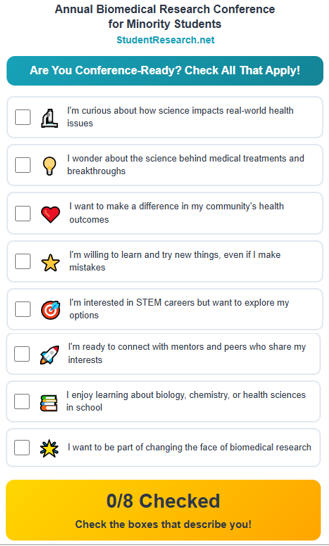
- Curiosity about science: Do you watch medical dramas and wonder about the real science behind treatments?
- Interest in health topics: Are you curious about how vaccines work or why diseases affect different communities?
- No research required: You don’t need previous lab experience or completed projects to attend.
- Passion over perfection: Interest and dedication matter more than maintaining a 4.0 GPA.
- First-generation welcome: These conferences especially support students whose families haven’t attended college.
- Start early: Even freshmen and sophomores can begin exploring conference opportunities and building connections.
- Open to discovery: You don’t need to know your exact career path yet.
Common Myths About Minority High School Students and Research Conferences
Many misconceptions prevent talented students from applying to an annual biomedical research conference for minority students. Understanding the truth about student research expectations helps you move forward confidently. Let’s debunk these harmful myths:
- Myth: You need straight-A grades | Reality: Passion, curiosity, and commitment matter more than perfect test scores.
- Myth: Research requires expensive lab equipment | Reality: Many successful projects use community surveys, field observations, or free online databases.
- Myth: Only seniors can attend | Reality: Start early! Freshmen through seniors are welcome at most conferences.
- Myth: You must know your exact major | Reality: Exploration is encouraged—conferences help you discover interests.
- Myth: Conferences are cutthroat and competitive | Reality: These events foster supportive communities where everyone celebrates your growth.
- Myth: You need connections to participate | Reality: Applications are open to all qualifying students regardless of background.
Real Success Stories from Annual Biomedical Research Conference Participants
Real students just like you have transformed their futures through an annual biomedical research conference for minority students. Their student research journeys began with simple curiosity and determination. These inspiring stories prove that anyone can succeed:
- Maria, first-time researcher: She had never stepped foot in a lab before junior year. Through her school’s science club, she connected with a local university professor. Her community health survey project earned recognition at her first conference. Now she’s studying public health on a full scholarship.
- James, passion discoverer: He attended a conference unsure about his interests. After hearing a neuroscientist’s keynote speech, he discovered his calling. He returned the next year presenting his own brain research.
- Aisha, scholarship winner: Networking at an annual biomedical research conference for minority students connected her with a mentor who recommended her for a prestigious summer program. That experience led to scholarship offers from multiple universities.
- David, future doctor: He started attending conferences as a sophomore. By senior year, he had presented three different projects. Medical schools noticed his dedication—he’s now pursuing his MD/PhD.
- Different starting points, same success: These students came from rural schools, urban districts, wealthy suburbs, and under-resourced communities. What united them was curiosity and willingness to try.
Struggling to master research writing techniques? StudentResearch.net transforms completed assignments into powerful learning tools. Our expertly crafted samples teach you proper citation, structure, and analysis. Learn from Ph.D. specialists while improving your own writing skills. Turn every assignment into a masterclass.
Step-by-Step Guide to Your First Annual Biomedical Research Conference for Minority Students
Now that you understand the possibilities, let’s create your action plan. Preparing for an annual biomedical research conference for minority students requires planning and dedication. Student research develops best with a clear timeline and specific goals. This step-by-step roadmap breaks down what to do and when to do it.
Timeline: 9 Months Before the Annual Biomedical Research Conference
Starting early maximizes your success at an annual biomedical research conference for minority students. These initial months focus on exploration and foundation-building for student research. Follow these essential action steps:
- Identify your scientific interests: Write down three topics that excite you—diseases, environmental health, technology in medicine, genetics, mental health, or public health.
- Research conference options: Search for annual biomedical research conferences for minority students online. Bookmark websites and note application deadlines.
- Connect with potential mentors: Email science teachers, school counselors, or local university professors expressing your interest in student research.
- Join relevant organizations: Participate in school science clubs, STEM programs, or community organizations supporting young researchers.
- Follow conferences on social media: Stay updated on deadlines, tips, and success stories from previous attendees.
- Create a dedicated folder: Organize all conference information, requirements, and contacts in one place for easy access.
Timeline: 6 Months Before – Starting Your Research Project for Minority High School Students
Six months out is the perfect time to launch your student research project. Many annual biomedical research conference for minority students require completed or ongoing research for presentations. Start developing your project systematically:
- Approach mentors professionally: Use email templates to contact researchers. Include your interests, goals, and why their work inspires you.
- Apply to summer research programs: Search Pathways to Science, NIH programs, and university REU opportunities specifically supporting minority high school students.
- Start independent projects: Work with science teachers to design feasible projects using school resources or online tools.
- Explore community-based research: Partner with local health clinics, environmental organizations, or community groups on relevant projects.
- Keep detailed research notes: Document everything from day one—observations, data, questions, and challenges you encounter.
- Learn research databases: Familiarize yourself with PubMed, Google Scholar, and discipline-specific databases for background research.
Timeline: 3 Months Before – Preparing Your Annual Biomedical Research Conference Application
Application time is crucial for an annual biomedical research conference for minority students. Your abstract summarizes your student research in a compelling, concise format. Complete these critical tasks:
- Write your research abstract: Draft a 250-500 word summary including your question, methods, results, and conclusions.
- Follow abstract guidelines carefully: Each conference provides specific formatting requirements—follow them to avoid disqualification.
- Gather required documents: Collect recommendation letters, transcripts, proof of enrollment, and any other requested materials.
- Apply for travel grants simultaneously: Many conferences offer financial assistance—apply as you submit your abstract.
- Get multiple feedback rounds: Ask your mentor, teachers, and peers to review your abstract and suggest improvements.
- Submit before the deadline: Don’t wait until the last day—technical issues happen, so submit at least 48 hours early.
- Avoid common mistakes: Watch for typos, unclear methods, overstated conclusions, and missing required sections.
Drowning in deadlines with multiple assignments due tomorrow? StudentResearch.net delivers quality work on time, every time. Our reliable service handles urgent requests while you focus on other priorities. Meet every deadline without sacrificing quality or losing sleep. Stress-free academic success starts here.
Timeline: 1 Month Before – Final Preparation for Minority High School Students
The final month focuses on presentation and logistics preparation. Success at an annual biomedical research conference for minority students requires professional materials and confident delivery. Handle these essential tasks:
- Design your research poster: Create a visually appealing, easy-to-read poster using templates or PowerPoint (most universities offer free printing).
- Practice your presentation repeatedly: Present to family members, friends, teachers, and anyone willing to listen and provide feedback.
- Finalize travel arrangements: Book flights, arrange hotel accommodations, and plan transportation to the conference venue.
- Prepare professional materials: Print business cards with your name, email, and research interests. Update and print multiple copies of your résumé.
- Research what to expect: Watch YouTube videos of previous conferences. Read blog posts from past attendees to reduce anxiety.
- Pack strategically: Include professional attire, comfortable walking shoes, poster tube, laptop, chargers, snacks, water bottle, and conference materials.
- Review conference schedule: Identify must-attend sessions, workshops, and networking events aligned with your interests.
Worried your research lacks academic depth? StudentResearch.net connects you with Master’s and Ph.D. subject specialists who ensure accurate, well-researched content. Our expert writers deliver university-level quality that meets rigorous academic standards. Experience the difference professional expertise makes in your assignments.
Money Matters – Funding Your Annual Biomedical Research Conference for Minority Students Experience
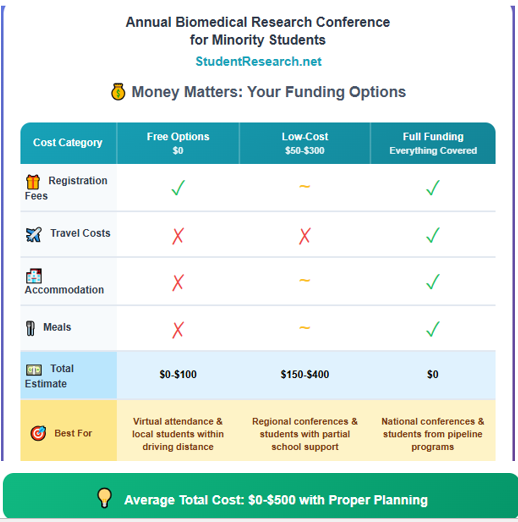
You’ve prepared your research—now let’s address the financial aspects. Many students assume an annual biomedical research conference for minority students is too expensive. However, numerous funding opportunities make student research accessible regardless of your financial situation. Don’t let cost prevent you from participating in these transformative experiences.
Free and Low-Cost Annual Biomedical Research Conference Options
Multiple conferences specifically design affordable access to an annual biomedical research conference for minority students. Understanding these options makes student research participation financially feasible. Explore these accessible opportunities:
- Automatic fee waivers: Many conferences waive registration fees automatically for underrepresented minority students and those demonstrating financial need.
- Regional conference savings: State-level and regional events typically cost $50-100 compared to $200-300 for national conferences.
- Virtual attendance options: Online participation eliminates travel expenses entirely while still providing presentation opportunities and networking.
- School district funding: Many districts maintain STEM travel budgets specifically supporting student research—ask your counselor or principal.
- Pipeline program coverage: Programs like TRIO, GEAR UP, and Upward Bound often cover full conference costs for participating students.
- Specific affordable conferences: ABRCMS offers extensive financial aid. SACNAS provides travel scholarships. Emerging Researchers National Conference prioritizes accessibility for HBCU and HSI students.
Scholarships and Travel Grants for Minority High School Students in STEM
Beyond reduced fees, dedicated funding sources support an annual biomedical research conference for minority students attendance. These scholarships and grants specifically target student research participation. Apply strategically to maximize your funding:
- Conference-specific travel awards: Most major conferences offer competitive travel grants ranging from $500-2,000 covering transportation, lodging, and meals.
- NSF funding opportunities: The National Science Foundation supports STEM diversity initiatives including conference travel for promising young researchers.
- NIH student programs: The National Institutes of Health funds various programs connecting minority high school students with biomedical research conferences.
- Private foundation grants: Organizations like the Gates Foundation, Sloan Foundation, and Hispanic Scholarship Fund provide STEM conference support.
- Corporate sponsorships: Pharmaceutical companies (Pfizer, Johnson & Johnson) and tech companies (Google, Microsoft) fund diversity in STEM initiatives.
- Application success strategies: Write compelling personal statements explaining your research goals, financial need, and how attendance advances your career.
- Typical award amounts: Expect grants covering partial costs ($300-800) or full expenses ($1,500-2,500) depending on travel distance.
- Timeline for applications: Apply for travel grants when submitting your abstract—many conferences review applications simultaneously.
Creative Fundraising for Annual Biomedical Research Conference Attendance
If scholarships don’t cover everything, creative fundraising can bridge the gap. Attending an annual biomedical research conference for minority students is an investment in your future. Your community often wants to support student research when you share your passion. Try these effective fundraising strategies:
- School-based fundraising: Present your opportunity to your principal, PTA, or school foundation—many schools maintain discretionary funds for exceptional opportunities.
- Local business sponsorships: Approach businesses with a professional proposal letter explaining your research, the conference, and how their support impacts your community.
- Community organization support: Service organizations like Rotary Club, Lions Club, Kiwanis, and faith communities often sponsor promising students.
- Online crowdfunding platforms: Create campaigns on GoFundMe or DonorsChoose with a compelling story, clear goals, and regular updates.
- Science competition winnings: Many local, regional, and state science fairs offer cash prizes—use winnings toward conference expenses.
- School counselor connections: Counselors often know about hidden funding sources, alumni donors, or local scholarships specifically for STEM students.
- Sponsorship letter template: Include your biography, research description, conference details, budget breakdown, and clear ask. Keep it to one page.
- Crowdfunding campaign tips: Post photos, videos, and updates. Share across all social media platforms. Thank donors publicly and report outcomes.
What Happens at an Annual Biomedical Research Conference for Minority Students – A Day-by-Day Breakdown
You’ve secured funding and prepared your presentation—now what actually happens? Understanding the typical schedule at an annual biomedical research conference for minority students reduces anxiety significantly. This day-by-day guide demystifies the student research conference experience. Knowing what to expect helps you maximize every moment.
Day 1: Registration and Networking at Your Annual Biomedical Research Conference
Your first day at an annual biomedical research conference for minority students sets the tone for success. These initial hours focus on orientation and making connections for student research. Here’s what typically unfolds:
- Check-in process: Arrive at the registration desk with your confirmation email. Receive your name badge, program guide, poster session assignment, and swag bag.
- Opening ceremony inspiration: Attend the welcome session featuring keynote speakers who share their journeys from students to established scientists.
- Meet-and-greet events: Participate in structured networking activities designed specifically to help minority high school students connect with peers and mentors.
- Exhibit hall exploration: Visit booths from universities, graduate programs, summer research programs, and STEM organizations recruiting diverse talent.
- First night networking strategies: Prepare your 30-second introduction. Ask open-ended questions. Exchange contact information with at least three people.
- Managing nerves and excitement: Remember everyone feels nervous. Focus on learning rather than perfection. Tomorrow’s presentation will feel more manageable after tonight’s connections.
- Making meaningful connections: Seek out other high school students. Introduce yourself to graduate students from your state. Thank speakers who inspired you.
Day 2: Presenting Your Research as a Minority High School Student
Presentation day is the highlight of your annual biomedical research conference for minority students experience. This is when your student research takes center stage. Approach it with confidence and enthusiasm:
- Poster session format: Your assigned time slot typically lasts 2-4 hours. You’ll stand by your poster while attendees visit, ask questions, and learn about your work.
- What judges evaluate: They assess research quality, presentation clarity, your understanding of methods, ability to answer questions, and scientific communication skills.
- Handling questions confidently: Listen carefully. It’s okay to say “I don’t know, but that’s an excellent question I’ll investigate.” Take notes on suggestions.
- Oral presentation tips: If selected for a talk, practice your 10-15 minute presentation dozens of times. Speak slowly and clearly. Make eye contact.
- Peak visiting hours: The first and last hours see the most traffic. Pace your energy by taking short breaks mid-session.
- Managing your energy: Bring water and snacks. Sit during slow periods. Stretch your legs when possible. Don’t feel obligated to stand rigidly for four hours.
- Collecting valuable feedback: Ask visitors for their cards. Request specific suggestions for strengthening your research. Note recurring questions to address in future work.
Day 3: Workshops and Sessions at the Annual Biomedical Research Conference
Day three of an annual biomedical research conference for minority students focuses on professional development and learning. These sessions expand your student research skills and career knowledge. Maximize these valuable learning opportunities:
- Workshop variety: Choose from sessions on career planning, graduate school applications, fellowship opportunities, technical skills (coding, statistical analysis), and laboratory techniques.
- Keynote speakers’ impact: Leading scientists share personal stories including failures, breakthroughs, and advice specifically for minority students navigating STEM careers.
- Breakout sessions by discipline: Attend specialty tracks in neuroscience, cancer biology, public health, genetics, or whatever aligns with your interests.
- Choosing session strategically: Review the program beforehand. Select 3-4 must-attend events. Leave space for spontaneous opportunities and rest.
- Active note-taking: Document key insights, resources mentioned, and action steps. Many presenters share slides or handouts—collect them.
- Networking during breaks: Coffee breaks and lunch provide invaluable informal networking. Join conversations at tables. Ask speakers questions one-on-one.
- Social events importance: Evening gatherings, cultural celebrations, and informal meetups often create the deepest connections. Don’t skip them due to exhaustion—push through!
Day 4: Awards, Closing, and Next Steps for Minority High School Students
The final day of your annual biomedical research conference for minority students celebrates achievements and launches your next chapter. This conclusion of the student research event propels you forward. Finish strong with these activities:
- Award ceremonies: Winners are announced in various categories (best poster, best presentation, outstanding high school researcher). Whether you win or not, celebrate everyone’s achievements.
- Closing keynote inspiration: The final speaker typically delivers a powerful call-to-action motivating continued persistence in STEM despite inevitable obstacles.
- Final networking opportunities: Exchange contact information with new friends, mentors, and recruiters. Make specific plans to stay connected.
- Collecting critical information: Grab business cards from everyone meaningful you met. Photograph posters or presentations that inspired you. Save program guides.
- Reflection and goal-setting: Take 30 minutes to journal about your experience. What inspired you? What did you learn? What will you do differently next time?
- Planning for next year: Discuss with mentors and peers about returning. Identify which conference you’ll target next. Set research goals for the coming year.
- Immediate action items: Send thank-you emails within 48 hours. Connect on LinkedIn. Follow up on specific opportunities mentioned during conversations.
Life-Changing Benefits of Annual Biomedical Research Conferences for Minority Students Beyond the Event
The conference ends, but your journey continues with powerful momentum. Participating in an annual biomedical research conference for minority students creates lasting advantages extending far beyond four days. Student research experience compounds over time, opening doors throughout your academic and professional career. Understanding these long-term benefits motivates continued engagement with the biomedical research community.
How Annual Biomedical Research Conferences Transform College Applications
Your participation in an annual biomedical research conference for minority students significantly strengthens college applications. Admissions officers specifically seek students with genuine student research experience. Leverage this advantage strategically:
- Standing out dramatically: While many applicants list “interested in science,” you demonstrate actual scientific practice, peer review, and professional presentation skills.
- What admissions officers value: They look for intellectual curiosity, resilience through challenges, collaboration skills, and genuine passion beyond coursework.
- Writing compelling essays: Share specific moments—a judge’s challenging question, a connection with a keynote speaker, or a breakthrough understanding during your research.
- Demonstrated STEM interest: Conference participation proves you’ve invested significant time and effort exploring your intended major beyond required classes.
- Honors section boost: List conference presentations, awards received, competitive selection rates, and any publications resulting from your research.
- Connection to intended major: Draw clear lines between your conference experience, current academic interests, and future college major or career goals.
- Conference mentor recommendations: Request letters from researchers or professors you met—their perspective carries weight as external validators of your potential.
- Effective essay angles: Focus on growth, not perfection. Discuss what you learned from challenges, not just achievements. Show how research changed your thinking.
Career Doors Opened by Annual Biomedical Research Conference Participation for Minority High School Students
An annual biomedical research conference for minority students creates career opportunities unavailable through traditional channels. Student research participation signals commitment that recruiters and mentors notice. These tangible benefits materialize surprisingly quickly:
- Direct university recruitment: College representatives attend specifically to identify talented minority students. Many offer on-site application workshops and fee waivers.
- Summer internship offers: Researchers recruiting lab assistants often prefer students they’ve met at conferences over unknown applicants from traditional pools.
- Research lab positions: Faculty members remember impressive presentations. They reach out months or years later with opportunities for promising students.
- Mentorship lasting decades: Connections made at an annual biomedical research conference for minority students often develop into lifelong professional relationships providing guidance at career crossroads.
- Industry connections: Pharmaceutical, biotech, and medical device companies send recruiters identifying future interns and employees years in advance.
- Graduate school pipelines: PhD program directors specifically recruit from these conferences, offering preview weekends, application support, and sometimes guaranteed admission.
- Diverse career pathways: Learn about options beyond traditional careers—MD, PhD, MD/PhD combinations, industry research, science policy, public health, science communication, and more.
- Documented persistence rates: Studies show annual biomedical research conference for minority students participants are 3-4 times more likely to complete STEM degrees and enter biomedical careers.
Personal Growth and Community Building for Minority High School Students in STEM
Beyond tangible career benefits, an annual biomedical research conference for minority students transforms self-perception and identity. Student research participation fundamentally changes how you see yourself and your possibilities. These psychological benefits often matter most:
- Building scientific confidence: You develop the identity “I am a scientist” rather than “I’m interested in science”—a crucial psychological shift.
- Finding your tribe: You meet peers who share your passion, understand your challenges, and celebrate your cultural identity alongside your scientific interests.
- Lifelong friendships: The bonds formed during intense conference experiences often last through college, graduate school, and professional careers.
- Role models who share your background: Seeing successful scientists who look like you, share your cultural heritage, or overcame similar obstacles shatters limiting stereotypes.
- Overcoming imposter syndrome: When surrounded by hundreds of minority students doing impressive research, you realize you absolutely belong in scientific spaces.
- Cultural pride in STEM: You learn to integrate your cultural identity with scientific identity rather than feeling forced to choose between them.
- Leadership development: Many conferences offer opportunities to mentor newer students, serve on advisory boards, or organize local events in your community.
- Mentoring others: As you advance, you become the role model for younger students discovering biomedical research through annual conferences.
- Changed self-perception: You stop viewing obstacles as personal failings and recognize systemic barriers while developing strategies to navigate them successfully.
Top Annual Biomedical Research Conferences for Minority Students to Target
You understand the benefits—now where should you apply? Multiple excellent annual biomedical research conferences for minority students operate nationwide. Each conference offers unique advantages for student research development. Strategic selection ensures you find the best fit for your interests, experience level, and goals.
Must-Attend National Annual Biomedical Research Conferences
Several premier conferences stand out as essential targets for serious student research participants. These flagship annual biomedical research conferences for minority students attract thousands of participants and extensive resources:
- ABRCMS (Annual Biomedical Research Conference for Minority Students): Organized by the American Society for Microbiology, this is the gold standard. Held each November in rotating U.S. cities. Welcomes 5,000+ participants including undergraduate and high school students. Features extensive workshops, hundreds of posters, networking events, and major university recruitment. Registration opens in summer. Apply early for travel grants. Website: www.abrcms.org
- SACNAS National Conference: The Society for Advancement of Chicanos/Hispanics and Native Americans in Science hosts the largest multidisciplinary STEM diversity conference. Typically held in October in major cities. Includes all STEM fields, not just biomedical research. Known for powerful cultural celebrations alongside scientific programming. High school students compete in separate divisions. Extremely welcoming to first-time attendees. Website: www.sacnas.org
- Emerging Researchers National Conference: Specifically designed for students from HBCUs, Hispanic-Serving Institutions, and Tribal Colleges. Usually held in February or March in Washington D.C. or Atlanta. Smaller, more intimate than ABRCMS or SACNAS (1,000-2,000 participants). Excellent for first-time presenters. Strong emphasis on graduate school preparation. Website: www.emerging-researchers.org
- Annual Symposium on STEM Diversity: Features strong representation from minority high school students. Typically held in spring. Focuses on creating pathways from high school through graduate education. Excellent mentoring programs pairing students with professionals.
- Competition levels: ABRCMS is most competitive for awards. SACNAS has highest attendance. Emerging Researchers offers most intimate experience. All welcome beginners.
- Best for first-timers: Start with regional conferences or Emerging Researchers National Conference to build confidence before tackling massive events like ABRCMS or SACNAS.
- Research interest alignment: ABRCMS focuses specifically on biomedical sciences. SACNAS welcomes all STEM disciplines. Choose based on your project type.
Regional and State-Level Annual Biomedical Research Conference Opportunities for Minority High School Students
Before tackling national conferences, consider regional events offering annual biomedical research conference for minority students experience closer to home. These accessible opportunities help you develop student research presentation skills with lower costs and less pressure:
- Northeast Region: Massachusetts Conference for Women in Science and Engineering (open to all genders). New York State Science Congress. Pennsylvania Junior Academy of Science. Connecticut STEM Conference.
- Southeast Region: Florida Science and Technology Conference. Georgia Junior Science and Humanities Symposium. North Carolina STEM Research Symposium. Virginia Student Research Conference.
- Midwest Region: Michigan Student Research Symposium. Illinois Junior Academy of Science. Ohio STEM Learning Network Conference. Wisconsin Science Olympiad Research Division.
- Southwest Region: Texas Science and Engineering Fair. New Mexico STEM Conference. Arizona Student Research Showcase. Oklahoma STEM Symposium.
- West Coast: California State Science Fair (includes research presentations). Washington STEM Education Conference. Oregon Student Research Symposium. Colorado Junior Science and Engineering Fair.
- University-hosted opportunities: Many major universities host undergraduate research conferences allowing exceptional high school students to present alongside college students.
- State science academies: Most states operate junior science academies hosting annual research symposiums specifically for high school students.
- Local advantages: Lower travel costs. Less intimidating environment. Easier to attend with school group. Builds presentation confidence before national stages.
- Resume building: Multiple regional presentations demonstrate sustained research commitment and progressive skill development to college admissions officers.
- Contact information: Search “[Your State] high school research conference” or contact your state’s science teachers association for specific opportunities.
Specialized Annual Biomedical Research Conferences by Interest Area
As your student research interests become more specific, targeted conferences offer deeper networking within specialties. These discipline-specific annual biomedical research conferences for minority students connect you with researchers in your exact field:
- Neuroscience focus: Society for Neuroscience hosts student programming at its annual meeting. The Brain Research Foundation offers youth symposiums.
- Cancer research: American Association for Cancer Research provides high school student programs. National Cancer Institute hosts summer research conferences.
- Public health: American Public Health Association welcomes student presentations. Conference on Health Disparities attracts minority student researchers.
- Environmental health: National Institute of Environmental Health Sciences hosts student events. Society for Environmental Toxicology and Chemistry includes student sessions.
- Computational biology: International Society for Computational Biology runs student groups. Many universities host bioinformatics symposiums welcoming advanced high schoolers.
- Clinical research: Academic Pediatric Association includes trainees. American Medical Association hosts medical student research, occasionally opening to high schoolers.
- Matching projects strategically: Read conference themes carefully. Some prefer basic science while others emphasize translational research or community health applications.
- Discipline-specific organizations: Join student chapters of professional societies in your field. They offer mentoring, resources, and conference opportunities targeted to your specialty.
Conclusion: Your Journey to Biomedical Research Excellence Starts Now
You’ve discovered the transformative power of an annual biomedical research conference for minority students. These events provide far more than just resume builders—they create communities, open career doors, and help you discover your full potential. Now it’s time to take action and launch your student research career with confidence.
Your next steps:
- Start today, not tomorrow: Don’t wait for the “perfect” project or until you feel “ready.” Begin exploring conferences this week. Reach out to one potential mentor today.
- Address your fears directly: Feeling intimidated is normal and expected. Remember that every successful scientist once stood where you stand now—uncertain but curious.
- Reject perfectionism: Waiting for perfect circumstances means missing opportunities. Your first conference won’t be perfect, and that’s completely okay. Growth happens through doing.
- Embrace your unique voice: Science desperately needs YOUR perspective, questions, and approaches. Your cultural background and life experiences create insights others miss.
- Access available resources: Countless people want to support your success—teachers, mentors, program coordinators, and funding organizations. Ask for help. Accept support. You deserve it.
- Share this guide: Forward this resource to friends, classmates, and younger students in your community. We all rise together by lifting others.
Remember, participating in an annual biomedical research conference for minority students isn’t just about your individual success. Every time you present your research, you change someone’s perception of who belongs in science. You’re not just building your own career—you’re transforming the entire landscape of biomedical research for future generations. Navigate annual biomedical research conferences for minority students with confidence. Launch your student research career with this complete guide. Your journey starts today. The scientific community is waiting for you.
Want to boost your GPA and impress your professors? StudentResearch.net helps you achieve higher grades through quality academic support. Our proven track record shows improved performance across all subjects. Transform your academic results and unlock your full potential today.

