

Imagine standing at the bedside of a critically ill patient, where every second counts and every beep of the monitor tells a story written in the language of biological structures. For a nurse, anatomy isn’t just a subject in a textbook; it is the physical map of human life that guides every injection, assessment, and life-saving intervention. Mastering anatomy for nursing students is the essential first step in transitioning from a classroom learner to a clinical expert capable of providing high-quality patient care.
Introduction to Human Anatomy for Clinical Practice
The study of anatomy for nursing students serves as the foundational pillar upon which all clinical reasoning and physical assessment skills are built. Understanding the spatial relationship between organs and systems allows you to move beyond rote memorization and toward a holistic understanding of how the body maintains homeostasis. By mastering these structures early, you ensure that your future interventions—from catheterization to wound care—are performed with precision and anatomical confidence.
- The Blueprint of Care: Anatomy provides the “why” behind every “how” in nursing, linking physical structures to physiological functions.
- Clinical Confidence: Knowledge of musculoskeletal and vascular landmarks reduces anxiety during invasive procedures and patient handovers.
- Patient Safety: Accurate anatomical identification is the primary defense against medication errors and procedural complications in a hospital setting.
Essential Structural Foundations: The Systems Approach
A systems-based approach to anatomy for nursing students allows for a logical progression from the simplest cellular structures to the most complex integrated systems. By categorizing the body into distinct functional units, students can more easily digest the vast amount of information required for nursing board exams. This section highlights the core systems that form the basis of the nursing curriculum and daily clinical observations.
Cardiovascular and Respiratory Architecture
- #1 Cardiac Landmarks: Understanding the location of the four heart valves (Aortic, Pulmonic, Tricuspid, and Mitral) is vital for accurate auscultation.
- #2 Pulmonary Divisions: Nurses must distinguish between the lobes of the lungs to perform effective chest physiotherapy and interpret breath sounds.
- #3 Vascular Access Points: Knowledge of the cephalic and basilic veins is a prerequisite for successful peripheral IV insertion.
Critical Details on Blood Flow and Pressure Points
- Systemic vs. Pulmonary Circulation: Students must memorize that the right side of the heart handles deoxygenated blood while the left handles oxygenated blood to avoid confusion during pathology exams.
- The Conduction System: Mastery of the Sinoatrial (SA) node and Atrioventricular (AV) node anatomy is the only way to master EKG interpretation in the ICU.
- Arterial Pressure Sites: Knowing the exact location of the radial, brachial, femoral, and dorsalis pedis arteries is mandatory for assessing patient perfusion.
The Musculoskeletal Framework and Patient Mobility
- #4 Bony Landmarks: Identifying the iliac crest or the greater trochanter is necessary for administering intramuscular injections safely.
- #5 Joint Function: Understanding synovial joint anatomy helps nurses assist with patient range-of-motion exercises and post-operative recovery.
Muscle Groups and Injection Safety
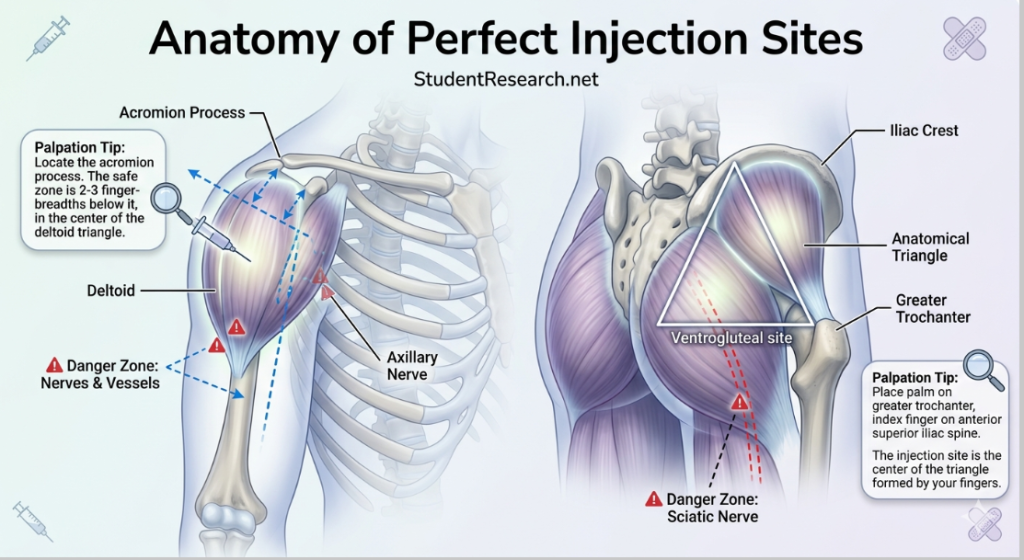
- The Deltoid Muscle: Accurate palpation of the acromion process ensures that vaccines are injected into the muscle belly rather than the joint space.
- Ventrogluteal Site: This is the preferred site for large volume injections because it is free of major nerves and vessels, provided the nurse understands the anatomical triangles of the hip.
- Vastus Lateralis: Essential for pediatric nursing, as this muscle is the primary site for immunizations in infants who are not yet walking.
Comparing Anatomical Study Methods for Student Success
Navigating the complexities of anatomy for nursing students requires a strategic choice of study tools, ranging from traditional textbooks to high-tech 3D modeling software. Different learners benefit from different modalities, and choosing the right combination can significantly impact your retention of spatial relationships. Below is a comparison of the most popular anatomical learning resources currently used in top-tier nursing programs.
| Learning Tool | Primary Benefit | Best For | Engagement Level |
| Cadaver Labs | Real-world tactile feel | Spatial awareness | High (Immersive) |
| 3D Apps | Portability & Layering | Visualizing deep structures | Medium-High |
| Flashcards | Repetition & Recency | Terminology memorization | Low-Medium |
| Diagram Drawing | Active Recall | System pathways | High (Kinesthetic) |
Digital vs. Physical Anatomy Resources
- #6 Interactive 3D Models: These tools allow students to “peel back” layers of tissue to see how nerves and vessels interact with muscle.
- #7 Physical Models: Handling a life-sized skeleton helps in understanding the mechanics of lifting patients and preventing nurse injury.
Clinical Correlations: Why Anatomy Matters at the Bedside
In the world of professional healthcare, anatomy for nursing students is never a standalone concept; it is always tied to a clinical outcome or a pathological state. Recognizing what is “normal” through anatomical study is the only way to quickly identify the “abnormal” during a head-to-toe assessment. This section explores how specific anatomical knowledge translates directly into life-saving nursing actions and diagnostic accuracy.
Integumentary Anatomy and Pressure Ulcer Prevention
- #8 Skin Layers: Understanding the epidermis, dermis, and hypodermis is critical for staging pressure injuries and choosing dressings.
- #9 Tissue Perfusion: Knowledge of capillary beds helps nurses assess peripheral circulation through capillary refill tests.
Deep Tissue and Wound Healing Mechanics
- Subcutaneous Fat Distribution: Nurses must understand how adipose tissue affects insulin absorption rates and needle length selection.
- Dermal Thermoregulation: Knowledge of sweat glands and dermal blood vessels helps nurses manage patients with hyperthermia or heat stroke.
- The Fascial Plane: Recognizing when a wound has reached the fascia is a critical “never event” that requires immediate surgical consultation.
Neurological Pathways and Patient Assessment
- #10 Cranial Nerve Anatomy: Assessing the 12 cranial nerves is a cornerstone of the neurological exam, especially in stroke or trauma cases.
Sensory vs. Motor Tracks
- The Oculomotor Nerve (CN III): Nurses must know that this nerve controls pupillary response; a “blown pupil” indicates life-threatening intracranial pressure.
- The Vagus Nerve (CN X): Understanding this pathway is essential because “valling out” can lead to sudden bradycardia during procedures like suctioning or bowel movements.
- The Sciatic Nerve: Proper anatomical knowledge of the lower back and gluteal region prevents permanent nerve damage during repositioning or injections.
Gastrointestinal Anatomy and Nutrition Support
- #11 The Alimentary Canal: Mapping the path from the esophagus to the rectum is necessary for administering tube feedings and medication.
- #12 Accessory Organs: Understanding the location of the liver, gallbladder, and pancreas helps in assessing patients with acute abdominal pain.
Landmarks for Enteral Access
- The Pyloric Sphincter: Understanding this muscular valve is key to determining if a feeding tube should be gastric or jejunal to prevent aspiration.
- The Ileocecal Valve: Locating this area helps nurses differentiate between small bowel obstructions and large bowel issues during physical palpation.
- Abdominal Quadrants: Dividing the abdomen into four zones allows nurses to communicate precisely with physicians about the location of a patient’s tenderness.
Genitourinary Structures and Fluid Balance
- #13 Renal Architecture: Understanding the cortex and medulla of the kidney is vital for nurses managing patients on dialysis or with acute kidney injury.
- #14 Urethral Anatomy: Differentiating between male and female urethral length and curvature is the primary factor in successful, trauma-free catheterization.
Bladder Dynamics and Catheter Care
- The Detrusor Muscle: Knowledge of bladder contraction helps nurses troubleshoot urinary retention and interpret bladder scan results.
- The Nephron Unit: While microscopic, understanding this “functional unit” allows nurses to grasp how diuretics like Lasix work at the cellular level.
- Ureteral Orifices: Visualizing how urine travels from the kidneys to the bladder helps in identifying the source of flank pain versus suprapubic pain.
Strategic Study Habits for Anatomy Mastery
Mastering anatomy for nursing students requires more than just long hours in the library; it demands a high-efficiency “Golden Workflow” of study techniques. Utilizing student research into cognitive science, we know that active recall and spaced repetition are far more effective than passive reading for long-term retention. By implementing these specific strategies, you can reduce study fatigue while significantly increasing your exam scores.
Memory Mnemonics and Visual Mapping
- #15 Acronyms for Success: Using phrases like “On Old Olympus’ Towering Tops” helps students remember the cranial nerves in order.
- #16 Body Mapping: Drawing anatomical structures on one’s own arm (using washable markers) can reinforce the location of underlying vessels.
Collaborative Learning and Student Research
- #17 Group Palpation: Practicing the location of pulses and landmarks with peers builds the “hands-on” memory needed for clinicals.
- #18 Leveraging Peer-Reviewed Data: Accessing student research papers on anatomical variations ensures that students are prepared for patients who don’t fit the “textbook” mold.
Struggling to bridge the gap between complex anatomy and high-distinction essays? StudentResearch.net provides expert academic support tailored for healthcare students. Get meticulously researched, plagiarism-free papers that mirror the professional standards required in modern clinical nursing environments today.
Visualizing the Inner World: Diagnostic Imaging and Anatomy
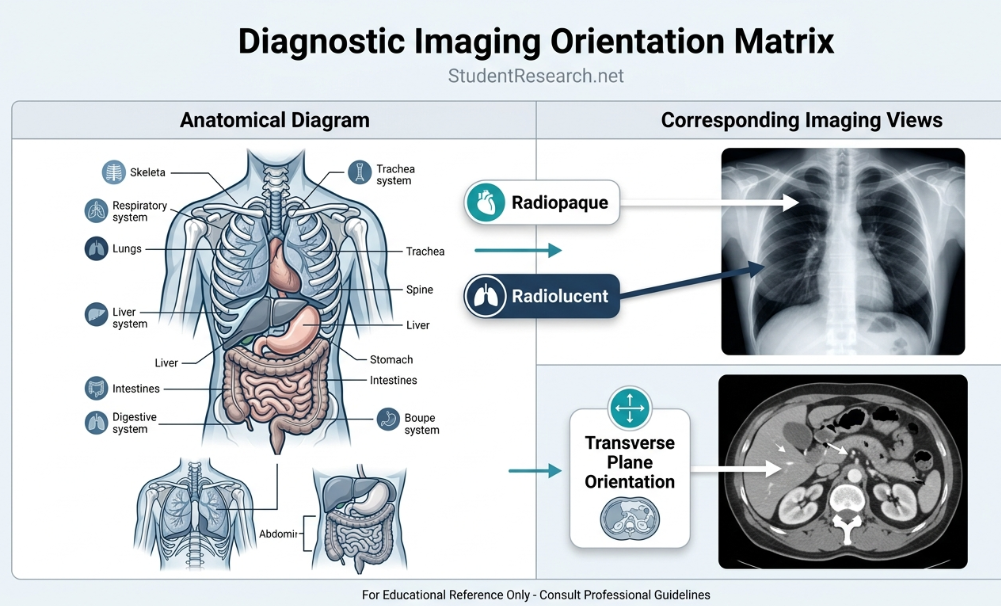
Modern nursing involves a heavy reliance on diagnostic imaging, making the ability to interpret the anatomy for nursing students on a screen a critical skill. Whether you are looking at a chest X-ray, a CT scan, or an ultrasound, you must be able to orient yourself to the patient’s internal structures. This bridge between physical anatomy and radiological imaging is where many nursing students find their “aha!” moment in understanding complex disease processes.
Radiographic Orientation and Landmarks
- #19 Shadow and Light: Learning how bones (radiopaque) and air (radiolucent) appear on an X-ray helps in verifying NG tube placement.
- #20 Cross-Sectional Views: Understanding transverse and sagittal planes is necessary for interpreting CT scans of the abdomen or brain.
Integrating Anatomy into the Nursing Process
The final stage of learning anatomy for nursing students is the seamless integration of this knowledge into the four pillars of the nursing process: Assessment, Planning, Implementation, and Evaluation. Your anatomical knowledge acts as the filter through which all patient data is processed, allowing you to prioritize care based on structural urgency. By viewing the patient through an anatomical lens, you become a more proactive and preventative member of the healthcare team.
Advanced Assessment Techniques
- Physical Exam Proficiency: Mastery of anatomical landmarks allows a nurse to detect a subtle heart murmur or a displaced apical pulse.
- Accurate Documentation: Using correct anatomical terminology (e.g., “distal,” “proximal,” “superior”) ensures clear communication within the healthcare team.
- Strategic Interventions: Understanding blood vessel pathways helps in choosing the best site for arterial blood gas draws.
Applying Student Research to Practice
- Evidence-Based Anatomy: Continually updating your knowledge through student research helps you stay current with new surgical techniques and anatomical findings.
- The Anatomy of Empathy: Understanding the physical basis of a patient’s pain can help nurses provide more compassionate and targeted comfort care.
- Standardized Care: Following protocols based on the latest student research ensures that anatomical variations are accounted for in clinical settings.
Is a mounting pile of nursing assignments blocking your path to clinical excellence? Let StudentResearch.net handle the heavy lifting of your academic workload. Secure your future with top-tier, custom-written research papers and order your nursing essay now!
Conclusion: Your Roadmap to Anatomical Excellence
Becoming proficient in anatomy for nursing students is a marathon, not a sprint, but it is one that pays dividends throughout your entire professional career. As you move forward, remember that every bone, muscle, and nerve you study is a part of the person you will one day help heal. By building a strong structural foundation now, you are ensuring a future of clinical excellence, patient safety, and professional confidence in the fast-paced world of nursing.
Master anatomy for nursing students with our guide to 15 vital structures, essential study tips, and clinical links for academic success.

